

Learning simple sentences in Grade 2 is one of the most important steps in a child’s language journey. At this stage, children begin to form their own thoughts in writing and speaking. Properly structured sentences build vocabulary, improve reading fluency, and strengthen grammar understanding. This complete guide gives students, teachers, and parents over 200 carefully selected simple sentences — covering daily life, school, family, animals, nature, and more.
Every sentence in this list is short, clear, and age-appropriate. Whether you are a parent helping your child at home or a teacher preparing a classroom worksheet, this article covers everything you need.
What Is a Simple Sentence for Grade 2?
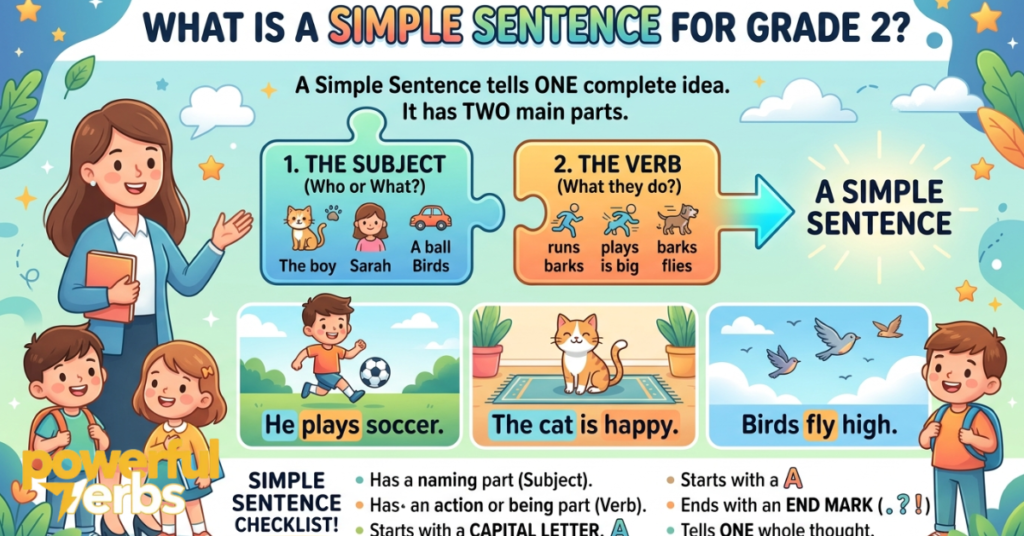
A simple sentence is a complete thought. It has two main parts:
- Subject — who or what the sentence is about
- Predicate — what the subject does or is
Examples:
- The dog barks loudly. (Subject: The dog | Predicate: barks loudly)
- She reads every night. (Subject: She | Predicate: reads every night)
- We love our school. (Subject: We | Predicate: love our school)
Simple sentences for second grade are short, use common words, and express one complete idea clearly.
Why Simple Sentences Matter in Grade 2
Grade 2 is when children transition from learning letters and words to building full sentences. Practicing simple sentences at this level helps children:
- Develop correct grammar habits early
- Improve their spoken English with confidence
- Build a strong reading and writing foundation
- Understand how subjects and predicates work together
- Expand their vocabulary through daily sentence practice
Research in early childhood literacy shows that sentence-level practice is more effective than isolated word memorization. When children read and write full sentences, they internalize grammar rules naturally.
Daily Life Simple Sentences for Grade 2
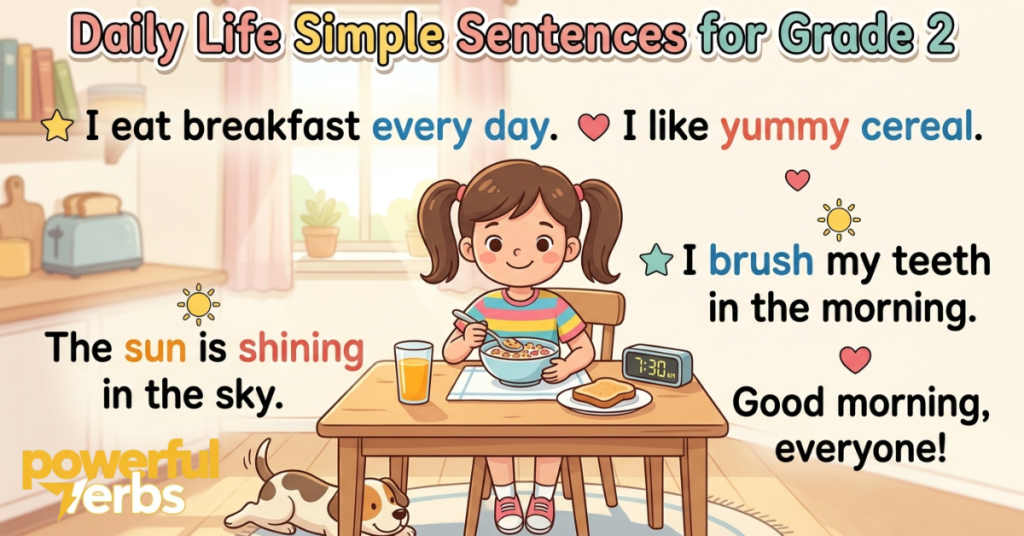
These sentences are based on things children do every single day. They are easy to memorize and speak.
- I wake up early in the morning.
- She brushes her teeth after breakfast.
- He washes his face every day.
- We eat breakfast together as a family.
- I put on my uniform for school.
- My mother packs my lunch box.
- He walks to the school bus stop.
- She ties her shoelaces before leaving.
- I carry my bag on my shoulders.
- We arrive at school before the bell rings.
- I sit in my seat quietly.
- She sharpens her pencil in the morning.
- He opens his notebook on the desk.
- We listen to the teacher carefully.
- I raise my hand to answer questions.
- She reads from the textbook aloud.
- He copies the lesson from the board.
- We go to the playground at recess.
- I drink water from my bottle.
- She eats her lunch in the cafeteria.
School Sentences for Grade 2 Students
School is where second graders spend most of their day. These sentences help children talk and write about their school life.
- My school has a big playground.
- I love my teacher very much.
- She explains lessons in a simple way.
- He always does his homework on time.
- We sit in neat rows in class.
- I use a pencil to write in my notebook.
- She draws beautiful shapes in art class.
- He is good at solving math problems.
- We sing the national anthem every morning.
- I keep my desk clean and tidy.
- She reads a storybook in the library.
- He borrows books from the school library.
- We have a science class on Monday.
- I enjoy physical education class most.
- She wins first place in the spelling bee.
- He scores full marks on his test.
- We celebrate our teacher’s birthday in class.
- I help my classmate with his work.
- She raises her hand before speaking.
- He erases his mistake neatly on the page.
Family Sentences for Class 2
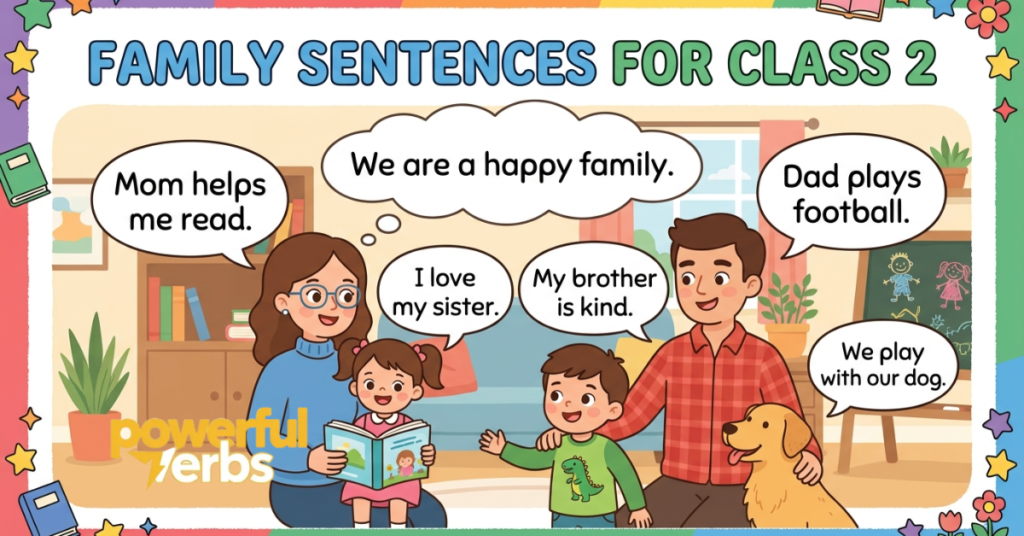
Family is the first and most familiar topic for young learners. These sentences help students describe their loved ones.
- My family is very loving and kind.
- I have a mother, a father, and one sister.
- My mother cooks delicious food every day.
- My father goes to the office in the morning.
- She plays with me after school every afternoon.
- My grandfather tells us amazing bedtime stories.
- My grandmother makes wonderful homemade sweets.
- We eat dinner together every night at the table.
- My brother helps me with my homework daily.
- I love spending weekends with my whole family.
- We visit our relatives on public holidays.
- My uncle teaches me how to ride a bicycle.
- My aunt brings gifts whenever she visits us.
- We take family photos during special events.
- My parents always support my studies and goals.
- I feel safe and happy inside my home.
- My sister and I share a bedroom together.
- We pray together as a family every evening.
- My mother reads me a story before bed.
- I love my family more than anything else.
Nature and Animals Sentences for Grade 2
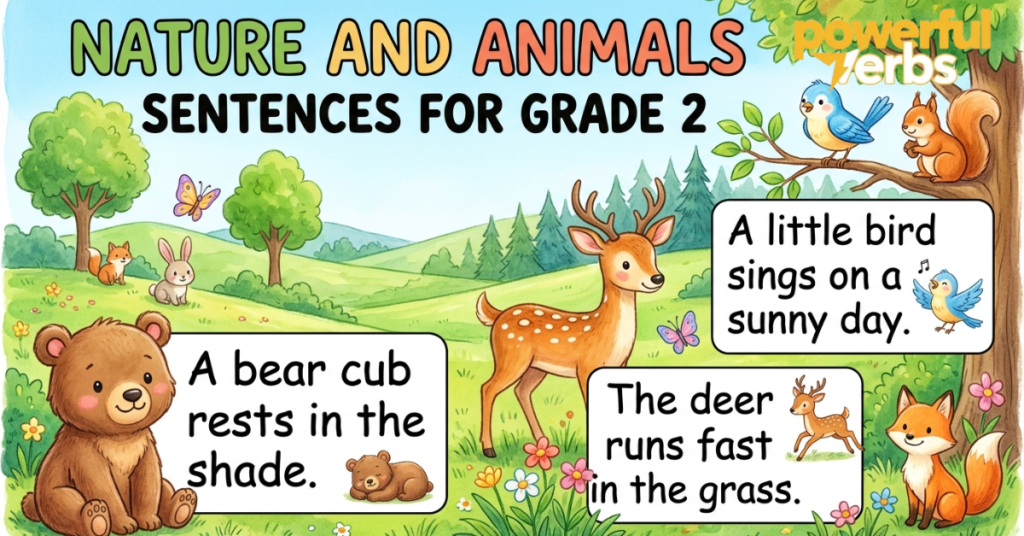
Children in Grade 2 are naturally curious about the world around them. These sentences introduce them to nature and animals in simple language.
- The sun rises in the east every morning.
- Birds sing sweetly from the branches above.
- The cat drinks milk from a small bowl.
- A big elephant has a very long trunk.
- The dog wags its tail when it is happy.
- Butterflies fly over the colorful flowers in the garden.
- The fish swims quietly in the clean water.
- A rabbit has two long and soft ears.
- The sky turns orange and pink at sunset.
- Rain falls from the dark clouds above us.
- The cow gives us fresh milk every morning.
- A parrot repeats the words that people say.
- The moon shines brightly on a clear night.
- A lion roars loudly in the deep forest.
- Trees give us fresh air and cool shade.
- The frog jumps from one leaf to another.
- Stars twinkle high up in the dark sky.
- A hen lays eggs in her warm nest.
- The horse runs fast across the open field.
- Flowers bloom in the garden during springtime.
Food and Fruits Sentences for 2nd Grade
Food is a fun and familiar topic that helps children practice adjectives and nouns together.
- I eat an apple every day after school.
- She loves drinking cold mango juice in summer.
- He eats a bowl of warm soup for dinner.
- We bake chocolate cookies on Saturday afternoons.
- I like to eat fresh strawberries with cream.
- She drinks a glass of milk every morning.
- He enjoys eating rice with spicy chicken curry.
- We share a pizza at the dinner table.
- I put honey on my bread for breakfast.
- She peels an orange before eating it carefully.
- He eats a banana after his afternoon nap.
- We grow tomatoes in our backyard garden.
- I drink fresh orange juice in the morning.
- She bites into a juicy red watermelon slice.
- He crunches on carrots for a healthy snack.
- We eat grapes straight from the fruit bowl.
- I love the smell of warm bread from the oven.
- She mixes yogurt with fruits for a healthy breakfast.
- He drinks green tea with his grandfather every evening.
- We enjoy a bowl of cold ice cream on hot days.
Feelings and Emotions Sentences for Grade 2
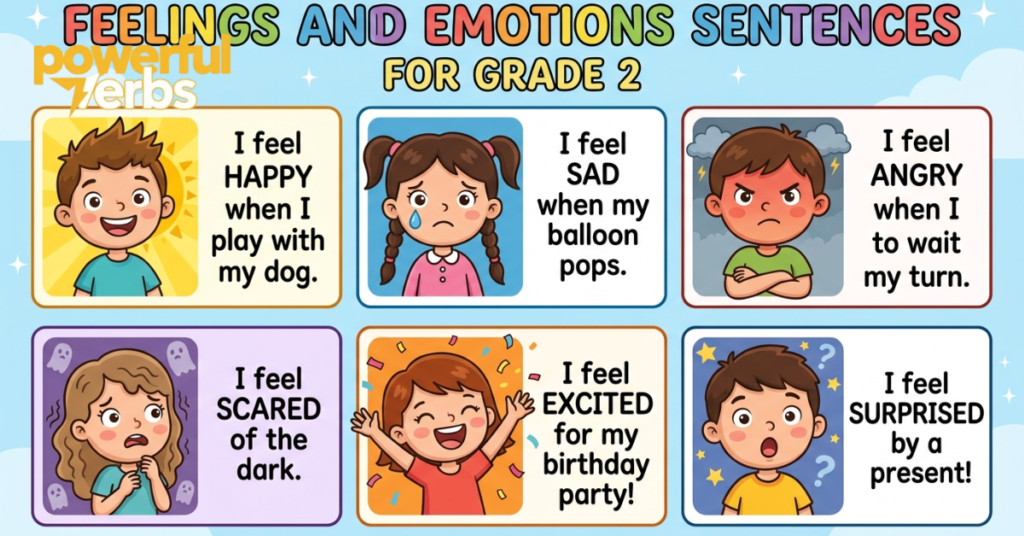
Teaching children to express their feelings through sentences is an important part of social and emotional learning.
- I feel happy when I play with my friends.
- She feels sad when she misses her mother.
- He gets excited before his birthday celebration.
- We feel proud when we win a competition.
- I feel nervous before speaking in front of the class.
- She feels grateful for all the help she receives.
- He feels tired after a long day at school.
- We feel cheerful on bright sunny mornings.
- I feel brave when I try something new today.
- She feels shy when she meets new people.
- He feels curious about how airplanes stay in the sky.
- We feel calm when we listen to soft music.
- I feel lonely when all my friends are busy.
- She feels surprised by the unexpected gift she receives.
- He feels angry when someone takes his things.
- We feel thankful for the food on our table.
- I feel energetic after a good night’s sleep.
- She feels worried when she forgets her homework.
- He feels peaceful sitting beside the calm river.
- We feel joyful during our school celebration days.
Action Sentences for 2nd Grade Students
Action sentences teach children how verbs work in a sentence. These are great for grammar practice.
- She jumps over the small puddle on the path.
- He runs around the track three full times.
- I climb up the tall tree in the park.
- We swim in the cool pool on summer days.
- She dances gracefully to the music in the hall.
- He kicks the football across the green field.
- I catch the ball with both of my hands.
- We skip along the path back to our home.
- She throws the frisbee to her friend in the yard.
- He lifts the heavy box with great effort.
- I pull the wagon across the dry gravel path.
- We push the swings for our younger siblings.
- She hops on one foot without losing her balance.
- He stretches his arms wide before morning exercise.
- I bend down to pick up the fallen pencil.
- We clap our hands to celebrate our good results.
- She waves her hand to say goodbye to friends.
- He nods his head to show he understands.
- I tiptoe quietly so as not to wake anyone.
- We march together in a straight and proud line.
Weather Sentences for Grade 2
Weather is a great topic for building descriptive language skills in young learners.
- Today the weather is warm and very sunny.
- Dark clouds are gathering in the sky above.
- It is raining heavily outside our classroom window.
- Strong winds blow the leaves off the tall trees.
- The ground is covered with white and soft snow.
- We wear heavy coats during cold winter mornings.
- She carries an umbrella on a cloudy rainy day.
- He loves playing in puddles after the heavy rain.
- The fog makes it hard to see far ahead.
- A beautiful rainbow appears after every heavy rainfall.
- The summer sun feels very hot on my skin.
- We drink extra water to stay cool in summer.
- She watches snowflakes fall silently from the winter sky.
- He builds a small snowman in the front yard.
- The spring breeze feels gentle and very refreshing today.
- We fly kites when the wind blows strongly outside.
- I wear a hat to protect my head from the sun.
- She slips on the icy road in winter morning.
- He wraps a warm scarf around his neck tightly.
- We enjoy watching thunderstorms safely from inside our home.
Colour and Shape Sentences for Grade 2
These sentences help children connect descriptive words like colors and shapes to their writing.
- The sky is a beautiful deep shade of blue.
- Her dress is bright red with white tiny dots.
- He draws a perfect circle on his white paper.
- The ball is round and colored orange and black.
- I color the sun yellow in my art book.
- She cuts out a green triangle from the paper.
- He paints his room in a light shade of blue.
- The flower petals are soft pink and pure white.
- I see a purple butterfly in the morning garden.
- She arranges colorful squares into a lovely pattern.
Short and Simple One-Line Sentences for Grade 2
These quick-practice sentences are perfect for warm-up activities, dictation, and daily handwriting practice.
- I can read.
- She can write.
- He can draw.
- We can sing.
- I like cats.
- She likes birds.
- He loves sports.
- We enjoy art.
- I go home.
- She stays calm.
- He works hard.
- We study well.
- I feel fine.
- She looks happy.
- He runs fast.
- We play fair.
- I drink water.
- She eats fruit.
- He writes clearly.
- We learn daily.
Sentences for Grade 2 Worksheet: Fill in the Blanks
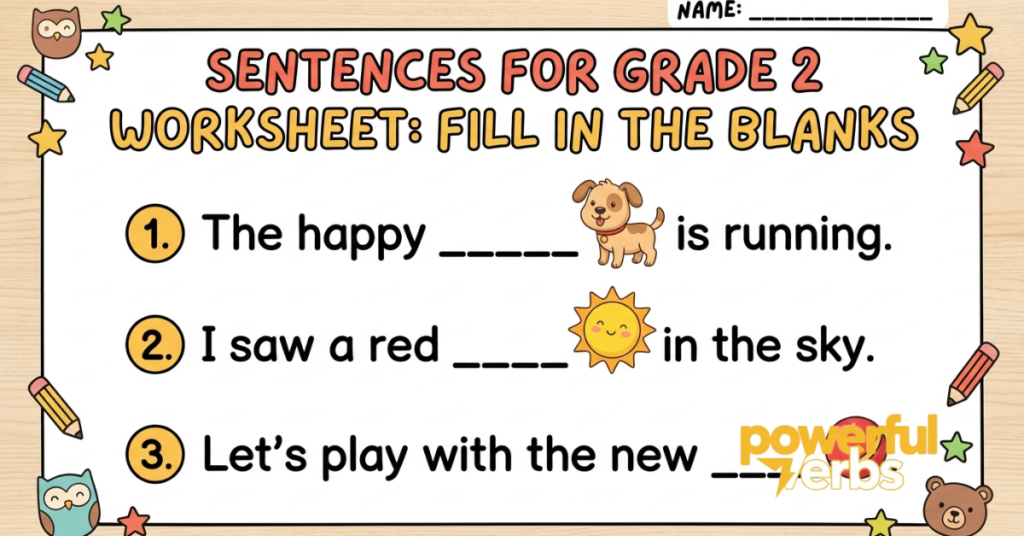
Use these exercises in the classroom or at home for extra practice. Let the child fill in the missing word.
- The _____ is shining in the clear blue sky. (sun)
- She drinks a glass of _____ every morning. (milk)
- I brush my _____ before going to bed. (teeth)
- The dog wags its _____ when it is happy. (tail)
- He rides his _____ in the park every evening. (bicycle)
- We read a _____ in the school library today. (book)
- The cat drinks _____ from a small bowl. (water)
- She paints a beautiful _____ with her brushes. (picture)
- I carry my _____ on my back to school. (bag)
- The bird sings sweetly from the _____ of the tree. (branch)
Sentences for Grade 2 Worksheet: True or False
Read each sentence and write True or False beside it.
- The sun rises in the west. (False)
- Fish live in water. (True)
- Cows give us fresh milk. (True)
- Birds have four legs. (False)
- We eat breakfast in the morning. (True)
- A lion is a small and gentle animal. (False)
- Trees give us clean and fresh air. (True)
- The sky is usually green in color. (False)
- Children go to school to learn. (True)
- We use a pencil to draw and write. (True)
Sentences for Grade 2: Arrange the Words (Jumbled Sentences)
Rearrange these words to form a correct sentence.
- plays / she / piano / the → She plays the piano.
- to / I / go / school / every day → I go to school every day.
- his / he / room / cleans / morning / every → He cleans his room every morning.
- milk / drinks / the / cat → The cat drinks milk.
- sings / beautifully / she → She sings beautifully.
- in / fish / swim / water → Fish swim in water.
- shines / the / morning / sun / every → The sun shines every morning.
- my / pack / I / lunch / own → I pack my own lunch.
- happy / makes / me / reading → Reading makes me happy.
- playground / play / we / the / in → We play in the playground.
10 Daily Sentences for Grade 2 Spoken Practice
These sentences are ideal for morning circle time, oral practice, or show-and-tell activities in class.
- Good morning! Today I feel wonderful and ready to learn.
- My name is _____ and I am in Grade 2 this year.
- My favorite subject in school is _____ because it is fun.
- I have _____ people in my family who love me.
- My best friend is _____ and we always play together.
- After school, I like to _____ before doing my homework.
- My favorite food is _____ because it tastes very good.
- I want to become a _____ when I grow up one day.
- The weather today is _____ and I feel _____ about it.
- One thing I am grateful for today is _____.
Tips for Parents: How to Help Your Child Practice These Sentences
Helping your child practice simple sentences does not require expensive materials. Try these easy methods at home:
1. Speak First, Write Later Say each sentence aloud together before writing it. Hearing the sentence helps children internalize its structure.
2. Daily Sentence Journaling Give your child a small notebook. Every evening, ask them to write three sentences about their day. Keep it short and enjoyable.
3. Sentence Card Games Write each word of a sentence on separate cards. Mix them up and let your child arrange them in the correct order.
4. Story Time Connection After reading a storybook, ask your child to say one simple sentence about the main character or event.
5. Praise Effort Over Perfection At this age, confidence matters more than flawless grammar. Celebrate every attempt your child makes.
Tips for Teachers: Classroom Activities for Simple Sentences
Teachers can make sentence practice engaging with these classroom-tested strategies:
Sentence of the Day: Write one sentence on the board each morning. Students copy it, identify the subject and verb, and draw a picture to match.
Partner Reading: Pair students together to read sentences aloud. One reads, the other listens and checks for fluency.
Sentence Relay Race: Divide the class into teams. Each team arranges jumbled word cards into a correct sentence as fast as possible.
Dictation Practice: Read sentences aloud slowly. Students write them down. Review together for spelling and punctuation.
Build-a-Sentence Wall: Post subjects and predicates separately on the board. Students come up and combine them to make new sentences.
Common Mistakes Grade 2 Students Make in Sentences
Understanding common errors helps students improve faster. Watch out for these:
| Mistake | Incorrect Example | Correct Example |
| Missing capital letter | the dog runs fast. | The dog runs fast. |
| No full stop | She eats lunch | She eats lunch. |
| Wrong verb form | He run very fast. | He runs very fast. |
| Incomplete sentence | Playing in the park. | We are playing in the park. |
| Missing subject | Likes to eat apples. | She likes to eat apples. |
Frequently Asked Questions About Grade 2 Sentences
What is the best way for Grade 2 students to practice simple sentences?
The most effective method is daily reading and writing practice. Children should read simple sentences aloud, write them in a notebook, and use them in natural conversations at home.
How many words should a Grade 2 sentence have?
Most Grade 2 sentences range from 5 to 10 words. Sentences should be long enough to express a complete idea but short enough for the child to read and write comfortably.
What topics are best for Grade 2 sentence practice?
Topics that are closest to a child’s daily experience work best. These include family, school, food, animals, weather, and feelings. Familiar topics make it easier to connect language to real life.
Should Grade 2 students use punctuation in their sentences?
Yes. By Grade 2, students should consistently use a capital letter at the beginning and a full stop, question mark, or exclamation mark at the end of every sentence.
How can parents support sentence learning at home?
Parents can read with their children daily, ask them to describe pictures in full sentences, and gently correct grammar in a positive, encouraging way. Making it a game reduces pressure and increases motivation.
What is the difference between a phrase and a sentence at Grade 2 level?
A phrase is a group of words that does not express a complete thought (e.g., “the big dog”). A sentence is a complete thought with a subject and verb (e.g., “The big dog barks loudly”).
Conclusion
Building strong sentence skills in Grade 2 is the foundation of excellent writing and communication in the years ahead. The 200+ sentences in this guide cover every important topic a second grader encounters — from daily routines and school life to nature, emotions, and food.
Use these sentences for reading practice, classroom worksheets, dictation exercises, or spoken English activities. The more a child reads, writes, and speaks in complete sentences, the faster their language skills will grow.
Bookmark this page for easy reference, share it with other parents and teachers, and download the PDF version for offline practice. Consistent daily practice with simple sentences builds the literacy habits that last a lifetime.

Liam Johnson is a dedicated language expert with 4 years of professional experience. He specializes in Grammar, Vocabulary, and Sentence structure.
