

Dialogue writing helps Class 6 students improve their communication, creativity, and language skills. This guide provides 50 engaging topics designed specifically for sixth graders to practice realistic conversations between characters.
These topics cover everyday situations that students can relate to, from school conversations to family discussions. Whether you’re a student or teacher, you’ll find diverse ideas that make dialogue writing fun, educational, and practical.
Dialogue Writing: What is it?
Dialogue writing is creating conversations between two or more characters using their spoken words. It includes quotation marks, speaker tags, and natural speech patterns that show how people talk in real situations.
Good dialogue writing helps readers understand characters’ personalities, feelings, and relationships through their words. Students learn to use punctuation correctly while making conversations sound realistic and interesting.
Why Use Class 6 Dialogue Writing Topics?
Class 6 dialogue writing topics help students practice real-life conversations in a safe, creative way. These topics improve grammar, vocabulary, and understanding of how people communicate in different situations.
Practicing dialogue writing builds confidence in speaking and writing skills that students use daily. It also develops critical thinking as students imagine different perspectives and create meaningful conversations.
60 Ideas for Class 6 Students to Write Dialogues
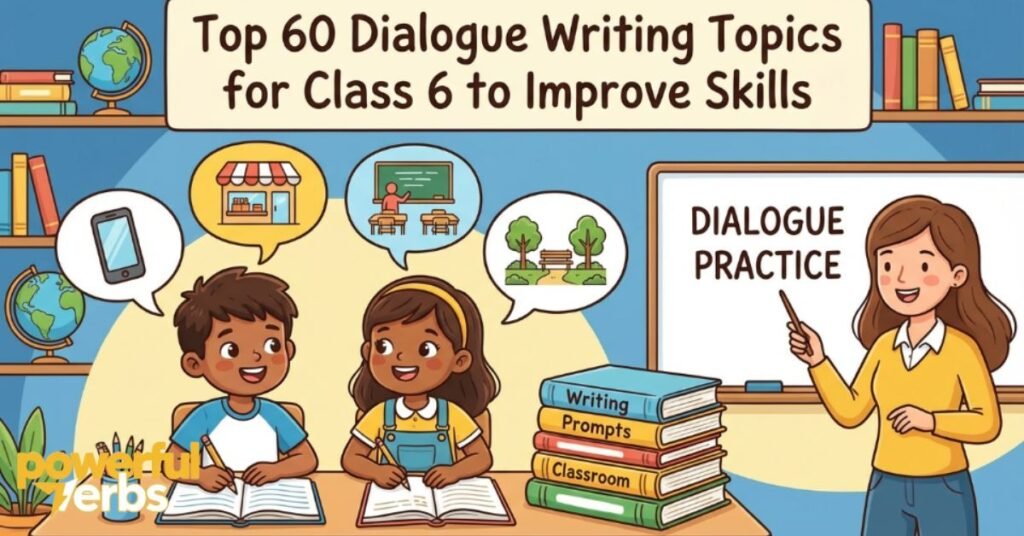
Here are 50 engaging dialogue topics perfect for Class 6 students to practice their writing skills. These topics cover school life, family situations, friendships, and everyday scenarios that sixth graders experience.
School-Related Topics:
- Two students are discussing their favorite subject
- A student asking the librarian for book recommendations
- Friends planning a group study session
- Student and teacher talking about improving grades
- Classmates discussing a science project
- Two friends choosing extracurricular activities
- Students sharing lunch in the cafeteria
- A new student asking for directions in school
- Friends discussing their holiday homework
- Students preparing for a school play
- Two classmates are talking about a field trip
- Student asking the sports teacher about tryouts
- Friends discussing a difficult math problem
- Student and principal conversation about discipline
- Classmates planning a birthday surprise
Family & Home Topics:
- A child asking parents for a pet
- Siblings deciding what to watch on TV
- Grandparent sharing a childhood story
- Child helping parent cook dinner
- Family planning a weekend trip
- Siblings resolving a fight over toys
- Child explaining a bad report card to parents
- Family discussing a new house rule
- Child asking for permission to attend a party
- Parent and child talking about responsibilities
- Siblings sharing a room peacefully
- Grandchild learning a skill from a grandparent
- Family choosing a vacation destination
- Child requesting a later bedtime
- Parent helping child with a problem
Friendship & Social Topics:
- Two friends making up after an argument
- Friends discussing their favorite hobbies
- Neighbors meeting for the first time
- Friends planning a sleepover
- Two students talking about their dreams
- Friends discussing a movie they watched
- Classmates organizing a charity event
- Friends sharing their weekend experiences
- Two students are discussing sports teams
- Friends helping each other with problems
- Classmates talking about their favorite books
- Friends discussing online safety
- Two students are planning a surprise party
- Friends talking about their role models
- Classmates discussing healthy eating habits
Everyday Situations:
- Customer and shopkeeper at a bookstore
- Patient and doctor at a clinic
- A passenger asking for directions from a stranger
- Child and gardener discussing plants
- Student and coach discussing team spirit
- Buyer and seller at a fruit market
- Child asking a police officer for help
- Visitor and receptionist at a hotel
- Customer ordering food at a restaurant
- The passenger and bus conductor are discussing the route
- Child and postman are talking about letters
- Customer and bank clerk opening an account
- A tourist asking a local about famous places
- Child and librarian discussing late book fees
- A passenger and taxi driver are discussing the fare
The Value of Writing Dialogues for Students in Class 6
Dialogue writing teaches Class 6 students how to express thoughts clearly and understand different viewpoints. It develops empathy by making students imagine what others might say and feel in various situations.
This skill improves reading comprehension because students learn to follow conversations in stories better. Regular dialogue practice also enhances vocabulary, grammar, and the ability to write engaging stories with realistic characters.
Key Benefits:
- Improves communication skills
- Develops creative thinking
- Enhances grammar and punctuation
- Builds vocabulary naturally
- Teaches perspective-taking
- Prepares for real conversations
Class 6 Dialogue Completion Exercises
Dialogue completion exercises give students a partial conversation that they must finish logically. These activities help students practice maintaining conversation flow, staying on topic, and creating appropriate responses.
Students learn to read context clues and respond naturally to what the other character says. This exercise builds both reading comprehension and creative writing skills simultaneously.
Example: Completing Dialogue with Patient
Incomplete Dialogue:
Doctor: Good morning! How are you feeling today?
Patient: Good morning, doctor. I’m not feeling well at all.
Doctor: Can you tell me what’s bothering you?
Patient: _________________
Doctor: _________________
Patient: _________________
Completed Example:
Doctor: Good morning! How are you feeling today?
Patient: Good morning, doctor. I’m not feeling well at all.
Doctor: Can you tell me what’s bothering you?
Patient: I’ve had a terrible headache for two days and feel very tired.
Doctor: Have you been sleeping properly and drinking enough water?
Patient: No, I’ve been studying late for exams and probably not drinking enough water.
Examples of Class 6 Dialogue Writing Topics: Teacher and Student Discussions
Teacher-student dialogues are excellent practice because they reflect real classroom situations. These conversations help students understand respectful communication with authority figures and how to ask for help.
Writing these dialogues teaches students appropriate language for formal situations. They learn to be polite, clear, and confident when speaking with teachers.
1. Concerning Exams
Student: Good morning, ma’am. May I talk to you about the upcoming exams?
Teacher: Of course! What would you like to know?
Student: I’m worried about the math exam. The geometry chapter seems very difficult.
Teacher: I understand your concern. Have you tried practicing the problems from the exercise?
Student: Yes, but I still get confused with some theorems.
Teacher: Come to my desk during lunch break. I’ll explain those theorems again with simpler examples.
2. Concerning Free Student Aid
Student: Ma’am, I heard about the free tutoring program after school. How can I join?
Teacher: That’s wonderful that you’re interested! The program runs Monday to Thursday from 4 to 5 PM.
Student: Do I need my parents’ permission to attend?
Teacher: Yes, please bring a signed consent form from your parents. I’ll give you one right now.
Student: Thank you, ma’am. Which subjects are covered in this program?
Teacher: We cover math, science, and English. You can choose the subjects you need help with.
3. Concerning Canteen Cuisine
Student: Sir, can I share a suggestion about the canteen menu?
Teacher: Certainly! I’m part of the canteen committee. What’s your suggestion?
Student: Many students would like healthier options, like fruits and salads, available daily.
Teacher: That’s a very good point. We’ve been discussing this recently in our meetings.
Student: Also, could we have more variety in sandwiches?
Teacher: I’ll definitely bring these suggestions to the next committee meeting. Thank you for sharing your ideas.
4. Concerning Assignment Assistance
Student: Ma’am, I’m struggling with the science assignment you gave yesterday.
Teacher: What part is giving you trouble? Let me help you understand it better.
Student: I don’t understand how to label the parts of a plant cell correctly.
Teacher: Look at the diagram on page 47 of your textbook. Each part has a specific function.
Student: Should I draw it from the book or create my own diagram?
Teacher: You can create your own diagram, but make sure all the parts are labeled accurately and neatly.
5. Concerning Academic Achievement
Student: Sir, I wanted to thank you for helping me improve all grades this term.
Teacher: I’m very proud of your progress! Your hard work really shows in your results.
Student: I followed your advice about making a study schedule, and it helped a lot.
Teacher: Excellent! Consistency is the key to success. Keep up the good work.
Student: I want to improve even more next term. Can you suggest what I should focus on?
Teacher: Work on your essay writing skills and try reading one extra book each month. That will help you tremendously.
Dialogue Types for Class 6 Practice
Different dialogue types help students practice various communication situations and styles. Understanding these types makes students versatile writers who can handle any conversation scenario.
Each type has its own purpose and tone that students should recognize and practice. Learning these variations prepares students for real-world communication challenges.
Common Dialogue Types:
| Type | Purpose | Example Situation |
| Formal Dialogue | Professional/respectful talk | Student and principal conversation |
| Informal Dialogue | Casual friendly chat | Two friends are discussing hobbies |
| Persuasive Dialogue | Convincing someone | A child asking parents for permission |
| Informative Dialogue | Sharing knowledge | Teacher explaining a concept |
| Conflict Resolution | Solving disagreements | Siblings making peace after a fight |
| Narrative Dialogue | Storytelling | Grandparent sharing memories |
Advice for Students in Class 6 on Writing Dialogue
Always use quotation marks correctly and start a new line when the speaker changes. This makes your dialogue easy to read and understand for everyone.
Make your characters sound natural by using everyday language and contractions like “I’m” or “don’t.” Read your dialogue aloud to check if it sounds like a real conversation between actual people.
Essential Tips:
- Use quotation marks for spoken words
- Start a new paragraph for each speaker
- Add speaker tags (said, asked, replied)
- Include emotions and actions in brackets
- Keep conversations realistic and natural
- Use appropriate punctuation (commas, question marks)
- Show character personality through word choice
- Avoid making dialogues too long or boring
- Read aloud to test naturalness
- Practice regularly with different topics
Conclusion
Dialogue writing is a valuable skill that Class 6 students can master with regular practice using these 50 engaging topics. From school conversations to family discussions, these diverse ideas help students develop communication skills, creativity, and confidence in both writing and speaking.
Remember to practice different dialogue types, use proper punctuation, and make conversations sound natural and realistic. The more you write dialogues, the better you’ll become at expressing ideas clearly and understanding how people communicate in real life situations.
Frequently Asked Questions
What are some good dialogue writing topics for Class 6 students to practice?
Good dialogue topics for Class 6 include student-teacher conversations, family discussions, friendship scenarios, and everyday situations like shopping or visiting a doctor. Popular topics are discussing exams, planning group studies, resolving sibling conflicts, and asking parents for permission.
How can dialogue writing help Class 6 students improve their English skills?
Dialogue writing improves grammar, vocabulary, punctuation, and communication skills while teaching students how to express thoughts clearly. It also develops creative thinking, empathy, and the ability to understand different perspectives through realistic conversation practice.
What is the easiest way to teach dialogue writing to sixth graders?
Start with simple, relatable topics like two friends talking or a student asking a teacher for help. Use examples, teach proper punctuation with quotation marks, and encourage students to read dialogues aloud to check if they sound natural.
Can you give me examples of dialogue between teacher and student for Class 6?
Common examples include conversations about exam preparation, requesting assignment help, discussing academic improvement, asking about school programs, or seeking clarification on difficult subjects. These dialogues should be respectful, clear, and show polite communication with authority figures.
What are the different types of dialogues Class 6 students should practice?
Students should practice formal dialogues (with teachers or principals), informal dialogues (with friends), persuasive dialogues (convincing parents), informative dialogues (sharing knowledge), conflict resolution dialogues, and narrative dialogues for storytelling. Each type serves different communication purposes.
How do you write a dialogue between two friends for Class 6?
Write in a casual, friendly tone using everyday language and contractions like “I’m” or “don’t.” Start each speaker’s words on a new line with quotation marks, include natural conversation flow, and add emotions or actions to make it realistic.
What punctuation rules should Class 6 students follow when writing dialogues?
Always use quotation marks around spoken words, place commas before closing quotes with speaker tags, start a new paragraph for each speaker, and use appropriate end punctuation inside quotes. Capitalize the first word of dialogue and use speaker tags like “said” or “asked.”
Are there any dialogue completion exercises for Class 6 students?
Yes, dialogue completion exercises provide partial conversations that students must finish logically. These activities help students practice maintaining conversation flow, creating appropriate responses, and understanding context clues while building reading comprehension skills.
What are some family-related dialogue topics suitable for Class 6?
Family dialogue topics include asking parents for a pet, siblings deciding what to watch on TV, planning weekend trips, explaining report cards, discussing chores and responsibilities, resolving sibling fights, and grandparents sharing childhood stories.
How often should Class 6 students practice dialogue writing to improve?
Students should practice dialogue writing at least 2-3 times per week to see significant improvement. Regular practice with different topics and dialogue types helps develop natural conversation flow, better vocabulary, proper punctuation habits, and confident communication skills.

Liam Johnson is a dedicated language expert with 4 years of professional experience. He specializes in Grammar, Vocabulary, and Sentence structure.
