

Homonyms are words that sound the same or look the same but have completely different meanings. This comprehensive guide provides 150 practical examples with sentences to help you master these tricky words and improve your vocabulary.
Understanding homonyms prevents confusion in reading and writing, making your communication clearer and more effective. These examples will help you use homonyms correctly in everyday conversations and writing.
What Are Homonyms?
Homonyms are words that share the same spelling or pronunciation but have different meanings. They can be confusing because one word can mean two or more completely different things depending on the context.
There are two main types of homonyms: homophones (same sound, different spelling) and homographs (same spelling, different meaning). Understanding the context helps you figure out which meaning is correct.
Examples:
- Bat – A flying animal / A piece of sports equipment
- Park – A public garden / To stop a vehicle
- Ring – A piece of jewelry / The sound a bell makes
- Right – Correct / Opposite of left / A legal entitlement
- Bank – Financial institution / Edge of a river
Types of Homonyms
Homonyms are divided into two main categories based on how they’re similar. Homophones sound identical but have different spellings and meanings, while homographs are spelled the same but may sound different.
Understanding these types helps you recognize patterns and avoid common mistakes. Both types are important for clear communication in English.
1. Homophones – Same sound, different spelling and meaning
- Examples: their/there/they’re, to/too/two, hear/here
2. Homographs – Same spelling, different meaning (may have different pronunciation)
- Examples: lead (metal) / lead (to guide), bow (weapon) / bow (to bend)
150 Homonyms with Sentences
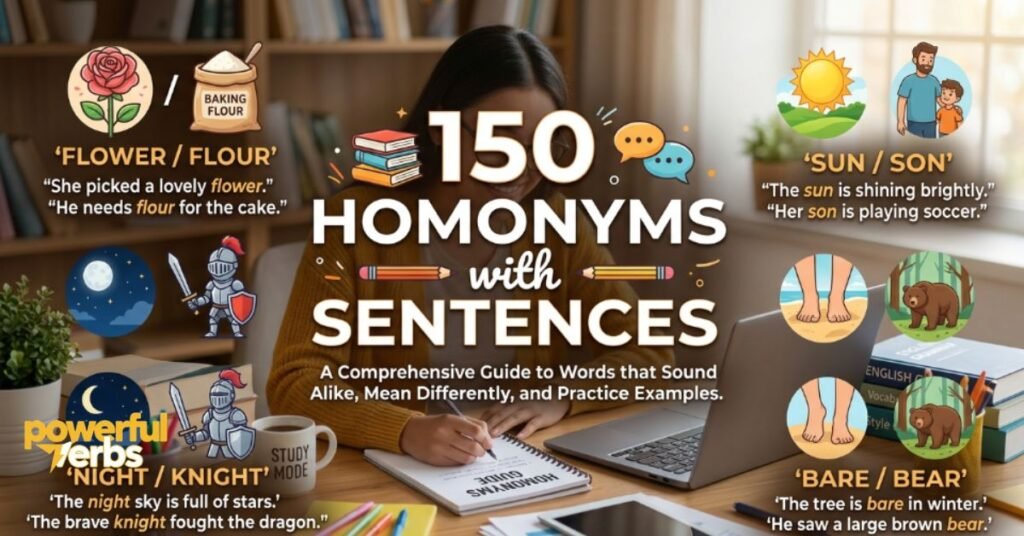
Here is a comprehensive list of 150 homonyms with clear example sentences. Each homonym is shown with its different meanings in practical contexts that you can use and understand easily.
A – B:
- Address – I need your home address. / The principal will address the students tomorrow.
- Air – We need fresh air to breathe. / She will air her opinions at the meeting.
- Arm – He broke his left arm. / The country will arm its soldiers with new weapons.
- Band – The rubber band snapped. / A music band performed at the concert.
- Bank – I deposited money at the bank. / We sat by the riverbank.
- Bark – The dog’s bark scared me. / The tree bark is rough and brown.
- Bat – A bat flew into the cave. / He hit the ball with a cricket bat.
- Bear – A grizzly bear lives in the forest. / I cannot bear this pain anymore.
- Beat – My heart beat faster during the race. / The drummer kept a steady beat.
- Bow – He took a bow after the performance. / The archer used a bow and arrow.
- Box – Put the books in a cardboard box. / He learned to box at the gym.
- Broke – She broke the glass accidentally. / He is broke and has no money.
- Blue – The sky is bright blue today. / The sad song made her feel blue.
- Ball – The children played with a red ball. / We attended a formal ball last night.
- Bat – The baseball bat is made of wood. / We saw a bat hanging upside down.
C – D:
- Can – I can swim very well. / Open the can of beans.
- Capital – Delhi is the capital of India. / You need capital to start a business.
- Cell – Every living thing has a cell. / The prisoner sat in his cell.
- Chicken – We cooked chicken for dinner. / Don’t be a chicken and try it!
- Close – Please close the door. / She stood close to her mother.
- Cold – It’s very cold outside today. / I caught a cold last week.
- Content – The content of the book is interesting. / She feels content with her life.
- Court – The tennis court needs repair. / The judge entered the court.
- Current – Check the current news online. / The river current is very strong.
- Date – What’s today’s date? / They went on a romantic date.
- Desert – The Sahara is a huge desert. / Don’t desert your friends in trouble.
- Die – Plants die without water. / Roll the die to play the game.
- Does – She does her homework daily. / The hunter shot two does.
- Dove – The white dove symbolizes peace. / He dove into the swimming pool.
- Down – The ball rolled down the hill. / The pillow is filled with duck down.
E – F:
- Ear – My left ear hurts. / An ear of corn was roasted.
- Evening – We meet every evening. / The ground needs to be evened out before planting.
- Express – The express train is faster. / Express your feelings honestly.
- Fair – The science fair was interesting. / She has fair skin. / That’s not a fair decision.
- Fall – Be careful not to fall. / Autumn is also called fall.
- Fan – Turn on the ceiling fan. / She is a huge fan of cricket.
- Fast – Cheetahs run very fast. / Muslims fast during Ramadan.
- Fine – The weather is fine today. / He paid a parking fine.
- Firm – The mattress is very firm. / She works at a law firm.
- Fit – These shoes fit me perfectly. / He had a sudden fit of anger.
- Flat – The land is completely flat. / They live in a small flat.
- Fly – Birds fly in the sky. / A fly landed on my food.
- Foot – I hurt my right foot. /There are 12 inches in one foot.
- Found – I found my lost keys. / They found a charity organization.
- Free – The samples are completely free. / The bird was set free.
G – H:
- Grave – They visited his grave. / The situation is very grave.
- Ground – The ball fell to the ground. / Ground the coffee beans finely.
- Gum – Chew this piece of gum. / My gum is bleeding.
- Hand – Wash your hands before eating. / Hand me that book, please.
- Hatch – The eggs will hatch soon. / Open the hatch to enter.
- Hide – Children love to hide and seek. / The animal’s hide is very thick.
- Hit – He hit the ball over the fence. / That song was a big hit.
- Hold – Hold my hand while crossing. / The ship’s cargo hold is full.
- Jam – Spread strawberry jam on toast. / We got stuck in a traffic jam.
- Junk – Throw away that junk. / We sailed on a Chinese junk.
- Kind – She is a very kind person. / What kind of music do you like?
- Last – This is my last chance. / These shoes will last for years.
- Lead – Lead is a heavy metal. / She will lead the team to victory.
- Lean – Lean the ladder against the wall. / He has a lean, athletic body.
- Left – Turn left at the corner. / Only two cookies are left.
L – M:
- Letter – I received a letter today. / A is the first letter of the alphabet.
- Lie – Don’t lie to me. / I need to lie down and rest.
- Light – Turn on the light, please. / This bag is very light.
- Like – I like chocolate ice cream. / She runs like a professional athlete.
- Live – Where do you live? / The concert will be broadcast live.
- Long – The Nile is a very long river. / I long to see my family.
- Mail – Check the mail box. / The knight wore chain mail armor.
- Match – Strike a match to light the candle. / Our team won the cricket match.
- Mean – What does this word mean? / Don’t be so mean to others.
- Might – I might visit tomorrow. / He used all his might to push the door.
- Mine – This book is mine. / They work in a coal mine.
- Minute – Wait a minute, please. / The writing is in minute details.
- Miss – I miss my grandmother. / Miss Smith is our teacher.
- Mole – A mole dug holes in the garden. / She has a mole on her cheek.
- Nail – Hammer the nail carefully. / I need to cut my nails.
N – P:
- Novel – I’m reading an interesting novel. / That’s a novel idea!
- Organ – The heart is a vital organ. / She plays the church organ beautifully.
- Pale – She looked pale after the illness. / Carry water in a pail.
- Palm – Coconuts grow on palm trees. / She read my palm.
- Park – Let’s play in the park. / Park your car in the garage.
- Patient – The doctor examined each patient. / Please be patient and wait.
- Pen – Write with a blue pen. / The sheep are in the pen.
- Pitch – The cricket pitch was dry. / Her voice has a high pitch.
- Plane – We traveled by plane. / Use a plane to smooth the wood.
- Plant – Water the plant daily. / They will plant trees tomorrow.
- Pole – The flag flies on a tall pole. / The North Pole is very cold.
- Pound – The bag weighs one pound. / Pound the spices into powder.
- Present – All students are present today. / I received a birthday present.
- Produce – Farmers produce crops. / Buy fresh produce from the market.
- Pupil – Every pupil must wear a uniform. / The pupil of your eye dilates.
Q – R:
- Quarry – Stones are extracted from a quarry. / The lion stalked its quarry.
- Rare – Pandas are rare animals. / I like my steak cooked rare.
- Refuse – I refuse to accept this. / Put the refuse in the bin.
- Rest – I need to rest for a while. / Eat the rest of your food.
- Right – Your answer is right. / Turn right at the signal. / Everyone has rights.
- Ring – She wears a diamond ring. / Did you hear the phone ring?
- Rose – The red rose smells sweet. / The sun rose at 6 AM.
- Row – Sit in the front row. / They had a big row yesterday.
- Ruler – Use a ruler to draw straight lines. / The king was a wise ruler.
- Run – I run every morning. / There’s a run in her stocking.
S – T:
- Saw – I saw a movie yesterday. / Cut the wood with a saw.
- Scale – Step on the weighing scale. / The fish has shiny scales.
- Seal – A seal swam in the ocean. / Seal the envelope before mailing.
- Season – Summer is my favorite season. / Season the food with salt.
- Sentence – Write a complete sentence. / The judge will sentence the criminal.
- Shed – The snake sheds its skin. / Tools are kept in the garden shed.
- Ship – The cargo ship sailed away. / We will ship your order tomorrow.
- Shoe – My left shoe is tight. / The blacksmith will shoe the horse.
- Sink – Wash dishes in the sink. / The heavy stone will sink in water.
- Slip – Don’t slip on the wet floor. / She wore a silk slip.
- Sock – I need a new pair of socks. / He gave him a sock on the jaw.
- Spell – Can you spell your name? / The witch cast a magic spell.
- Spring – Flowers bloom in spring. / Water flows from the spring.
- Squash – Play a game of squash. / Squash the can before recycling.
- Stamp – Put a stamp on the letter. / Don’t stamp your feet angrily.
- Stalk – The flower stalk is green. / The cat began to stalk the mouse.
- Stick – The dog fetched a stick. / Stick the poster on the wall.
- Swallow – Chew before you swallow. / A swallow built a nest.
- Tap – Turn on the water tap. / Someone tapped on my shoulder.
- Tear – A tear rolled down her cheek. / Don’t tear the paper.
T – W:
- Tender – The meat is very tender. / Submit your tender for the project.
- Tire – I need to change a flat tire. / Long walks tire me out.
- Toast – I like butter on my toast. / Let’s toast to your success!
- Train – The train arrives at noon. / Train your dog to sit.
- Trunk – The elephant’s trunk is strong. / Pack clothes in the trunk.
- Type – What type of phone do you have? / Type your password carefully.
- Volume – Increase the volume on the TV. / This book has high volume sales.
- Watch – Watch the movie with me. / My watch shows the wrong time.
- Wave – Wave goodbye to your friends. / A huge wave hit the shore.
- Wear – Wear warm clothes today. / The old shoes show wear and tear.
- Well – She sings very well. / Draw water from the well.
- Wound – The soldier had a deep wound. / She wound the clock every night.
- Yard – Children play in the yard. / Buy three yards of fabric.
- Bat – The vampire bat drinks blood. / He swung the bat powerfully.
- Bear – I can’t bear loud noises. / The polar bear hunts seals.
Additional Examples:
- Bill – Pay the electricity bill. / The duck has a yellow bill.
- Bolt – Tighten the bolt with a wrench. / The horse began to bolt.
- Book – Read this interesting book. / Book your tickets online.
- Chest – He has a broad chest. / Open the treasure chest.
- Club – Join the chess club. / He was attacked with a club.
- Coach – The football coach trains players. / We traveled by coach to London.
- Crane – A crane lifted heavy materials. / The beautiful crane bird flew away.
- Cricket – Play cricket on Sunday. / A cricket chirped at night.
- Drill – The dentist used a drill. / Students practice fire drills regularly.
- Duck – The duck swam in the pond. / Duck your head to avoid hitting it.
- File – Keep documents in a file. / File your nails smoothly.
- Iron – Iron is a strong metal. / Iron your shirt before wearing.
- Key – I lost my house key. / Practice is the key to success.
- Leaves – The tree leaves turned yellow. / She leaves for work at 8 AM.
- Pound – My dog weighs 20 pounds. / Pound the meat to make it tender.
Important Tips for Using Homonyms
Always read the full sentence to understand which meaning of a homonym is being used. Context clues like surrounding words and the topic help you figure out the correct meaning.
Practice using homonyms in your own sentences to remember their different meanings better. Pay attention to spelling differences in homophones to avoid writing mistakes.
Helpful Tips:
- Read the entire sentence for context
- Look for clue words around the homonym
- Practice writing sentences with both meanings
- Create flashcards with examples
- Learn homophones in pairs or groups
- Use a dictionary when unsure
- Pay attention to pronunciation differences
Common Mistakes
Students often confuse homophones like “their/there/they’re” or “to/too/two” in writing. These spelling errors happen because the words sound identical but have completely different spellings and meanings.
Another common mistake is using the wrong meaning of a homograph without checking the context. Always reread your sentences to ensure you’ve used the correct word for your intended meaning.
Frequent Errors:
- Writing “your” instead of “you’re.”
- Mixing up “hear” and “here.”
- Confusing “their,” “there,” and “they’re.”
- Using “to” instead of “too” or “two.”
- Writing “its” when you mean “it’s.”
- Mixing “accept” and “except.”
- Confusing “affect” and “effect.”
- Wrong usage of “brake” and “break.”
Conclusion
Homonyms are fascinating words that make English rich but sometimes confusing for learners. This list of 150 homonyms with clear example sentences helps you understand how the same word can have multiple meanings based on context.
Regular practice with these examples will improve your vocabulary, reading comprehension, and writing skills significantly. Remember to always check the context and pay attention to spelling differences in homophones to communicate clearly and correctly in English.
Frequently Asked Questions
What are homonyms, and can you give me some examples with sentences?
Homonyms are words that sound the same or look the same but have completely different meanings. Examples include “bat” (animal/sports equipment), “bank” (financial institution/river edge), and “ring” (jewelry/sound a bell makes).
How many types of homonyms are there in English grammar?
There are two main types of homonyms: homophones (words that sound the same but have different spellings, like “their/there/they’re”) and homographs (words spelled the same but with different meanings, like “bow” – weapon or to bend).
What is the difference between homophones and homographs with examples?
Homophones sound identical but have different spellings and meanings (like “hear/here” or “to/too/two”), while homographs are spelled the same but have different meanings and may sound different (like “lead” the metal or “lead” to guide).
Can you show me sentences using the word bank as a homonym?
“Bank” as a homonym means: “I deposited money at the bank” (financial institution) and “We sat by the river bank” (edge of water). The context of the sentence determines which meaning is correct.
What are some common homonym mistakes students make in writing?
Common mistakes include confusing “their/there/they’re,” “to/too/two,” “your/you’re,” “its/it’s,” and “hear/here.” These errors happen because the words sound identical but have different spellings and meanings that students mix up.
How can I teach my child to understand homonyms better?
Use context clues by reading complete sentences, create flashcards with both meanings and example sentences, practice writing sentences for each meaning, and encourage reading aloud to notice pronunciation differences. Regular practice with real-life examples makes learning easier.
What are the most confusing homonyms in the English language?
The most confusing homonyms include “bear/bare,” “lead/lead,” “tear/tear,” “bow/bow,” “wind/wind,” and “their/there/they’re.” These words confuse because they either sound the same with different spellings or are spelled the same with different pronunciations.
How do you use context to figure out which homonym meaning is correct?
Read the entire sentence and look for clue words around the homonym that indicate its meaning. The topic of conversation, surrounding words, and sentence structure all provide hints about which definition of the homonym is being used.
Are there any tricks to remember the difference between common homophones?
Yes, create memory tricks like “There has ‘here’ in it for location,” “They’re = they are,” and “Their shows ownership.” Use visual associations, rhymes, or silly sentences to connect the spelling with the meaning you want to remember.
Why is it important to learn homonyms for improving English skills?
Learning homonyms improves vocabulary, reading comprehension, writing accuracy, and prevents embarrassing spelling mistakes in formal communication. Understanding homonyms helps you interpret texts correctly and express yourself clearly in both speaking and writing.

Liam Johnson is a dedicated language expert with 4 years of professional experience. He specializes in Grammar, Vocabulary, and Sentence structure.
