

Verbs with the letter “O” are some of the most useful and powerful words in the English language. They help us describe actions, express feelings, and communicate ideas in a clear and simple way. Whether you are a student, a writer, or an English learner, knowing these verbs will take your skills to the next level.
Learning verbs that start with or contain the letter “O” gives you a strong base for everyday conversations, school essays, and professional writing. This complete guide covers 150+ verbs with O, their meanings, tenses, and practice exercises.
What Are Verbs with O?
Verbs with “O” are words that show an action, a state, or an occurrence and begin with or include the letter “O.” They are a core part of English grammar and appear in almost every sentence we speak or write. Examples include open, observe, offer, operate, and overcome.
These verbs can be action verbs, linking verbs, or helping verbs. They work in every tense — present, past, and future — and are used in both formal and informal English. Understanding them helps you build sentences that are clear, correct, and natural.
Why Learning Verbs with O is Important
Verbs are the engine of every sentence — without them, nothing moves. Learning verbs that start with “O” gives you dozens of new ways to express actions, make requests, describe situations, and tell stories. They appear in textbooks, newspapers, emails, and daily conversations all the time.
These verbs also help you score better on English tests like IELTS, TOEFL, SAT, and school exams. Teachers and examiners look for a wide range of vocabulary, and knowing strong O verbs like optimize, outperform, and orchestrate makes your writing stand out. Building this habit early creates a strong English foundation for life.
Action Verbs Starting with O
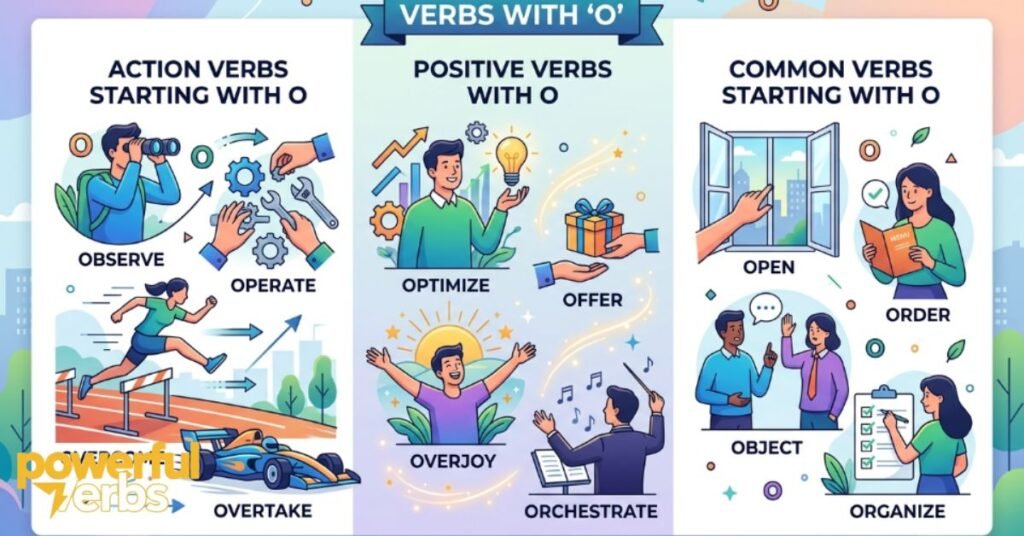
Action verbs show what someone or something does. The verbs below are strong, clear, and commonly used in everyday English writing and speaking.
| # | Verb | Meaning |
| 1 | Open | To make something accessible or unlocked |
| 2 | Observe | To watch or study something carefully |
| 3 | Offer | To present something for someone to accept |
| 4 | Operate | To run, control, or work a machine or system |
| 5 | Order | To command someone or request something |
| 6 | Organize | To arrange things in a neat and planned way |
| 7 | Overcome | To successfully deal with a problem or challenge |
| 8 | Obtain | To get or receive something through effort |
| 9 | Occupy | To take up space, time, or a position |
| 10 | Omit | To leave out or not include something |
| 11 | Own | To legally possess or have something |
| 12 | Outline | To describe the main points of something |
| 13 | Oppose | To go against or disagree with something |
| 14 | Opt | To make a choice or decision |
| 15 | Occur | To happen or take place |
| 16 | Owe | To be required to pay or give something |
| 17 | Obey | To follow rules, laws, or instructions |
| 18 | Object | To express disagreement or disapproval |
| 19 | Obtain | To get through effort or request |
| 20 | Offend | To cause hurt, upset, or anger |
| 21 | Output | To produce or send out a result |
| 22 | Overpower | To defeat by using greater strength |
| 23 | Overlook | To fail to notice or to ignore something |
| 24 | Overtake | To catch up and pass someone or something |
| 25 | Oversee | To watch over and manage a task or team |
Positive Verbs with O
Positive verbs carry uplifting, encouraging, and motivating meanings. They are perfect for motivational writing, kind messages, speeches, and personal development content.
| # | Positive Verb | Meaning |
| 1 | Optimize | To make something as effective as possible |
| 2 | Overcome | To rise above and defeat a challenge |
| 3 | Offer | To give help, support, or kindness |
| 4 | Outshine | To perform much better than others |
| 5 | Organize | To bring order, clarity, and structure |
| 6 | Open | To unlock new doors and possibilities |
| 7 | Outperform | To do better than expected or required |
| 8 | Originate | To create or start something brand new |
| 9 | Outgrow | To move beyond old limits and grow stronger |
| 10 | Outreach | To connect with and help other people |
| 11 | Oblige | To do a kind favor for someone |
| 12 | Outdo | To go beyond what was done before |
| 13 | Outlast | To survive or endure longer than others |
| 14 | Orchestrate | To plan and organize something skillfully |
| 15 | Outclass | To be clearly superior in quality or skill |
| 16 | Uplift | To raise someone’s mood or spirits |
| 17 | Own | To take proud and full responsibility |
| 18 | Outbrave | To show more courage than expected |
| 19 | Outlearn | To grow faster by learning more |
| 20 | Outserve | To serve others beyond what is required |
| 21 | Outvalue | To be worth more in quality or effort |
| 22 | Outpace | To move or grow faster than others |
| 23 | Outreach | To extend help beyond normal limits |
| 24 | Outwit | To be cleverer and smarter in a situation |
| 25 | Outwork | To work harder and more than anyone else |
Common Verbs Starting with O
These are the O verbs you will hear and use almost every single day. They are simple, clear, and essential for basic and advanced English communication.
| # | Verb | Example Sentence |
| 1 | Open | Please open the window, it is too hot. |
| 2 | Order | She ordered a large pizza for dinner. |
| 3 | Offer | He offered his seat to the old woman. |
| 4 | Own | They own a beautiful house by the lake. |
| 5 | Obey | Always obey traffic rules for your safety. |
| 6 | Operate | The doctor operates on patients every day. |
| 7 | Obtain | She obtained her university degree last year. |
| 8 | Occur | Earthquakes occur without any warning. |
| 9 | Owe | I owe you a big thank you for your help. |
| 10 | Omit | Do not omit any important details from the report. |
| 11 | Object | He objected to the unfair decision loudly. |
| 12 | Observe | The scientist observed the experiment for hours. |
| 13 | Overcome | She overcame her fear of public speaking. |
| 14 | Organize | Can you organize the files on my desk? |
| 15 | Opt | I opted for the easier but longer route. |
| 16 | Output | The factory outputs 500 units every day. |
| 17 | Overlook | He overlooked a small but important mistake. |
| 18 | Oversee | The manager oversees all daily operations. |
| 19 | Overthrow | The people overthrew the corrupt government. |
| 20 | Outrun | The athlete outran everyone in the race. |
| 21 | Outline | She outlined her plan in just five minutes. |
| 22 | Occupy | The soldiers occupied the town for weeks. |
| 23 | Oppose | Many people oppose the new construction plan. |
| 24 | Offend | His rude words offended everyone in the room. |
| 25 | Overtake | The fast car overtook the truck on the highway. |
| 26 | Overhaul | The mechanic overhauled the entire engine. |
| 27 | Ooze | Honey oozes slowly from the jar. |
| 28 | Oscillate | The fan oscillates from side to side. |
Irregular and Regular O Verbs
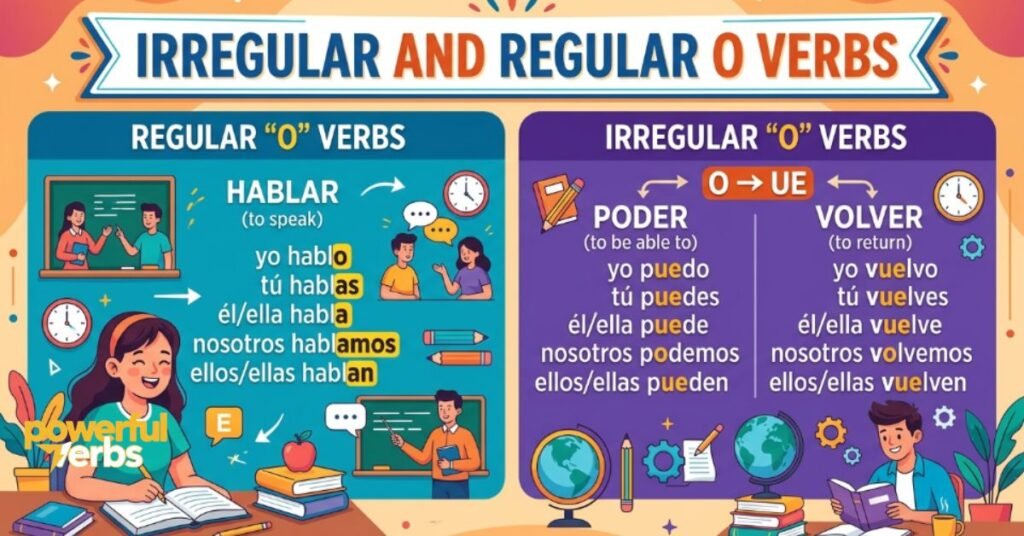
Knowing the difference between regular and irregular verbs helps you use the correct form in every tense. Regular verbs simply add -ed for past tense, while irregular verbs change their spelling completely.
Regular O Verbs:
| Base Form | Past Tense | Past Participle | Meaning |
| Open | Opened | Opened | To unlock or access |
| Order | Ordered | Ordered | To request or command |
| Offer | Offered | Offered | To present or give |
| Operate | Operated | Operated | To run or control |
| Organize | Organized | Organized | To arrange neatly |
| Obey | Obeyed | Obeyed | To follow instructions |
| Obtain | Obtained | Obtained | To get or receive |
| Omit | Omitted | Omitted | To leave out |
| Object | Objected | Objected | To disagree |
| Occur | Occurred | Occurred | To happen |
| Observe | Observed | Observed | To watch carefully |
| Offend | Offended | Offended | To upset or hurt |
| Oppose | Opposed | Opposed | To go against |
| Outline | Outlined | Outlined | To describe key points |
| Optimize | Optimized | Optimized | To improve fully |
| Occupy | Occupied | Occupied | To take up space |
| Overlook | Overlooked | Overlooked | To miss or ignore |
| Overhaul | Overhauled | Overhauled | To fix completely |
| Oscillate | Oscillated | Oscillated | To swing back and forth |
| Output | Outputted | Outputted | To produce a result |
Irregular O Verbs:
| Base Form | Past Tense | Past Participle | Meaning |
| Overcome | Overcame | Overcome | To defeat a challenge |
| Overthrow | Overthrew | Overthrown | To remove from power |
| Outdo | Outdid | Outdone | To exceed in effort |
| Outrun | Outran | Outrun | To run faster than |
| Outbid | Outbid | Outbid | To offer more money |
| Outgrow | Outgrew | Outgrown | To grow beyond limits |
| Outride | Outrode | Outridden | To ride better than others |
| Outshine | Outshone | Outshone | To shine more brightly |
| Overtake | Overtook | Overtaken | To pass or go beyond |
| Oversee | Oversaw | Overseen | To supervise a process |
| Outfight | Outfought | Outfought | To fight and win |
| Outthink | Outthought | Outthought | To think more cleverly |
| Outbuy | Outbought | Outbought | To buy more than others |
| Overeat | Overate | Overeaten | To eat too much |
| Outspeak | Outspoke | Outspoken | To speak more boldly |
Verbs Ending with O
Some English verbs end with the letter “O.” These verbs are unique and appear very frequently in both formal and informal conversations.
| # | Verb | Past Tense | Example Sentence |
| 1 | Do | Did | I did my homework on time. |
| 2 | Go | Went | She went to the market this morning. |
| 3 | Undo | Undid | He tried to undo his careless mistake. |
| 4 | Outdo | Outdid | She outdid herself at the competition. |
| 5 | Echo | Echoed | His kind words echoed in her heart. |
| 6 | Veto | Vetoed | The president vetoed the new law. |
| 7 | Zero | Zeroed | We zeroed in on the main problem. |
| 8 | Undergo | Underwent | He underwent a long surgery last week. |
| 9 | Forego | Forewent | She forewent her holiday to finish work. |
| 10 | Forgo | Forwent | He chose to forgo his lunch break. |
| 11 | Redo | Redid | The student redid the assignment carefully. |
| 12 | Overdo | Overdid | Don’t overdo the salt in the recipe. |
How to Use Verbs with O in Sentences
Using verbs correctly in different tenses makes your English sound natural and professional. Below you will find clear examples of how to use O verbs across all five major sentence types.
Present Tense
Present tense is used for habits, facts, routines, and things that are happening right now. Use the base form of the verb for most subjects and add -s for he, she, or it.
- She opens the bookstore every morning at 8 AM.
- He observes the stars carefully through his telescope.
- They organize team meetings every Monday without fail.
- I offer help to my classmates whenever they need it.
- The machine operates smoothly without any problems.
- Our teacher outlines the lesson before she begins teaching.
- He always obeys the rules and never causes any trouble.
- The river overflows every year during the monsoon season.
- She opts for healthy food over junk food every time.
- The company outputs thousands of products every single week.
Past Tense
Past tense is used for actions that started and finished in the past. Regular verbs add -ed and irregular verbs change their form completely.
- She opened the door quietly so no one would wake up.
- He ordered a large meal after a long day at work.
- They overcame every obstacle with patience and hard work.
- I obtained my driving license after three attempts.
- The team organized the entire school event in just two days.
- She outperformed every other student in the final exam.
- He observed the behavior of animals in the wild for weeks.
- They opposed the new rule but could not change the decision.
- The manager oversaw the whole project from start to finish.
- She outshone every performer on the stage that night.
Perfect Tense (Past Participle)
Perfect tense shows an action that is completed but still has a connection to the present. Use has / have / had before the past participle form of the verb.
- She has opened a brand new café in the city center.
- He has overcome his longtime fear of public speaking.
- They have organized the whole event without any outside help.
- I have offered my support to the team many times before.
- The engineer has operated this machine for over ten years.
- She has outperformed all her previous records this season.
- He has observed thousands of birds during his research career.
- We have obtained permission from the school to use the hall.
- The government has opposed the treaty since the beginning.
- She has outgrown the challenges that once held her back.
Negative Sentences
To make a sentence negative in English, add do not (don’t), does not (doesn’t), or did not (didn’t) before the base form of the verb.
- She does not open the shop on Sundays or public holidays.
- He did not order anything from the restaurant menu last night.
- They do not obey the classroom rules and cause many problems.
- I did not omit any important points from my assignment.
- We do not operate the factory on national holidays.
- She does not overlook any mistake in her students’ work.
- He did not overcome his fears easily — it took years of effort.
- The company does not produce low-quality products under any condition.
- I do not object to working extra hours when the team needs help.
- They did not organize the event properly, and it became a mess.
Questions
To form a question in English, place the helping verb (do / does / did / has / have) before the subject and use the base form of the main verb.
- Does she open the store before 9 AM every morning?
- Did he overcome the problem without anyone’s help?
- Do they organize company events every single quarter?
- Has she offered her help to the new students yet?
- Did you obtain your certificate from the testing center?
- Does the machine operate well in cold weather conditions?
- Have they observed any unusual behavior in the lab results?
- Did the team overlook any important details in the report?
- Does he always obey the rules set by the school authorities?
- Have you ever outperformed your own personal expectations?
Exercises and Practice Tables
Practice is the fastest way to remember new verbs and use them correctly. Try the exercises below and check your answers with the answer key.
📝 Exercise 1 — Fill in the Blank: (Choose the correct verb: open / offer / organize / observe / obtain)
| # | Sentence | Answer |
| 1 | Please _____ the window. It is very hot here. | open |
| 2 | She will _____ her help to anyone who needs it. | offer |
| 3 | The scientist wants to _____ the behavior of bees. | observe |
| 4 | Can you _____ the files in alphabetical order please? | organize |
| 5 | You need to _____ a visa before traveling abroad. | obtain |
| 6 | He will _____ the bakery every day at 7 AM sharp. | open |
| 7 | The charity will _____ free meals for poor families. | offer |
| 8 | She had to _____ special permission from the principal. | obtain |
| 9 | The students _____ the ant colony for their science project. | observe |
| 10 | He plans to _____ a big birthday party for his parents. | organize |
📝 Exercise 2 — Change the Tense:
| Present Tense | Past Tense | Perfect Tense |
| She opens the shop. | She opened the shop. | She has opened the shop. |
| He offers help. | He offered help. | He has offered help. |
| They organize it. | They organized it. | They have organized it. |
| I observe nature. | I observed nature. | I have observed nature. |
| We obtain results. | We obtained results. | We have obtained results. |
| She overcomes fear. | She overcame fear. | She has overcome fear. |
| He overlooks errors. | He overlooked errors. | He has overlooked errors. |
| They oppose the law. | They opposed the law. | They have opposed the law. |
| I outperform others. | I outperformed others. | I have outperformed others. |
| She outshines them. | She outshone them. | She has outshone them. |
📝 Exercise 3 — Make It Negative:
| Positive Sentence | Negative Sentence |
| She opens the door every day. | She does not open the door every day. |
| He ordered food last night. | He did not order food last night. |
| They obey the school rules. | They do not obey the school rules. |
| I omitted the last paragraph. | I did not omit the last paragraph. |
| We operate on weekends. | We do not operate on weekends. |
| She overlooks small mistakes. | She does not overlook small mistakes. |
| He overcame his shyness. | He did not overcome his shyness easily. |
| They organized the annual event. | They did not organize the annual event. |
📝 Exercise 4 — Make a Question:
| Statement | Question |
| She opens the store early. | Does she open the store early? |
| He offered help to others. | Did he offer help to others? |
| They have organized the trip. | Have they organized the trip? |
| She observed the experiment. | Did she observe the experiment? |
| He overcame his fear. | Did he overcome his fear? |
| We obtain results every week. | Do we obtain results every week? |
| She outperforms her teammates. | Does she outperform her teammates? |
| They oppose the new policy. | Do they oppose the new policy? |
Conclusion
Verbs with “O” are some of the most important and widely used words in the English language. From simple words like open and order to powerful ones like overcome and optimize, these verbs give you the tools to speak and write with confidence in any situation.
Start adding these verbs to your daily writing and speaking practice right away. The more you use them, the more natural and fluent your English will become — and that is the real key to mastering any language!
Frequently Asked Questions
What are some common verbs that start with the letter O in English?
Some common verbs starting with O include open, offer, observe, organize, operate, obtain, obey, overcome, order, and opt. These verbs are used every day in speaking, writing, and professional communication.
What are positive verbs starting with O that I can use in my writing?
Positive verbs starting with O include optimize, outshine, overcome, outperform, originate, organize, outgrow, and outreach. These uplifting verbs are perfect for motivational writing, speeches, and personal development content.
How many verbs in English start with the letter O?
There are over 150 verbs in English that start with the letter O, ranging from simple everyday words like open and order to advanced ones like orchestrate and optimize. Learning these verbs greatly improves your vocabulary and writing skills.
What is the difference between regular and irregular verbs starting with O?
Regular O verbs like open, offer, and organize simply add -ed to form their past tense, while irregular O verbs like overcome, overtake, and outdo change their spelling completely. Knowing the difference helps you use the correct verb form in every tense.
Can you give me examples of verbs starting with O used in a sentence?
Sure! Here are a few natural examples — She opens the store every morning, He overcame his fear of speaking, and They organized the entire event in two days. These sentences show how O verbs work in real, everyday English conversation.
What are some action verbs starting with O for kids and students?
Great action verbs starting with O for students include open, obey, observe, order, organize, obtain, opt, outline, operate, and overcome. These are simple, powerful words that are commonly taught in school and used in everyday writing and speaking.
How do I use verbs starting with O in past tense correctly?
To use O verbs in past tense, add -ed to regular verbs like observed, offered, and organized, and memorize irregular forms like overcame, overtook, and outdid. Always match the correct past form to make your sentences grammatically accurate and natural.
What are some verbs ending with the letter O in English?
Common English verbs ending with O include do, go, undo, redo, echo, veto, forego, outdo, overdo, and undergo. These verbs appear frequently in both casual conversation and formal writing across all English-speaking countries.
Why is it important to learn verbs with O for English language learners?
Learning verbs with O gives English learners a wide range of words to express actions, make requests, and describe situations clearly and confidently. These verbs appear in daily conversations, school exams, and professional settings, making them essential for fluent and effective communication.
How can I practice using verbs starting with O to improve my English fluency?
You can practice O verbs by writing daily sentences, filling in blank exercises, changing verb tenses, and using them in short conversations or journal entries. Consistent daily practice with these verbs builds fluency fast and helps you remember them naturally without memorizing lists.

Liam Johnson is a dedicated language expert with 4 years of professional experience. He specializes in Grammar, Vocabulary, and Sentence structure.
