

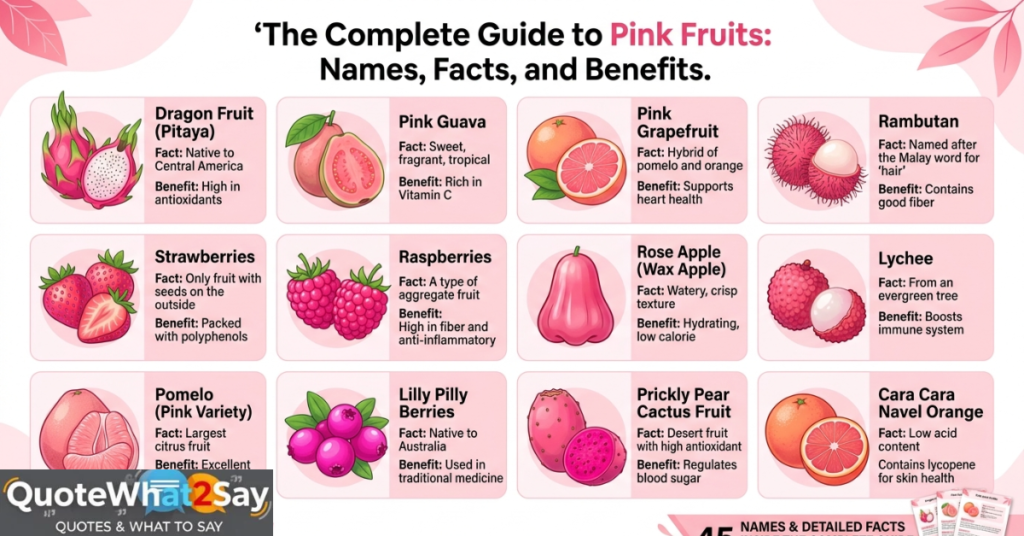
Pink fruits are some of the most visually striking and nutritionally powerful foods on the planet. Whether you are shopping at a grocery store, exploring a tropical market, or planning a healthy diet, knowing which fruits are pink — and why — gives you a real advantage. This complete guide covers 45 pink fruits with pictures, surprising facts, health benefits, and practical uses so you never run out of ideas in the kitchen or at the table.
What Is a Pink Fruit?
A pink fruit is any fruit that displays pink coloring in its skin, flesh, or both. This pink pigmentation usually comes from powerful plant compounds called anthocyanins and lycopene, which are the same antioxidants responsible for reducing inflammation and protecting cells from damage. Pink fruits range from common supermarket staples like strawberries and watermelon to rare tropical varieties like sampinit and pink sapote.
Many people ask: what makes a fruit pink? The answer lies in soil conditions, sunlight exposure, and the genetic makeup of the plant. The deeper and more vibrant the pink color, the higher the concentration of beneficial phytonutrients.
Why Eat Pink Fruits?
Before exploring the full list, here is why pink fruits deserve a regular spot in your diet:
- High in antioxidants that protect against chronic disease
- Rich in Vitamin C for immune strength and skin health
- Natural hydration from high water content fruits like watermelon
- Heart-protective compounds found in pomegranate and pink grapefruit
- Gut-friendly fiber in guava, raspberries, and figs
- Anti-inflammatory lycopene and anthocyanins throughout the list
Now let us explore every pink fruit you should know, organized from most common to most rare.
Common Pink Fruits Everyone Should Know
1. Watermelon (Pink Flesh)
Watermelon is the most recognized pink fruit in the world. Its bright rosy interior is loaded with lycopene, a carotenoid antioxidant linked to lower risk of heart disease and certain cancers. With over 92% water content, watermelon is one of the most hydrating foods available.
Flavor: Sweet, refreshing, mildly floral Best Uses: Fresh slices, fruit salads, agua fresca, smoothies, grilled wedges Key Nutrients: Lycopene, Vitamin A, Vitamin C, potassium, citrulline Origin: Originated in West Africa; now cultivated globally across the USA, China, Turkey, and Brazil Surprising Fact: The rind is edible and contains citrulline, an amino acid that supports blood flow and athletic recovery
2. Strawberry
Few fruits are as universally beloved as the strawberry. Technically an accessory fruit rather than a true berry, each strawberry carries its seeds on the outside rather than inside. It is one of the most antioxidant-dense foods per calorie available.
Flavor: Sweet with a bright tang and floral aroma Best Uses: Fresh eating, jams, smoothies, baked goods, salads, chocolate dipping Key Nutrients: Vitamin C, manganese, folate, potassium, ellagic acid Origin: Hybridized in Brittany, France in the 1700s from North American and Chilean species Surprising Fact: A single cup of strawberries delivers more Vitamin C than a medium orange
3. Raspberry
Raspberries are a powerhouse of nutrition packed into a tiny, delicate structure. Each berry is actually a cluster of tiny drupelets, and they come in red, pink, purple, and gold varieties. Pink raspberries are slightly milder and sweeter than their red counterparts.
Flavor: Bright, tart-sweet with a slightly floral finish Best Uses: Jams, desserts, sauces, baked goods, yogurt toppings, cocktails Key Nutrients: Fiber, Vitamin C, manganese, quercetin, ellagic acid Origin: Native to Europe and Northern Asia; cultivated globally Surprising Fact: Raspberries contain one of the highest fiber contents of any fruit — about 8 grams per cup
4. Pink Grapefruit
Pink grapefruit sits at the intersection of refreshing and intensely nutritious. Its rosy flesh gets its color from lycopene and beta-carotene, the same antioxidants found in tomatoes and carrots. It is among the best breakfast fruits for metabolic health.
Flavor: Tart, slightly bitter, with a sweet finish Best Uses: Fresh segments, juice, salads, cocktails, marmalade Key Nutrients: Lycopene, Vitamin C, Vitamin A, potassium, naringenin Origin: Discovered as a natural hybrid in Barbados in the 18th century Surprising Fact: Pink grapefruit contains naringenin, a flavonoid shown to improve insulin sensitivity and reduce liver fat
5. Dragon Fruit (Pink Flesh Pitaya)
Dragon fruit is one of the most visually dramatic fruits on earth. The pink-fleshed variety, also called red pitaya, has a significantly higher antioxidant load than the white-fleshed variety. Inside its electric magenta exterior lies sweet, speckled flesh that tastes like a mild blend of kiwi and pear.
Flavor: Mildly sweet, slightly earthy, with a pleasant crunch from the seeds Best Uses: Smoothie bowls, fresh slices, fruit platters, tropical desserts Key Nutrients: Betalains, Vitamin C, iron, magnesium, prebiotic fiber Origin: Central America; now extensively farmed in Vietnam, Thailand, China, and Malaysia Surprising Fact: Dragon fruit contains betalains — pigments so intense they are used as natural food coloring in commercial products
6. Guava (Pink Flesh)
Pink guava is a tropical powerhouse that outperforms many other fruits in sheer nutrient density. Its vivid pink interior is sweeter and more aromatic than white guava, and it contains four times the Vitamin C found in a medium orange.
Flavor: Sweet, musky, tropical, slightly floral Best Uses: Fresh eating, juices, smoothies, jams, desserts, guava paste Key Nutrients: Vitamin C, lycopene, folate, potassium, dietary fiber Origin: Native to Central America and the Caribbean; widely cultivated in tropical regions worldwide Surprising Fact: Guava leaves are used in traditional medicine across Asia and Latin America to regulate blood sugar levels
7. Lychee
Lychee is a subtropical fruit prized for its exceptionally aromatic and juicy flesh. Beneath its rough, red-pink shell lies translucent white-to-pink flesh that bursts with a flavor often described as a cross between a rose and a grape.
Flavor: Floral, intensely sweet, subtly tart Best Uses: Fresh, canned, cocktails, desserts, fruit salads, ice cream Key Nutrients: Vitamin C, copper, potassium, polyphenols, B vitamins Origin: Southern China; cultivated for over 2,000 years Surprising Fact: Lychee contains oligonol, a rare polyphenol with documented anti-fatigue and anti-inflammatory properties
8. Pomegranate
Pomegranate is one of the oldest cultivated fruits in human history, with records of its use dating back over 5,000 years. Its jewel-like arils — the edible seed pods — are bursting with polyphenols that rival red wine and green tea in antioxidant capacity.
Flavor: Sweet-tart, rich, complex with a slightly astringent finish Best Uses: Fresh arils, juice, salad dressings, sauces, cocktails, rice dishes Key Nutrients: Punicalagins, punicic acid, Vitamin C, Vitamin K, folate Origin: Iran and the Himalayas; spread to the Mediterranean thousands of years ago Surprising Fact: Pomegranate juice has been shown to reduce blood pressure and improve memory in clinical trials
9. Pink Lady Apple
The Pink Lady apple is one of the most commercially successful apple varieties of the past 50 years. It is immediately recognizable by its rose-blushed skin, exceptionally crisp texture, and perfectly balanced sweet-tart flavor that holds up beautifully in both raw and cooked applications.
Flavor: Crisp, sweet-tart, aromatic with honey notes Best Uses: Fresh eating, baking, juicing, cheese boards, salads Key Nutrients: Quercetin, fiber, Vitamin C, potassium Origin: Developed in Western Australia in the 1970s; now grown commercially across three continents Surprising Fact: Pink Lady apples have one of the highest antioxidant levels among commercial apple varieties tested by food scientists
10. Peach (Pink-Fleshed Varieties)
Few summer fruits evoke as much seasonal pleasure as a ripe, juice-dripping peach. The pink-fleshed varieties are among the most aromatic stone fruits available, with a perfumed sweetness that is hard to replicate in any processed food.
Flavor: Intensely sweet, floral, slightly tangy near the skin Best Uses: Fresh, grilled, baked pies, cobblers, jams, salsas, smoothies Key Nutrients: Vitamin A, Vitamin C, potassium, niacin, beta-carotene Origin: Native to China; cultivated for over 4,000 years Surprising Fact: Peach fuzz serves a biological purpose — it helps regulate moisture around the fruit and deters insects from damaging the flesh
Tropical Pink Fruits Worth Discovering
11. Rambutan (Pink-Red Varieties)
Rambutan is a hairy, festive-looking tropical fruit from Southeast Asia. Its name comes from the Malay word for “hair,” describing the colorful spines covering its exterior. Inside, the translucent, lychee-like flesh is juicy, mildly sweet, and refreshing.
Flavor: Floral sweetness with a mild grape-like tang Best Uses: Fresh, fruit salads, desserts, cocktail garnishes Key Nutrients: Vitamin C, copper, manganese, iron, fiber Origin: Malaysia and Indonesia; widely cultivated across Southeast Asia
12. Passionfruit (Pink Varieties)
Pink passionfruit is a more ornamental and aromatic variety than the common purple type. Its floral-tropical flavor is unmatched among small fruits, making it a prized ingredient in gourmet cooking and premium beverages.
Flavor: Intensely tropical, floral, sweet-tart Best Uses: Juice, dessert sauces, cocktails, yogurt, tropical salads Key Nutrients: Vitamin A, Vitamin C, iron, potassium, dietary fiber Origin: Native to South America; now grown in Australia, Kenya, and Hawaii
13. Java Apple
The Java apple, also called wax apple or water apple, is a crisp, refreshing fruit popular throughout Southeast Asia. Its mild flavor and crunchy texture make it an ideal hot-weather snack that is also extremely low in calories.
Flavor: Subtly sweet, watery, faintly floral — similar to a very mild apple Best Uses: Fresh eating, salads, pickled preparations, sambals Key Nutrients: Vitamin C, calcium, dietary fiber, water content Origin: Native to the Malay Peninsula and Indonesia
14. Rose Apple (Syzygium)
Despite its name, the rose apple is not related to the common apple. It belongs to the myrtle family and carries a distinctive rose-water fragrance that makes it unlike any other fruit. Its bell-shaped form and pale pink to white skin make it visually elegant.
Flavor: Delicately sweet with a noticeable rose-water perfume Best Uses: Fresh, chilled slices, salads, candied preparations Key Nutrients: Vitamin C, calcium, thiamine, fiber Origin: Native to tropical Asia, particularly India, Bangladesh, and Sri Lanka
15. Pink Banana
Unlike the familiar yellow Cavendish banana, the pink banana is a smaller, softer, and more fragrant variety. Its pinkish-bronze skin and sweet, custard-like flesh make it a highly prized fruit in tropical markets.
Flavor: Rich, sweet, creamy with a raspberry-like undertone Best Uses: Fresh eating, smoothies, baked goods, tropical desserts Key Nutrients: Potassium, Vitamin B6, Vitamin C, manganese Origin: Southeast Asia; grown in tropical regions worldwide
16. Pineapple (Pink-Fleshed Variety)
The pink-fleshed pineapple, specifically the Pinkglow variety developed by Del Monte, has a distinctly rosy interior caused by lycopene retention during ripening. It is sweeter and less acidic than standard yellow pineapple, making it gentler on the palate.
Flavor: Sweeter and less tart than regular pineapple, with tropical floral notes Best Uses: Fresh eating, tropical salads, desserts, smoothie bowls Key Nutrients: Bromelain, Vitamin C, manganese, lycopene Origin: Developed through selective breeding; grown in Costa Rica
17. Star Apple (Pink Flesh Varieties)
Cut a star apple in half horizontally and the seed arrangement creates a perfect star pattern in the flesh — hence its name. Pink-fleshed varieties have a milky, custard-like consistency that is deeply satisfying eaten fresh and chilled.
Flavor: Creamy, mildly sweet, with a slight astringency near the skin Best Uses: Fresh, chilled and scooped, smoothies, tropical desserts Key Nutrients: Calcium, Vitamin C, phosphorus, dietary fiber Origin: Native to the Caribbean and Central America
18. Sapote (Pink-Tinged Varieties)
Sapote is a soft, custard-textured fruit from Mexico and Central America with a flavor reminiscent of sweet potato mixed with honey. The pink-tinged varieties have an especially rich, caramel-like sweetness that works beautifully in frozen desserts.
Flavor: Honey-sweet, custardy, with notes of sweet potato and vanilla Best Uses: Fresh eating, ice cream, smoothies, puddings, baking Key Nutrients: Vitamin C, Vitamin A, dietary fiber, iron, calcium Origin: Mexico and Central America; grown in Florida and other warm regions
19. Acerola Cherry
Acerola looks like a common cherry but is nutritionally extraordinary. It holds the distinction of being one of the richest known sources of natural Vitamin C on earth — a single small fruit can contain more Vitamin C than an entire orange.
Flavor: Sharply tart, bright, intensely tangy with mild sweetness Best Uses: Juiced, smoothies, health supplements, frozen pulp, herbal tonics Key Nutrients: Vitamin C (extraordinary levels), Vitamin A, magnesium, potassium Origin: Caribbean and Central America; commercially produced in Brazil
20. Lilly Pilly Berries
Lilly pilly is an Australian native berry with brilliant, glossy skin in shades of deep pink to magenta. Its flavor combines citrus acidity with a spicy clove-like note that is found in no other fruit, making it a celebrated ingredient in modern Australian cuisine.
Flavor: Tart, citrusy, with a distinctive spicy clove-like undertone Best Uses: Jams, jellies, desserts, fermented beverages, sauces Key Nutrients: Vitamin C, antioxidants, anthocyanins Origin: Indigenous to Australia; used in Aboriginal food traditions for thousands of years
Berry-Type Pink Fruits
21. Cranberry
Cranberry’s vivid red-pink color signals a concentration of proanthocyanidins — a class of antioxidants particularly effective at preventing certain bacterial infections. It is one of only three commercially grown fruits native to North America.
Flavor: Very tart, slightly bitter, astringent — rarely eaten raw without sweetening Best Uses: Juice, dried snacks, sauces, baked goods, supplements Key Nutrients: Proanthocyanidins, Vitamin C, Vitamin E, manganese, fiber Origin: Native to North America; traditionally harvested by Indigenous peoples
22. Loganberry
The loganberry is a natural hybrid of a blackberry and a raspberry, accidentally developed in California in 1881. Its larger size and bolder flavor set it apart from both parent fruits, offering an exceptional tartness ideal for jams and cooking.
Flavor: Bold, tart-sweet, more intense than raspberry with blackberry depth Best Uses: Jams, pies, sauces, wines, fresh eating in season Key Nutrients: Vitamin C, Vitamin K, manganese, dietary fiber Origin: Santa Cruz, California; cultivated in the USA and UK
23. Pink Currants
Pink currants are a translucent, jewel-like berry sitting between red and white currants in both appearance and flavor. They are marginally sweeter than red currants, making them more versatile for both sweet and savory cooking.
Flavor: Bright, sweet-tart, crisp with a clean finish Best Uses: Jams, jellies, fruit tarts, summer puddings, cocktail garnishes Key Nutrients: Vitamin C, Vitamin K, manganese, dietary fiber Origin: Europe; cultivated since the medieval period
24. Wild Strawberry
Wild strawberries are miniature ancestors of the cultivated strawberry, and their flavor is incomparably more intense despite their tiny size. A handful of wild strawberries delivers more aromatic complexity than an entire punnet of supermarket berries.
Flavor: Concentrated strawberry flavor, intensely aromatic, slightly tart Best Uses: Fresh eating, gourmet desserts, jams, infused creams Key Nutrients: Vitamin C, anthocyanins, ellagic acid, folate Origin: Native to Europe and North America; still found growing wild in forests seasonally
25. Bayberry (Chinese / Yangmei)
Yangmei is a Chinese fruit with an entirely unique texture — its flesh is composed of tiny juicy protrusions rather than smooth pulp, creating an experience unlike any other berry. It has been consumed in China for over 2,000 years and is considered a delicacy.
Flavor: Sweet-tart, deeply aromatic, complex with notes of cranberry and plum Best Uses: Fresh, pickled, fermented into wine or spirits, juiced Key Nutrients: Vitamin C, myricetin, cyanidin, dietary fiber Origin: Southern China; cultivated for centuries and now available in Asian markets globally
Stone and Pome Pink Fruits
26. Figs (Pink Varieties)
Pink and rosy-interior figs are among the most ancient fruits in human cultivation, referenced across thousands of years of agricultural history. Their soft flesh, honeyed sweetness, and complex seed-studded texture make them a uniquely satisfying fruit.
Flavor: Rich, honeyed, jammy with a subtle floral and caramel note Best Uses: Fresh, dried, baked, jams, cheese pairings, Mediterranean cooking Key Nutrients: Calcium, potassium, dietary fiber, Vitamin B6, copper Origin: Middle East and Mediterranean; one of the first plants cultivated by humans
27. Pink Pearl Apple
The Pink Pearl apple is a visually stunning variety with golden-green skin that conceals a bright pink-to-magenta interior. It is a favorite among specialty growers and gourmet chefs for its visual drama and distinctive tart flavor profile.
Flavor: Tart, mildly sweet, faintly floral — more acidic than Pink Lady Best Uses: Salads, desserts, juice, charcuterie boards, apple sauces Key Nutrients: Quercetin, fiber, Vitamin C, anthocyanins (from pink flesh) Origin: Developed at the University of California in 1944 by plant breeder Albert Etter
28. Pear (Pink Varieties)
Pink pears, including Starkrimson and red Williams varieties, are visually striking with their blush-red to rosy-pink skin over classic pear-shaped forms. Their flavor is slightly richer than standard green pears, with a softer floral sweetness.
Flavor: Gently sweet, buttery, softly floral Best Uses: Fresh eating, poached in wine, baked tarts, salads with blue cheese Key Nutrients: Copper, Vitamin C, Vitamin K, dietary fiber, potassium Origin: Europe and Western Asia; cultivated for over 3,000 years
Citrus Pink Fruits
29. Pink Pomelo
The pomelo is the largest citrus fruit in the world and the ancestor of the modern grapefruit. Pink-fleshed pomelo varieties are sweeter and less bitter than grapefruit, making them more accessible for those who find grapefruit too tart.
Flavor: Mildly sweet, refreshing citrus with very little bitterness Best Uses: Fresh segments, salads, marmalade, Southeast Asian cooking Key Nutrients: Vitamin C, potassium, fiber, naringenin, spermidine Origin: Southeast Asia; one of the original citrus species from which most others descend
30. Lemonade Lemon
The lemonade lemon is a hybrid citrus variety with a surprisingly sweet, almost juice-like flavor that can be eaten out of hand like an orange. Its pale pink interior and yellow exterior make it a novelty fruit with broad appeal.
Flavor: Sweet, mild citrus with almost no acidity — more like lemonade than lemon Best Uses: Lemonade, cocktails, fresh eating, salad dressings, desserts Key Nutrients: Vitamin C, citric acid (mild), potassium, flavonoids Origin: Developed in Australia as a citrus hybrid; popular in the USA and UK
31. Pink Kiwi Fruit
Pink kiwi is a more recent arrival to commercial fruit markets, featuring a smooth or slightly fuzzy exterior that hides a vibrant pink-to-red center. It is sweeter than the standard green kiwi and delivers a tropical flavor reminiscent of a cross between strawberry and classic kiwi.
Flavor: Sweet, tropical, mildly tangy with strawberry-like notes Best Uses: Fresh sliced, fruit salads, smoothies, dessert garnish Key Nutrients: Vitamin C, Vitamin K, folate, potassium, actinidin Origin: Developed through selective breeding in New Zealand and China; now commercially grown in Italy, New Zealand, and China
Tart and Cooking Pink Fruits
32. Rhubarb
Rhubarb is botanically a vegetable but treated universally as a fruit in culinary tradition. Its vivid pink stalks have a sharp, mouth-puckering tartness that transforms into something complex and fruity once cooked with sugar.
Flavor: Intensely tart, astringent, bright — must be cooked for most uses Best Uses: Pies, crumbles, stewed compotes, jams, chutneys, cocktails Key Nutrients: Vitamin K, calcium, manganese, dietary fiber Origin: Originally from Siberia and China; adopted in British cooking in the 18th century Important Note: Rhubarb leaves are toxic and must never be consumed
33. Strawberry Tree Fruit (Arbutus unedo)
Despite sharing a name with strawberries, the Arbutus fruit is entirely different — a Mediterranean wild fruit with a granular, subtly sweet flesh and striking amber-red color. It ferments naturally on the tree, and in Portugal it is used to distill a traditional spirit called medronho.
Flavor: Mildly sweet, slightly mealy, with subtle floral and earthy notes Best Uses: Fresh eating, jams, jellies, wine, traditional Mediterranean spirits Key Nutrients: Vitamin C, tannins, malic acid, dietary fiber Origin: Mediterranean basin and Western Europe; used since ancient Greek and Roman times
Rare Pink Fruits from Around the World
34. Sampinit
Sampinit is a wild raspberry native to the Philippines and broader Southeast Asia. It grows in highland forests and mountainous regions, where it is harvested seasonally by local communities. Its flavor is noticeably more complex than cultivated raspberries.
Flavor: Sweet-tart with a mild musky quality and intense berry aroma Best Uses: Fresh eating, local jams, preserved fruit, traditional desserts Key Nutrients: Vitamin C, anthocyanins, dietary fiber Origin: Southeast Asia; endemic to the Philippines and surrounding tropical regions
35. Pink Mulberry
Pink mulberry is a softer, sweeter alternative to the more common dark purple or black mulberry. Its elongated form and rosy color make it visually distinctive, and its flavor profile leans toward mild sweetness with less of the tannic bite found in darker mulberry varieties.
Flavor: Sweet, mild, faintly wine-like with a pleasant aroma Best Uses: Fresh eating, jams, wines, dried fruit, desserts Key Nutrients: Resveratrol, Vitamin C, iron, calcium, dietary fiber Origin: Asia; cultivated across China, Turkey, and the Middle East for centuries
36. Pink Weeping Cherry Fruit
The fruit of the pink weeping cherry tree is primarily ornamental, but it is edible — small, tart, and dark pink to purple when ripe. It is most commonly associated with Japanese sakura culture rather than fruit production, though the cherries can be eaten fresh or preserved.
Flavor: Tart, slightly bitter, with a faint floral-cherry note Best Uses: Fresh eating in small quantities, jams, ornamental arrangements Key Nutrients: Vitamin C, anthocyanins, quercetin Origin: Japan; cultivated ornamentally worldwide in temperate climates
37. Pink Bayberry Wine Grape (Yangmei varieties)
Fermented yangmei or bayberry is used across Zhejiang province in China to produce a traditional pink-hued fruit wine. The resulting beverage carries the fruit’s signature sweet-tart complexity in a light, aromatic drink.
38. Pomelo (Honey Pink Varieties)
Honey pomelo is a premium cultivar of pink pomelo with an exceptionally thick pith and intensely sweet segments. It is most commonly found in high-end Asian supermarkets and is given as a gift during festive occasions across East and Southeast Asia.
Flavor: Honey-sweet, very mild, almost no bitterness Best Uses: Fresh eating, ceremonial fruit platters, festive gifting Key Nutrients: Vitamin C, spermidine, fiber, flavonoids Origin: Southeast Asia; premium varieties cultivated in Thailand and China
39. Pink Guava (White and Red Skin Varieties)
Beyond the standard pink guava, several specialty varieties exist with distinct skin colors. Mexican cream guava has a thinner pink blush on white skin and an exceptionally creamy, sweet interior. Thai pink guava has a crunchier flesh often eaten with salt and chili.
Flavor: Ranges from sweet and creamy to crunchy and mildly sweet depending on variety Best Uses: Eaten fresh (with salt/chili in Southeast Asia), juiced, desserts Key Nutrients: Vitamin C, lycopene, dietary fiber, folate Origin: Tropical Americas; hybridized varieties developed in Thailand and Mexico
40. Loganberry (Olallie Cross)
A close relative of the standard loganberry, the Olallie cross is a Pacific Northwest specialty that combines deeper flavor complexity with a slightly firmer texture, making it more suitable for commercial growing and extended shelf life.
41. Pineberry
The pineberry is a cultivated strawberry variety that looks like a white strawberry with red seeds, but its flavor is a remarkable combination of strawberry and fresh pineapple. The flesh has a pale pink blush when fully ripe.
Flavor: Strawberry with a distinct pineapple-citrus twist Best Uses: Fresh eating, desserts, fruit salads, garnish Key Nutrients: Vitamin C, folate, manganese, ellagic acid Origin: South America; revived through European cultivation programs in the Netherlands
42. Pink Passion Fruit
Pink passion fruit has a distinctly rosy to reddish outer skin rather than the dark purple of common passionfruit. Its pulp is slightly sweeter and less acidic, making it more approachable for fresh consumption without added sugar.
Flavor: Floral, tropical, sweet-tart with pronounced passion fruit intensity Best Uses: Fresh pulp over desserts, cocktails, tropical smoothies, salad dressings Key Nutrients: Vitamin A, Vitamin C, iron, dietary fiber Origin: South America; grown commercially in Australia, Colombia, and Kenya
43. Pink Dragon Fruit (Selenicereus costaricensis)
This species of dragon fruit produces a deeper, more vivid magenta flesh than the common pink pitaya. Its flavor is more pronounced and it contains higher levels of betalain antioxidants, making it a premium choice among dragon fruit varieties.
Flavor: Sweeter and more intensely flavored than standard dragon fruit Best Uses: Smoothie bowls, fresh eating, natural food coloring, premium desserts Key Nutrients: Betalains, Vitamin C, iron, prebiotic fiber, magnesium Origin: Costa Rica; cultivated commercially in Vietnam and Malaysia
44. Mountain Soursop (Pink Flesh Varieties)
Certain regional varieties of soursop grown at altitude develop a pink-tinged flesh rather than the standard white interior. These mountain varieties are prized locally for their more complex, less acidic flavor compared to lowland soursop.
Flavor: Creamy, mildly sweet-tart with tropical floral notes and less sharpness Best Uses: Fresh, smoothies, traditional beverages, ice cream Key Nutrients: Vitamin C, B vitamins, acetogenins, potassium Origin: Tropical highland regions of Central and South America
45. Lilly Pilly (Syzygium luehmannii — Riberry)
The riberry is a smaller, more intensely flavored species of lilly pilly with clove-spice and cranberry-like notes. It is increasingly used in modern Australian cuisine and has been adopted by gourmet food producers for premium jams and sauces.
Flavor: Spicy-tart, cranberry-like, with a warm clove and cinnamon undertone Best Uses: High-end jams, meat glazes, sauces, flavored vinegars, specialty desserts Key Nutrients: Anthocyanins, Vitamin C, rutin, ellagic acid Origin: Coastal rainforests of eastern Australia; used by Aboriginal Australians for centuries
Pink Fruits Nutrition Comparison Table
| Fruit | Stand-Out Nutrient | Key Health Benefit |
| Acerola Cherry | Vitamin C (extraordinary) | Immune defense and skin collagen |
| Watermelon | Lycopene | Heart and prostate protection |
| Pomegranate | Punicalagins | Blood pressure and memory support |
| Guava (Pink) | Vitamin C and lycopene | Immunity and eye health |
| Dragon Fruit | Betalains and prebiotic fiber | Gut health and cellular protection |
| Raspberry | Ellagic acid and fiber | Gut health and anti-cancer properties |
| Pink Grapefruit | Naringenin and lycopene | Metabolic and cardiovascular support |
| Lychee | Oligonol | Anti-fatigue and anti-inflammation |
| Cranberry | Proanthocyanidins | Urinary tract protection |
| Strawberry | Ellagic acid and folate | Heart health and healthy pregnancy |
White vs Pink Dragon Fruit: Complete Comparison
| Feature | White Dragon Fruit | Pink Dragon Fruit |
| Flesh Color | White with black seeds | Vivid pink to magenta |
| Flavor Intensity | Mild and subtle | Sweeter and more pronounced |
| Antioxidant Level | Moderate | Higher (more betalains) |
| Best Use | Smoothies and fresh eating | Smoothie bowls and desserts |
| Market Price | Standard | Premium |
| Key Growing Regions | Vietnam, Thailand, Mexico | Vietnam, Malaysia, Costa Rica |
| Texture | Soft and juicy | Slightly denser and juicier |
How to Choose the Best Pink Fruits When Shopping
Knowing which pink fruit to buy is only useful if you can pick the best one. Here are practical selection tips:
Watermelon: Look for a creamy yellow patch on the underside — this indicates it ripened on the vine. A hollow sound when tapped suggests good water content.
Strawberries: Choose berries with full red-pink color to the tip. Avoid pale or white shoulders, which indicate under-ripeness and poor flavor.
Dragon Fruit: A ripe dragon fruit should give slightly to gentle pressure. Avoid fruit with large brown blotches or completely soft spots.
Guava: Ripe guava turns from bright green to yellow-green with a strong floral aroma. Slight softness when pressed indicates peak ripeness.
Pomegranate: Choose the heaviest pomegranate relative to its size — more weight means more juice. The skin should be firm and free of soft spots.
Lychee: Fresh lychees should have pinkish-red skin. Browning skin is a sign of aging but does not necessarily affect flesh quality if bought within days of harvest.
Creative Ways to Use Pink Fruits in the Kitchen
Pink fruits are some of the most versatile ingredients available. Here are some ideas that go beyond the obvious:
Pink Fruit Salsa: Combine diced watermelon, mango, red onion, jalapeño, lime juice, and fresh cilantro. Serve with grilled fish or chicken for a striking presentation and flavor contrast.
Dragon Fruit Smoothie Bowl: Blend frozen pink dragon fruit with coconut milk and banana. Top with granola, fresh raspberries, sliced strawberries, and chia seeds.
Pomegranate Molasses: Reduce pomegranate juice with sugar and lemon juice until syrupy. Use as a glaze for lamb, a salad dressing base, or a drizzle over desserts.
Guava Paste with Cheese: Slice firm guava paste thin and pair with aged manchego or cream cheese on crackers — a classic Latin American appetizer with global appeal.
Rhubarb Compote: Simmer rhubarb stalks with sugar, orange zest, and a vanilla pod. Serve warm over oatmeal, yogurt, or vanilla ice cream.
Lychee Sorbet: Blend lychee pulp with lime juice and a light sugar syrup, then freeze. The result is a floral, elegant sorbet with minimal effort.
Frequently Asked Questions About Pink Fruits
What gives pink fruits their color?
Pink fruits get their color from two main groups of plant pigments: anthocyanins, which produce pink, red, and purple tones and are found in strawberries, raspberries, and lychee; and lycopene and betalains, which produce vivid pink-red tones in watermelon, pink dragon fruit, and pink guava. Both groups are powerful antioxidants.
Are pink fruits healthier than other colored fruits?
Pink fruits are among the most nutrient-dense options available, largely because the pigments responsible for their color — anthocyanins, lycopene, and betalains — are themselves potent antioxidants with documented health benefits. However, all colorful fruits offer unique nutritional profiles, and variety across colors is the best dietary strategy.
What is the best pink fruit for weight loss?
Watermelon, strawberries, raspberries, and pink grapefruit are all excellent choices for weight management. They are high in water content, rich in fiber, relatively low in calories, and provide genuine satiety. Pink grapefruit in particular has been studied for its role in improving insulin sensitivity and metabolic rate.
What is the rarest pink fruit in the world?
Among commercially available fruits, the pink-fleshed pineapple (Pinkglow by Del Monte) is one of the rarest and most expensive. Among wild fruits, sampinit and riberry are largely unknown outside their native regions. The mountain soursop pink variants are perhaps the least documented.
Can you eat dragon fruit skin?
Dragon fruit skin is technically edible but not commonly consumed due to its tough, waxy texture. It is not toxic, and some health food producers dry and powder it for use in teas and supplements. The flesh is where all the flavor and most of the nutrition resides.
What is the sweetest pink fruit?
Pink banana, lychee, and ripe pink guava are among the sweetest pink fruits by natural sugar content. Lychee in particular registers exceptionally high on the sweetness scale, with about 15 to 16 grams of sugar per 100 grams of flesh.
Final Thoughts
Pink fruits represent some of the most beautiful, delicious, and nutritionally valuable foods in the world. From the extraordinary Vitamin C density of the acerola cherry to the ancient cultural significance of the pomegranate, and from the dramatic visual impact of dragon fruit to the quiet complexity of wild strawberries, this color category of fruits deserves far more attention than it typically receives.
Adding more pink fruits to your diet is one of the simplest and most enjoyable ways to increase antioxidant intake, support immune function, and bring genuine visual excitement to meals. Whether you are eating a handful of raspberries at breakfast, drinking a glass of pomegranate juice at lunch, or blending a dragon fruit smoothie bowl for dinner, you are making a choice that your body and your palate will both appreciate.
Explore the full list, try the ones you have never tasted, and share the discovery with someone who loves food as much as you do.

Liam Johnson is a dedicated language expert with 4 years of professional experience. He specializes in Grammar, Vocabulary, and Sentence structure.
