

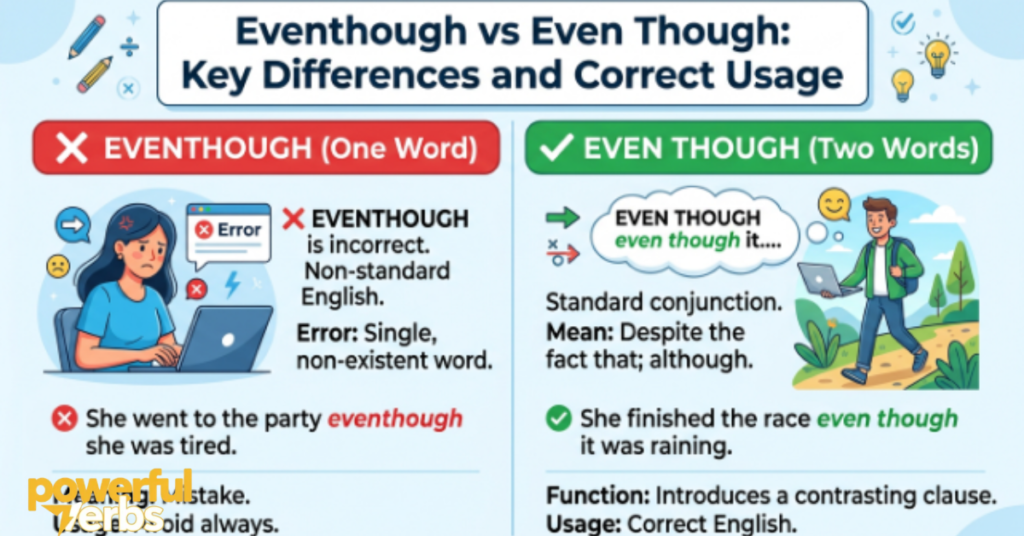
Every skilled writer knows that tiny grammar choices carry enormous weight. One of the most quietly persistent mistakes in English writing is the misspelling “eventhough” — typed as a single word when it should always appear as two. Whether you are drafting a formal report, a compelling blog post, or a casual email, getting this right is non-negotiable. This guide breaks down everything you need to know about “even though” vs “eventhough,” covering grammar rules, linguistic history, real-world examples, SEO-writing tips, and expert-backed corrections — all in one place.
see also: Is It Become or Became? Complete Breakdown of Tense, Meaning & Correct Usage
What Does “Even Though” Actually Mean?
“Even though” is a subordinating conjunction in the English language. It connects two clauses by expressing a contrast or concession — meaning that one thing is true despite something else also being true.
Its structure works like this: the main clause states a result or fact, and the “even though” clause introduces a surprising or contradictory condition. The word “even” acts as an intensifier, strengthening the sense of contrast that “though” already creates. Together, they form a powerful, nuanced connector that is essential in both spoken and written English.
Consider this example: “Even though the exam was difficult, she scored full marks.” Here, the difficulty of the exam is the unexpected contrast to the impressive result. The phrase creates logical tension that draws the reader forward.
Is “Eventhough” a Real Word? The Direct Answer
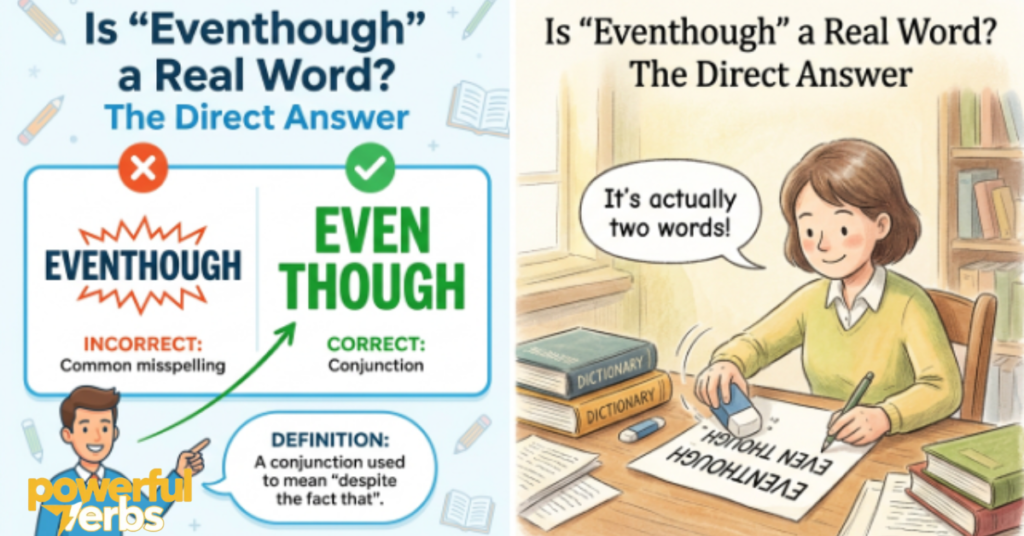
No. “Eventhough” written as a single word is not a recognized term in English. It does not appear in any major dictionary — including Merriam-Webster, Oxford English Dictionary, Cambridge Dictionary, or Collins English Dictionary. Grammar authorities and style guides universally reject it as a spelling error.
The merged form “eventhough” has no grammatical identity. It is neither a conjunction, a preposition, nor any other part of speech. It is simply a typo that has spread widely through informal digital writing, fast typing habits, and the merging effect of natural speech.
Searching for “eventhough” on any professional grammar resource returns zero results — because it does not exist as a legitimate word.
The Core Grammar Rule Behind “Even Though”
Understanding why “even though” must be written as two words requires a brief look at English morphology — the rules that govern how words are formed and combined.
In English, compound conjunctions and connective phrases retain their individual word boundaries. Unlike German, for instance, English does not freely merge words into longer compound forms. Phrases like “as long as,” “so that,” “in order to,” and “even though” all maintain spaces between their components because each word carries its own distinct grammatical function.
“Even” functions as an adverb that intensifies or emphasizes. “Though” functions as a conjunction that introduces contrast. When used together, they combine their individual meanings — emphasis plus contrast — but they do not fuse into a single unit. The space between them is grammatically necessary, not optional.
This is why every grammar handbook, academic writing guide, and professional style manual treats “even though” as a two-word phrase without exception.
Why So Many Writers Make This Mistake
The confusion between “eventhough” and “even though” is completely understandable. It is not a sign of carelessness but rather a natural response to how spoken English works.
When people say “even though” aloud in normal conversation, the two words blend together seamlessly. There is no audible pause between “even” and “though.” The phrase sounds like a single rhythmic unit — almost like “eventhough” — and when writers type the way they speak, the merged spelling follows naturally.
Several other factors accelerate the spread of this error. Mobile keyboards and fast typing on touchscreens increase the likelihood of accidentally skipping the spacebar. Autocorrect tools often fail to flag the error because “eventhough” is not a common dictionary entry that spell-checkers actively monitor. Social media platforms, where informal writing dominates and speed is prized over precision, have allowed the merged form to circulate widely — giving it a false sense of legitimacy through sheer repetition.
None of these explanations, however, make “eventhough” correct. Frequency of use in informal settings does not confer grammatical acceptance.
Correct vs Incorrect: Side-by-Side Sentence Examples
Seeing the difference in real sentences is the fastest way to internalize the rule.
Incorrect: Eventhough he apologized, the damage was already done. Correct: Even though he apologized, the damage was already done.
Incorrect: She kept running eventhough her legs were burning. Correct: She kept running even though her legs were burning.
Incorrect: Eventhough the deadline passed, they submitted the report. Correct: Even though the deadline passed, they submitted the report.
Incorrect: He smiled eventhough he was deeply upset. Correct: He smiled even though he was deeply upset.
Incorrect: Eventhough the results were surprising, the team stayed calm. Correct: Even though the results were surprising, the team stayed calm.
In every case, the only difference is the space — but that space is the boundary between a spelling error and correct, professional English.
Historical and Linguistic Background of “Even Though”
The phrase “even though” has roots in Middle English, where both “even” and “though” were independent, well-established words. Historical texts from the 14th and 15th centuries show the two words used in close conjunction to express concession and emphasis, and they were always written separately.
As the English language evolved through the Early Modern period into contemporary usage, the phrase maintained its two-word structure. No authoritative historical text, grammar treatise, or published literature ever recorded “eventhough” as a merged alternative. The separation of the two words is not a modern prescriptive rule — it is a structural characteristic that has remained consistent across centuries of English writing.
This historical consistency is significant. It demonstrates that the split form is not an arbitrary preference but a deeply embedded feature of how the English language handles compound connectors.
How “Even Though” Differs from Similar Conjunctions
Writers frequently need to choose between “even though,” “although,” “though,” “even if,” and “despite.” Understanding the subtle distinctions between these alternatives prevents both grammatical errors and meaning distortions.
Even though states a real, actual contrast. Both clauses describe something that is true. Example: “Even though it rained, the event continued.” The rain happened. The event continued. The contrast is factual.
Even if introduces a hypothetical or conditional scenario. Example: “Even if it rains, the event will continue.” The rain has not happened yet — it is a possibility.
Although is nearly synonymous with “even though” and can often replace it. Example: “Although it rained, the event continued.” The tone is slightly more formal.
Though is a lighter, more conversational version. It can appear mid-sentence or at the end of a clause, which “even though” cannot. Example: “The event continued, though it rained.”
Despite is a preposition, not a conjunction, so it must be followed by a noun or gerund, not a clause. Example: “Despite the rain, the event continued.”
Knowing which connector to use — and how to use it — reflects a sophisticated command of English grammar and significantly improves the precision of writing.
Real-World Impact: Why This Mistake Costs You Credibility
Grammar errors are not just technical violations — they carry social and professional consequences that writers often underestimate.
In academic writing, submitting work that contains consistent spelling errors like “eventhough” signals a lack of attention to detail. Professors, reviewers, and examiners notice such mistakes, and they affect the perceived quality of the argument regardless of how strong the content is.
In professional communication, emails and reports that contain basic spelling errors reduce the writer’s authority. Research in business communication consistently shows that readers form rapid judgments about a writer’s competence based on the surface quality of their prose. A single repeated error — especially a subtle one that is easy to fix — can undermine months of relationship-building.
For content creators, bloggers, and SEO writers, the stakes are even higher. Search engines evaluate content quality through multiple signals, and writing that contains non-standard spellings can negatively affect how a page is assessed. Beyond algorithms, human readers make trust decisions in seconds. A grammar error in the opening lines of an article can increase bounce rates and reduce the time-on-page metrics that signal content value.
Fixing “eventhough” to “even though” takes zero effort and pays dividends across every context in which writing is consumed.
Common Mistakes Writers Make Beyond Just the Spelling
Even writers who know to separate “even” and “though” sometimes misuse the phrase in other ways.
One frequent error is placing a comma in the wrong position. When “even though” begins a sentence, a comma should follow the subordinate clause before the main clause begins. Example: “Even though she was exhausted, she completed the project.” When “even though” appears mid-sentence connecting two clauses, no comma is needed before it. Example: “She completed the project even though she was exhausted.”
Another mistake is using “even though” when “even if” is more appropriate. Writers sometimes blur the line between actual events and hypothetical ones, choosing “even though” for conditions that have not yet occurred. This creates a factual assertion where a conditional one is intended.
A third error is writing “even though” after “but,” creating a redundancy. “But even though she tried” combines two contrasting connectors unnecessarily. In most cases, simply “even though she tried” or “but she tried” is cleaner.
Smart Alternatives to “Even Though” for Writing Variety
Repeating the same conjunction throughout a piece of writing creates monotony. Skilled writers rotate between several options to maintain rhythm and freshness while preserving meaning.
“Although” is the closest synonym and works in virtually every situation where “even though” is appropriate. “Though” offers a slightly more relaxed, conversational tone. “Despite” followed by a noun phrase creates elegant sentence variation. “Regardless of the fact that” is a more formal option suited to legal or academic writing. “In spite of the fact that” carries a similar weight. “Notwithstanding” is rare but precise in formal and contractual writing.
Each of these alternatives carries slightly different connotations and fits different stylistic registers. Building familiarity with all of them gives writers a richer grammatical toolkit.
Quick Reference Comparison Table
| Form | Status | Grammatical Role | Example |
| Even though | Correct | Subordinating conjunction | Even though it was cold, she swam. |
| Eventhough | Incorrect | Not a word | — |
| Although | Correct | Subordinating conjunction | Although it was cold, she swam. |
| Even if | Correct | Conditional conjunction | Even if it gets cold, she will swim. |
| Despite | Correct | Preposition (+ noun) | Despite the cold, she swam. |
How to Proofread for This Mistake Effectively
Building a habit of catching “eventhough” before publication is straightforward with the right approach.
The most reliable method is using the Find function (Ctrl+F or Cmd+F) in any word processor or browser, searching for “eventhough” as a single string. This instantly locates every instance in a document. Browser extensions like Grammarly also flag this error in real time as you type.
For manual proofreading, reading your text aloud slows down the eye and forces attention to individual words rather than anticipated meaning. When reading silently, the brain often autocorrects familiar errors without registering them consciously. Reading aloud breaks this habit and surfaces spelling mistakes more reliably.
Printing the document and proofreading on paper is another effective technique. The physical medium creates psychological distance from the screen-based writing process and encourages more careful word-by-word reading.
Conclusion
The difference between “eventhough” and “even though” comes down to a single space — but that space represents the boundary between incorrect and correct English. “Even though” is a two-word subordinating conjunction with centuries of linguistic history, universal dictionary recognition, and consistent support from every grammar authority. “Eventhough” is a spelling error that has spread through informal digital writing but carries no grammatical legitimacy in any context.
Whether you are writing academic papers, professional emails, creative content, or SEO articles, the rule is absolute and simple: always write “even though” as two separate words. Applying this correction consistently improves the professionalism, clarity, and credibility of everything you write — and it costs nothing more than a single tap of the spacebar.
see also: Itself or Its self? The Mistake That Makes You Sound Like a Beginner
FAQs
Is “eventhough” ever acceptable in informal writing?
No. Even in informal contexts, text messages, or social media posts, “eventhough” is a spelling error. Informal registers allow relaxed tone and casual vocabulary, but they do not override fundamental spelling rules. “Even though” remains the only acceptable form in any context.
Can “even though” start a sentence?
Yes, and it commonly does. When “even though” begins a sentence, it introduces the subordinate clause, which is then followed by a comma and the main clause. Example: “Even though the meeting ran long, the team reached a decision.”
What is the difference between “even though” and “even if”?
“Even though” refers to real, factual situations — things that actually happened. “Even if” refers to hypothetical or conditional scenarios — things that might happen. The distinction is between actuality and possibility.
Does using “even though” change sentence meaning versus “although”?
In most everyday usage, “even though” and “although” are interchangeable. However, “even though” carries a slightly stronger emphasis on the contrast — the word “even” adds a layer of surprise or intensity. “Although” is more neutral.
Why doesn’t spellcheck always catch “eventhough”?
Standard spellcheck tools identify words that do not appear in their dictionary. Some spellcheck databases either include “eventhough” as a recognized variant or fail to flag it because it is a compound of two known words. Grammar-checking tools like Grammarly are more reliable for catching this specific error.
Is “even though” one word in any other language’s equivalent?
Some languages do use single merged words for what English expresses as “even though.” German “obwohl,” French “bien que,” and Spanish “aunque” are all single words. This is partly why speakers of these languages learning English sometimes write “eventhough” — they are transferring a structural intuition from their native language. In English, however, the two-word form is always required.

Liam Johnson is a dedicated language expert with 4 years of professional experience. He specializes in Grammar, Vocabulary, and Sentence structure.
