
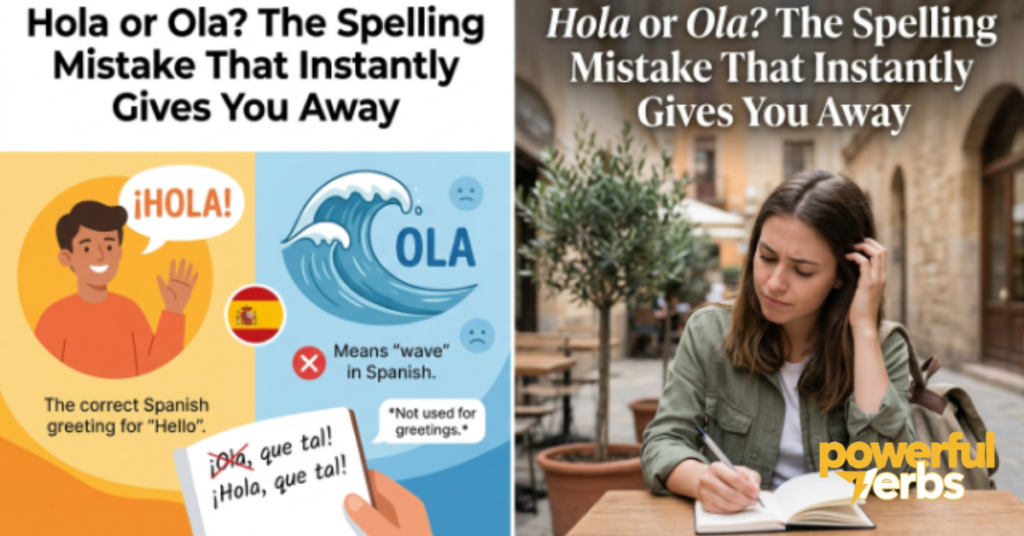
You hear someone say it out loud, and it sounds exactly the same either way — but written down, “hola” and “ola” are two completely different words with two completely different meanings. Mix them up in a text message, a caption, or a greeting card, and a Spanish speaker will notice instantly.
This guide clears up the confusion for good: what each word actually means, why they sound identical despite being spelled differently, where the silent letter comes from, and how to use both correctly without ever second-guessing yourself again.
Why These Two Words Trip Up So Many People

“Hola” and “ola” are homophones — they’re pronounced exactly the same way, but they don’t share a single letter of meaning. This kind of mix-up is rare in Spanish compared to English, which makes it stand out even more when it happens. The culprit is a single silent letter at the start of one word, and once you understand where that letter went, the confusion disappears.
What “Hola” Actually Means
“Hola” is the everyday Spanish word for “hello.” It’s warm, casual, and flexible enough to use with almost anyone — a close friend, a shop assistant, or even a coworker in a relaxed workplace.
Quick facts:
- It functions as a greeting, similar to “hi” or “hey” in English
- It carries a silent “H,” which is the root of most spelling confusion
- It works equally well in speech, texting, and casual writing
Example sentences:
- Hola, ¿qué tal tu día?
- Hola a todos, bienvenidos.
- Hola, soy nuevo aquí.
What “Ola” Actually Means
“Ola” has nothing to do with greetings at all — it means “wave,” specifically the kind you’d see crashing on a beach or rolling across open water.
Quick facts:
- It’s a noun, not an interjection or greeting
- It refers to a physical wave of water
- It can also be used figuratively, similar to how English uses “wave” for trends or surges
Example sentences:
- La ola arrastró la arena hacia la orilla.
- Una ola de calor llegó esta semana.
- Los surfistas esperaban la ola perfecta.
Hola vs Ola: Side-by-Side Comparison
| Word | Meaning | Part of Speech | Example |
| hola | hello | interjection/greeting | Hola, buenos días. |
| ola | wave | noun | La ola fue impresionante. |
Why the “H” in Hola Is Completely Silent
Spanish dropped the breathy /h/ sound from spoken language centuries ago, but the letter often stuck around in spelling for historical reasons. That’s why a whole family of common Spanish words — hombre, hermano, hablar, hacer — all begin with a letter you never actually pronounce.
“Hola” simply inherited that same pattern. The H is there in writing, silent in speech, and exactly the reason it sounds identical to “ola” despite being spelled so differently.
How to Pronounce Hola Correctly
The correct pronunciation is a smooth, even “OH-lah” — light and flat, without stress on either syllable.
Common pronunciation mistakes:
- Saying “HO-la” with a hard, audible H sound
- Stressing the second syllable instead of keeping it even
- Confusing the rhythm with the English word “holler”
Once you drop the H sound entirely and let the word glide, it instantly sounds more natural.
Where “Hola” Came From
“Hola” traces back to old interjections used across the Iberian Peninsula to call out or greet someone, similar in spirit to the English exclamation “holla!” As Latin evolved into Spanish, the breathy H sound faded from pronunciation across many words, while the spelling preserved it as a historical fingerprint.
By the time Spanish exploration and colonization spread the language across Latin America, “hola” had already become the standard, go-to greeting — and it has stayed that way ever since.
How “Hola” Feels Across Different Spanish-Speaking Regions
Just as “hello” carries a slightly different tone depending on where you hear it in the English-speaking world, “hola” shifts subtly from country to country.
| Region | Common Feel | Frequent Alternatives |
| Spain | Short, crisp delivery | Buenas, ¿Qué tal? |
| Mexico | Friendly and widely used | ¿Qué onda?, Buenas |
| Argentina | Often elongated playfully | Che, ¿Cómo andás? |
| Colombia | Upbeat and casual | Quiubo, Buenas |
| Caribbean nations | Quick, relaxed tone | Oye, ¿Qué lo que? |
Every Spanish-speaking country recognizes and uses “hola” — regional alternatives simply add extra flavor on top of it.
Common Mistakes People Make With Hola and Ola
- Writing “ola” when greeting someone — Incorrect: Ola, ¿cómo estás? Correct: Hola, ¿cómo estás?
- Using “hola” to describe a wave — Incorrect: La hola del mar era enorme. Correct: La ola del mar era enorme.
- Overpronouncing the H in hola — saying “HO-la” instead of the smooth “OH-lah” sound native speakers use
- Assuming Portuguese “olá” and Spanish “ola” mean the same thing — they don’t; Portuguese “olá” means hello, while Spanish “ola” means wave
- Mixing the two words in writing without proofreading — a single missing or extra H completely changes the sentence’s meaning
A Simple Trick to Never Mix Them Up Again
Match the H in “hola” to the H in “hello” — both words start the same way, and both serve the exact same purpose as a greeting. “Ola,” without that H, simply flows the way the wave it describes flows: smooth, open, and uninterrupted.
Other Spanish Homophones That Confuse Learners
Spanish has fewer homophones than English overall, but a handful of pairs cause similar mix-ups in writing.
| Pair | Meaning 1 | Meaning 2 |
| votar / botar | to vote | to throw away |
| haber / a ver | to have | let’s see |
| hecho / echo | made/done | I throw |
Recognizing this pattern — silent letters and merged sounds creating written confusion — helps you catch similar mistakes before they happen.
Why “Hola” Feels Familiar Even to Non-Spanish Speakers
Thanks to music, movies, social media, and everyday cultural exchange, “hola” has crossed far beyond Spanish-speaking communities. It shows up in English conversations, online gaming chats, and casual greetings among people who don’t speak another word of Spanish.
Part of the global familiarity also comes from similar-sounding greetings in other languages, like Portuguese “olá,” which shares a root but stays firmly separate in meaning from Spanish “ola.”
Using “Hola” Naturally in English Conversations
“Hola” fits comfortably into casual, multicultural, and hospitality-driven settings — think customer service, tourism, or friendly group chats. It feels noticeably forced, though, when dropped into formal business emails or conversations where no one involved speaks Spanish.
Natural examples:
- Hola, team! Ready to get started?
- Hola, welcome back!
Better avoided:
- Formal contracts or official business correspondence
- Conversations with no cultural or linguistic connection to Spanish
The One Rule That Settles This for Good
Use “hola” whenever you’re greeting someone — it means hello, plain and simple. Use “ola” only when you’re talking about a wave of water. If you remember nothing else, remember this: hola greets people, ola belongs to the ocean.
see also: Useing or Using: Which Word Is Correct? (Simple Guide)
FAQs
What’s the actual difference between hola and ola?
Hola means hello and is used as a greeting, while ola means wave and refers to water.
Why does hola have a silent H?
Spanish lost the breathy /h/ sound from pronunciation centuries ago, but many words kept the letter in spelling.
Do hola and ola sound exactly the same when spoken?
Yes, they’re homophones — pronounced identically despite having completely different meanings and spellings.
Is ola ever used as a greeting in any Spanish-speaking region?
No, ola always refers to a wave and is never used to say hello.
Can I use hola in professional English writing?
It’s better reserved for casual or hospitality contexts; formal business writing typically calls for standard English greetings instead.
Is hola the same as Portuguese olá?
They look similar and both mean hello, but they belong to different languages with different pronunciation rules.
Final Thoughts
The difference between “hola” and “ola” comes down to one silent letter carrying all the meaning. Once you connect that H to “hello,” this mix-up becomes impossible to forget — whether you’re texting a friend, traveling abroad, or simply talking about the ocean.

Liam Johnson is a dedicated language expert with 4 years of professional experience. He specializes in Grammar, Vocabulary, and Sentence structure.
