

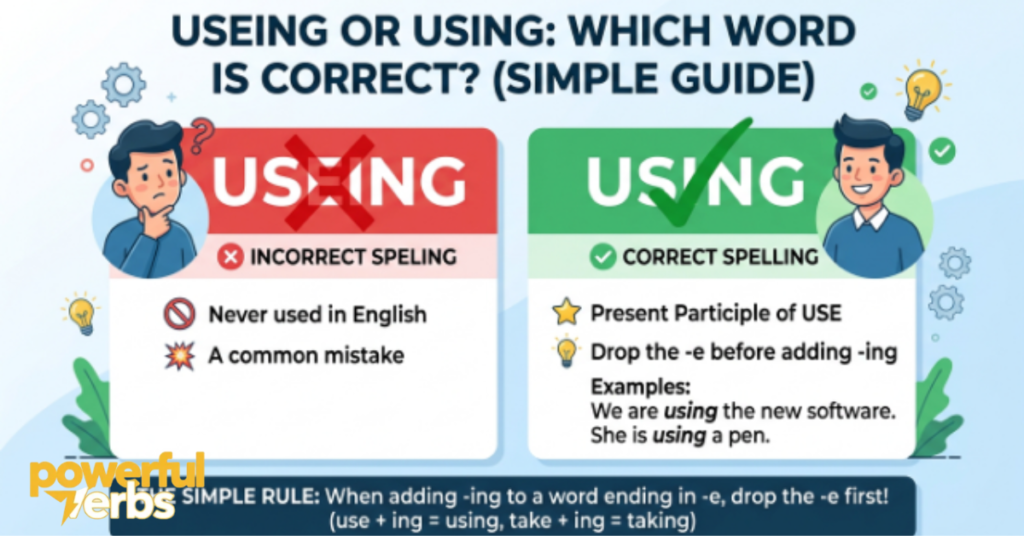
If you have ever paused mid-sentence wondering whether to type “useing” or “using,” you are not alone. This is one of the most common spelling slips in English, and it trips up students, content writers, business professionals, and even fluent English speakers. The good news is that the answer is simple, and once you understand the rule behind it, you will never make this mistake again.
see also: 200+ Simple Sentences for Grade 2 Students with PDF
Quick Answer
Correct spelling: using Incorrect spelling: useing
There is only one accepted spelling of this word in modern English, and it is using. The form “useing” does not appear in any dictionary, is flagged by every spell checker, and is considered a basic grammar error in academic, professional, and casual writing alike.
Why Do People Write “Useing” Instead of “Using”?
The confusion comes from how English usually forms the present participle (the -ing form) of a verb. In most cases, you simply attach -ing to the end of a base verb:
- walk → walking
- talk → talking
- play → playing
Because this pattern feels automatic, many writers apply the same logic to the word use and end up with “useing.” The problem is that use belongs to a different category of verbs — ones that end in a silent e. English has a separate, very consistent rule for these verbs, and that rule is what makes “using” correct instead of “useing.”
The Silent “E” Rule Explained

When a verb ends with a silent e, that final e is dropped before adding the suffix -ing. This keeps the pronunciation smooth and avoids an awkward double-vowel spelling. Here is the rule in action with several common verbs:
| Base Verb | Add “-ing” Correctly | Incorrect Form |
| use | using | useing |
| make | making | makeing |
| write | writing | writeing |
| hope | hoping | hopeing |
| drive | driving | driveing |
| believe | believing | believeing |
Notice the pattern: in every single case, the silent e disappears the moment -ing is attached. This is not a special exception for the word “use” — it is a standard rule of English spelling that applies across hundreds of verbs.
Where the Word “Use” Comes From
The verb use traces back to the Latin word usus, related to uti, meaning “to employ” or “to make use of.” It entered English through Old French and has kept a consistent meaning for centuries: to put something into service or apply it for a purpose. Its grammatical behavior, however, follows ordinary modern English rules — meaning the silent e drop applies the same way it does to any other e-ending verb.
Is There a Difference Between American and British Spelling?
This is one of the few areas in English where regional spelling differences do not apply. Unlike words such as color/colour or organize/organise, the -ing form of “use” is identical everywhere English is spoken.
- American English: using
- British English: using
- Canadian English: using
- Australian English: using
No matter which English-speaking country your audience is in, using is the only correct option. This makes it a safe, universal spelling for global content, business communication, and SEO writing.
How to Use “Using” Correctly in a Sentence
“Using” functions as the present participle of the verb “use,” and it can appear in continuous tenses, as a gerund, or as part of a longer phrase. Here are natural examples across different writing styles:
In everyday conversation: I’m using my brother’s laptop until mine gets repaired.
In business and email writing: We recommend using the updated version of the software for better security.
In academic or formal writing: The researchers collected their data using a controlled survey method.
In social media captions: Been using this skincare routine for a month and already see results.
As a sentence starter: Using public transport regularly can reduce your monthly expenses.
In every example above, “using” describes an ongoing action or method — which is exactly the grammatical role the -ing form is meant to play.
Common Mistakes Writers Make With This Word
Beyond the basic “useing” typo, a few related errors show up often in casual and even professional writing:
- Writing “useing” inside hashtags or captions, where spell check is sometimes ignored
- Mixing up “using” with “use of,” which changes the sentence structure
- Dropping the -ing entirely and writing “use” in a sentence that needs a continuous tense, such as “I am use the app” instead of “I am using the app”
Spell-check tools, Google’s autocorrect, and grammar software like Grammarly will all mark “useing” as an error, which is one more reason this spelling never appears in published or professional content.
A Simple Trick to Remember the Rule
If you ever hesitate while typing this word, picture the e-drop rule as a checkpoint: any time a verb ends in a silent e, that letter steps aside before -ing joins the word. Say it out loud as a habit:
“Drop the e, then add -ing.”
Apply that same checkpoint to other tricky verbs like write, hope, believe, or create, and the spelling will become automatic over time.
Why Correct Spelling Matters for Your Writing
Small spelling errors like “useing” can quietly damage how readers perceive your content. In blog posts, resumes, business emails, and SEO articles, accuracy builds trust. Search engines also favor well-edited, grammatically correct content when ranking pages, which means a simple fix like this one can have a real impact on how your writing performs and how credible it looks to your audience.
Conclusion
The debate between “useing” and “using” has a clear, permanent answer: using is correct, and useing is always a spelling error. This happens because English drops the silent e at the end of a verb before attaching -ing, a rule that applies consistently across American, British, Canadian, and Australian English. Once this rule clicks, you can apply it confidently not just to “use,” but to dozens of other common verbs you write every day.
see also: 150+ Negative Habits: Bad Habit Examples Everyone Should Avoid in 2026
FAQs
Is “useing” a real word in any dictionary?
No. “Useing” does not appear in any major English dictionary, including Oxford, Merriam-Webster, or Cambridge. It is universally treated as a misspelling of “using.”
Why does the silent “e” get removed before “-ing”?
English spelling avoids placing a vowel directly before “-ing” when the base verb already ends in a silent “e.” Dropping the “e” keeps the word easier to read and pronounce, and it’s the standard rule for nearly all “e”-ending verbs.
Does this rule apply only to the word “use”?
No, it applies broadly. Verbs like make, write, drive, hope, and believe all follow the exact same pattern of dropping the final “e” before “-ing” is added.
Is “using” a verb or a noun?
“Using” is most commonly a verb form (a present participle), as in “I am using this tool.” It can also act as a gerund, functioning like a noun, as in “Using public transport saves money.”
Can a sentence start with the word “using”?
Yes, this is grammatically correct and common in formal writing. For example: “Using renewable energy can lower long-term costs.”
How can I avoid making this spelling mistake in the future?
The easiest method is to memorize the rule rather than the word itself: if a verb ends in a silent “e,” remove that “e” before adding “-ing.” Practicing this with a few common verbs will make it second nature.

Liam Johnson is a dedicated language expert with 4 years of professional experience. He specializes in Grammar, Vocabulary, and Sentence structure.
