
Every language has words that look deceptively simple on the surface but carry enormous grammatical weight underneath. In English, few word pairs cause as much quiet confusion as become and became.
These two words are not interchangeable. They do not serve the same function. They do not belong in the same sentences. Yet writers at every level — students drafting essays, professionals composing emails, content creators publishing articles — regularly swap one for the other without realizing the error changes the meaning of their sentence entirely.
The confusion is understandable. Both words come from the same root. They look nearly identical. They sound similar when spoken quickly. But in the framework of English grammar, they occupy completely separate positions on the timeline of events. One describes what is happening or what happens regularly. The other describes what already happened and is fully finished.
This guide breaks down every form, every rule, and every usage pattern connected to become and became. By the end, you will not need to pause and second-guess yourself. The right choice will feel immediate, automatic, and confident.
The Core Difference — Become vs Became at a Glance

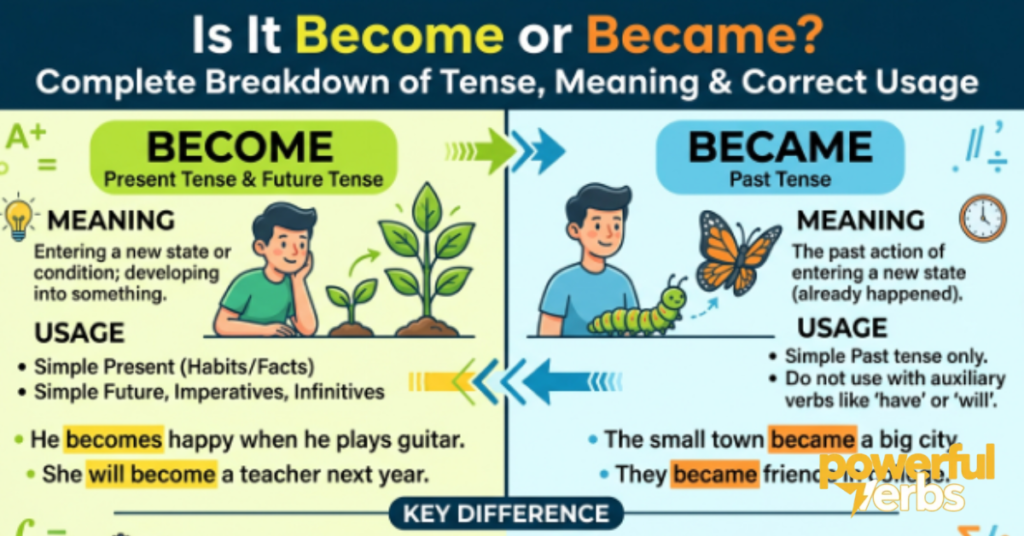
The single most important thing to understand about become and became is this: they represent two different points in time.
Become is the base form and present tense form of the verb. It describes transformations that are happening now, happen regularly, or are described as general truths about the world. It is the form you reach for when the action exists in the present moment or when the sentence makes a timeless observation.
Became is the simple past tense form of the same verb. It describes a transformation that started in the past, completed in the past, and is fully finished. There is no ongoing quality to become. The change it describes has already resolved itself entirely before the sentence is even written.
Become also functions as the past participle, which means it appears again in perfect tenses alongside helping verbs like has and have. This dual role — base form and past participle — is part of what makes an irregular verb and part of what makes the entire become-versus-became question feel more complicated than it really is.
Once you anchor these identities firmly in your mind, every other rule in this guide becomes a natural extension of that foundation.
What Does “Become” Mean and When Do You Use It?
The verb become means to undergo a change, to transition into a new state, or to start existing in a form that was not present before. It captures transformation at its most fundamental — the process by which something or someone moves from one condition into another.
In present tense usage, become appears when the subject is plural or when the subject is a first-person or second-person pronoun. It also appears when the sentence is describing a habitual pattern, a general truth, or an ongoing situation rather than a completed historical event.
Sentences built around present-tense carry an inherent openness. They describe situations that are still unfolding, still repeatable, or still true at the moment of speaking or writing.
Children become more independent as they grow older and take on new responsibilities at school and at home. Athletes become stronger through consistent training that challenges their physical and mental limits. Relationships become deeper when both people invest genuine time and honest communication into them. Ideas become movements when enough people believe in them and act on that belief together. Problems become opportunities when the person facing them decides to look at the situation from a different angle.
Notice that none of these sentences are describing something that happened once and concluded. Every one of them describes a process that repeats, continues, or applies universally. That is the distinguishing quality of present-tense become — it lives in the ongoing and the universal rather than the finished and the specific.
Become also appears after modal verbs — those auxiliary verbs that express possibility, necessity, ability, or permission. When you pair become with can, could, might, may, will, would, or should, you are building sentences about potential change rather than actual completed change.
Stress can become a serious health problem when it goes unaddressed for long periods of time. Disagreements may become productive conversations if both parties approach them with genuine curiosity. A single decision will become the turning point of an entire career in ways that are impossible to predict from the outside.
All of these modal constructions use the base form become because the modal verb itself carries the tense and the conditionality. The main verb that follows a modal is always the base form, never the simple past, which means never follows a modal verb under any grammatically correct circumstances.
What Does “Became” Mean and When Do You Use It?
Became is the simple past tense of become, and its role is both clear and specific. It belongs in sentences that describe a completed transformation — a change that began in the past, finished in the past, and is no longer in progress at the time of writing or speaking.
The defining characteristic of became is completion. Whatever change the sentence is describing, that change is done. It happened. It concluded. The timeline has moved forward, and the transformation being described exists only in the historical record of events.
She became a respected physician after years of rigorous training and late-night study sessions that tested everything she had. The small coastal village became one of the most photographed destinations in the country after a travel writer mentioned it in a widely circulated magazine. His casual interest in astronomy became a lifelong passion that eventually led him to a career at a research observatory. The argument between the two colleagues became the catalyst for a broader conversation about workplace culture that the organization had been avoiding for years. What started as a simple sketch became the centerpiece of an internationally recognized art exhibition.
Each of these sentences places the change firmly in the past. The person became a physician — that process is over. The village became a destination — that shift already occurred. The interest became a passion — that transformation is complete. Every instance of became points backward in time to a defined moment or period when something changed and finished changing.
A reliable test for became is whether a specific past time reference fits naturally into the sentence. If you can add “in 2019,” “last summer,” “ten years ago,” “during that period,” or “overnight” without the sentence becoming awkward, became is almost certainly the correct choice. These time markers anchor the change to a specific point in the past, which is precisely the territory became is designed to describe.
The weather became significantly colder during the final weeks of November. The negotiations became tense when both sides refused to compromise on the core issues. She became the first woman in her family to complete a university degree. The company became profitable three years after its founding.
All of these sentences describe finished facts. They are not describing something happening right now. They are not describing habitual patterns. They are reporting completed history, and became is the grammatically correct tool for that purpose.
Become vs Becomes — Subject-Verb Agreement Explained
English grammar requires that a verb agree with its subject in both number and person. For the verb become, this means understanding when to use become and when to use becomes in present tense sentences.
The rule is consistent and applies across all regular and irregular present-tense verbs in English. When the subject is a third-person singular — meaning he, she, it, or any singular noun — the verb takes an -s ending. When the subject is first person singular, second person singular or plural, or third person plural, the verb takes no ending.
Become is the correct form when the subject is I, you, we, they, or any plural noun. Becomes is the correct form when the subject is he, she, it, or any singular noun that refers to one person, place, thing, or idea.
She becomes more articulate every time she presents her research to a new audience. He becomes visibly uncomfortable when the conversation shifts toward topics he has not prepared for. The river becomes dangerous to cross during the rainy season when water levels rise unpredictably. It becomes obvious quite quickly that the plan was never designed with long-term sustainability in mind.
Contrast these with plural and other subjects: They become more collaborative when the project requires genuine interdependence. We become better communicators when we practice listening as much as speaking. People become more resilient through adversity that challenges but does not overwhelm them.
The -s ending in becomes is small but grammatically significant. Omitting it when the subject is singular, or adding it when the subject is plural, produces a subject-verb agreement error that makes writing feel less polished and less credible in professional contexts.
Has Become vs Have Become — Present Perfect Tense Made Simple
The present perfect tense in English describes actions or changes that began in the past but maintain a connection to the present moment. They are not purely historical in the way that simple past sentences are. They carry a sense of current relevance — the past event still matters now, still affects the present situation, or has only recently concluded.
To form the present perfect tense with become, you combine the appropriate helping verb — has or have — with the past participle form of become. The past participle of become is become, which is the same as the base form. This is a defining feature of this particular irregular verb and a source of significant confusion for many writers.
Has become is used when the subject is third-person singular — he, she, it, or a singular noun.
The global conversation around mental health has become more open and less stigmatized over the past decade. She has become the most reliable member of the entire research team since joining the organization. The technology has become an essential component of modern medical diagnosis that physicians rely on daily.
Have become is used when the subject is first person singular, second person singular or plural, or any plural subject.
Remote working arrangements have become a permanent feature of the professional landscape rather than a temporary adjustment. I have become more selective about the projects I take on as my understanding of my own strengths has deepened. We have become more aware of the environmental consequences of decisions that once seemed entirely routine. You have become someone your younger self would recognize but not fully anticipate.
The present perfect tense with has become or have become is particularly useful in writing about trends, gradual transformations, and developments that began at some point in the past but remain actively relevant to the current moment. It bridges history and present in a way that neither simple past nor simple present can accomplish on its own.
Why “Has Became” Is Always a Grammar Error
Among all the errors connected to become and became, “has became” is the most widespread and the most clearly incorrect. It appears frequently in informal writing, social media posts, student essays, and even some published content that did not receive careful editing.
The error stems from a misunderstanding about how perfect tenses are constructed. In English, every perfect tense — present perfect, past perfect, and future perfect — is built using a helping verb followed by the past participle of the main verb. The helping verb changes to indicate the time frame. The main verb stays in its past participle form regardless of which helping verb precedes it.
For become, the past participle is become — not became. Became is exclusively the simple past tense form. It has no role in perfect tense constructions. When a writer uses “has became,” they are combining a perfect-tense helping verb with a simple past tense main verb, which violates the fundamental structural rule of how perfect tenses work in English grammar.
The correct forms are has become and have become. These pair the helping verb with the correct past participle and produce grammatically sound sentences. “Has became” and “have became” are always wrong, without exception, regardless of context, subject, or sentence structure.
He has become the most decorated athlete in the history of that competition. The project has become significantly more complex than anyone originally anticipated. They have become the leading voice in a field that barely existed five years ago. These are all correct. Replace become with became in any of these sentences and the grammar breaks immediately and completely.
Would Become, Will Become, and Could Become — Modal Verb Usage
Modal verbs add layers of meaning to sentences — expressing possibility, prediction, obligation, permission, and conditionality. When modal verbs appear alongside become, the form of become that follows is always the base form, never the past tense became.
This rule applies to every modal verb in English without exception. Can, could, may, might, will, would, shall, should, and must are all followed by the base form of the main verb. Since the base form of this verb is become, that is always what appears after a modal, regardless of the tense or conditionality of the sentence.
Will describes confident future predictions about transformations expected to happen.
Automation will become the dominant force reshaping employment across every major industry over the next two decades. The small startup will become a significant player in the market if it maintains its current growth trajectory. This policy will become law once the final vote is completed.
Would become describes hypothetical transformations, polite predictions, or changes viewed from a past perspective looking toward what was then the future.
She said the experience would become the most formative chapter of her professional life. If both parties committed to the agreement, the partnership would become the most significant collaboration in the organization’s history. He believed that dedication would become his greatest competitive advantage over time.
Could become and might express possibility — transformations that are plausible but not certain.
The regional conflict could become a broader international crisis if diplomatic channels are not engaged immediately. A small misunderstanding between colleagues might become a significant team dynamic issue if it is not addressed early and honestly.
Every one of these modal constructions uses become because the modal verb handles the tense dimension of the sentence, leaving the main verb free to remain in its base form.
Become vs Became in Past Continuous and Past Perfect Tenses
Beyond simple past and present perfect, become appears across other tense structures that writers sometimes overlook when thinking about this verb pair.
The past continuous tense describes an action that was in progress at a specific point in the past. For become, this produces “was becoming” or “were becoming” — constructions that capture a transformation that was actively unfolding at some previous moment.
The situation was becoming increasingly difficult to manage as new complications emerged each day. Relations between the two organizations were becoming strained by mid-year, long before the formal dispute was declared. She was becoming more skilled with every project she completed, even when the projects themselves were challenging and imperfect.
These constructions do not use became because the past continuous requires the -ing form of the verb paired with was or were, not the simple past.
The past perfect tense describes a transformation that was completed before another past event occurred. It uses had followed by the past participle become.
By the time the investigation concluded, the story had become one of the most closely followed cases in the country. She realized the situation had become more serious than she initially understood when she first received the report. The relationship had become strained long before either party acknowledged the problem openly.
Had became is never correct. The past perfect always requires the past participle, which for this verb is become, making had become the only grammatically acceptable construction.
Tense Ti meline — How All Forms of Become Connect
Visualizing where each form of become sits on a timeline of events helps clarify why each one exists and what specific temporal purpose it serves.
The base form become sits at the center of the timeline, describing the present moment or timeless truths that exist outside any specific time frame. It is the neutral, unanchored form from which all other forms extend outward.
Became reaches backward from the center, pointing exclusively to events that are finished and located at a specific point in the past. It has no connection to the present moment. Whatever it describes is over.
Has become and have become reach slightly backward while maintaining a connection to the present. They describe transformations that originated in the past but whose effects, relevance, or results are still active and significant right now.
Had become reaches even further back, describing transformations that were already complete by the time another past event occurred. It is the most historically distant of all the forms.
Was becoming and were becoming describe a past transformation that was still in progress at a specific past moment — caught mid-change, mid-development, mid-shift.
Will become, would become, could become, and might become all point forward, describing changes expected, predicted, or hypothesized to occur in the future or under certain conditions.
Each form has its own lane on this timeline, and understanding those lanes removes the ambiguity that causes so many writers to default to whichever form sounds most familiar.
Mixing Tenses — The Most Common Errors Writers Make
Tense consistency is one of the most fundamental requirements of clear, professional writing. When writers shift between tenses within a single sentence or across closely connected sentences without a deliberate reason for doing so, the reader loses their orientation in time, and the writing becomes confusing even when the individual words are all spelled correctly.
With become and became, tense mixing most often occurs when a writer begins a sentence in the past tense and then unconsciously slips back into the present, or when a writer uses became in a context that requires the present perfect form has become.
A past-tense sentence describing a completed event should maintain its past tense throughout. “The company became profitable and expands into three new markets” mixes past tense with present tense within a single connected thought. The correct version uses consistent past tense: “The company became profitable and expanded into three new markets.”
A present-perfect construction describing ongoing relevance should not incorporate became. “She has became more confident since taking the course” incorrectly uses the simple past form where the past participle is required. The correct version is “She has become more confident since taking the course.”
A present-tense sentence describing habitual patterns should not suddenly shift to became when describing what the subject does regularly. “He becomes anxious before presentations, and last week he became unable to speak” is actually correct because the shift is deliberate — the first clause describes a habit and the second describes a specific past event. Deliberate tense shifts that serve a clear narrative purpose are acceptable. Accidental tense shifts that occur because the writer lost track of the timeline are the errors to avoid.
Become vs Became in Academic, Business & Creative Writing
Different writing contexts impose different standards on verb tense use, and understanding those standards helps writers choose between become and became with greater precision and purpose.
In academic writing, tense choice signals whether the writer is describing established knowledge, historical events, ongoing research findings, or current consensus. Become appears in statements of general principle that reflect the current state of understanding in a field. Became appears in historical accounts of how a field developed, how a theory was established, or how a discovery occurred at a specific point in time. The present perfect has become appears when describing how a concept or practice has evolved and why that evolution remains relevant to the argument being made.
In business writing, become and became serve strategic communication purposes. Became appears in retrospective reports, case studies, and historical performance reviews that document what happened during a specific period. Become and has become appear in forward-looking analyses, trend assessments, and strategic recommendations that connect past developments to current conditions and future implications.
In creative writing, the choice between become and became shapes the temporal texture of the narrative. A story told in past tense uses became for completed transformations in the narrative timeline. A story told in present tense uses become for transformations happening within the story’s ongoing present moment. Mixing these without intention disrupts the reader’s sense of when events are occurring, which weakens narrative immersion and clarity.
Real-Life Scenarios That Clarify Every Form
Abstract grammar rules become genuinely meaningful when they are anchored to situations that feel real and recognizable. These scenarios demonstrate exactly how each form of become functions in practice.
A young professional joins a company as an entry-level analyst. Over three years, she develops her skills and takes on larger responsibilities. Today, she holds a senior position and leads her own team. To describe her journey, you might write: “When she joined the organization, she was becoming more comfortable with data analysis week by week. By the end of her first year, she had become the go-to person for complex reports. She became team lead in her third year. She has become one of the most respected figures in the department. She will become a director if the current trajectory continues.”
Each sentence uses a different form of become, and each form places her transformation at a specific point on a timeline that stretches from the past through the present into the anticipated future. The forms are not interchangeable. Replacing any one of them with another would misrepresent where on that timeline the specific transformation occurred.
A technology company launches a product that initially receives mixed reviews. Over time, it gains a loyal user base. Today, it is considered an industry standard. “The product was becoming more refined with each software update during the first year. It had become commercially viable by the end of year two. It became the market leader in year three. It has become the standard tool that professionals in the field rely on daily. It will become the platform on which the next generation of tools is built.”
These scenarios demonstrate that the entire family of become forms works together as a system, with each member occupying a distinct and non-negotiable position in the timeline of events.
Memory Techniques That Actually Work
Knowing the rules intellectually is different from applying them automatically under the pressure of real writing. These memory techniques bridge that gap and help the correct form surface without deliberate analysis.
The first technique is the timeline anchor. Before choosing between become and became, ask yourself a single question: is this change finished or is it still true? If the change is finished, use became. If the change is still true, ongoing, or relevant to the present, use become or one of the perfect tense forms.
The second technique targets the “has became” error specifically. Remind yourself that “has” is a perfect-tense helper, and perfect-tense helpers always reach for the past participle. The past participle of this verb is become — the same as the base form. So “has” always reaches for become, never for became. Became belongs only with simple past, where it stands alone without any helping verb beside it.
The third technique uses a time-marker substitution test. Try inserting “yesterday” or “in 2018” into your sentence. If it fits naturally, your sentence is simple past — use became. Then try inserting “right now” or “these days.” If that fits better, your sentence is present tense — use become. If neither fits cleanly but the sentence feels connected to both past and present, you are likely dealing with present perfect — use has become or have become.
The fourth technique connects the double letters in became to the idea of something being double-done — fully complete, finished twice over, absolutely in the past. This is a loose association but an effective one for writers who process information visually and need a quick mental trigger.
Connected to Become and Became
Search engines understand content not just through exact keywords but through the broader network of semantically related terms that appear throughout a piece of writing. For a guide covering become and became, the following LSI and NLP-connected terms strengthen topical authority and improve search visibility.
Core grammatical terms naturally woven through this content include: irregular verb, verb tense, simple past tense, present tense, past participle, present perfect tense, past perfect tense, modal verbs, subject-verb agreement, helping verb, auxiliary verb, and base form.
Usage and clarity terms include: tense consistency, grammatical error, correct usage, common grammar mistakes, English grammar rules, verb conjugation, sentence structure, and writing clarity.
Contextual and applied terms include: professional writing, academic English, business communication, formal English, everyday English usage, English language learners, grammar guide, and grammar tips.
All of these terms belong naturally within the scope of this topic and appear throughout this article in context-appropriate positions that support both readability and search engine comprehension.
see also: SFS Meaning in Text: What It Stands For on Instagram, Snapchat & TikTok
FAQs
What is the simplest way to choose between become and became?
Ask whether the transformation is finished or still true. Finished and in the past means became. Still true, ongoing, or relevant to now means become or has become.
Can became ever follow the words has or have?
No. Has and have always require the past participle form, which is become. “Has became” and “have became” are always grammatically incorrect without any exception.
Why does become serve as both the base form and the past participle?
Become is an irregular verb that does not follow the standard pattern of adding -ed to form its past participle. English has several such verbs — run, come, and become among them — where the past participle matches the base form rather than the simple past.
Is it ever correct to write “he become” without the -s ending?
No, when the subject is a third-person singular noun or pronoun in present tense, the verb must take the -s ending. The correct form is “he becomes,” not “he become.”
How does “had become” differ from “has become”?
Has become connects a past transformation to the present moment and implies current relevance. Had become describes a transformation that was already complete before another past event occurred, placing it further back on the timeline with no direct connection to the present.
Does the form of become change when used in questions or negatives?
In questions and negatives using do, does, or did, the base form become always appears regardless of subject or tense context. “Did she become nervous?” and “She did not become nervous” both use become because did already carries the past tense information.
Conclusion
The difference between become and became is not a minor grammatical technicality. It is a meaningful distinction that changes the timeline of every sentence it appears in and communicates fundamentally different information to the reader about when a transformation occurred and whether it is still relevant to the present.
Become describes what is true now, what happens regularly, and what might happen under certain conditions. Became describes what happened once, in the past, and is now complete. Has become and have become bridge those two territories, anchoring past change to present significance. Had become, was becoming, and all the modal constructions serve their own precise temporal functions within that broader system.
Mastering this verb and all its forms does not require memorizing abstract rules in isolation. It requires understanding what each form is trying to communicate about time — and then trusting that understanding to guide every writing decision that involves this verb.
Your writing becomes more precise when your grammar is accurate. Your credibility becomes stronger when your sentences mean exactly what you intend. And the confidence that comes from knowing you have chosen correctly becomes, over time, one of the most valuable tools any writer carries.

Liam Johnson is a dedicated language expert with 4 years of professional experience. He specializes in Grammar, Vocabulary, and Sentence structure.
