

If you’ve spotted “SFS” pop up in a DM, a comment, or a story caption and felt completely lost, you’re far from alone. This short abbreviation shows up constantly across social media, and once you know what it means, you’ll start noticing it everywhere.
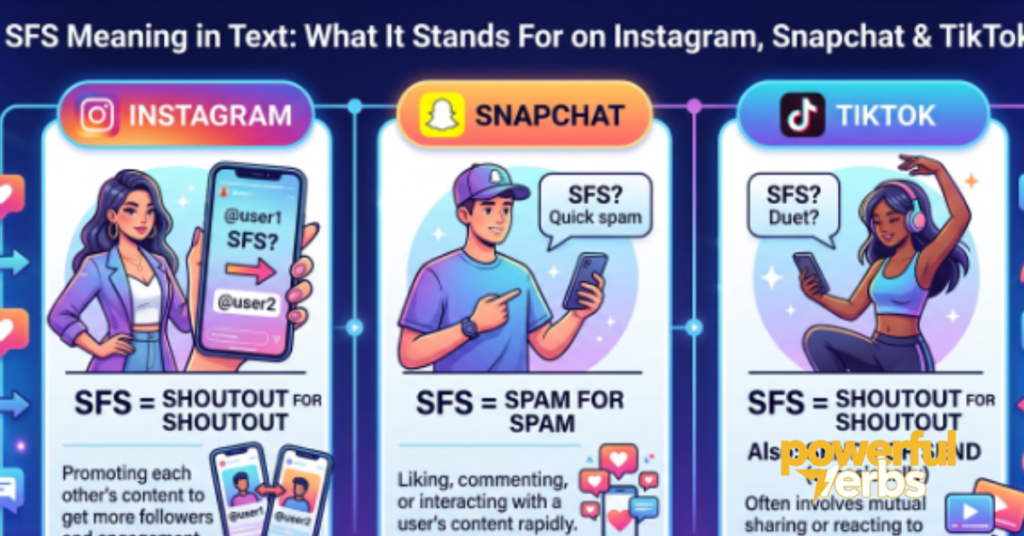
SFS stands for “Shoutout For Shoutout.” It’s a simple exchange where two people promote each other’s profiles so both sides gain visibility and new followers.
This guide breaks down exactly what SFS means, how it works across different platforms, when it’s worth using, and how to avoid the common pitfalls that come with it.
see also: Afterward vs Afterwards: Meaning, Differences, and Correct Usage
What Does SFS Actually Mean?

At its core, SFS describes a mutual promotion deal between two social media users. One person agrees to feature the other’s profile, and in return, the second person does the same thing back.
Think of it as a trade: “I’ll promote you if you promote me.” Neither side pays money — it’s a free way to gain exposure by tapping into someone else’s audience.
A Simple Way to Picture It
Imagine you have a friend named Sara. You post on your story:
“Go follow Sara, her content is amazing!”
In return, Sara posts on her story:
“Check out my friend’s page, you won’t regret it!”
That exchange — you promoting her, her promoting you — is exactly what SFS represents. Both accounts benefit, and both audiences get introduced to someone new.
Where You’ll Most Commonly See SFS
This abbreviation isn’t limited to a single platform. It shows up across:
- Instagram stories and direct messages
- Snapchat stories and snap exchanges
- TikTok comments and duets
- Group chats and private messages
- Public comment sections under viral posts
It has become one of the easiest, cost-free strategies smaller accounts use to grow their following without relying on ads or paid promotions.
Why People Use SFS So Often
There are several practical reasons this trend has stuck around for years:
Gaining new followers — Smaller or newer accounts often struggle with visibility, and SFS introduces them to an entirely new audience instantly.
Speeding up growth — Instead of waiting for organic reach, two accounts combine their audiences for a quicker boost.
Building community — SFS often turns into genuine friendships or collaborations between creators in the same niche.
Improving perceived popularity — A higher follower count can make a profile look more established and trustworthy to new visitors.
SFS Meaning on Instagram
On Instagram specifically, SFS usually plays out through story shares. One user tags the other’s account in a story, often with a short caption like “go follow this amazing page,” and the second user mirrors the gesture.
Example exchange:
| Step | What Happens |
| User A messages “SFS?” | Proposing a shoutout trade |
| User B replies “Sounds good!” | Agreeing to the exchange |
| User A tags User B in their story | User A’s followers discover User B |
| User B tags User A in their story | User B’s followers discover User A |
| Both accounts gain new followers | A mutual win for everyone involved |
SFS Meaning on Snapchat
Snapchat’s version of SFS works almost identically, but it leans more on Snapchat usernames being shared directly in a Story rather than through a feed post. Younger users especially rely on this method since Snapchat’s culture revolves heavily around quick, story-based sharing.
If someone sends you “SFS?” on Snapchat, they’re essentially asking: “Want to post each other’s usernames so we both grow?”
SFS Meaning on TikTok
TikTok has its own twist on the trend. Instead of stories, SFS often happens through:
- Pinned comments mentioning another creator
- Duets or stitches that tag the original creator
- Shoutouts inside video captions
Because TikTok’s algorithm rewards engagement and watch time, an SFS exchange here can sometimes drive even faster growth than on Instagram or Snapchat, especially if both creators share a similar audience.
Does SFS Always Mean “Shoutout For Shoutout”?
Mostly, yes — but context matters. In a handful of other communities, the same three letters can carry slightly different meanings:
| Alternate Meaning | Common Setting |
| Snap For Snap | Snapchat-specific exchanges |
| Spam For Spam | Gaming communities, Reddit threads |
| Sorry For Spam | Forums and comment sections |
That said, on Instagram, Snapchat, and TikTok specifically, “Shoutout For Shoutout” is by far the dominant meaning you’ll encounter.
Common Problems People Run Into With SFS
While SFS can be a great growth tool, it isn’t flawless. A few recurring issues include:
One-sided deals — Someone agrees to an SFS, gets the shoutout, then never follows through on their end.
Low-quality followers — New followers gained through SFS sometimes have little genuine interest in your content.
Audience mismatch — Swapping shoutouts with an account in a completely different niche rarely brings engaged followers.
Overdoing it — Posting too many SFS shoutouts in a short period can come across as spammy to your existing audience.
How to Make SFS Actually Work for You
A few simple habits can dramatically improve your results:
- Only agree to SFS exchanges with accounts that share your niche or interests
- Check the other account’s engagement, not just their follower count, before agreeing
- Limit shoutouts to a reasonable frequency so your feed doesn’t feel cluttered
- Prioritize a smaller number of genuine, active followers over a large number of inactive ones
How to Politely Ask Someone for SFS
If you want to propose an exchange, keep your message friendly and direct:
“Hey! Love your content — want to do an SFS?” “Hi! Would you be up for a shoutout swap today?” “SFS? I can post you right now if you’re interested!”
A polite, low-pressure tone almost always gets a better response than a generic copy-paste message.
When It’s Better to Decline an SFS Request
It’s completely fine to say no. Consider turning down a request when:
- The account’s content doesn’t match your niche or audience
- Their previous posts feel inconsistent with your brand
- They’ve failed to follow through on a past SFS agreement
- You simply don’t feel it benefits your page right now
Is SFS Against Platform Rules?
No — SFS exchanges are completely allowed on Instagram, Snapchat, and TikTok. None of these platforms prohibit mutual shoutouts. The only thing to avoid is relying on bots or fake engagement tools, since that does violate most platforms’ terms of service.
SFS Compared to Other Social Media Abbreviations
| Abbreviation | Full Meaning | Typically Used On |
| SFS | Shoutout For Shoutout | Instagram, Snapchat, TikTok |
| F4F | Follow For Follow | Instagram, TikTok |
| L4L | Like For Like | |
| DM | Direct Message | All platforms |
| IMO | In My Opinion | Texting, comments |
| TBH | To Be Honest | Texting, social media |
conclusion
SFS remains one of the simplest, cost-free ways for creators and everyday users to grow their presence online. At its heart, it’s nothing more than a mutual favor — you promote someone, and they promote you right back. Whether it shows up on Instagram, Snapchat, or TikTok, the underlying idea never really changes. The key to making it work is choosing the right partners, staying consistent, and avoiding spammy overuse. Done thoughtfully, SFS can introduce your page to genuinely interested followers rather than empty numbers. The next time “SFS?” lands in your inbox, you’ll know exactly what’s being asked and how to respond with confidence. With this understanding, you’re fully equipped to use SFS the smart way across any platform you choose.
see also: Useing or Using: Which Word Is Correct? (Simple Guide)
FAQs
What does SFS mean in a text message?
SFS stands for “Shoutout For Shoutout,” a mutual promotion exchange between two social media users.
Does SFS mean the same thing on Instagram and Snapchat?
Yes, the concept stays the same, though the method of sharing differs slightly between the two apps.
Is doing SFS safe for my account?
Yes, as long as you exchange shoutouts with genuine accounts and avoid bots or fake engagement tools.
Can SFS actually help me gain real followers?
Yes, especially when you trade shoutouts with accounts that share a similar niche or audience.
Is SFS allowed on TikTok?
Yes, TikTok permits shoutout exchanges through comments, captions, or duets without any restrictions.
Are there other meanings for SFS besides “Shoutout For Shoutout”?
Occasionally, but in the context of Instagram, Snapchat, and TikTok, this remains the most common meaning by far.

Liam Johnson is a dedicated language expert with 4 years of professional experience. He specializes in Grammar, Vocabulary, and Sentence structure.
