

Introduction
Nouns are one of the most important parts of English grammar. A noun is a word that names a person, place, thing, animal, idea, or feeling. Without nouns, it becomes difficult to make meaningful sentences because nouns help us understand who or what we are talking about.
In English, nouns are divided into different types based on their meaning and use. Learning the types of nouns with examples and rules helps students improve their grammar, writing, and speaking skills. In this lesson, we will discuss the main types of nouns, their rules, and easy examples to understand them clearly.
What Are Nouns & Why Do We Need Them?
Nouns are the building blocks of every sentence. Without nouns, we cannot talk about people, places, things, or ideas. They are the most important part of the English language.
Simple Definition of Nouns (Beginner-Friendly Explanation)
A noun is a word that names something. It can be a person like a teacher, a place like a school, a thing like a book, or an idea like freedom. Simply put, if you can name it, it is a noun.
Understanding Nouns (Basic Concept)
How Nouns Work in Sentences
Nouns play different roles in a sentence. They can be the subject doing the action, the object receiving the action, or the focus of the whole sentence. For example, in “The dog barked,” the word “dog” is the noun and subject.
Why Nouns Are Important in Communication
Every time we speak or write, we use nouns to tell who or what we are talking about. They give meaning to our sentences and help the listener understand our message clearly. Good noun use makes communication strong and clear.
Types of Nouns (Main Classification)
English has many types of nouns, and each one works differently. Learning all types helps you write better sentences and score higher in exams. Below are the nine main types you must know.
✦ Common Nouns
A common noun names any general person, place, or thing. It does not refer to a specific name. Examples: dog, city, teacher, book, river.
✦ Proper Nouns
A proper noun names a specific person, place, or thing and always starts with a capital letter. Examples: Ali, Pakistan, Amazon, Monday, Lahore.
✦ Concrete Nouns
A concrete noun names something you can see, touch, hear, smell, or taste. It is physical and real. Examples: apple, chair, music, rain, flower.
✦ Abstract Nouns
An abstract noun names something you cannot touch or see. It refers to feelings, ideas, or qualities. Examples: love, anger, freedom, happiness, knowledge.
✦ Countable Nouns
A countable noun names things you can count one by one. They have both singular and plural forms. Examples: one cat, two cats, three books, four chairs.
✦ Uncountable Nouns
An uncountable noun names things that cannot be counted individually. They have no plural form. Examples: water, milk, sand, air, information.
✦ Collective Nouns
A collective noun names a group of people, animals, or things as one unit. Examples: a team of players, a flock of birds, a bunch of flowers.
✦ Singular Nouns
A singular noun names only one person, place, or thing. Examples: a boy, one table, the city, a cat, this book.
✦ Plural Nouns
A plural noun names more than one person, place, or thing. It usually ends in -s or -es. Examples: boys, tables, cities, cats, books.
Detailed Explanation & Comparison (Step-by-Step Understanding)
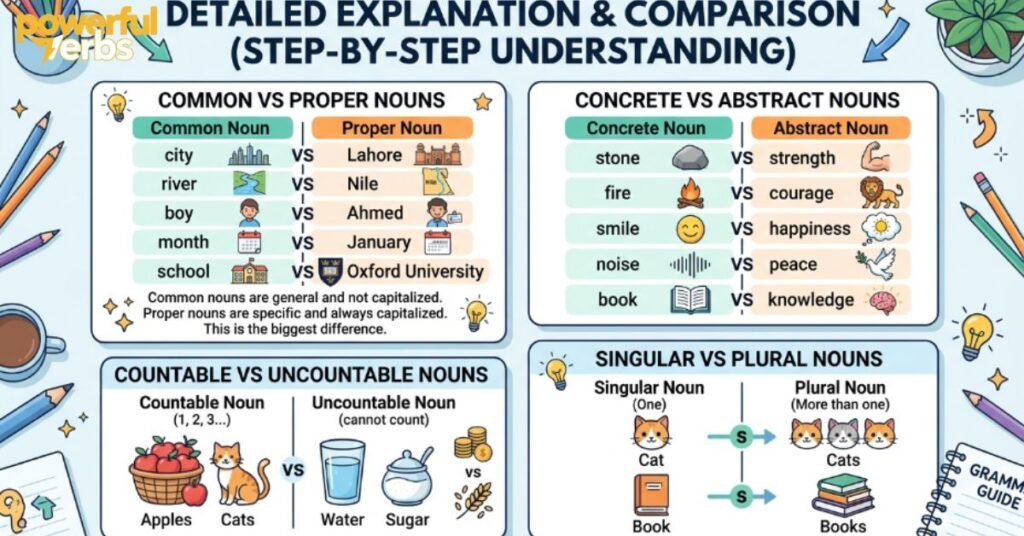
☆ Common vs Proper Nouns
| Common Noun | Proper Noun |
| city | Lahore |
| river | Nile |
| boy | Ahmed |
| month | January |
| school | Oxford University |
Common nouns are general and not capitalized. Proper nouns are specific and always capitalized. This is the biggest difference between the two.
☆ Concrete vs Abstract Nouns
| Concrete Noun | Abstract Noun |
| stone | strength |
| fire | courage |
| smile | happiness |
| noise | peace |
| book | knowledge |
Concrete nouns are things you can experience with your five senses. Abstract nouns are things that exist only in the mind or heart.
☆ Countable vs Uncountable Nouns
| Countable Noun | Uncountable Noun |
| pen/pens | ink |
| apple/apples | juice |
| chair/chairs | furniture |
| coin/coins | money |
| idea/ideas | advice |
Countable nouns can use “a,” “an,” or numbers. Uncountable nouns cannot use a/an or be made plural.
☆ Singular vs Plural Nouns
| Singular | Plural |
| child | children |
| box | boxes |
| leaf | leaves |
| tooth | teeth |
| woman | women |
Most nouns become plural by adding -s or -es, but some have irregular plural forms that you must memorize.
☆ Collective Nouns Explained with Real-Life Examples
A collective noun looks singular but refers to a whole group. For example, “The team is playing well” uses the team as one unit. Common collective nouns include army, crew, class, jury, and flock.
Noun Rules You Must Remember
Capitalization Rules (Proper Nouns)
Always capitalize proper nouns, no matter where they appear in a sentence. Names of people, cities, countries, days, and months are always capitalized. For example, write “Friday,” not “friday,” and “Sara,” not “sara.”
Rules for Making Plurals
Most nouns add -s to become plural, like book → books. Nouns ending in -ch, -sh, -x, -s add -es, like box → boxes. Some nouns have completely different plural forms, like mouse → mice.
Countable vs Uncountable Usage Rules
Use a, an, many, and few only with countable nouns. Use much, less, and some with uncountable nouns. Never say “two waters” or “a piece of furniture” because these are uncountable.
Abstract Nouns Rule (Non-Physical Concepts)
Abstract nouns are usually uncountable and do not use a/an. You cannot say “a happiness” or “two freedoms.” However, some abstract nouns can be countable in certain cases, like “a great idea.”
Examples Section (Practice Learning)

20+ Real-Life Examples Table
| Noun | Type | Example Sentence |
| dog | Common | The dog is barking. |
| Paris | Proper | Paris is a beautiful city. |
| stone | Concrete | He threw a stone. |
| love | Abstract | She feels deep love. |
| apple | Countable | I ate two apples. |
| sugar | Uncountable | Add some sugar. |
| team | Collective | The team won the match. |
| child | Singular | One child is crying. |
| children | Plural | All children are playing. |
| river | Common | The river is clean. |
| Nile | Proper | The Nile is in Africa. |
| music | Concrete | Music fills the room. |
| freedom | Abstract | Freedom is priceless. |
| book | Countable | I read three books. |
| water | Uncountable | Drink more water. |
| class | Collective | The class passed the test. |
| cat | Singular | A cat sat on the mat. |
| cats | Plural | Three cats are sleeping. |
| bread | Uncountable | She bought some bread. |
| army | Collective | The army marched forward. |
| idea | Abstract | That is a great idea. |
| flower | Concrete | The flower smells sweet. |
Sentence-Based Examples for Each Noun Type
- Common Noun: The teacher explained the lesson clearly.
- Proper Noun: Monday is the first school day of the week.
- Concrete Noun: She put the cup on the table.
- Abstract Noun: Patience is a great quality.
- Countable Noun: There are five birds on the roof.
- Uncountable Noun: We need more time to finish.
- Collective Noun: A herd of cows crossed the road.
- Singular Noun: A girl is reading in the library.
- Plural Noun: The students finished their homework.
Common Mistakes & How to Fix Them
Confusing Common vs Proper Nouns
Many students write proper nouns in lowercase, which is wrong. Always remember that the names of specific people, places, and things need a capital letter. Write “I live in Karachi,” not “I live in Karachi.”
Using Uncountable Nouns Incorrectly
Students often say, “Give me some advice” or “I have a lot of homework.” These are wrong because advice and homework are uncountable. The correct forms are “Give me some advice” and “I have much homework.”
Plural Errors
A common mistake is adding -s to irregular nouns. Never write “childs,” “mouses,” or “teeths.” The correct plurals are children, mice, and teeth. Always learn irregular plurals separately.
Misunderstanding Abstract Nouns
Students sometimes confuse abstract nouns with adjectives. For example, “happy” is an adjective, but “happiness” is an abstract noun. Always look for the noun form when writing sentences about feelings or ideas.
Practice Exercises (Learning by Doing)
A) Fill in the Blanks
Fill in each blank with the correct type of noun.
- The __________ (proper noun) is the capital of France.
- She has a lot of __________ (abstract noun) in her heart.
- A __________ (collective noun) of lions is called a pride.
- He drank a glass of __________ (uncountable noun).
- The __________ (plural noun) are playing in the park.
B) Identify the Type of Noun
Write the type of noun for each underlined word.
- Ahmed is my best friend. → ___________
- She has a lot of courage. → ___________
- The flock flew over the mountain. → ___________
- I need some milk. → ___________
- The children laughed loudly. → ___________
C) Sentence Correction Practice
Find and correct the mistake in each sentence.
- I saw two sheeps in the field.
- She gave me an advice about my studies.
- my brother lives in london.
- He has three informations about the case.
- The class are working hard. (Hint: Collective noun = singular verb)
Answer Key
Complete Solutions for Exercises
Fill in the Blanks Answers:
- Paris
- love/kindness
- pride
- water/juice
- children/boys
Identify the Noun Type Answers:
- Ahmed → Proper Noun
- courage → Abstract Noun
- flock → Collective Noun
- milk → Uncountable Noun
- children → Plural Noun
Sentence Correction Answers:
- I saw two sheep in the field.
- She gave me some advice about my studies.
- My brother lives in London.
- He has some information about the case.
- The class is working hard.
Mini Quiz (Test Your Understanding)
10 Short Questions — Mixed Difficulty Level
- What type of noun is honesty?
- Write the plural of leaf.
- Is gold countable or uncountable?
- What type of noun is Islamabad?
- Give one example of a collective noun.
- Correct this: “She has many luggages.”
- What is the abstract noun of the word brave?
- Write a sentence using a proper noun.
- Is team a singular or collective noun?
- Name two uncountable nouns used in daily life.
Quick Answers:
- Abstract Noun
- leaves
- Uncountable
- Proper Noun
- flock, army, team
- She has much luggage.
- bravery
- (Student’s own answer)
- Collective Noun
- water, milk/sugar/air
Creative Learning Activity (For Kids & Beginners)
Fun Writing Task
Write 5 sentences about your school using at least one noun from each type: common, proper, concrete, abstract, and collective. This helps you practice all noun types in a real and meaningful way.
Noun Hunt Activity (Find Nouns in a Paragraph)
Read the paragraph below and circle or list all the nouns you can find. Then write what type each noun is.
“Ali went to the market in Lahore. He bought some sugar, three apples, and a bunch of flowers. His mother felt great happiness when she saw the flowers. A crowd of shoppers filled the busy street.”
Nouns to find: Ali, market, Lahore, sugar, apples, bunch, flowers, mother, happiness, crowd, shoppers, street—see how many types you can identify!
Real-Life Usage of Nouns
How Nouns Are Used in Daily Conversation
We use nouns every single time we speak. When you say “Pass me the salt” or “Call the doctor,” you are using nouns. They make every conversation clear, direct, and easy to understand.
Importance in Writing, Speaking, and Exams
Strong noun knowledge helps you write better essays, give clearer speeches, and score higher marks on English tests. Teachers and examiners always check if students are using nouns correctly in their answers.
Summary / Quick Revision
| Noun Type | Key Feature | Example |
| Common | General name | dog, city |
| Proper | Specific + Capital | Ali, London |
| Concrete | Can be sensed | apple, fire |
| Abstract | Cannot be touched | joy, peace |
| Countable | Can be counted | book, apple |
| Uncountable | Cannot be counted | water, air |
| Collective | Group as one | team, flock |
| Singular | One only | cat, child |
| Plural | More than one | cats, children |
Conclusion
Nouns are the most powerful and most used words in the English language. From simple conversations to academic writing, nouns help us name everything around us and communicate clearly with others.
By learning all nine types of nouns, their rules, and common mistakes, you are building a strong foundation for your entire English grammar journey. Practice daily, review this guide often, and your noun skills will improve fast.
Frequently Asked Questions
What are the different types of nouns with examples?
Nouns are classified into common, proper, abstract, concrete, collective, countable, uncountable, compound, and possessive nouns. For example, a dog is common, London is proper, and happiness is abstract.
What is the difference between a common noun and a proper noun, with examples?
A common noun refers to any general person, place, or thing (e.g., city, teacher), while a proper noun names a specific one and is always capitalized (e.g., Paris, Mr. Smith).
Can you give me examples of abstract nouns used in sentences?
Abstract nouns name ideas, feelings, or qualities you cannot touch. Examples include freedom (“Freedom is priceless”), courage (“She showed great courage”), and love (“Love conquers all”).
What is a collective noun, and how is it used in a sentence?
A collective noun refers to a group of people, animals, or things as a single unit. Examples: a flock of birds, a team of players, and a bunch of grapes—used with either singular or plural verbs depending on context.
What are countable and uncountable nouns, and what are the rules for using them?
Countable nouns can be counted and used with a/an or pluralized (e.g., one apple, two apples), while uncountable nouns cannot be counted or pluralized (e.g., water, advice, furniture). Use much with uncountable nouns and many with countable nouns.
What is a concrete noun, and how is it different from an abstract noun?
A concrete noun refers to something you can physically see, touch, or sense (e.g., a table, rain, or music), whereas an abstract noun refers to something intangible, like an emotion or concept (e.g., sadness or justice).
What are compound nouns, and what are the rules for writing them correctly?
Compound nouns are formed by combining two or more words to create a new noun. They can be written as one word (toothbrush), hyphenated (mother-in-law), or as two separate words (ice cream). Always check a dictionary for the correct form.
What are possessive nouns, and how do you use an apostrophe with them?
Possessive nouns show ownership and are formed by adding ‘s to singular nouns (e.g., the dog’s bone) or just an apostrophe to plural nouns ending in s (e.g., the teachers’ lounge). For irregular plurals, add ‘s (e.g., children’s books).
What is the rule for changing singular nouns to plural nouns in English?
Most nouns become plural by adding -s (e.g., cat → cats), but nouns ending in -s, -sh, -ch, or -x take -es (e.g., bus → buses). Irregular nouns change form entirely, such as man → men and child → children.
How do you identify the type of noun in a sentence for grammar purposes?
To identify a noun type, ask: Is it capitalized and specific? (Proper). Can you touch it? (Concrete vs. Abstract). Does it name a group? (Collective). Can it be counted? (Countable vs. Uncountable). Applying these quick checks helps classify any noun accurately and instantly.

Liam Johnson is a dedicated language expert with 4 years of professional experience. He specializes in Grammar, Vocabulary, and Sentence structure.
