

Introduction: Why This Confusion Happens
English learners often mix up “grammar” and “grammer” because the word sounds like it should end in “-er.” This spelling confusion is one of the most common mistakes made by students and beginners worldwide.
The correct spelling is always grammar—”grammer” does not exist in the English language. Understanding why this confusion happens helps you remember the right spelling forever.
Meaning of Grammar (Core Definition)
What “Grammar” Actually Means in English
Grammar is the complete set of rules that controls how we arrange words to form correct sentences. It covers everything from verb tenses and punctuation to sentence structure and word order.
Why It Is Important in Communication
Without grammar, sentences become confusing and hard to understand. Good grammar makes your writing clear, professional, and easy to read for everyone.
Simple Real-Life Explanation
Think of grammar as the traffic rules of language. Just like traffic rules keep cars moving safely, grammar keeps your sentences moving clearly and correctly.
✔ Correct spelling: grammar ❌ Incorrect spelling: grammer
Spelling Breakdown and Linguistic Reason
Origin of the Word “Grammar”
The word “grammar” comes from the Old French word “gramaire” and the Latin word “grammatica.” Both original forms end in “-ar,” which is why the correct English spelling also ends in “-ar.”
Why “Grammer” Is Not Accepted in English
“Grammer” has never been a valid English word in any dictionary. It is simply a misspelling created by people writing the word the way it sounds to them. No grammar book, style guide, or dictionary accepts “grammer” as correct.
How Pronunciation Leads to Spelling Confusion
When people say the word “grammar” quickly, the ending sounds like “-er” in casual speech. This tricks many learners into writing “grammer” instead of the correct “-ar” ending that the word has always had.
Step-by-Step Understanding
English Works on Rules
English spelling follows rules that come from the word’s origin and history. Many words are not spelled the way they sound, and grammar is a perfect example of this important fact.
Grammar = System of Rules
Grammar itself is a system of rules, and interestingly, it also follows a spelling rule. The word comes from Latin and French roots that both end in “-ar,” so the correct spelling must end in “-ar” too.
We Use Grammar Naturally Every Day
Every sentence you speak or write uses grammar rules automatically. When you say “She is happy” instead of “She is happy,” you are following grammar rules without even thinking about it.
Why People Miswrite It as “Grammer”
The main reason is that English pronunciation does not always match spelling. The “-ar” ending in grammar sounds like “-er” when spoken fast, which causes many learners to make this very common spelling mistake.
Simple Memory Technique to Remember
Use this trick: “A good grammar student gets an A.” The word “grammar” ends in “-ar,” just like the letter “A” that good students want to earn. Say it—gramm-AR—and remember the “A” at the end.
Grammar vs Grammer: Comparison Table
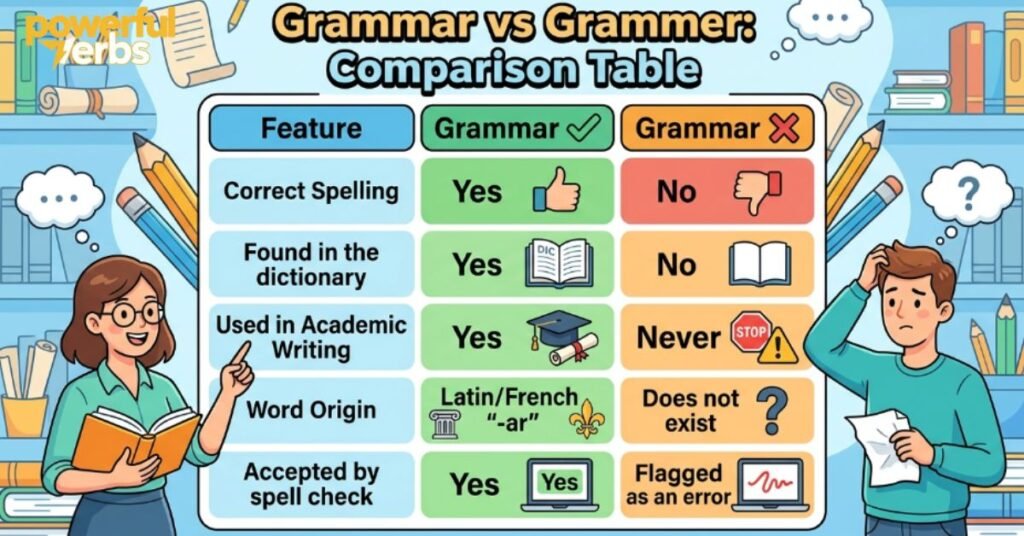
| Feature | Grammar ✔ | Grammer ✗ |
| Correct Spelling | Yes | No |
| Found in the dictionary | Yes | No |
| Used in Academic Writing | Yes | Never |
| Word Origin | Latin/French “-ar” | Does not exist |
| Accepted by spell check. | Yes | Flagged as an error |
Usage Examples Side by Side
| Correct Usage ✔ | Incorrect Usage ✗ |
| She studies grammar every day. | She studies grammer every day. |
| Good grammar improves writing. | Good grammer improves writing. |
| English grammar has many rules. | English grammer has many rules. |
| He passed his grammar test. | He passed his grammer test. |
Common Miswritten Sentences
- ✗ “My grammer is improving.” → ✔ “My grammar is improving.”
- ✗ “Learn basic grammer first.” → ✔ “Learn basic grammar first.”
- ✗ “The grammer book is on the shelf.” → ✔ “The grammar book is on the shelf.”
Common Spelling Patterns in English
Words Ending in “-ar” vs “-er” Confusion
Many English words end in “-ar” but sound like “-er” when spoken aloud. This creates spelling problems for learners who write by sound rather than by rule.
| Correct “-ar” Words | Common Misspelling |
| grammar | grammer |
| calendar | calender |
| collar | coller |
| dollar | doller |
| pillar | piller |
| icular | iculer |
Why English Spelling Feels Inconsistent
English borrows words from Latin, French, German, and Greek, and each language brings its own spelling rules. This is why words like “grammar” look different from how they sound—their spelling comes from a completely different language root.
Rules to Remember the Correct Form
Golden Rule
Always trust the dictionary spelling: “grammar.” Never spell any word by sound alone in English. When in doubt, check a reliable dictionary or spell-checker before submitting your work.
Helpful Learning Patterns
- Pronunciation ≠ spelling in English — just because a word sounds like “-er” does not mean it ends in “-er.”
- Double “m” is standard in grammar—the word always has double m in the middle: gram-mar.
- • The “-ar” ending is fixed — it has never changed since the word entered English centuries ago.
Real-Life Importance of Correct Spelling
Academic Writing
Teachers and professors notice spelling mistakes immediately in essays and reports. Writing “grammer” in an academic paper shows carelessness and can negatively affect your overall grade.
Exams and Assignments
In English exams, spelling carries marks. A simple mistake like writing “grammer” instead of “grammar” can cost you marks that you worked hard to earn throughout the year.
Professional Communication
Emails, reports, and business messages with spelling mistakes look unprofessional. Correct spelling builds trust and shows that you take your work seriously in any professional setting.
Online Content and Messaging
Even in social media posts and online messages, spelling mistakes are noticed. Using correct spelling online shows that you have strong English skills and helps you communicate effectively.
Common Mistakes Learners Make
Writing “Grammer” in Essays
This is the most frequent error found in student essays and homework. Many students have written “grammer” so many times without correction that it has become a habit that is hard to break.
Relying Only on Sound-Based Spelling
English is not a phonetic language, which means spelling by sound is unreliable. Learners who always write words the way they sound will continue making spelling errors like this one throughout their studies.
Ignoring Correction Tools
Spell-checkers in MS Word, Google Docs, and phones automatically flag “grammer” as wrong. Ignoring these red underlines is a bad habit that allows simple spelling mistakes to keep repeating in your writing.
How to Fix This Mistake
Reading Habit Improvement
The more you read books, articles, and textbooks, the more your brain naturally absorbs correct spellings. Seeing grammar spelled hundreds of times correctly trains your memory automatically.
Writing Practice Methods
Write the word “grammar” five times every day for one week. Repetition builds muscle memory and trains your hand and brain to always write the correct spelling without thinking.
Using Spell-Check Effectively
Enable spell-check in every writing tool you use and never ignore its suggestions. When it underlines “grammer” in red, fix it immediately and say the correct spelling out loud to reinforce it.
Learning Root Words
Understanding where a word comes from helps you spell it correctly. Since grammar comes from Latin/French with an “-ar” ending, knowing its root tells you exactly how it must be spelled every time.
Practice Exercises
A) Fill in the Blanks
Fill each blank with the correct word: grammar or grammer.
- English __________ has many important rules.
- She bought a new __________ book yesterday.
- Good __________ helps you write clear sentences.
- My teacher said my __________ needs improvement.
- He is studying __________ for his English exam.
B) Choose the Correct Spelling
Circle the correct spelling in each pair.
- grammar / grammer
- grammer / grammar
- GRAMMAR / GRAMMER
- Grammer / Grammar
- grammarr / grammar
C) Identify Correct Usage in Sentences
Write ✔ for correct and ✗ for incorrect sentences.
- She is learning English grammer. ___
- His grammar is excellent. ___
- We studied grammer in class today. ___
- Grammar rules are easy to learn. ___
- I forgot my grammer notes at home. ___
D) Correct the Mistakes
Rewrite each sentence correctly.
- My grammer teacher is very strict.
- She knows English grammer very well.
- The grammer exercise was too hard.
- He failed the grammer test last week.
- Good grammer is important in writing.
E) Write Your Own Sentences
Write three original sentences using the word grammar correctly in each one.
Answer Key
Full Solutions for All Exercises
Fill in the Blanks Answers:
- grammar
- grammar
- grammar
- grammar
- grammar
Choose the Correct Spelling Answers:
- grammar ✔
- grammar ✔
- GRAMMAR ✔
- Grammar ✔
- grammar ✔
Identify Correct Usage Answers:
- She is learning English grammer. ✗
- His grammar is excellent. ✔
- We studied grammer in class today. ✗
- Grammar rules are easy to learn. ✔
- I forgot my grammer notes at home. ✗
Correct the Mistakes Answers:
- My grammar teacher is very strict.
- She knows English grammar very well.
- The grammar exercise was too hard.
- He failed the grammar test last week.
- Good grammar is important in writing.
Mini Quiz (Self-Test Section)
10 Short Questions — Quick Knowledge Check
- Which spelling is correct: grammar or grammer?
- Where does the word “grammar” originally come from?
- Why do people often misspell it as “grammer”?
- Does the word “grammar” end in “-ar” or “-er”?
- Is “grammer” found in any English dictionary?
- What is the double letter found in the middle of grammar?
- Name one memory trick to remember the correct spelling.
- What does spell-check do when you write “grammer”?
- Give one example of another “-ar” word that sounds like “-er.”
- Write one correct sentence using the word grammar.
Quick Answers:
- grammar ✔
- Latin and Old French
- Because it sounds like “-er” when spoken
- “-ar”
- No, never
- Double “m”—gram-mar
- “gramm-AR—remember the A!”
- It flags it with a red underline as an error
- calendar, collar, dollar
- (Student’s own answer)
Summary (Final Revision Point)
| Point | Detail |
| Correct Spelling | grammar |
| Incorrect Spelling | grammer |
| Word Origin | Latin / Old French |
| Ending | Always “-ar” |
| Double Letter | “mm” in the middle |
| Found in the dictionary | Only “grammar” |
| Memory Trick | gramm-AR → remember the “A.” |
Conclusion
The only correct spelling is grammar—”grammer” is simply a misspelling that no dictionary or style guide has ever accepted. The word comes from Latin and French roots that both end in “-ar,” which is why the correct form will always end in “-ar.”
Now that you know the reason, the rule, and the tricks, you will never misspell this word again. Practice the exercises, use spell-check wisely, and build a strong reading habit to master correct spelling in all your English writing.
Frequently Asked Questions
1. What is the difference between grammar and grammer spelling?
“Grammar” is the correct spelling, referring to the rules of language. “Grammer” is a common misspelling with no valid definition in English.
2. Is it spelled “grammar” or “grammer” when I’m writing about language rules?
Always use “grammar”—it’s the only correct spelling. “Grammer” is a frequent spelling mistake that should be avoided in formal and informal writing.
3. Why do so many people misspell “grammar” as “grammer”?
People misspell it because the “-er” ending feels more natural in English (like “hammer” or “summer”). However, grammar follows a Latin-origin pattern ending in “-ar.”
4. How can I remember the correct spelling of “grammar” and not write “grammer” by mistake?
Use this trick: “Bad grammar will make me mad”—both “grammar” and “mad” end in “-ar” and “-ad.” Or simply remember: GrammAR, not grammER.
5. Does “grammer” mean anything, or is it just a wrong spelling of grammar?
“Grammer” has no meaning in the English language. It is purely a misspelling of grammar, which refers to the structural rules governing a language.
6. Which spelling is accepted in dictionaries—grammar or grammer?
Only grammar appears in English dictionaries like Merriam-Webster and Oxford. “Grammer” is not a recognized word and will be flagged as an error in most spell checkers.
7. Is grammer ever used as a surname or proper noun instead of a spelling error?
Yes—Grammer can appear as a proper noun, most notably as the surname of actor Kelsey Grammer. Outside of names, it is always a misspelling of grammar.
8. What are the most common English words people confuse with grammar that are spelled with an E-R ending?
Words like “hammer,” “stammer,” and “summer” end in “-er,” which leads people to write “grammer.” But “grammar” is derived from the Old French “gramaire,” keeping the “-ar” ending.
9. How does knowing the origin of the word “grammar” help me spell it correctly every time?
Grammar comes from the Greek word “grammatikē” and Latin “grammatica”—both ending in “-a.” Knowing its classical root helps reinforce that the correct ending is “-ar,” not “-er.”
10. Can using wrong spelling like “grammer” instead of “grammar” hurt my SEO or content credibility?
Yes, absolutely. Misspelling grammar as “grammer” damages your content’s credibility, increases bounce rates, and signals low quality to search engines like Google, which can negatively impact your SEO rankings.

Liam Johnson is a dedicated language expert with 4 years of professional experience. He specializes in Grammar, Vocabulary, and Sentence structure.
