

Understanding the difference between legal and illegal is one of the most useful things you can learn in everyday life. These two words guide how people live, work, and interact in society. Knowing them helps you make better decisions.
Introduction
Every day, people make choices, and many of those choices are connected to the law. Whether you are using the internet, driving a car, or buying something, the concept of legal and illegal is always present. Understanding these terms helps you stay safe, act responsibly, and communicate clearly.
Core Definitions
What Does “Legal” Mean?
Something is legal when it is allowed or permitted by the law. It means society, through rules and governments, has agreed that a certain action is acceptable. For example, wearing a seatbelt, paying taxes, and owning a licensed business are all legal activities.
What Does “Illegal” Mean?
Something is illegal when it goes against the law. It is an action that is not allowed and can result in punishment such as fines, arrest, or imprisonment. Stealing, driving without a license, and fraud are all illegal.
Simple Explanation (Easy Understanding)
“Legal” means the law says “yes”—you can do it without fear of punishment. “Illegal” means the law says “no”—doing it can get you in serious trouble. Think of it this way: running a red light is illegal because it breaks a traffic rule, but crossing the street at a proper crosswalk is legal because it follows the rules.
Word Formation & Language Breakdown
Root Word Concept
The word “legal” comes from the Latin word “lex” or “legalis,” which means “law.” It is the base from which many law-related words are formed, such as “legalize,” “legislation,” and “legally.”
Prefix Explanation
The word “illegal” is formed by adding the prefix “il-“ to the word legal. In English, the prefix “il-” means “not.” So illegal simply means “not legal.” Other examples of this prefix include illogical (not logical) and illegible (not readable). Prefixes are powerful because they completely flip the meaning of a word with just a few letters.
Why the Difference Matters in Language
Many people confuse legal and illegal in writing, especially when they use them in the wrong sentence context. For example, saying “it is legal to steal” is factually wrong and linguistically confusing. Using these words correctly shows strong language skills and clear thinking.
Legal vs Illegal: Key Differences
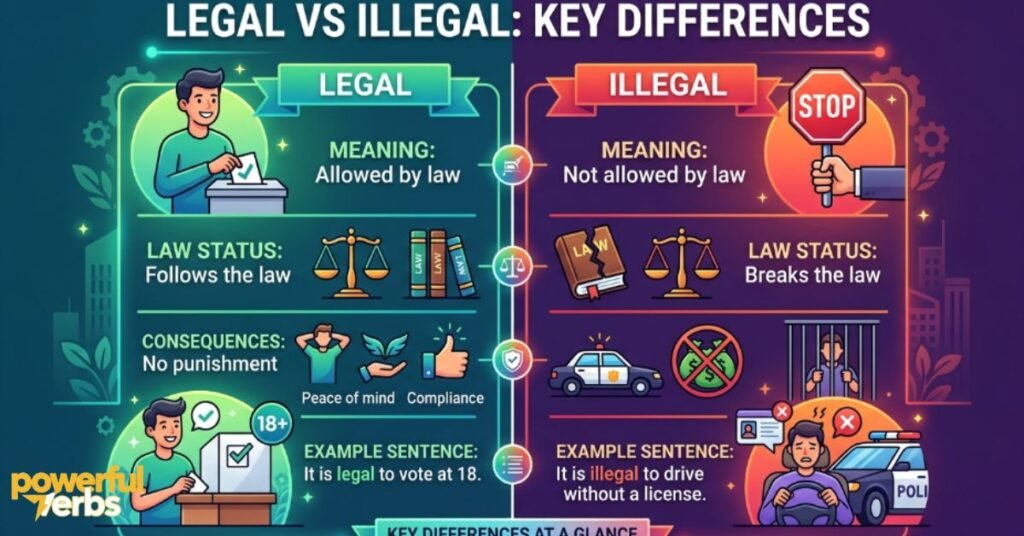
| Feature | Legal | Illegal |
| Meaning | Allowed by law | Not allowed by law |
| Law Status | Follows the law | Breaks the law |
| Consequences | No punishment | Fines, arrest, jail |
| Example Sentence | It is legal to vote at 18. | It is illegal to drive without a license. |
Real-Life Examples
Everyday Life Examples
- Paying for your groceries at the store is legal.
- Walking on a sidewalk is legal.
- Shoplifting (taking items without paying) is illegal.
- Hacking into someone’s computer is illegal.
Legal vs Illegal Activities (Table Format)
| Activity | Legal or Illegal? |
| Wearing a helmet while riding a bike | Legal |
| Driving through a red light | Illegal |
| Paying your electricity bill | Legal |
| Copying someone’s exam answers | Illegal |
| Owning a pet | Legal |
| Poaching wild animals | Illegal |
| Buying medicine from a licensed pharmacy | Legal |
| Selling fake products | Illegal |
| Using a public park | Legal |
| Trespassing on private property | Illegal |
Usage in Sentences
Sentence Structure Patterns
- “It is legal to ___.”
- “It is illegal to ___.”
These are the most common and clear ways to use these words in everyday English.
Example Sentences
- It is legal to park your car in a designated parking zone.
- It is illegal to drive a car without a valid license.
- It is legal to take photos in a public park.
- It is illegal to record someone without their permission in many countries.
- It is legal to start a small business with proper registration.
- It is illegal to sell items without paying the required taxes.
Importance in Real Life
Education System: Students learn about legal and illegal actions to understand rights, responsibilities, and school rules. It builds civic knowledge from a young age.
Law Awareness: Citizens must know basic laws to avoid breaking them. Ignorance of the law is not accepted as an excuse in most legal systems.
Social Responsibility: Knowing what is legal and illegal helps people respect others’ rights. It builds a more peaceful and fair community.
Digital World (Online Legality): In today’s internet age, many actions online can be illegal—like cyberbullying, piracy, or identity theft. Understanding online legality is more important than ever.
Common Mistakes & How to Fix Them
Misusing “legal”/”illegal” in writing: Some writers say “it’s not legal” when they mean “illegal.” While both can be correct, “illegal” is more formal and direct in most situations.
Confusion with “lawful/unlawful”: Lawful and legal are nearly the same, and so are unlawful and illegal. However, “lawful” is often used in more formal or legal documents, while “legal/illegal” is used in everyday speech and writing.
Simple correction tips: Always ask yourself, “Is the action allowed by law?” If yes, use legal. If not, use illegal. Read your sentence aloud—if it sounds wrong, it probably is.
Practice Section
Fill in the Blanks (10 Questions)
- It is ________ to cross the road at a zebra crossing.
- It is ________ to steal from a shop.
- Drinking and driving is ________.
- Paying your taxes on time is ________.
- Hacking into a bank account is ________.
- It is ________ to own a pet cat.
- Selling pirated movies is ________.
- Wearing a seatbelt is ________ and also required.
- Using someone’s password without permission is ________.
- Getting a driver’s license before driving is ________.
(Answers: 1-legal, 2-illegal, 3-illegal, 4-legal, 5-illegal, 6-legal, 7-illegal, 8-legal, 9-illegal, 10-legal)
Choose the Correct Word (5 Questions)
- It is ________ (legal/illegal) to vote in elections.
- Shoplifting is ________ (legal/illegal).
- Driving with a valid license is ________ (legal/illegal).
- Bullying someone online is ________ (legal/illegal).
- Starting a registered business is ________ (legal/illegal).
(Answers: 1-legal, 2-illegal, 3-legal, 4-illegal, 5-legal)
Make Your Own Sentences (5 Tasks)
- Write a sentence using “legal” about school life.
- Write a sentence using “illegal” about something online.
- Write a sentence using “it is legal to…” about food or shopping.
- Write a sentence using “it is illegal to…” about driving.
- Write one sentence with both “legal” and “illegal” in it.
Mini Quiz (Test Your Understanding)
10 Short MCQs:
- What does “legal” mean?
- a) Against the law
- b) Allowed by law
- c) Dangerous
- d) Unknown
- What does the prefix “il-” mean?
- a) Very
- b) Before
- c) Not
- d) With
- Which of these is illegal?
- a) Paying for a movie ticket
- b) Copying a movie without permission
- c) Watching a movie at home
- d) Buying a movie online
- “It is ________ to drive without a license.”
- a) Legal
- b) Illegal
- c) Useful
- d) Safe
- Which word is the opposite of “legal”?
- a) Lawful
- b) Illegal
- c) Formal
- d) Allowed
- Where does the word “legal” come from?
- a) French
- b) Greek
- c) Latin
- d) German
- Which activity is legal?
- a) Owning a registered car
- b) Selling fake medicine
- c) Hacking a website
- d) Stealing electricity
- What is the correct sentence?
- a) It is illegal to pay taxes.
- b) It is illegal to steal.
- c) It is legal to cheat.
- d) It is illegal to vote.
- “Lawful” is most similar in meaning to:
- a) Illegal
- b) Criminal
- c) Legal
- d) Unlawful
- Which of these is an illegal online activity?
- a) Sending an email
- b) Hacking someone’s account
- c) Watching YouTube
- d) Downloading a free app
Creative Learning Activity
Story Builder Exercise
Task: Write a short story (5–8 sentences) using the words “legal” and “illegal” at least once each. Your story should show what happens when someone makes a legal choice and what happens when someone makes an illegal choice. You can write about a character at school, in a store, or online. Share your story with a classmate and discuss!
Example starter: “One day, Sara found a wallet on the ground. She had two choices…”
Summary / Key Takeaways
- Legal means something is allowed by law, while illegal means it is not allowed and can lead to punishment.
- The word “illegal” uses the prefix “il-,” which means “not,” making it the direct opposite of “legal.”
- Knowing the difference helps in school, daily life, online safety, and social responsibility.
- Always think before you act: Is this allowed by law? If yes, it is legal. If not, it is illegal.
Related Legal Vocabulary
| Word | Meaning |
| Lawful | Permitted by law (formal use) |
| Unlawful | Against the law (formal use) |
| Legal rights | Things you are allowed to do by law |
| Penalty | Punishment for breaking the law |
| Legislation | A set of laws made by the government |
| Jurisdiction | The area or range where a law applies |
| Offense | A legal term for breaking the law |
| Compliance | Following rules and laws properly |
Conclusion
“Legal” and “illegal” are two simple but powerful words that shape how society works. Understanding them gives you the knowledge to make smart, safe, and responsible choices in everyday life. The more clearly you understand the law, the better you can protect yourself and respect others around you.
Frequently Asked Questions
1. What is the main difference between something being legal and something being illegal?
Something is legal when it’s permitted or authorized by the laws of a country or region, while something is illegal when it’s prohibited by law and can result in penalties, fines, or imprisonment.
2. How do I know if an action I’m about to take is legal or illegal in my country?
You can check your local laws, consult a licensed attorney, or visit your government’s official legal website—because what’s legal in one country may be completely illegal in another.
3. Can something be morally wrong but still completely legal under the law?
Yes, many actions can be morally or ethically wrong yet perfectly legal—such as lying to a friend or breaking a promise—because laws are written by governments, not based solely on personal ethics.
4. What happens to a person when they are caught doing something illegal?
When someone is caught doing something illegal, they may face arrest, criminal charges, fines, community service, or imprisonment, depending on the severity of the offense and the laws of their jurisdiction.
5. Why do legal and illegal boundaries change from one country to another?
Legal and illegal boundaries differ across countries because each nation creates its own laws based on its culture, religion, history, and governance—for example, cannabis is legal in Canada but illegal in many other nations.
6. Is it possible for something that used to be illegal to become legal over time?
Absolutely — laws evolve with society, and many things once illegal, like interracial marriage or same-sex relationships in various countries, have become legal through legislative reform or court rulings.
7. What is the difference between a civil illegal act and a criminal illegal act?
A criminal illegal act is an offense against the state, punishable by jail or fines (like theft or assault), while a civil illegal act involves disputes between individuals—such as breach of contract—typically resolved through compensation rather than imprisonment.
8. How does ignorance of the law affect whether something is considered legal or illegal?
Ignorance of the law is generally not accepted as a legal defense—meaning if you unknowingly break a law, you can still be held legally responsible, which is why knowing your local laws matters.
9. Can a business activity be legal in one state but illegal in another state within the same country?
Yes, especially in countries like the United States, where state laws differ—for instance, certain gambling activities, firearms regulations, or recreational substances may be legal in one state but illegal in another.
10. What is the simplest way to explain the difference between legal and illegal to a child?
The simplest way is to say: legal means allowed by the rules everyone must follow, and illegal means breaking those rules in a way that can get you into serious trouble with the police or courts.

Liam Johnson is a dedicated language expert with 4 years of professional experience. He specializes in Grammar, Vocabulary, and Sentence structure.
