

Introduction
Texting slang is everywhere now — in DMs, comment sections, stories, and group chats. Every few months, a new short form takes over, and if you are not up to date, it can feel confusing. ICL is one of those words that suddenly started showing up everywhere and left a lot of people wondering what it actually means.
If you saw ICL in a message and had no idea what to make of it, you are in the right place. This guide covers everything — the full form, the meaning, real examples, how to reply, and much more. By the time you finish reading, ICL will feel like a word you have always known.
ICL Meaning in One Line (Quick Answer for Featured Snippet)
ICL means “I Can’t Lie”—it is used in texting and social media to express honesty, share a real opinion, or admit something genuine about a feeling or situation.
What Does ICL Mean in Text?
ICL stands for “I Can’t Lie.” It is one of the most honest things you can say in a text. When someone uses ICL, they are dropping the act and telling you exactly how they feel—no filter, no exaggeration, just the truth.
Think of it like a signal that says, “What I am about to tell you is real.” It works the same way as saying “to be honest” or “not gonna lie” in a regular conversation, just way shorter and more casual. People use it to give compliments, admit mistakes, share opinions, or react to something that genuinely surprised them.
Full Form of ICL
| Short Form | Full Form | Used For |
| ICL | I Can’t Lie | Honesty, real opinions, genuine reactions |
Origin of ICL Slang
ICL did not come out of nowhere. It grew out of African-American Vernacular English (AAVE), which has given the internet a huge number of popular slang words over the years. Phrases like “I can’t lie” have been used in everyday Black American speech for decades as a way of emphasizing truth and being real with someone.
As social media platforms like Twitter, Vine, and later TikTok and Instagram grew, AAVE phrases started spreading fast across the internet. By the late 2010s, “I Can’t Lie” had been shortened to ICL and was being used by people all over the world. Today, it is a mainstream texting term that most young people recognize instantly.
Different Meanings of ICL (If Any)
In almost every case, ICL means “I Can’t Lie.” That is the standard and widely accepted meaning across all platforms and age groups. However, in very rare and specific contexts, a few alternative meanings exist—though none of them are common or widely used.
| Meaning | Context |
| I Can’t Lie | Most common—texting, social media, DMs |
| In Case Later | Very rare, rarely used |
| I Could Laugh | Extremely rare, not a standard meaning |
How Is ICL Used in Chat?
ICL is super flexible. You can place it at the very start of a sentence or drop it in the middle. It acts like a truth stamp — whatever comes after ICL is meant to be taken seriously as a genuine thought or feeling.
It works in so many different chat situations. You can use it when you want to compliment someone without it sounding fake. You can use it when you need to admit something awkward. You can use it when something surprises you, and you want to react honestly. It adds a layer of realness to whatever you are saying, which is why people love it.
ICL Meaning in Different Situations
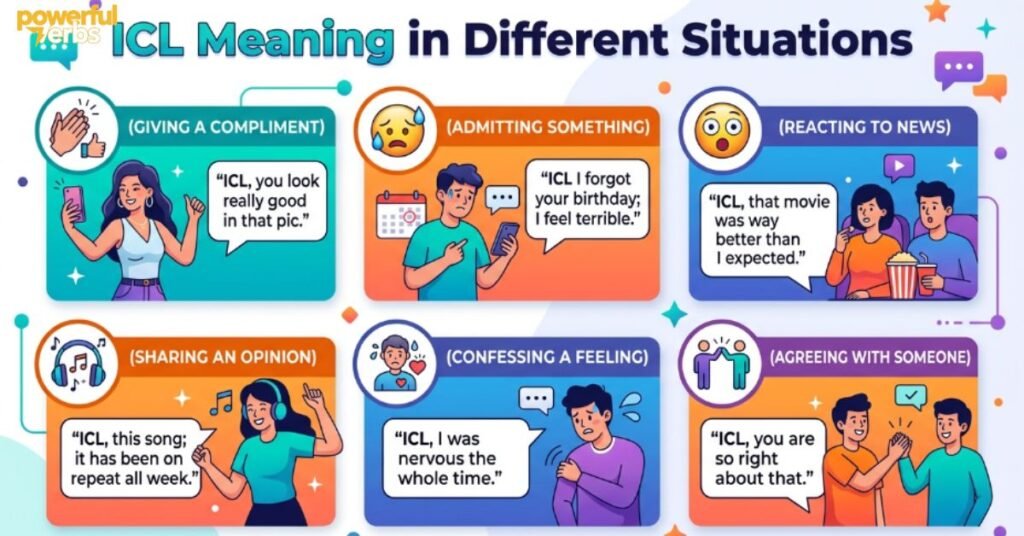
| Situation | Example |
| Giving a compliment | “ICL, you look really good in that pic.” |
| Admitting something | “ICL I forgot your birthday; I feel terrible.” |
| Reacting to news | “ICL, that movie was way better than I expected.” |
| Sharing an opinion | “ICL, this song; it has been on repeat all week.” |
| Confessing a feeling | “ICL, I was nervous the whole time.” |
| Agreeing with someone | “ICL, you are so right about that.” |
What Does ICL Mean to a Girl / Boy?
ICL means the same thing regardless of who sends it. When a girl uses ICL, she is being genuinely open — whether she is complimenting you, admitting something, or reacting to a situation. When a boy uses ICL, it carries the same weight of honesty and realness.
The meaning does not change based on gender. What matters is the context of the sentence that follows ICL. If someone says, “ICL I love spending time with you,” that is a sincere and warm message, no matter who sends it. ICL is just an honest word—it belongs to everyone.
Is ICL Rude or Polite?
ICL is not rude at all. It is actually one of the more positive slang words in texting because it is rooted in honesty. Using ICL shows that you are being real with someone, which is generally a good thing in any friendship or relationship.
The only time ICL might feel slightly awkward is if what follows it is too blunt or harsh. But that is not about the word itself—it is about the message. ICL on its own is casual, friendly, and sincere.
When Should You Use ICL?
- When you want to give someone a genuine, heartfelt compliment
- When you are admitting something you feel a little embarrassed about
- When you want to share a strong, honest opinion about something
- When something surprises you, and you want to react authentically
- When you want the other person to know you are being completely real
- When you agree with someone deeply and want to show it
When Should You NOT Use ICL?
ICL is a casual slang word, and it belongs in casual conversations only. There are clear situations where using it would be a mistake and could make you look unprofessional or careless.
Avoid ICL in work emails, messages to your boss or teacher, school assignments, job applications, or any kind of formal writing. In those situations, always replace ICL with proper phrases like “to be honest,” “frankly,” or “I must admit.” Knowing when not to use slang is just as important as knowing how to use it.
ICL Meaning in Chat Examples
- “ICL, that test was so hard; I blanked on half of it.”
- “ICL I cried at that movie, and I am not ashamed.”
- “ICL, your cooking is actually incredible.”
- “ICL, I have been really stressed lately.”
- “ICL, I did not expect to enjoy that at all.”
- “ICL, she handled that situation really well.”
ICL in Sentences (Simple Examples)
- “ICL, this is the best pizza I have ever had in my life.”
- “ICL, I had no idea you were that talented.”
- “ICL, I miss those days more than I expected.”
- “ICL, that comeback was kind of impressive.”
- “ICL, I would have done the same thing in your position.”
Real Conversation Examples Using ICL
Example 1 — Reacting to a show: Alex: Did you watch the new episode last night? Sam: Yes, omg, ICL, I was not ready for that ending at all. Alex: Right?? I had to rewatch it twice.
Example 2 — Giving a compliment: Riya: How do I look in this dress? Zara: ICL, you look absolutely stunning. This is your best outfit ever. Riya: Okay, stop. You are making me blush.
Example 3 — Relating to someone: Jordan: I stayed up till 3 am studying and still feel unprepared. Chris: ICL, the same; I don’t even remember what I read after midnight. Jordan: Why do we do this to ourselves every time?
Example 4 — Admitting something: Priya: You seemed quiet at the party yesterday. Noor: ICL, I was really anxious the whole time; big crowds stress me out. Priya: I had no idea. I would have stayed with you.
ICL Meaning on WhatsApp
On WhatsApp, ICL is mostly used in personal one-on-one chats and group conversations with close friends. It adds a layer of sincerity to messages and makes what you are saying feel more personal and trustworthy. WhatsApp conversations tend to be more private and emotional, so ICL fits right in when someone is opening up or being real about something.
ICL Meaning on Instagram
On Instagram, ICL appears a lot in comment sections. People drop it under photos and reels to give genuine reactions—things like “ICL this pic goes so hard” or “ICL I needed this today.” It stands out in comment sections because it feels more real than generic responses like “so cute” or just dropping emojis.
ICL Meaning on Snapchat
Snapchat is built on quick and casual communication, and ICL fits that energy perfectly. People use it in snap replies and DMs when they want to react honestly to something. Since Snapchat messages disappear, the conversations tend to feel even more private and raw—making ICL a very natural fit there.
ICL Meaning in Text Messages
In regular SMS text messages, ICL is used between close friends who text each other casually every day. It makes messages feel more personal and direct. When your friend texts you, “ICL I really needed that conversation,” they are telling you that the moment meant something real to them.
Best Replies to ICL
When someone sends you ICL, they are being vulnerable and honest. The best thing you can do is match that energy. Do not brush it off or ignore the honesty—acknowledge it and keep the conversation going in a genuine way. A warm, real reply always lands better than a cold or dismissive one.
How to Respond to ICL in Chat
- “Facts, I feel the same way.”
- “Thank you for being real with me, seriously.”
- “ICL, I needed to hear that too.”
- “I appreciate the honesty; it means a lot.”
- “That is so valid; I completely get it.”
- “Real ones always keep it honest; I respect that.”
Funny Replies to ICL
- “Okay, bestie, the truth really does always come out.”
- “You really said that out loud, and I respect it.”
- “ICL the same; we are literally the same person in different fonts.”
- “The honesty jumped out, and I am here for it.”
Smart & Polite Responses
- “That means a lot coming from you, genuinely.”
- “Real talk, I feel the same way about it.”
- “Same here, no cap whatsoever.”
- “You did not have to say that, but I am so glad you did.”
Similar Slang Words Like ICL
ICL is not the only honest slang in texting. There is a whole family of words that people use to signal they are being real. Some are older, some are newer, but they all carry a similar spirit of dropping the mask and saying what you actually mean.
ICL vs Other Slang (FR, NGL, IMO)
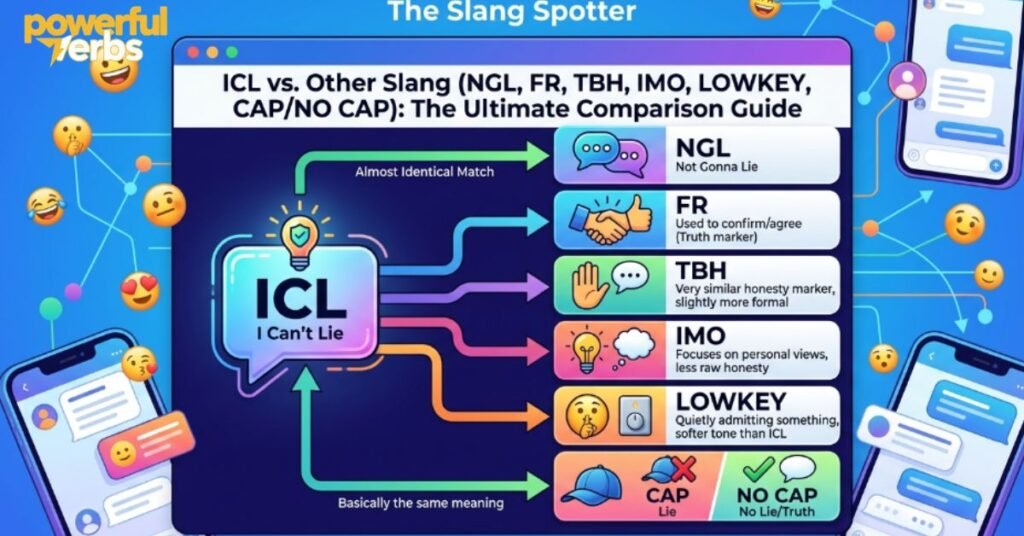
| Slang | Full Form | Similarity to ICL |
| NGL | Not Gonna Lie | Almost identical—the closest match to ICL |
| FR | For Real | Used to confirm or agree with something true |
| TBH | To Be Honest | Very similar honesty marker, slightly more formal |
| IMO | In My Opinion | More about personal views, less about raw honesty |
| LOWKEY | Low Key | Quietly admitting something, softer tone than ICL |
| CAP / NO CAP | Lie / No Lie | “No cap” is basically the same as ICL in meaning |
Alternatives to ICL in Chat
If you want to say something similar without using ICL, here are easy replacements that carry the same meaning: NGL, TBH, FR FR, Lowkey, No Cap, Not gonna lie, Real talk, Honestly though, I will be real with you.
Is ICL Popular in 2025–2026?
Yes, ICL is absolutely still popular in 2025 and remains widely used going into 2026. Unlike some slang words that burn bright for a few months and then disappear, ICL has proven to have real staying power. It fills a genuine need in texting — a short and easy way to signal honesty — which is why it has not faded out.
TikTok comment sections, Instagram DMs, Twitter threads, and Snapchat conversations all still use ICL regularly. It has moved from being a trendy new word to a stable part of everyday online communication for Gen Z and younger millennials.
Who Uses ICL the Most?
ICL is most popular among teens and young adults between the ages of 13 and 25. Gen Z users on TikTok, Snapchat, and Instagram are the biggest users of this slang. However, as with most internet slang, it has slowly spread to older age groups too—especially millennials who spend a lot of time on social media.
It is also more common in informal, close-knit conversations. You are more likely to see ICL between best friends or in group chats than in conversations between acquaintances or coworkers.
Common Mistakes When Using ICL
- Using it in formal messages, emails, or schoolwork is always a big mistake
- Overusing it in every single sentence until it loses all meaning
- Confusing ICL with similar-looking abbreviations like ICU (I See You) or IRL (In Real Life)
- Using it sarcastically without context—it can confuse the other person
- Spelling it lowercase as “icl” in situations where it feels too casual even for the tone
Tips to Use Slang Correctly in Conversations
- Only use slang with people who are familiar with it—never with teachers, bosses, or older family members who may not understand
- Match the tone and energy of the person you are texting—if they are being formal, stay formal.
- When in doubt, write the full phrase—”I can’t lie” is always clear and never confusing.
- Do not force slang into a sentence just to sound cool—it should flow naturally.
- Read the room—slang that works in a funny group chat might feel off in a serious one-on-one conversation.
Can ICL Be Used in Formal Writing?
No. ICL has no place in formal writing of any kind. This includes school essays, college applications, professional emails, business reports, cover letters, and official documents. In formal writing, always replace ICL with proper phrases like “To be honest,” “Frankly speaking,” “I must admit,” or “In all honesty.” Using slang in formal writing makes you look unprepared and careless, no matter how good the rest of your content is.
Conclusion
ICL means “I Can’t Lie” — a short and powerful slang used across texting and social media to express genuine honesty. Whether someone is complimenting you, confessing a feeling, or sharing a strong opinion, ICL is their way of saying that what comes next is completely real and unfiltered.
Now that you know the full meaning of ICL, where it came from, how to use it in different situations, and how to reply when someone sends it to you, you are fully up to speed. Use it naturally, keep it in casual spaces, and remember—the best conversations are always the honest ones.
Frequently Asked Questions
1. What does ICL mean when someone sends it to you in a text message?
ICL stands for “I Can’t Lie” in texting — it’s used to express honesty or emphasize that someone is being genuine about their feelings or opinion.
2. How do you use ICL in a text conversation naturally?
You use “ICL” before a statement you want to sound honest about, like “ICL, that movie was actually really good”—it signals you’re dropping any pretense and speaking from the heart.
3. Is ICL the same as saying “to be honest” or “TBH” in a text?
Yes, ICL is very similar to TBH (To Be Honest)—both signal sincerity, but ICL carries a slightly stronger, more emphatic tone, as if the person really can’t hold back what they’re feeling.
4. What are some everyday examples of ICL used in a real text message?
Common examples include “ICL, I missed you so much,” “ICL, that was hilarious,” or “ICL, I didn’t expect that at all”—all used to stress that the speaker is being completely truthful.
5. How should you reply when someone texts you ICL in a message?
When someone uses ICL, they’re being vulnerable or genuine, so a warm and matching reply works best—something like “Aww, same honestly” or “ICL, I feel the same way” keeps the conversation real.
6. Is ICL used more on Snapchat, Instagram, or iMessage compared to other platforms?
ICL is popular across all major messaging platforms, including Snapchat, Instagram DMs, iMessage, and WhatsApp—it’s especially common among Gen Z users who value authentic, unfiltered communication.
7. Can ICL ever be used sarcastically or in a funny way in texts?
Absolutely—ICL is often used sarcastically for humor, like “ICL I love waking up at 5 am” to mean the opposite, which is why reading the tone and context of the message is always important.
8. Does ICL have any other meanings besides “I Can’t Lie” in digital communication?
In rare contexts, ICL can also stand for “I Couldn’t Laugh” (meaning something wasn’t funny) or refer to technical terms like “Implantable Collamer Lens” in medical texts—but in casual texting, “I Can’t Lie” is by far the most common meaning.
9. Is it okay to use ICL in professional or semi-formal text messages?
No—ICL is strictly informal slang best kept for casual chats with friends or social media. In professional or semi-formal messages, it’s better to write out “To be honest” or “Honestly” in full.
10. How is ICL different from other honesty slang like NGL, TBH, and ISTG in texting?
While NGL (Not Gonna Lie), TBH (To Be Honest), and ISTG (I Swear To God) all express truthfulness, ICL feels more spontaneous and emotionally driven—it’s the one you reach for when a feeling just bursts out naturally.

Liam Johnson is a dedicated language expert with 4 years of professional experience. He specializes in Grammar, Vocabulary, and Sentence structure.
