

Introduction
“In effect” and “in affect”—one tiny letter difference, but a huge grammar mistake. Millions of people mix these two phrases every single day in emails, essays, and professional writing.
This guide breaks down the real difference, shows you exactly when to use each one, and gives you simple tricks so you never get it wrong again.
Quick Answer
“In effect” is the correct phrase to use in almost every situation. It means something is active, true, or officially in force. “In affect” is almost always incorrect and should not be used in standard writing.
✅ The new rule is in effect starting Monday.
❌ The new rule is in affect starting Monday.
What Is the Difference Between “Effect” and “Affect”?
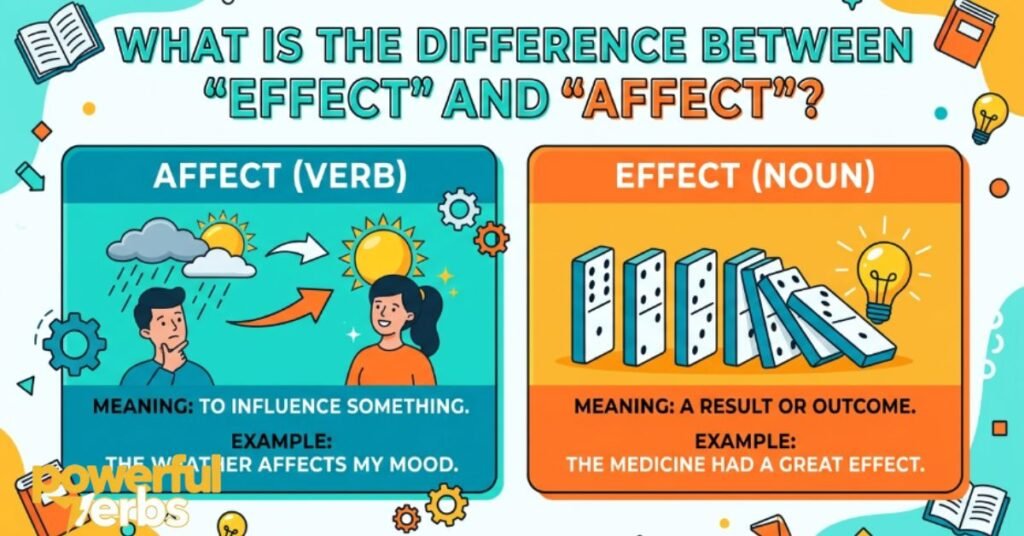
Before diving deep, you need to understand the root words first. This is the foundation that makes everything else easy.
“Effect” is a noun. It means a result, outcome, or something active. Affect is a verb. It means to influence or have an impact on something.
| Word | Part of Speech | Meaning | Example |
| Effect | Noun | A result or outcome | The medicine had a great effect. |
| Affect | Verb | To influence something | The weather affects my mood. |
They sound similar but work very differently in a sentence. Mixing them up is one of the most common grammar mistakes in English writing.
Correct Usage: In Effect
Meaning and Proper Use
“In effect” is a phrase that means something is currently active, functioning, or in force. It is also used to mean “essentially” or “basically” when explaining something.
It works perfectly in legal writing, formal notices, news reports, and everyday conversation. Anytime something is officially happening or practically true, “in effect” is your go-to phrase.
Examples in Sentences
- The new traffic law is in effect as of January 1st.
- The company’s dress code has been in effect for three years.
- By saying nothing, she was, in effect, agreeing with the decision.
- The curfew will remain in effect until further notice.
- He was, in effect, running the entire department on his own.
Incorrect Usage: In Affect
Why “In Affect” Is Usually Wrong
“In affect” is not a standard English phrase. Most of the time, people write “in affect” when they actually mean “in effect.” This is simply a spelling error caused by the confusion between the two root words.
There is no common idiom or expression called “in affect” in everyday English. If you write it in a formal email, essay, or report, it will look like a grammatical mistake to any careful reader.
Common Misunderstanding
Many people think “affect” and “effect” are just two ways to spell the same word. They are not — they are completely different words with different jobs in a sentence.
The phrase “in effect” is built on the noun “effect.” Since “affect” is a verb, it cannot form the same kind of phrase. Think of it this way: you would not say “in run” instead of “in motion.” The same logic applies here.
The Origin of “Effect” and “Affect”
Both words come from Latin roots, which is part of why they are so easy to confuse. Understanding where they came from helps you remember the difference.
- “Effect” comes from the Latin word “effectus,” meaning “accomplishment” or “result.”
- “Affect” comes from the Latin word “affectare,” meaning “to strive after” or “to influence.”
They entered the English language through Old French and have been used separately for centuries. The confusion grew as English spelling became more standardized and the two words sounded nearly identical in speech.
British English vs American English Usage
Whether Usage Differs by Region
Good news — this one is simple. Both British English and American English use “in effect” in the same way. There is no regional difference in how this phrase is used or spelled.
Whether you are writing for a UK audience or a US audience, “in effect” is always correct. “In effect” is considered wrong in both versions of English.
Formal vs Informal Differences
In formal writing, “in effect” often appears in legal documents, government notices, and academic papers. In informal writing, people use it in everyday conversation to mean “basically” or “essentially.”
Both uses are perfectly correct. The phrase works across all levels of formality without any change in meaning or spelling.
Which One Should You Use?
You Should Always Use “In Effect” When:
- A rule, law, or policy is officially active
- You want to say something is “basically true” in simpler terms
- You are writing in a legal or formal context
- You are describing something that is currently in force
- You are explaining a practical reality in everyday language
You Should NOT Use “In Affect” Unless:
- You are writing in academic psychology about emotional “affect” as a clinical term
- A psychology textbook specifically uses it in a technical phrase
- You are quoting a clinical definition word for word
Outside of psychology research papers, “in affect” has almost no place in correct English writing. When in doubt—always choose “in effect.”
Common Mistakes with “In Effect” or “In Affect”
These are the most common errors writers make — and most of them happen without the writer even noticing.
- Writing “in affect” when describing a law or rule that is active
- Using “affect” and “effect” as if they mean the same thing
- Assuming the phrase changes based on context when it does not
- Confusing “affect” as a noun (psychology term) with the everyday meaning
- Autocorrect is changing “effect” to “affect” without the writer catching it
How to Avoid This Mistake
Simple Memory Tricks
The easiest trick is the RAVEN rule:
Remember — Affect is a verb, and Effect is a noun.
Another trick: think of FACE—For Affect use a Comma before a verb, for example.
Or simply remember: “The effect affected everything.” Effect = action. Affect = action.
Grammar Tips
- If you can replace the word with “result,” use “effect.”
- If you can replace the word with “influence,” use “affect.”
- If you are writing a phrase starting with “in ___”—almost always use “in effect”
- Read the sentence aloud and ask, “Is this a thing or an action?”
Corrections & Fixes
These before-and-after examples show exactly how the mistake looks—and how to fix it:
| ❌ Wrong | ✅ Correct |
| The new policy is in affect. | The new policy is in effect. |
| The ban was put in affect last week. | The ban was put into effect last week. |
| The rule remains in affect until Monday. | The rule remains in effect until Monday. |
| In affect, he was the boss all along. | In effect, he was the boss all along. |
| The law went in affect immediately. | The law went into effect immediately. |
In Effect or In Affect in Everyday Examples
Emails
✅ “Please note that the new working hours are in effect starting this Monday.”
❌ “Please note that the new working hours are in affect starting this Monday.”
Workplace Notices
✅ “The updated safety policy is now in effect for all departments.”
This is one of the most common places the mistake appears. Always double-check formal workplace writing before sending.
News Reports
✅ “A statewide travel ban is in effect following the severe weather warning.”
News writing demands precision. Journalists use “in effect” constantly to report on active rules, bans, or situations.
Legal Writing
✅ “The agreement shall remain in effect until terminated by either party.”
In legal documents, this phrase carries real weight. Using “in affect” here would be a serious professional error.
Academic Writing
✅ “The regulation has been in effect since the study was conducted.”
Academic writers need to be especially precise. Outside of psychology, “in affect” should never appear in any academic paper.
Comparison Table: In Effect vs In Affect
| Feature | In Effect ✅ | In Affect ❌ |
| Correct phrase? | Yes | Rarely |
| Root word | Effect (noun) | Affect (verb) |
| Common usage | Laws, rules, facts | Rare/incorrect |
| Formal writing | Always correct | Avoid completely |
| Legal context | Standard phrase | Major error |
| Academic context | Correct | Only in psychology |
| Everyday speech | Natural and clear | Sounds wrong |
| Autocorrect risk | Low | High — easy typo |
Google Trends & Usage Insights
Which Phrase Is Searched More
“In effect” is searched thousands of times more than “in affect” every single month worldwide. Most searches for “in affect” are from people trying to find out if it is correct—and the answer is almost always no.
Google’s data shows that “in effect” dominates in formal writing, news content, and legal documents across all English-speaking countries. “In affect” barely registers as a real phrase in published content.
Real Usage Patterns
In a search of published books, newspapers, and websites, “in effect” appears millions of times. “In affect” appears mostly in grammar correction articles, question forums, and error examples.
The data is clear: professional writers, editors, and journalists rarely use “in affect.” It is largely a mistaken phrase rather than a real expression.
Quick Summary
| Question | Answer |
| Which is correct? | In effect ✅ |
| Can I say “in affect”? | Almost never ❌ |
| What does “in effect” mean? | Active, in force, or basically true |
| What part of speech is “effect”? | Noun |
| What part of speech is “affect”? | Verb |
| Is there a regional difference? | No—both British and American English use “in effect” |
| Best memory trick? | RAVEN — Affect = Verb, Effect = Noun |
| When is “in affect” ever okay? | Only in clinical psychology (rare) |
Conclusion
“In effect” is the correct phrase, and it is the one you should use every single time — in emails, essays, legal documents, and everyday writing. “In affect” is almost always a mistake, and now you know exactly why.
Remember the RAVEN rule: check your writing before you send it, and share this guide with anyone who still mixes these two up. One small grammar fix can make your writing look sharp, professional, and trustworthy.
Frequently Asked Questions
1. What is the difference between “in effect” and “in affect” in English grammar?
“In effect” is the correct phrase, meaning something is active or operative. “In affect” is almost always a grammatical error, as “affect” is typically a verb or noun related to emotion, not used in this prepositional phrase.
2. When should I use “in effect” in a sentence?
Use “in effect” when describing something that is currently active, functioning, or in force—for example, “The new policy is in effect starting Monday.” It signals that a rule, law, or condition is operational.
3. Is it ever grammatically correct to say “in affect”?
No, “in affect” is not a standard grammatical phrase in English. The correct expression is always “in effect.” Confusing the two is one of the most common affect vs. effect mistakes among writers.
4. How do I remember whether to use “affect” or “effect” in everyday writing?
A simple trick: affect is usually the action (verb), and effect is the result (noun). So the phrase “in effect” uses the noun form, making “effect” the correct choice every single time.
5. What does “in effect” actually mean when used in a sentence?
“In effect” means something is currently in place, active, or producing real results. It can also mean “in practice” or “essentially”—for example, “He was, in effect, running the entire company by himself.”
6. Can “affect” ever be used as a noun, and does that change the rule about “in affect”?
Yes, “affect” can be a noun in psychology, referring to an emotional state or expression. However, even in that context, the phrase “in affect” is not used. The prepositional expression always remains “in effect.”
7. What are the most common mistakes people make with “in effect” vs “in affect”?
The most common mistake is writing “in affect” instead of “in effect” due to confusion between the two homophones. Since both words sound similar when spoken, many people swap them without realizing it, especially in informal writing and emails.
8. How do I use “in effect” correctly in a formal or professional document?
In formal writing, use “in effect” to indicate that a policy, law, or agreement is currently active—for example, “The revised terms will be in effect as of January 1st.” Always double-check that you’ve used “effect,” not “affect.”
9. Are there any examples of sentences where “in effect” changes the meaning if you swap it with “in affect”?
Yes — “The curfew is in effect” clearly means the curfew is active. Writing “the curfew is in affect” produces a grammatically incorrect sentence that confuses the reader and undermines your credibility in professional or academic writing.
10. What is the quickest way to check if I’m using “effect” or “affect” correctly before publishing my content?
Ask yourself: Is the word acting as a verb (action)? Use affect. Is it acting as a noun (result or thing)? Use effect. For the phrase “in ___,” always choose effect — it is the only grammatically accepted form in standard English.

Liam Johnson is a dedicated language expert with 4 years of professional experience. He specializes in Grammar, Vocabulary, and Sentence structure.
