

Many people write “disregulated” when they actually mean “dysregulated.” This is one of the most common spelling mistakes in psychology, health, and academic writing. Getting it wrong can make your work look unprofessional.
This article clears up the confusion once and for all. You will learn the correct word, why the wrong one feels right, and how to never mix them up again.
Introduction: Why This Confusion Matters More Than You Think
Quick context
The words “dysregulated” and “disregulated” look almost the same, but only one of them is real. This small spelling difference causes big problems in medical reports, school papers, and health content online.
Why this mistake is common but important to fix
Most people learn words by sound, and both versions sound nearly identical when spoken. But in writing, especially in professional or academic work, using the wrong form shows a lack of language accuracy. It matters more than it seems.
The Core Difference You Need to Know
Simple side-by-side explanation
“Dysregulated” is the correct, dictionary-approved word. “Disregulated” is a misspelling that does not exist in any standard dictionary. The prefix is what changes everything.
One-line clarity
Dysregulated = real word. Disregulated = spelling mistake.
What Does “Dysregulated” Mean? (Clear & Practical Definition)
Plain-English Definition
“Dysregulated” means something is not working properly or is out of normal control. It describes a system, emotion, or function that has gone out of balance.
Understanding the Prefix: Why “Dys” Changes Everything
The prefix “dys” comes from Greek and means “bad,” “difficult,” or “abnormal.” When you add it to “regulated,” it means the regulation process is broken or impaired, not just reversed.
Prefix Breakdown (Dys vs Dis)
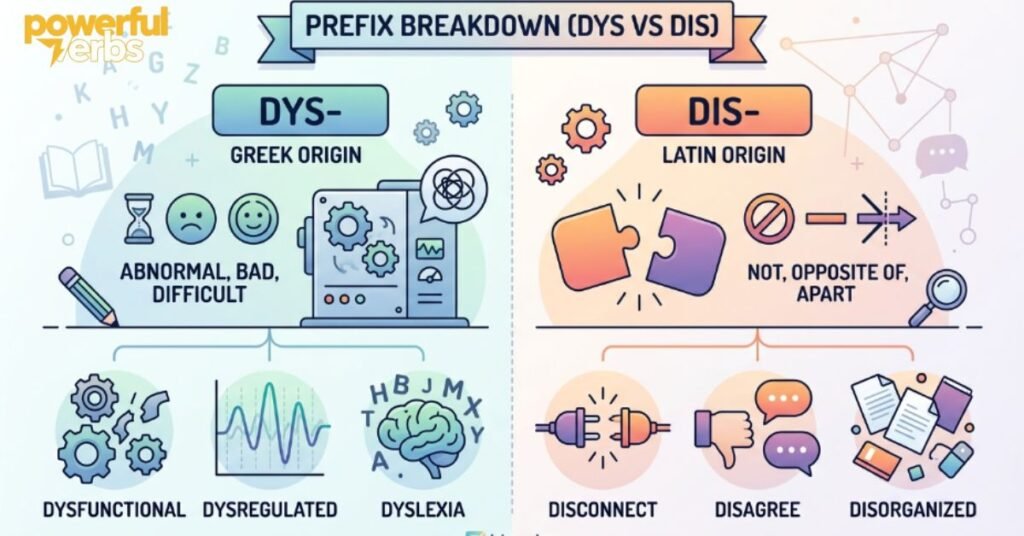
Understanding prefixes helps you choose the right word every time. Here is a clear breakdown:
| Prefix | Origin | Meaning | Example |
| Dys- | Greek | Abnormal, bad, difficult | Dysfunctional, dysregulated, dyslexia |
| Dis- | Latin | Not, opposite of, apart | Disconnect, disagree, disorganized |
“Dys” signals something is impaired. “Dis” signals something is reversed or removed. These are two very different ideas.
Is “Disregulated” a Real Word? The Truth Explained
Reality Check: Is “Disregulated” Correct?
No. “Disregulated” is not a recognized word in English. It does not appear in Merriam-Webster, Oxford, or any major medical dictionary. It is simply a misspelling.
Why “Disregulated” Feels Right (But Isn’t)
Because so many common English words start with “dis,” our brain automatically reaches for that pattern. It feels natural because of words like “disorder” and “disconnected,” which are similar in meaning.
Why You Won’t Find It in Dictionaries
Dictionaries only list words with accepted usage and linguistic roots. “Disregulated” has no proper root because “dis” + “regulated” does not create a meaningful or correct combination in standard English.
Why People Keep Using “Disregulated” (Common Mistakes Explained)
The Real Reason Behind the Confusion
Most people have heard the word “dysregulated” spoken aloud but never studied its spelling. When writing it down, they guess and go with the more familiar “dis” prefix.
Influence of Other “Dis-” Words
Words like “disorder,” “disruptive,” and “disorganized” are all related to emotional and behavioral topics. Since “dysregulated” also fits that topic area, writers assume it must follow the same “dis” pattern.
Spelling Patterns That Mislead
English has far more “dis” words than “dys” words in everyday use. This creates a strong habit of defaulting to “dis” even when “dys” is correct.
Why “Dysregulated” Is the Correct Term
Prefix Meaning Matters
“Dysregulated” uses “dys” because it describes a system that is functioning abnormally, not one that is simply “not regulated.” The meaning is about impaired function, not the absence of function.
Key Insight You Should Remember
If something is dysregulated, it is still trying to function but doing so in a broken or harmful way. That is exactly what “dys” means, and that is why no other prefix works here.
Dysregulated vs Disregulated: Side-by-Side Comparison
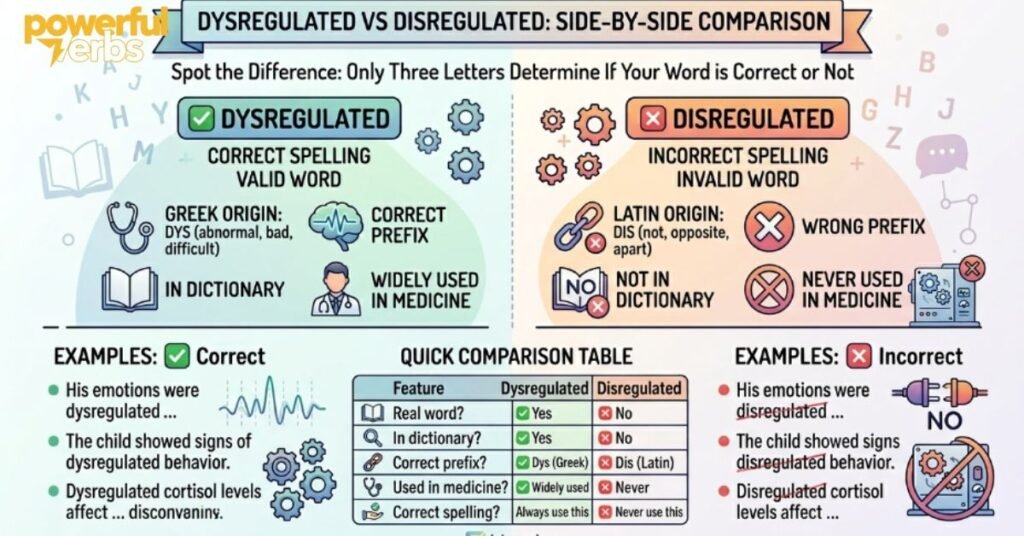
Spot the Difference
Both words look nearly identical at first glance. The only difference is three letters: “dys” vs “dis.” But that tiny change determines whether your word is correct or not.
❌ Incorrect
- His emotions were disregulated after the stressful event.
- The child showed signs of disregulated behavior.
- Disregulated cortisol levels affect sleep patterns.
✅ Correct
- His emotions were dysregulated after the stressful event.
- The child showed signs of dysregulated behavior.
- Dysregulated cortisol levels affect sleep patterns.
Quick Comparison Table
| Feature | Dysregulated | Disregulated |
| Real word? | ✅ Yes | ❌ No |
| In dictionary? | ✅ Yes | ❌ No |
| Correct prefix? | ✅ Dys (Greek) | ❌ Dis (Latin) |
| Used in medicine? | ✅ Widely used | ❌ Never |
| Correct spelling? | ✅ Always use this | ❌ Never use this |
What Happens If You Use “Disregulated”?
In Professional Writing
Using “disregulated” in a professional report or resume can instantly reduce your credibility. Readers with a medical or psychology background will immediately notice the error.
In Academic or Medical Contexts
In research papers, clinical notes, and medical documentation, accuracy in terminology is critical. “Disregulated” in these settings signals a lack of subject knowledge.
In Online Content
Search engines like Google are built to recognize correct spelling and proper terminology. Using “disregulated” in blog posts or articles can lower your search ranking and reduce reader trust.
Dysregulated Meaning in Psychology (Where It Matters Most)
Dysregulated Definition in Psychology
In psychology, dysregulation refers to a person’s inability to manage their emotional or behavioral responses healthily. It is a clinical term used by therapists, counselors, and psychiatrists.
Emotional Dysregulation Meaning
Emotional dysregulation means a person’s emotions go out of control more easily and more intensely than expected. They may overreact to small triggers or struggle to calm down after being upset.
What Emotional Dysregulation Looks Like in Real Life
Dysregulated Behavior Examples
- Sudden anger outbursts over minor issues
- Crying without being able to stop
- Shutting down completely during conflict
- Impulsive decisions made out of emotion
Short Scenario
Imagine a student who gets a small criticism from a teacher and immediately bursts into tears, leaves the room, and cannot focus for the rest of the day. That is a dysregulated emotional response in action.
Dysregulated Emotions vs Normal Emotional Responses
Clear comparison
| Normal Emotional Response | Dysregulated Emotional Response |
| Feels sad, recovers in minutes | Feels sad, stays overwhelmed for hours |
| Gets angry, calms down quickly | Gets angry, cannot stop the reaction |
| Feels anxious before a test | Feels paralyzed by anxiety all day |
| Adjusts to change with effort | Falls apart when routine changes |
Helps the reader relate
Everyone feels big emotions sometimes. The difference is how long it lasts and how much it interferes with daily life. Dysregulation means the emotional system has lost its balance.
Dysregulated Nervous System Explained
Signs of a Dysregulated Nervous System
- Constant feeling of being on edge
- Trouble sleeping or staying asleep
- Digestive problems with no clear cause
- Feeling numb or disconnected from your body
- Heart racing even in calm situations
What’s Happening Inside the Body
When the nervous system is dysregulated, it gets stuck in “fight or flight” mode or goes too far into “shutdown” mode. The body cannot find its natural calm resting state.
Dysregulation in Biology: Beyond Emotions
Scientific Examples
- Dysregulated immune system: attacks healthy cells (as in autoimmune disease)
- Dysregulated hormones: too much or too little cortisol, insulin, or thyroid hormone
- Dysregulated gene expression: linked to cancer development
Core Concept
In biology, dysregulation means a system that normally self-corrects has lost that ability. It applies to any biological process, not just emotional health.
A Simple Analogy
Think of your body’s systems like a thermostat. A regulated thermostat keeps the temperature steady. A dysregulated thermostat either blasts heat all day or shuts off completely, never finding balance.
Mental Health Conditions Linked to Dysregulation
Common Conditions
Many mental health diagnoses involve emotional or neurological dysregulation as a core feature.
Anxiety
People with anxiety disorders often have a dysregulated fear response. Their nervous system treats everyday situations like life-threatening dangers.
ADHD
ADHD includes emotional dysregulation as a key but often overlooked symptom. People with ADHD may react more intensely to frustration, excitement, or disappointment than others.
PTSD
Trauma causes deep dysregulation in the nervous system. Survivors of trauma often have a hyperactivated stress response that stays switched on long after the danger has passed.
Workplace and Daily Life Impact of Dysregulation
Workplace Emotional Dysregulation
Dysregulated employees may struggle with deadlines under pressure, conflict with colleagues, and receive constructive feedback. It does not mean they are bad workers, just that their emotional system needs support.
Everyday Situations
- Road rage after minor traffic delays
- Snapping at family members when tired
- Crying during small disagreements
- Feeling completely drained after social events
These are all signs of dysregulation showing up in daily life.
Dysregulated Child: Symptoms and Support
Common Symptoms
- Frequent meltdowns that seem out of proportion
- Difficulty transitioning between activities
- Aggressive reactions to frustration
- Extreme clinginess or complete withdrawal
- Trouble calming down without adult help
Treatment and Support Approaches
- Consistent daily routines to build safety
- Calm, regulated responses from caregivers
- Play therapy or talk therapy for children
- Teaching simple breathing and grounding techniques
- Avoiding shame-based discipline methods
How to Improve Emotional Dysregulation (Practical Steps)
Actionable Strategies
- Practice deep breathing for 5 minutes daily
- Use grounding techniques like the 5-4-3-2-1 method
- Keep a daily emotion journal to track patterns
- Seek therapy, especially DBT (Dialectical Behavior Therapy)
- Build a consistent sleep and exercise routine
Quick Tip
You cannot think your way out of dysregulation. Your body needs physical calming first before your logical brain can engage. Start with breath, then thought.
Why “Dys” vs “Dis” Confusion Keeps Happening
Simple Explanation
English borrowed “dys” from Greek and “dis” from Latin. Both appear in medical and psychological vocabulary, but “dys” words are less common in everyday speech. That rarity makes them easier to forget and easier to misspell.
Comparison Table
| Dys- Words (Greek) | Dis- Words (Latin) |
| Dysregulated | Disorder |
| Dysfunctional | Disconnected |
| Dyslexia | Disruptive |
| Dysphoria | Disorganized |
| Dystopia | Discomfort |
Quick Practice: Test Your Understanding
Fill in the Blank
- The therapist noted that the patient showed signs of emotional ___regulation.
- A ___regulated immune system can lead to autoimmune disease.
- Children with ADHD often struggle with ___regulated responses to frustration.
(Answer: All three blanks = “dys”)
Fix the Sentence
- ❌ Her nervous system was disregulated after the accident.
- ✅ Her nervous system was dysregulated after the accident.
Bonus Challenge
Write three original sentences using “dysregulated” correctly in different contexts — one emotional, one biological, one behavioral.
Simple Rules & Memory Tricks
Easy Rule to Remember
If the word describes something working badly or abnormally, use “dys.” If it means something is simply removed or reversed, use “dis.”
Memory Trick That Actually Works
Think: DYS = Difficulty. Both start with “dy.” If something is difficult to regulate, it is DYSregulated. This one mental link will save you every time.
Common Mistakes to Avoid
- ❌ Writing “disregulated emotions”—always use “dysregulated.”
- ❌ Using “disregulation”—the correct noun is “dysregulation.”
- ❌ Assuming both spellings are acceptable variants—they are not
- ❌ Trusting autocorrect — it sometimes accepts “disregulated” without flagging it
- ❌ Copying wrong spellings from unreliable websites — always verify with a dictionary
Key Takeaways You’ll Actually Remember
- “Dysregulated” is the only correct spelling—”disregulated” does not exist
- “Dys” comes from Greek and means abnormal or impaired
- Dysregulation affects emotions, behavior, the nervous system, and biology
- It is a key term in psychology, medicine, and everyday health discussions
- The confusion happens because “dis” words are more common in everyday English
- Always double-check your spelling in academic, clinical, and professional writing
- A simple memory trick: DYS = Difficulty regulating
Conclusion
“Dysregulated” and “disregulated” are not two versions of the same word. One is correct; one does not exist. Now that you understand the difference, you will never mix them up again.
Use “dysregulated” every single time, in every context. It is the right word, backed by Greek roots, medical dictionaries, and professional usage worldwide.
Frequently Asked Questions
1. What is the difference between dysregulated and disregulated?
“Dysregulated” is the correct, widely accepted spelling used in psychology and medicine to describe impaired self-regulation, while “disregulated” is a common misspelling that is not recognized in standard clinical or academic usage.
2. Is it spelled “dysregulated” or “disregulated” when talking about emotions?
The correct spelling is dysregulated. When describing emotional states where a person cannot manage their feelings effectively, mental health professionals always use “dysregulated,” not “disregulated.”
3. Why do people confuse “dysregulated” with “disregulated” in everyday speech?
People confuse the two because the prefix “dis-” is far more common in English (e.g., “disorder,” “disconnect”), while “dys-” comes from Greek and is less familiar, making “disregulated” feel natural even though it is incorrect.
4. What does it mean when someone says a child is dysregulated?
When a child is described as dysregulated, it means they are struggling to control their emotions, behavior, or attention, often appearing overwhelmed, explosive, or shut down—a term rooted in neuroscience and trauma-informed care.
5. Can I use “disregulated” instead of “dysregulated” in a formal paper or medical document?
No, you should always use dysregulated in formal, medical, or academic writing. “Disregulated” is not a recognized clinical term and could undermine the credibility of your work.
6. What is the root difference between the prefixes “dys” and “dis” that causes this spelling confusion?
The prefix “dys-“ (from Greek) means abnormal or impaired, while “dis-“ (from Latin) means apart, away, or reversal. Since dysregulation refers to impaired regulation — not reversed regulation — “dys-” is the grammatically correct prefix.
7. How do therapists and psychologists define the word “dysregulated” in a session?
Therapists use dysregulation to describe a state where the nervous system is overwhelmed, and a person cannot return to a calm baseline on their own, often linked to anxiety, ADHD, PTSD, or trauma responses.
8. Is nervous system dysregulation the same as being disregulated?
They refer to the same concept in everyday conversation, but the medically and scientifically correct term is nervous system dysregulation. “Disregulation” is simply a spelling error that has crept into informal usage over time.
9. How can I remember the correct spelling of dysregulated versus disregulated?
A simple memory trick: think of other “dys-“ words like dyslexia, dysfunction, and dysmorphia—all describing something impaired or abnormal. Since dysregulated means impaired regulation, it belongs in the same family.
10. Are there any dictionaries or style guides that list “disregulated” as an accepted alternative to “dysregulated”?
No major dictionary, style guide, or medical reference—including Merriam-Webster, the APA, or DSM-5—recognizes “disregulated” as a valid alternative. “Dysregulated” remains the sole correct and accepted form across all authoritative sources.

Liam Johnson is a dedicated language expert with 4 years of professional experience. He specializes in Grammar, Vocabulary, and Sentence structure.
