

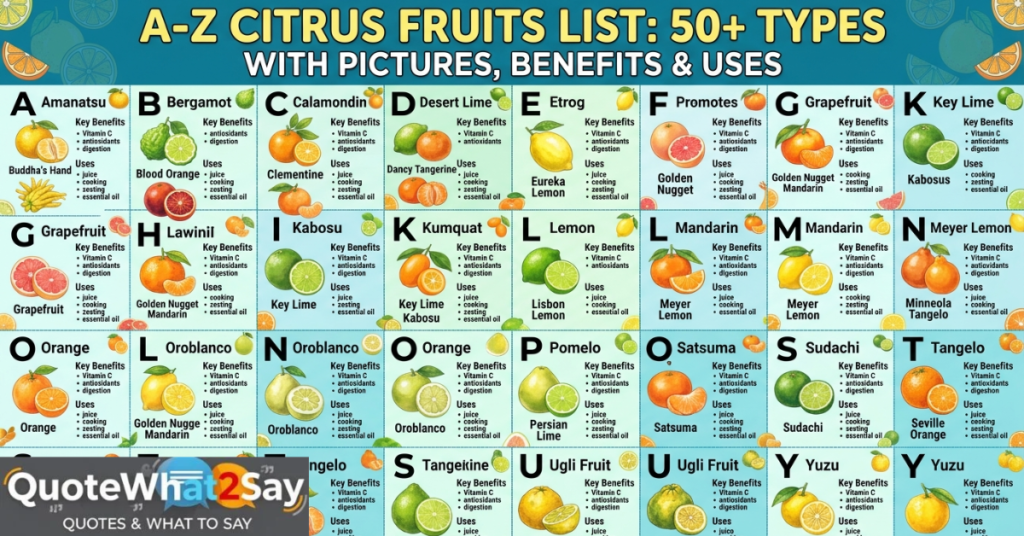
Citrus fruits are among the most widely consumed fruits in the world — and for good reason. They are packed with vitamin C, natural antioxidants, and bright flavors ranging from intensely sour to delicately sweet. Whether you are squeezing fresh juice for breakfast, zesting a lemon over pasta, or candying a thick pomelo rind, citrus fruits play a central role in kitchens and cultures across every continent.
This complete A-Z guide covers 50+ types of citrus fruits with their names, pictures, health benefits, and culinary uses. Each entry goes beyond basic descriptions to help you truly understand the flavor profile, best uses, and what makes each variety unique. Whether you are a home cook, a nutrition enthusiast, a gardener, or simply curious about the diversity of the citrus family, this list is your most comprehensive reference.
What Are Citrus Fruits?
Citrus fruits belong to the Rutaceae family and are scientifically classified under the genus Citrus. They grow on flowering trees and shrubs in tropical and subtropical climates. All citrus fruits share a few defining characteristics: a segmented interior filled with juice-filled vesicles, a fragrant peel rich in essential oils, and a flavor that balances acidity with varying degrees of sweetness.
The three original ancestral citrus species from which nearly all modern varieties descend are the citron, the pomelo, and the mandarin. Every orange, lemon, lime, grapefruit, and hybrid you know today traces its genetic roots back to one or more of these three fruits.
Key Nutritional Benefits of All Citrus Fruits
Before diving into the full list, here is what citrus fruits universally offer:
- Vitamin C — Supports immune function, collagen production, and skin health
- Flavonoids — Plant compounds with anti-inflammatory and antioxidant properties
- Dietary fiber — Promotes healthy digestion and stable blood sugar
- Folate — Important for cell division and particularly vital during pregnancy
- Potassium — Supports heart health and healthy blood pressure
- Low calorie density — Most citrus fruits are naturally low in calories and fat-free
Complete A-Z List of Citrus Fruits
A
Australian Finger Lime
Also known as: Citrus caviar Origin: Queensland and New South Wales, Australia Flavor Profile: Bright, tangy, intensely acidic with herbal undertones
The Australian Finger Lime is one of the most visually dramatic citrus fruits in existence. Its elongated shape — resembling a small finger or a chili pepper — contains hundreds of tiny, bead-like juice vesicles that pop with a burst of sour citrus flavor when you bite into them. This is why chefs around the world call them “citrus caviar.”
Unlike most citrus fruits, Finger Limes are not squeezed or juiced. Instead, the fruit is sliced open and the pearls are scattered directly over oysters, sashimi, grilled fish, avocado toast, or high-end desserts as a finishing garnish. The visual effect is striking — tiny glistening spheres of green, pink, or red depending on the variety.
Culinary uses: Seafood topping, fine dining garnish, sauces, cocktails, vinaigrettes Health benefits: High in vitamin C, folate, and potassium; contains unique antioxidants not found in other citrus Fun fact: There are over 75 known varieties of Australian Finger Lime, ranging in color from pale yellow to deep purple-red
B
Bergamot Orange
Origin: Southern Italy (Calabria region) Flavor Profile: Floral, intensely aromatic, bitter with light sweetness
Bergamot is one of the most aromatic citrus fruits in the world, yet very few people have ever eaten one fresh. The fruit looks like a small, slightly flattened yellow-green orange and has an extraordinarily fragrant peel. Most bergamots are grown commercially for their essential oil, which is what gives Earl Grey tea its distinctive floral scent.
The flesh of a bergamot is sour and bitter too intense for most people to eat raw. However, the peel is pressed for oil used in perfumery, aromatherapy, and food flavoring. In Calabria, Italy, bergamot marmalade is a beloved traditional product.
Culinary uses: Earl Grey tea flavoring, marmalade, pastry zest, liqueurs, perfumery Health benefits: Contains bergapten and other polyphenols that may support heart health and cholesterol balance Fun fact: Bergamot is one of the few fruits where the peel is more commercially valuable than the juice
Blood Orange
Origin: Sicily, Italy and Spain Flavor Profile: Sweet-tart citrus with subtle berry and raspberry undertones
Blood oranges are immediately recognizable by their deep crimson or ruby-red interior flesh, which comes from a pigment called anthocyanin — the same antioxidant compound found in blueberries and cherries. This pigmentation develops only when the fruit experiences a significant difference between daytime and nighttime temperatures during the growing season.
There are three main varieties of blood orange:
- Moro — the darkest variety with the most intense berry flavor
- Tarocco — Italian origin, considered the sweetest blood orange
- Sanguinello — Spanish variety, slightly more acidic than Tarocco
In terms of flavor, blood oranges taste like a regular sweet orange crossed with a hint of raspberry or strawberry. They are exceptional in fresh juice, salads, marmalades, sorbet, cocktails, and as a color-rich garnish on desserts.
Culinary uses: Fresh juice, salads, curd, sorbet, cocktails, marmalade Health benefits: Rich in anthocyanins, vitamin C, and folate; anthocyanins are linked to anti-inflammatory effects and cardiovascular protection Fun fact: Blood oranges grown in warm climates without cold nights may produce very little red pigmentation, appearing nearly identical to navel oranges on the outside
C
Calamansi (Calamondin)
Origin: Philippines and Southeast Asia Flavor Profile: Intensely sour with a floral, slightly sweet aroma
Calamansi — spelled kalamansi in Filipino — is the citrus king of Southeast Asia. This tiny round fruit, about the size of a large marble, packs more sour punch per milliliter than almost any other citrus. The exterior skin is thin and turns from green to orange when fully ripe, but is typically used while still green.
In the Philippines, calamansi is as essential as salt. It is squeezed over almost everything: grilled pork, fried rice, noodles, soups, and marinades. Mixed with soy sauce, it becomes the classic Filipino dipping sauce. Calamansi juice is also a popular cold drink, served with sugar and ice.
Culinary uses: Marinades, dipping sauces, beverages, soups, desserts, skincare Health benefits: Exceptional vitamin C content; used in traditional medicine for skin brightening, digestion support, and immune defense Fun fact: Calamansi is also called “Philippine lime,” though it is technically a hybrid between a mandarin and a kumquat
Citron
Origin: South and Southeast Asia; one of the three original ancestral citrus fruits Flavor Profile: Mildly sour, very aromatic peel, minimal pulp
Citron is one of the original “true” citrus fruits — along with pomelo and mandarin — from which all other citrus varieties descend. It is a large, lumpy, thick-skinned fruit that contains very little juice or pulp. The entire point of a citron is its extraordinarily fragrant rind.
In ancient times, citron was cultivated purely for its perfume and its rind. Today it is used in candied peel, baked goods, preserved lemon preparations, and liqueurs. The Italian liqueur cedro is made from citron rind. In Jewish tradition, the citron (known as etrog) plays an important ceremonial role during the festival of Sukkot.
Culinary uses: Candied peel, baking, liqueurs, marmalade, ceremonial use Health benefits: Rind contains high concentrations of limonene and other citrus terpenes with antioxidant properties Fun fact: Citron was the first citrus fruit to reach the Mediterranean world, brought by traders from India around 300 BCE
Clementine
Origin: Algeria; named after Father Clément Rodier who is credited with discovering it Flavor Profile: Sweet, mild, almost honey-like with very low acidity
Clementines are the ideal citrus fruit for snacking. They are seedless (or nearly so), peel effortlessly, separate cleanly into segments, and taste sweet without any harsh sourness. They are a natural hybrid between a sweet orange and a mandarin.
What makes clementines special is their consistently sweet flavor across the season — they ripen from November through February in the Northern Hemisphere, making them a staple winter fruit. Their thin, loose skin practically falls off when you press it with your thumb.
Culinary uses: Fresh eating, fruit salads, juicing, desserts, holiday gift boxes Health benefits: Good source of vitamin C, B vitamins, and potassium; easy digestibility makes them suitable for children and elderly Fun fact: Clementines are often marketed under the brand name “Cuties” or “Halos” in the United States
D
Dekopon (Sumo Citrus)
Origin: Japan; a hybrid of Kiyomi orange and Ponkan mandarin Flavor Profile: Exceptionally sweet, rich, with very low acidity and no bitterness
Dekopon — sold internationally as “Sumo Citrus” — is widely considered the most premium eating citrus in the world. The fruit is immediately recognizable by its large size and distinctive protruding “topknot” or bump at the stem end. The skin is thick but peels off in large, clean pieces revealing intensely sweet, seedless segments.
Dekopon was developed in Japan in the 1970s and was so prized that it was originally sold only as a luxury gift, with single fruits fetching the equivalent of $10 or more in premium Japanese department stores. It is now commercially grown in California and Brazil.
Culinary uses: Fresh eating only (too delicate and sweet for cooking), premium gifting Health benefits: Rich in vitamin C, hesperidin, and nobiletins — flavonoids with anti-inflammatory properties Fun fact: In Japan, Dekopon must meet strict standards for sugar content and acid level before it can be officially labeled and sold under that name
E
Etrog
Origin: Mediterranean, cultivated for over 2,000 years Flavor Profile: Very fragrant rind; flesh is dry, pithy, and barely edible
Etrog is a variety of citron with deep cultural and religious significance in Jewish tradition. During the week-long festival of Sukkot, Jewish communities around the world hold a perfect, unblemished etrog as one of the “Four Species” used in ritual observance. Because of this, an etrog must be grown with extreme care — any blemish, scratch, or imperfection disqualifies it from ritual use, driving the price of perfect specimens into hundreds of dollars.
From a culinary standpoint, etrog behaves like citron — its thick, fragrant rind is used for candied peel, marmalade, and infused spirits. The juice is sharp and very sour.
Culinary uses: Candied peel, preserves, infused vodka or brandy, marmalade Health benefits: High in essential oils, limonoids, and antioxidant terpenes Fun fact: The Talmud describes the etrog as “the fruit of a beautiful tree” — making it one of the few fruits specifically mentioned in ancient religious scripture
F
Fingered Citron (Buddha’s Hand)
Origin: Northeast India and China Flavor Profile: No pulp or juice — purely aromatic; rind is mildly bitter and floral
Buddha’s Hand is the most unusual-looking fruit in the entire citrus family. It consists entirely of a bundle of long, curved yellow segments that spread outward like fingers — giving it the appearance of a hand in a Buddhist prayer gesture, which is how it got its name.
There is essentially no flesh, juice, or seeds inside Buddha’s Hand. The entire fruit is rind and pith. This makes it completely useless as a food fruit in the traditional sense — but extraordinarily valuable as a perfume fruit. Its scent is powerfully floral, with notes of lemon, jasmine, and fresh laundry. It is placed in rooms, closets, and temples as a natural fragrance.
In cooking, the zest and inner peel are used to infuse spirits, flavor sugar, perfume baked goods, and make candied citrus peel.
Culinary uses: Infused vodka or gin, citrus sugar, candied peel, zesting, fragrance Health benefits: Contains high concentrations of limonene and coumarin compounds; used in traditional Chinese medicine Fun fact: Buddha’s Hand is so important in Chinese culture that it is considered a symbol of happiness, longevity, and good fortune
G
Galgal Lemon (Indian Round Lime)
Origin: Himalayan foothills of India and Nepal Flavor Profile: Very sharp, intensely acidic, thick aromatic rind
Galgal is a large, rough-skinned citrus native to the Himalayan region. It is one of the oldest citrus fruits cultivated in South Asia and forms the backbone of many traditional Indian preserved foods. The juice is more acidic than a standard lemon, and the thick rind has a strong, almost medicinal citrus fragrance.
In Indian kitchens, galgal is the traditional citrus for making nimbu ka achar (lemon pickle) — whole fruits or wedges preserved in salt, spices, and mustard oil. The rind softens over months in the brine and becomes deeply flavorful.
Culinary uses: Pickles, chutneys, traditional preserves, juice, Ayurvedic preparations Health benefits: High in vitamin C and digestive enzymes; used in Ayurvedic medicine for liver support and digestion Fun fact: Galgal is sometimes called “hill lemon” because it grows best at high altitudes where cool temperatures concentrate its acids and aroma
Grapefruit
Origin: Barbados, 18th century; a natural hybrid of pomelo and sweet orange Flavor Profile: Juicy, bitter-sweet, refreshing with a clean finish
Grapefruit is one of the most popular large citrus fruits in the world. Named because it grows in grape-like clusters on the tree, grapefruit comes in three main flesh colors — white/yellow, pink, and red — with red varieties (like Ruby Red) being the sweetest and most popular.
The distinctive bitter note in grapefruit comes from a compound called naringin, which is unique to grapefruit and its close relatives. This same compound is responsible for grapefruit’s famous interaction with certain medications — naringin inhibits enzymes in the gut that break down drugs, potentially causing dangerous increases in medication levels in the blood.
Culinary uses: Fresh eating, breakfast juice, salads, cocktails (especially the Paloma), marmalade, dressings Health benefits: Excellent source of vitamin C, lycopene (in pink/red varieties), and fiber; supports metabolism and immune function Important note: People taking certain medications (statins, blood pressure drugs, antihistamines) should consult a doctor before consuming grapefruit regularly
I
Ichang Lemon
Origin: Central China Flavor Profile: Lemon-like aroma, strongly acidic juice, thick aromatic rind
The Ichang Lemon is a cold-hardy citrus hybrid that can survive temperatures far below what standard lemons tolerate — making it invaluable for gardeners in cooler climates who want to grow citrus. The fruit has a lemon-like aroma and flavor with slightly more floral notes than a standard Lisbon or Eureka lemon.
Culinary uses: Juice, zest, citrus flavoring in cold-climate cooking Health benefits: Comparable to standard lemon in vitamin C and citric acid content Fun fact: The Ichang Lemon is a parent species of the Yuzu fruit and can survive freezing temperatures down to -10°C
Ichang Papeda
Origin: Central China and surrounding regions Flavor Profile: Extremely sour, thick-rinned, barely edible raw
The Ichang Papeda is one of the wild citrus relatives that exists primarily as a genetic bridge in the citrus family tree. It is deeply cold-hardy and has contributed cold-tolerance genes to many cultivated hybrids through breeding programs. The fruit itself is very sour and thick-skinned, with strong fragrance but limited culinary appeal when eaten fresh.
Culinary uses: Rare regional culinary use; primarily valued in citrus breeding programs Health benefits: Rich in aromatic terpenes and antioxidant flavonoids Fun fact: Papedas are a subgroup of primitive citrus species that retain many ancestral traits
J
Jabara
Origin: Wakayama Prefecture, Japan Flavor Profile: Sour with yuzu-like floral aroma; intensely fragrant rind
Jabara is a rare Japanese citrus that has attracted scientific attention in recent years due to research suggesting it may help reduce allergic reactions. It is grown almost exclusively in the Kitayama village in Wakayama Prefecture. The fruit has a complex, floral sourness similar to yuzu, and its rind is powerfully fragrant.
Culinary uses: Juice, zest, dressings, drinks, fermented beverages Health benefits: Contains narirutin, a flavonoid that some studies suggest may help modulate histamine response and seasonal allergy symptoms Fun fact: Demand for Jabara fruit increased dramatically after scientific papers about its potential anti-allergy properties were published
K
Kabosu
Origin: Oita Prefecture, Japan Flavor Profile: Sharply sour, deeply aromatic, clean acidic finish
Kabosu is a round green Japanese citrus that looks like a lime but tastes distinctly different more complex and aromatic, with a cleaner, slightly floral sourness. It is traditionally harvested while green, even though the fruit eventually turns yellow when fully ripe. The green stage is preferred because it has the most intense aroma.
In Japanese cuisine, kabosu juice is squeezed over grilled fish, nabe hot pot, soba noodles, and ponzu sauce. The fruit is a staple of Oita Prefecture cooking and is considered one of Japan’s most important regional citrus varieties.
Culinary uses: Finishing squeeze for grilled foods, sauces, ponzu, hot pot dishes, cold noodles Health benefits: High in vitamin C, citric acid, and flavonoids; supports digestion and immune function Fun fact: Kabosu is sometimes mistaken for yuzu, but the two fruits have distinct flavor profiles — kabosu is sharper and less floral than yuzu
Kaffir Lime (Makrut Lime)
Origin: Southeast Asia (Thailand, Indonesia, and surrounding countries) Flavor Profile: Extremely pungent peel; sour juice; leaves are floral and herbal
Kaffir lime increasingly referred to as Makrut lime to avoid a historically offensive term is one of the most distinctive citrus fruits in Asian cooking. The fruit itself has a bumpy, wrinkled peel and contains very little juice. However, the leaves and rind are among the most aromatic of any citrus plant.
The double-leaf of the Makrut lime where two leaf lobes grow end to end, giving the appearance of a single figure-8-shaped leaf is unmistakable and is one of the most important aromatic herbs in Thai, Indonesian, and Cambodian cooking. The leaves are torn or sliced into curries, soups, and stir-fries to release their intensely floral, lime-forward fragrance.
Culinary uses: Leaves in curry paste, soups, rice dishes, and coconut-based curries; rind in Thai curry pastes; juice in some traditional preparations Health benefits: Rich in alkaloids and flavonoids; used in traditional medicine for oral health, skin care, and stress relief Fun fact: The “double leaf” of the Makrut lime is actually two leaves that have fused together during evolution — a trait unique to this species
Key Lime
Origin: Southeast Asia; now associated with the Florida Keys Flavor Profile: More intensely aromatic and acidic than Persian lime; slightly floral
Key limes are smaller, rounder, thinner-skinned, and more aromatic than the standard Persian limes found in most grocery stores. Their juice has a more complex, floral tartness that makes it irreplaceable in the dessert they inspired: Key Lime Pie.
Key lime trees were once extensively grown in the Florida Keys hence the name but a hurricane in 1926 wiped out most of the groves, and today most Key limes sold in the United States are imported from Mexico and Central America.
Culinary uses: Key Lime Pie, marinades, cocktails (especially margaritas), ceviche, dressings Health benefits: Excellent source of vitamin C, citric acid, and flavonoids Fun fact: Authentic Key Lime Pie filling turns pale yellow not green because it is made with Key lime juice and egg yolks. Green Key Lime Pie is usually colored artificially.
Kumquat
Origin: China Flavor Profile: Sweet peel with tart interior eat the whole fruit
Kumquats are unique in the citrus world because they are meant to be eaten whole skin and all. The thin, bright orange peel is sweet, while the interior segments are quite sour. When you bite into a kumquat and chew, the sweetness of the peel and the sourness of the pulp combine into a pleasingly complex flavor.
Kumquats are small about the size and shape of a large grape or small olive and can be eaten as a snack, sliced into salads, used in marmalade, or simmered into syrups and preserves. They are one of the few citrus fruits that thrive in cooler climates and are popular container plants in temperate regions.
Culinary uses: Fresh eating (whole), marmalade, candied kumquats, desserts, salads, drinks Health benefits: Uniquely high in fiber (because you eat the peel), plus vitamin C and antioxidants Fun fact: The name “kumquat” comes from the Cantonese gam gwat, meaning “golden orange”
L
Lemon
Origin: Northeast India; spread to Persia and then the Mediterranean Flavor Profile: Bright, intensely acidic, clean, and refreshing
The lemon is arguably the single most important citrus fruit in world cuisine. No other fruit does what lemon does — its sharp, clean acidity brightens flavors, balances richness, replaces vinegar, preserves color, tenderizes proteins, and adds freshness to both sweet and savory dishes. A squeeze of lemon changes everything.
There are several major commercial lemon varieties:
- Eureka — the standard California lemon; acidic, available year-round
- Lisbon — similar to Eureka but with slightly thicker skin and more seeds
- Meyer — sweeter, thinner-skinned hybrid (covered separately)
- Primofiori — a Spanish variety common across Europe
Culinary uses: Every category of cooking — dressings, marinades, baking, beverages, preserves, sauces, desserts Health benefits: Outstanding source of vitamin C and citric acid; supports iron absorption, immune function, and digestive health Fun fact: Lemon juice is one of the few substances acidic enough to denature proteins — this is why citrus ceviche “cooks” raw fish without heat
Lime
Origin: Southeast Asia Flavor Profile: Tart, green, aromatic, with more herbal notes than lemon
The Persian lime — the standard lime found in supermarkets globally — is seedless, thick-skinned, and has a reliably tangy flavor. Its versatility in beverages, Mexican and Southeast Asian cooking, and cocktails makes it one of the world’s most consumed citrus fruits.
Fresh lime juice and zest are used in guacamole, tacos, cocktails (margaritas, mojitos, daiquiris), ceviche, Thai salads, Vietnamese soups, Indian chutneys, and hundreds of other preparations worldwide.
Culinary uses: Cocktails, Mexican cuisine, Southeast Asian cooking, marinades, desserts Health benefits: Rich in vitamin C, flavonoids, and potassium; supports immune function and skin health Fun fact: Limes were historically carried on British naval ships to prevent scurvy — giving British sailors the nickname “Limeys”
Limequat
Origin: A hybrid between Key lime and kumquat, developed in Florida Flavor Profile: Lime-forward tartness with a slightly sweet edible peel
Limequats inherit the best traits of both parents: the intense lime flavor of Key lime and the edible sweet peel of kumquat. The fruit is small, oval to round, and yellowish-green when ripe. Like kumquats, they can be eaten whole or used in marmalade and preserves.
Culinary uses: Eaten whole, marmalade, cocktail garnish, preserves, tart desserts Health benefits: High in vitamin C and fiber (when eaten with peel) Fun fact: Limequats are more cold-tolerant than Key limes, making them a popular choice for home gardeners in cooler climates
Lisbon Lemon
Origin: Portugal Flavor Profile: Classic sharp lemon acidity, abundant juice
The Lisbon lemon is one of the two major commercial lemon varieties alongside the Eureka. It produces an abundance of acidic, flavorful juice and is widely used in commercial lemon juice production. The skin is slightly thicker than the Eureka and it performs well in cooler climates.
Culinary uses: All lemon applications — beverages, cooking, baking, dressings Health benefits: High vitamin C, citric acid, and bioflavonoids Fun fact: The Lisbon lemon is thought to have originated in Portugal from seeds brought from Australia in the 19th century
M
Mandarin
Origin: China and Southeast Asia Flavor Profile: Sweet, mild, aromatic — the archetypal easy-peel citrus
Mandarins are the broad category of loose-skinned, easy-peeling, sweet citrus fruits. Many of the most popular citrus varieties — including tangerines, clementines, satsumas, and ponkan — are technically types of mandarin. The name itself comes from the Mandarin-speaking court of the Chinese emperor, where the bright orange fruits were prized as luxury gifts.
Mandarins are smaller than oranges, have a more flattened shape, and are significantly easier to peel. Their loose skin separates from the flesh with almost no effort. The segments pull apart cleanly, making them the most convenient citrus for on-the-go snacking.
Culinary uses: Fresh eating, salads, desserts, marmalade, holiday gifting Health benefits: Excellent source of vitamin C, beta-carotene (precursor to vitamin A), and hesperidin; supports eye health and skin health Fun fact: In Chinese New Year tradition, giving mandarins is a symbol of wealth and good luck because their bright orange color resembles gold coins
Meiwa Kumquat
Origin: China; named after a city in China Flavor Profile: Rounder shape, sweeter flesh, less tart than Nagami kumquat
The Meiwa kumquat is the sweeter of the two main kumquat varieties. Its rounder shape (compared to the oval Nagami) and thicker, sweeter peel make it the preferred variety for fresh eating. Many people who find regular kumquats too tart enjoy Meiwa because the sugar content of both peel and flesh is more balanced.
Culinary uses: Fresh eating (whole), syrups, preserves, candied fruit Health benefits: Rich in fiber, vitamin C, and plant antioxidants Fun fact: Meiwa kumquats are sometimes called “Hong Kong kumquats” in international markets
Melogold
Origin: University of California breeding program; a hybrid of white grapefruit and pomelo Flavor Profile: Sweet, mild, very low bitterness compared to grapefruit
Melogold is a large hybrid citrus with a thick, pale yellow rind and sweet, mild flesh. It was developed to offer the size and appearance of grapefruit without the characteristic bitter aftertaste that some people dislike. The flavor is closer to pomelo — gentle, sweet, and refreshing with only a whisper of grapefruit’s bitterness.
Culinary uses: Fresh eating, fruit salads, fresh juice Health benefits: High in vitamin C and dietary fiber; lower naringin content than grapefruit (less bitter, fewer medication interactions) Fun fact: Melogold was developed alongside Oroblanco by the same University of California breeding team in the 1970s-80s
Meyer Lemon
Origin: China; brought to the United States by agricultural researcher Frank Meyer in 1908 Flavor Profile: Sweeter and less acidic than standard lemons; thin skin with floral notes
Meyer lemons are a hybrid between a standard lemon and a mandarin or sweet orange, giving them a unique flavor profile — less sharp, more floral, slightly sweet, and with a thin, almost edible skin. They are enormously popular in baking and dessert-making because their gentler acidity adds citrus flavor without overpowering other ingredients.
Meyer lemons are seasonal (typically available November through March) and are often sold at a premium. Home gardeners love them because Meyer lemon trees are smaller, more compact, and more cold-tolerant than standard lemon varieties, making them excellent container plants.
Culinary uses: Lemon curd, tarts, cakes, preserved Meyer lemons, pasta sauces, dressings, cocktails Health benefits: Rich in vitamin C, flavonoids, and essential oils; slightly higher sugar content than standard lemons Fun fact: Meyer lemons were widely planted as ornamental trees until it was discovered they were carrying a citrus virus that was infecting commercial orchards; disease-free Meyer lemon varieties were developed and reintroduced
N
Nagami Kumquat
Origin: China Flavor Profile: Oval shape, tartly sour flesh, sweet peel — the classic kumquat
The Nagami is the most widely cultivated and commercially available kumquat variety. It is oval in shape (distinguishing it from the rounder Meiwa) with a bright orange skin that is sweet and a segment interior that is sharply sour. When eaten whole, the contrast between the sweet peel and the tart flesh is part of the appeal.
Culinary uses: Eating whole, marmalade, candied kumquats, sliced into cocktails, pickled kumquats Health benefits: High in vitamin C, fiber (from the peel), and pectin (a soluble fiber that supports gut health and cholesterol) Fun fact: Nagami is a Japanese word, and the kumquat was introduced to Japan from China before being brought to the West by plant hunter Robert Fortune in the 1840s
O
Orange (Navel Orange)
Origin: Brazil; a mutation discovered in a monastery in the 1820s Flavor Profile: Sweet, juicy, seedless, with rich orange flavor
The navel orange is the world’s most popular fresh-eating orange. It gets its name from the small secondary fruit that grows opposite the stem end, creating an indentation that resembles a human navel. Navel oranges are seedless, easy to peel, and reliably sweet — qualities that make them the standard orange in supermarkets worldwide.
Navel oranges are at their peak from November through June. Unlike Valencia oranges, they are not ideal for juicing because their juice becomes bitter when exposed to air due to a compound called limonin.
Culinary uses: Fresh eating, salads, desserts, marmalade; not recommended for juicing ahead of time Health benefits: Outstanding source of vitamin C, folate, thiamine, and fiber Fun fact: Every navel orange in the world is genetically identical to a single mutation found at the Monastery of Bahia in Brazil around 1820 — they are propagated entirely by cuttings, not seeds
Orangequat
Origin: Hybrid between orange and kumquat Flavor Profile: Small fruit with edible peel, tangy flesh, and mild orange sweetness
Orangequats combine the mild sweetness of orange with the edible peel characteristic of kumquats. They are small, can be eaten whole, and work well in specialty marmalades and preserves. Less common than pure kumquats or oranges, they appeal to people who want a milder, less tart kumquat-style eating experience.
Culinary uses: Fresh eating, marmalade, specialty preserves, dessert garnish Health benefits: Provides fiber (from edible peel), vitamin C, and flavonoids
Oroblanco
Origin: University of California; grapefruit and pomelo hybrid Flavor Profile: Sweet, mild, thick green-yellow rind, almost no bitterness
Oroblanco — meaning “white gold” in Spanish — was one of the first commercially successful pummelo-grapefruit hybrids. Its thick rind is greenish-yellow even when fully ripe, which sometimes leads shoppers to underestimate its ripeness. Inside, the segments are seedless, sweet, and refreshingly mild.
Oroblanco contains lower levels of the bitter compound naringin than standard grapefruit, making it accessible to people who dislike grapefruit’s bitterness.
Culinary uses: Fresh eating, fruit salads, juicing Health benefits: Rich in vitamin C and antioxidants; lower naringin content means fewer interactions with medications than standard grapefruit Fun fact: Oroblanco inspired the development of the Sweetie citrus, a variety popular in Israel that is now widely exported
P
Persian Lime
(See: Lime — the standard lime available in most markets globally)
Pomelo
Origin: Southeast Asia; one of the three original ancestral citrus fruits Flavor Profile: Mild, gentle sweetness with light bitterness; very large and thick-rinded
The pomelo is the largest citrus fruit in the world — some specimens can reach the size of a basketball and weigh over a kilogram. Despite their imposing size, pomelos have a surprisingly mild, sweet flavor that lacks the sharp bitterness of grapefruit (one of its descendants).
Inside the thick, spongy rind are large, juicy segments with a pleasant sweetness and a very gentle bitterness. In Southeast Asian cultures — particularly in China, Vietnam, and Thailand — pomelo is eaten fresh in sections, added to salads, or used in festival and New Year celebrations as a symbol of luck and prosperity.
Culinary uses: Fresh eating, fruit salads, Southeast Asian salads (like Thai yam som-o), preserves Health benefits: Rich in vitamin C, fiber, potassium, and antioxidants; supports heart health and digestion Fun fact: In Chinese culture, pomelos are given as gifts during the Mid-Autumn Festival and are placed on altars as offerings — their name (youzi) is associated with blessings and good fortune
Ponkan
Origin: China and India; one of the most widely grown mandarins in Asia Flavor Profile: Richly sweet, highly aromatic, with loose skin and large segments
Ponkan is one of the most popular mandarin varieties in Asia, particularly in China, Japan, and Taiwan. It has a loose, easy-peel skin and large, sweet segments with a rich, full mandarin flavor. Ponkan season runs from November through January, making it a beloved winter fruit associated with the holiday season in many Asian countries.
Culinary uses: Fresh eating, gifting, juicing, desserts Health benefits: High in vitamin C, hesperidin, and natural sugars; energizing and hydrating Fun fact: In Taiwan, Ponkan is considered the premium mandarin variety and is gifted beautifully packaged during the Lunar New Year
R
Rangpur Lime
Origin: India and Bangladesh; a hybrid of mandarin and lemon or citron Flavor Profile: Looks like a small orange; tastes intensely sour and acidic
Rangpur lime is one of the most confusing citrus fruits visually — it looks like a small, orange-skinned mandarin, but tastes nothing like one. Its juice is sharply sour and acidic, similar to a lemon or lime, making it inappropriate for fresh eating but excellent for culinary use where high acidity is needed.
Rangpur lime is used in pickling, Indian chutneys, gin production (it is one of the key ingredients in Tanqueray Rangpur gin), and cooking preparations that require strong sour citrus flavor.
Culinary uses: Pickles, chutneys, gin production, acidic drinks, cooking Health benefits: High in vitamin C and citric acid; good source of antioxidants Fun fact: Rangpur lime is a key botanica ingredient in Tanqueray Rangpur Gin, bringing an unusual floral-sour note to the spirit
S
Satsuma
Origin: Japan (Satsuma Province, now Kagoshima Prefecture) Flavor Profile: Very sweet, nearly seedless, extremely easy to peel, mild acidity
Satsumas are cold-hardy mandarins beloved for their reliability and sweetness. They are among the first citrus fruits of the season, ripening in October and November. Their paper-thin skin practically removes itself, and the segments separate cleanly with almost no strings. Satsumas are the easiest-to-eat citrus fruit in existence.
Culinary uses: Fresh eating, holiday snacking, fruit salads Health benefits: Good source of vitamin C, fiber, and potassium; low in calories Fun fact: Satsumas are named after the feudal province in Japan where they were extensively cultivated; they were introduced to the United States through a U.S. Senator’s wife who planted them in Louisiana in 1876
Seville Orange (Bitter Orange)
Origin: Southeast Asia; cultivated extensively in Spain Flavor Profile: Intensely bitter, highly aromatic, sharp acidity — not edible raw
The Seville orange is the citrus world’s great paradox — it looks like a perfect, beautiful orange, but taking a bite would be a deeply unpleasant experience. Seville oranges are inedibly bitter and sour when eaten fresh, but they produce one of the most complex and aromatic citrus flavors in the world when cooked.
Seville orange marmalade — Britain’s most beloved breakfast preserve — cannot be authentically made with any other citrus. The fruit’s natural pectin content creates a perfect gel, and its bitter-aromatic flavor is unlike anything else. Seville oranges are also the traditional flavoring in Grand Marnier, Cointreau, and other orange liqueurs, as well as in the classic French sauce bigarade.
Culinary uses: Marmalade, liqueurs (Grand Marnier, Cointreau), duck à l’orange sauce, traditional Spanish cooking Health benefits: High in synephrine (a metabolic compound), bioflavonoids, and aromatic terpenes Fun fact: The Seville orange season is brutally short — just a few weeks in January and February — which drives a frenzied annual tradition of marmalade-making across the UK
Shiranui
Origin: Japan; developed at the National Institute of Fruit Science Flavor Profile: Large, very sweet, juicy segments with low seeds — similar to Dekopon
Shiranui is closely related to Dekopon and shares its characteristic bumpy top, though it is technically a separate variety. It is large, sweet, easy to peel, and has almost no seeds. Like Dekopon, it is prized in Japan as a premium fresh-eating mandarin and is available in specialty stores internationally.
Culinary uses: Fresh eating, premium gifting Health benefits: Rich in vitamin C, nobiletins, and hesperidin Fun fact: Shiranui and Dekopon are sometimes used interchangeably in markets outside Japan, though they are technically distinct varieties
Sudachi
Origin: Tokushima Prefecture, Japan Flavor Profile: Very sour, intensely green aromatic, small and thin-skinned
Sudachi is a small Japanese green citrus that resembles a very small lime but delivers a much more complex, aromatic sourness. It is almost never eaten — it is purely a finishing flavor fruit. A cut sudachi is squeezed over grilled fish (sanma, matsutake mushrooms), soba noodles, hot pot, and ponzu sauce right before eating.
Culinary uses: Finishing squeeze over grilled foods, soba, ponzu sauce, cocktails Health benefits: High in vitamin C, citric acid, and unique flavonoids including sudachitin Fun fact: Sudachitin — a flavonoid unique to sudachi — has been studied for potential effects on fat metabolism and blood sugar regulation
Sweet Orange
Origin: A hybrid of pomelo and mandarin, originating in South or Southeast Asia Flavor Profile: Balanced sweetness and mild acidity — the archetypal orange flavor
The term “sweet orange” covers all standard orange varieties: Navel, Valencia, Cara Cara, and others. Sweet orange is the most produced fruit in the world by volume, with Brazil, the United States, China, and Spain as the top producers. It is the foundation of the global juice industry.
Culinary uses: Fresh eating, juicing, marmalade, baking, zesting, salads Health benefits: One of the best natural sources of vitamin C per serving; also provides folate, potassium, thiamine, and fiber Fun fact: It takes approximately 3 medium oranges to produce one 200ml glass of orange juice
T
Tangelo
Origin: Florida, USA; a hybrid of tangerine and grapefruit (or pomelo) Flavor Profile: Juicy, sweet-tart, with a nipple-like protrusion at the stem end
Tangelos — particularly the Minneola variety — are immediately recognizable by the small bump or protrusion at their stem end. They are larger than mandarins, easy to peel, and have a rich, sweet-tart juice that combines the sweetness of tangerine with just a hint of grapefruit’s refreshing tartness.
Culinary uses: Fresh eating, juicing, salads Health benefits: Good source of vitamin C, folate, and potassium Fun fact: The Minneola tangelo is sometimes marketed as the “Honeybell” orange due to its bell-like shape
Tangerine
Origin: Southeast Asia; the name derives from Tangier, Morocco, from where the fruit was exported to Europe Flavor Profile: Deep orange peel, sweet, slightly more complex than clementine
Tangerines are a group of mandarin varieties with deep orange skin, sweet flesh, and a slightly richer flavor than clementines. They typically have a few seeds and a slightly stronger citrus aroma. The term “tangerine” and “mandarin” are often used interchangeably in markets, though technically tangerines are a specific subgroup.
Culinary uses: Fresh eating, juice, fruit salads, desserts, cocktails Health benefits: Contains vitamin C, beta-carotene, hesperidin, and potassium Fun fact: Tangerine essential oil — pressed from the peel — is widely used in aromatherapy and natural cosmetics for its uplifting, sweet-citrus scent
U
Ugli Fruit
Origin: Jamaica; a natural hybrid of grapefruit, orange, and tangerine Flavor Profile: Sweet-tart, juicy, with citrus complexity — tastes better than it looks
Ugli fruit — also spelled UGLI — takes its name entirely from its appearance. The fruit has a rough, wrinkled, blotchy greenish-yellow peel that looks unappetizing at best. But beneath that uninspiring exterior is juicy, sweet-tart flesh that blends the best characteristics of all three of its parent fruits.
Ugli fruit is grown almost exclusively in Jamaica and available only from December through April. It peels like a mandarin (the skin is thick but loose), and the segments are large and juicy.
Culinary uses: Fresh eating, juice, desserts, salads Health benefits: Good source of vitamin C, folate, and potassium; contains flavonoids from its grapefruit heritage Fun fact: “UGLI” is actually a registered trademark of the Jamaican company Cabel Hall Citrus Limited, which grows and exports the fruit
V
Valencia Orange
Origin: Spain; named after the city of Valencia Flavor Profile: Sweeter and more complex than navel oranges; perfect for juicing
Valencia oranges are the world’s premier juicing orange. Unlike navel oranges, their juice does not turn bitter after squeezing — making them the standard for commercial orange juice production worldwide. They ripen from spring through summer, giving them a different season than navel oranges and ensuring year-round orange availability.
Culinary uses: Juicing, cocktails, marmalade, fresh eating (though seeds can be present) Health benefits: Excellent vitamin C content; also provides hesperidin, folate, and potassium Fun fact: About 85% of all commercial orange juice in the world is made from Valencia oranges
Volkamer Lemon
Origin: Mediterranean region; an ancient lemon-mandarin hybrid Flavor Profile: Lemon-forward acidity with a slightly mandarin-like aromatic note
The Volkamer Lemon is a vigorous, productive citrus tree used primarily as a rootstock in commercial citrus farming — its strong root system improves the growth and productivity of grafted citrus varieties. The fruit itself has a strongly acidic juice with a faint floral undertone from its mandarin heritage.
Culinary uses: Juice, zest, citrus flavoring Health benefits: High in citric acid and vitamin C Fun fact: Most Volkamer lemon cultivation happens invisibly — below the graft line on commercial citrus trees — where its roots do the real work
Y
Yuzu
Origin: Central China and Tibet; widely cultivated in Japan, Korea, and China Flavor Profile: Extraordinarily aromatic — like a cross between lemon, grapefruit, and mandarin; very sour
Yuzu is the most aromatic citrus fruit in the world. Its fragrance is difficult to describe — it has notes of lemon, grapefruit, mandarin, and something floral that belongs entirely to itself. No other fruit smells like yuzu, which is why it has become one of the most sought-after flavoring ingredients in fine dining around the world.
The juice is intensely sour — even more so than lemon — and is used sparingly. But the zest and juice of yuzu are used in everything from ponzu sauce to yuzu kosho (a Japanese condiment), yuzu sake, yuzu chocolate, yuzu cheesecake, yuzu salad dressings, and yuzu cocktails.
In Japan, the winter solstice tradition of tōji involves floating whole yuzu fruits in the bathwater for a fragrant, relaxing ritual believed to protect health through the cold months.
Culinary uses: Ponzu sauce, yuzu kosho, cocktails, desserts, dressings, ceviche, chocolates, bath rituals Health benefits: Exceptionally high in vitamin C, yuzu contains unique flavonoids including naringenin and hesperidin; anti-inflammatory and antioxidant properties Fun fact: Yuzu trees take 10-20 years to fruit from seed — but grafted trees produce much sooner. The long wait made yuzu a symbol of patience and perseverance in Japanese culture.
Comprehensive Health Benefits Chart
| Citrus Fruit | Key Nutrients | Primary Health Benefits |
| Orange (Navel/Valencia) | Vitamin C, folate, thiamine, fiber | Immune support, collagen production, heart health |
| Lemon | Vitamin C, citric acid, bioflavonoids | Digestion, iron absorption, detox support |
| Lime | Vitamin C, flavonoids, potassium | Skin health, antioxidant protection, immune defense |
| Grapefruit | Vitamin C, lycopene, naringin, fiber | Heart health, metabolism support, antioxidant protection |
| Mandarin | Vitamin C, beta-carotene, hesperidin | Eye health, skin health, immune function |
| Tangerine | Vitamin C, beta-carotene, potassium | Heart support, blood pressure, immunity |
| Clementine | Vitamin C, calcium, B vitamins, fiber | Bone strength, digestion, immune defense |
| Pomelo | Vitamin C, potassium, fiber | Heart health, digestion, antioxidant support |
| Bergamot | Polyphenols, bergapten | Cholesterol balance, heart health, anti-inflammatory |
| Calamansi | Vitamin C, citric acid | Immune defense, digestion, skin brightening |
| Yuzu | Vitamin C, naringenin, hesperidin | Anti-inflammatory, antioxidant, immune support |
| Kumquat | Vitamin C, fiber, pectin | Digestive health, cholesterol support, antioxidants |
| Blood Orange | Vitamin C, anthocyanins, folate | Anti-inflammatory, cardiovascular health, antioxidant |
| Meyer Lemon | Vitamin C, flavonoids | Immune support, skin health, digestion |
| Key Lime | Vitamin C, flavonoids | Immune defense, antioxidant protection |
| Sudachi | Vitamin C, sudachitin | Antioxidant, potential metabolic support |
| Australian Finger Lime | Vitamin C, folate, potassium, unique antioxidants | Immune support, antioxidant defense |
| Seville Orange | Synephrine, bioflavonoids, terpenes | Metabolic support, antioxidant protection |
How to Choose and Store Citrus Fruits
Choosing Fresh Citrus
The best citrus fruits are heavy for their size — which indicates high juice content. Color is less reliable than weight. A lemon that feels dense and heavy will yield far more juice than one of the same size that feels light. Additional tips:
- Avoid fruits with soft spots, dry patches, or shriveled skin
- A thin, smooth skin generally indicates more juice (thinner rind = more pulp ratio)
- Fragrance near the stem end is a sign of good flavor development
- For eating varieties (mandarins, clementines), look for no signs of mold at the navel or stem
Storing Citrus
- At room temperature: Most citrus keeps well for 1 week at room temperature
- Refrigerated: Extends shelf life to 3-4 weeks for most varieties
- Zest first: Before juicing any citrus fruit, zest the peel and freeze the zest in small portions — it is too valuable to waste
- Freezing juice: Citrus juice freezes well in ice cube trays for up to 6 months
Culinary Guide: Which Citrus to Use and When
| Goal | Best Citrus Choice |
| Brighten a savory dish | Lemon, lime, or yuzu |
| Add color to a dessert | Blood orange, finger lime |
| Make authentic marmalade | Seville orange, Meyer lemon, grapefruit |
| Finish grilled fish or meat | Yuzu, kabosu, sudachi, or lemon |
| Create a refreshing cold drink | Calamansi, lime, lemon, or orange |
| Add texture as a garnish | Australian finger lime pearls |
| Tenderize proteins in a marinade | Lemon, lime, or calamansi |
| Perfume a room naturally | Buddha’s Hand, etrog, bergamot |
| Pickle or preserve | Galgal lemon, Rangpur lime, lemon |
| Bake a delicate citrus dessert | Meyer lemon, blood orange, yuzu |
| Make a cocktail | Lime, lemon, blood orange, grapefruit, yuzu |
FAQs
Is a strawberry a citrus fruit?
No. Strawberries are not citrus. They belong to the rose family (Rosaceae) and grow on low-growing plants. Citrus fruits grow on trees and belong to the Rutaceae family.
Are kiwis citrus fruits?
No. Kiwi fruits belong to the genus Actinidia and are not related to citrus. They share a high vitamin C content with citrus fruits, but are botanically unrelated.
Are mangoes citrus fruits?
No. Mangoes are tropical fruits belonging to the Anacardiaceae family (the cashew family). They are not related to citrus.
What is the most nutritious citrus fruit?
All citrus fruits are nutritious. However, Australian Finger Lime contains a uniquely diverse antioxidant profile not found in other citrus. Among common varieties, blood oranges are particularly rich due to their anthocyanin content in addition to vitamin C.
Which citrus fruit has the highest vitamin C?
Per 100 grams, guava actually beats all citrus for vitamin C content, but among pure citrus fruits, lemon, lime, and calamansi rank highest in vitamin C concentration.
Can you eat the skin of citrus fruits?
Most citrus peels are edible and contain the highest concentration of essential oils, antioxidants, and flavonoids. However, conventional citrus should be washed thoroughly before zesting due to pesticide residues on the skin. Kumquats, limequats, and orangequats are specifically meant to be eaten skin and all.
What is the sweetest citrus fruit?
Dekopon (Sumo Citrus) is widely regarded as the sweetest citrus fruit available commercially. Among common varieties, clementines, Satsuma mandarins, and Ponkan are among the sweetest.
What is the most sour citrus fruit?
Calamansi and Rangpur lime compete for the most intensely sour commonly-used citrus. Australian Finger Lime and Ichang Papeda are also extremely acidic. Among common varieties, limes and lemons have the highest citric acid content.
Summary
This article provides a comprehensive A-Z reference to citrus fruits for educational, culinary, and nutritional purposes. Always consult a healthcare professional before making significant dietary changes, especially if you are taking medication (grapefruit in particular can interact with common drugs).

Liam Johnson is a dedicated language expert with 4 years of professional experience. He specializes in Grammar, Vocabulary, and Sentence structure.
