

Have you ever typed a sentence and then paused — wondering if you spelled the word itself correctly? You are not alone. Thousands of people search “sentance or sentence” every single day, making it one of the most common spelling confusions in the English language.
The tricky part is not that the word is complicated. It is that English pronunciation can mislead even experienced writers. When you say “sentence” out loud, the middle vowel blurs just enough to make “sentance” feel like a reasonable guess. It is not — but understanding exactly why helps you never make the mistake again.
In this guide, you will learn the correct spelling, the full meaning of the word in both grammar and legal contexts, the four types of sentences every writer should know, and real-world examples across emails, classrooms, courtrooms, and everyday speech. By the time you finish reading, the correct spelling will be locked into your memory for good.
see also:Phoenix vs Pheonix: Meaning, Spelling, and Key Differences (2026)
Quick Answer: The correct spelling is “sentence.” The word “sentance” does not exist in the English language — it is simply a misspelling that should always be avoided in every form of writing.
Sentence or Sentance — Which One Is Right?
This is one of the most searched spelling questions in English grammar, and the answer is straightforward. “Sentence” is the only accepted, dictionary-recognized spelling in both British and American English. “Sentance” is a phonetic error — it sounds close but carries no meaning, no definition, and no place in standard written communication.
Whether you are composing a professional email, submitting an academic paper, or writing a social media caption, using “sentance” instead of “sentence” signals a spelling mistake that can undermine your credibility as a writer.
At a Glance: Sentence vs Sentance
| Word | Status | Recognized in Dictionaries | Correct Example |
| Sentence | Correct | Yes — all major English dictionaries | She wrote a clear sentence. |
| Sentance | Incorrect | No — not recognized anywhere | ~~She wrote a clear sentance.~~ |
What Does “Sentence” Actually Mean?
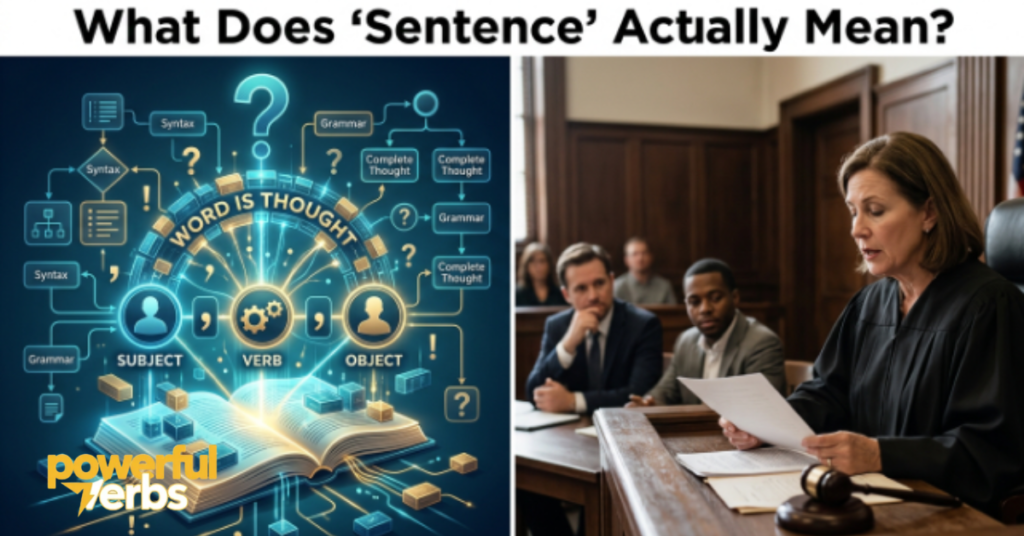
The word sentence carries two distinct meanings in English, which is another reason it appears so frequently in everyday language.
In Grammar and Writing: A sentence is a group of words that contains a subject and a predicate and expresses a complete thought. It begins with a capital letter and ends with a period, question mark, or exclamation point.
In Law and Justice: A sentence refers to the formal punishment assigned by a judge or court following a criminal conviction.
Both meanings are widely used, both are spelled “sentence,” and neither ever becomes “sentance” under any circumstance.
see also:Vender or Vendor? Here’s the Real Difference
The Four Types of Sentences in English Grammar
Understanding sentence types helps reinforce correct usage. These are the four core classifications used in English linguistics and language instruction.
Declarative Sentence — Makes a statement or expresses a fact. Example: The sun rises in the east every morning.
Interrogative Sentence — Asks a direct question. Example: Have you ever visited the mountains in autumn?
Imperative Sentence — Gives a command, instruction, or request. Example: Please submit your assignment before the deadline.
Exclamatory Sentence — Expresses strong emotion or emphasis. Example: What an incredible performance that was!
Each of these is a grammatically complete unit of language — and each one is always called a “sentence,” never a “sentance.”
Why Do So Many People Write “Sentance” by Mistake?
The misspelling “sentance” happens for a logical reason rooted in how English sounds versus how it is spelled. When native and non-native speakers pronounce “sentence,” the middle vowel often blurs. The “-ence” ending sounds somewhat similar to “-ance” in casual speech, which causes writers to default to the wrong suffix.
English has many words ending in “-ance” — distance,urance, performance, relevance — which reinforces this pattern. Since both endings sound similar when spoken quickly, the brain sometimes selects the wrong one during writing.
The fix is simple: Remember that “sentence” ends in -ence, just like the words “complete,” “presence,” and “evidence.” A sentence, by definition, expresses a complete thought — so link the word to “complete” in your memory, and the correct ending will follow naturally.
Sentence: Correct Usage Across Different Contexts

Grammar and Academic Writing
A well-crafted sentence improves the overall readability of any written work. In academic writing, sentence structure directly affects the clarity of your argument and the strength of your analysis.
Every sentence in an essay should serve a purpose — whether to introduce a point, provide evidence, or offer a conclusion.
Linguists define a grammatically complete sentence as one that contains at minimum a subject and a finite verb.
Legal and Judicial Context
The defendant received a reduced sentence after the appeal was reviewed by the court.
Sentencing guidelines vary by jurisdiction, but the fundamental meaning of the word remains consistent across all legal systems.
The judge carefully read the sentence aloud so the entire courtroom could hear the ruling.
Everyday Conversation and Digital Communication
Can you rephrase that sentence? It is a little unclear.
Your opening sentence sets the tone for the entire message.
A strong subject line is basically the first sentence your reader sees.
Real-World Examples: How “Sentence” Appears in Practice
Writers across all fields use the word “sentence” constantly. Here is how it appears in realistic, everyday scenarios.
In a Classroom: The teacher asked each student to write a sentence using the vocabulary word of the day.
In a Newsroom: The editor flagged a run-on sentence in the third paragraph and asked the reporter to break it into two.
In a Courtroom: After deliberating for six hours, the jury delivered its verdict and the judge announced the sentence.
In a Text Message: Hey, your last sentence didn’t make sense — did you mean to write something else?
In an Office Email: Please keep each sentence short and direct so the report is easy to skim.
In an Academic Paper: Each topic sentence should clearly introduce the central argument of its paragraph.
see also:Shiney or Shiny: Which Spelling Is Actually Correct?
Spelling Breakdown: S-E-N-T-E-N-C-E
One reliable method for locking in the correct spelling is to break the word into visible parts.
sen + ten + ce
Notice that the word “ten” sits right in the middle of “sentence.” You can use this as a memory anchor — a sentence has ten letters, and “ten” lives inside it. Count them: S-E-N-T-E-N-C-E. That is exactly ten characters.
This trick works for both native English speakers and ESL learners who frequently mix up “-ence” and “-ance” endings.
British English vs American English: Any Difference?
None whatsoever. The spelling “sentence” is identical in British English, American English, Canadian English, Australian English, and every other major variety of the language. There is no regional variation, no alternate form, and no dialect in which “sentance” becomes acceptable.
This makes the rule especially easy to apply — no matter where in the world you are writing, the correct spelling never changes.
Final Word
Spelling matters, and “sentence” is one of those words that trips up even careful writers. The rule is absolute: the correct form is always sentence, never sentance. Whether you are writing for school, work, legal purposes, or personal expression, the correct spelling remains the same across every context, every region, and every style guide.
Keep the mnemonic in mind — sen + ten + ce — and this spelling will stay with you permanently.
FAQs
Is “sentance” ever correct in any dialect of English?
No. “Sentance” is not recognized in any dialect, regional variety, or historical form of English. It is always a spelling error.
Can a single word be a sentence?
Yes. Single-word sentences are grammatically valid. “Stop!” “Help!” and “Go!” are all complete sentences because they contain an implied subject and a clear verb.
What is the difference between a sentence and a clause?
A clause contains a subject and a verb but may not express a complete thought on its own. A sentence always expresses a complete, independent thought and can stand alone.
Does “sentence” have more than one meaning?
Yes. In grammar, it refers to a complete unit of language. In legal contexts, it refers to the punishment handed down by a court after a conviction.
How do you avoid run-on sentences?
Break long sentences into shorter ones using a period, or join them correctly with a semicolon or coordinating conjunction such as “and,” “but,” or “so.”
What is the origin of the word “sentence”?
The word comes from the Latin “sententia,” meaning opinion or feeling, which itself derives from “sentire,” meaning to feel or perceive. It entered Middle English through Old French as a term for meaning or judgment.

Liam Johnson is a dedicated language expert with 4 years of professional experience. He specializes in Grammar, Vocabulary, and Sentence structure.
