

If you’ve ever paused mid-sentence wondering whether to write “referral” or “referal,” you’re not alone. This is one of the most frequently searched spelling questions in English, and it shows up constantly in healthcare paperwork, job applications, business emails, and marketing copy.
Here’s the short answer: referral is the only correct spelling. Referal is a misspelling and should never appear in professional, academic, or formal writing.
This guide explains exactly why “referral” keeps its double “r,” where the confusion comes from, how the underlying spelling rule actually works, and how to use the word naturally and correctly so the mistake never creeps back into your writing.
see also:250+ Daily Routine Vocabulary Words in English with Pictures and Examples
Referral or Referal: The Quick Answer
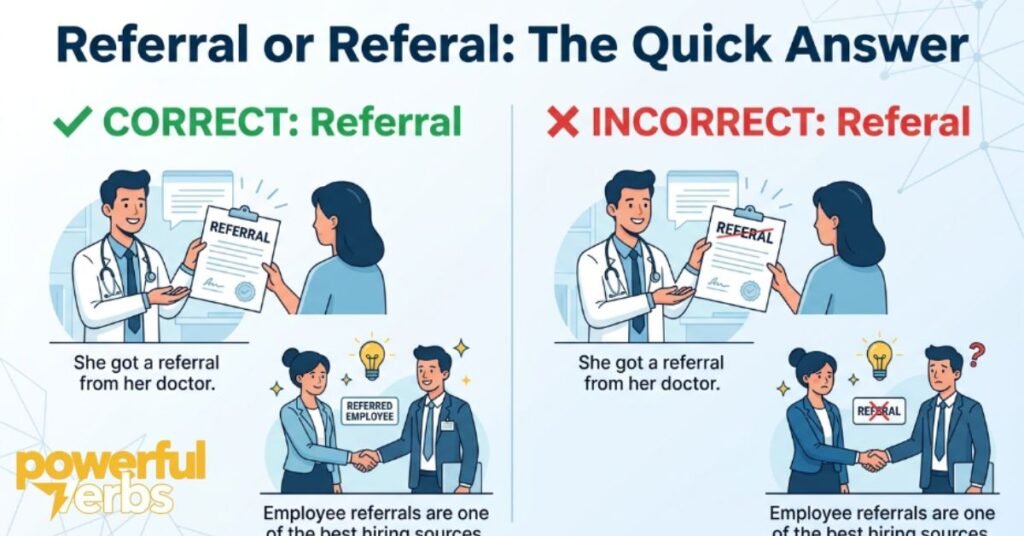
Correct: She got a referral from her doctor. Incorrect: She got a referal from her doctor.
Correct: Employee referrals are one of the best hiring sources. Incorrect: Employee referals are one of the best hiring sources.
| Spelling | Status | Why |
| Referral | Correct | Standard spelling in every major English dictionary |
| Referal | Incorrect | A common typo caused by dropping one “r” |
There is no version of English, formal or informal, regional or global, where “referal” is an accepted spelling. It isn’t a casual variant, it isn’t a British or American difference, and it doesn’t appear in any standard dictionary. It’s simply a typo that has become common enough to confuse writers everywhere.
What “Referral” Actually Means

Understanding the meaning helps explain why this word gets typed so often, and why it gets misspelled so often, too. A referral is the act of directing, recommending, or passing someone (or something) along to another person, service, or resource.
The word shows up across several everyday contexts. In healthcare, a referral is when a doctor sends a patient to a specialist for further treatment. In recruitment, it’s when an employee recommends a candidate for an open role, often through a company’s employee referral program.
In business and marketing, a referral usually describes a customer who arrived because another customer recommended the brand, frequently tracked through a referral code, referral link, or referral bonus. In casual conversation, it can simply mean a recommendation, like a friend referring you to a reliable mechanic or a good restaurant.
Because the word is so common in resumes, medical forms, and marketing emails, it gets typed quickly and repeatedly, which is exactly the kind of writing where a missing letter slips through unnoticed.
see also:A-Z Citrus Fruits List: 50+ Types with Pictures, Benefits & Uses
Synonyms and Related Terms
Knowing the words that travel alongside “referral” makes its spelling, and its usage, easier to remember. Close synonyms include recommendation, endorsement, recommendation letter, introduction, lead, and referral source. In digital marketing specifically, you’ll also see related terms like referrer, referral traffic, and referral marketing, all of which describe how someone arrives at a business through another person’s recommendation rather than through advertising. None of these related words change the spelling rule for “referral” itself, but recognizing them helps confirm you’re using the right word for the right context.
Why So Many People Write “Referal” Instead

If this mistake were random, it wouldn’t be searched online thousands of times every month. There’s a clear linguistic reason behind it, and it comes down to how the word is built.
“Referral” comes from the verb “refer” plus the suffix “-al.” Most English speakers already know that adding “-al” to a word usually doesn’t require doubling a letter — think of “denial,” “arrival,” or “approval.” That pattern makes “referal” feel intuitively correct, even though it isn’t. The brain is applying a general rule to a word that actually follows a more specific one.
Autocorrect tools don’t always catch the difference either, especially on mobile keyboards, where a misspelling can slip through if a personal dictionary has “learned” it from repeated use. Combine that with fast typing in emails, CRM systems, and job applications, and the error spreads quietly across thousands of documents.
The Spelling Rule Behind the Double “R”

This is the part most explanations skip, and it’s the part that actually makes the correct spelling stick in memory long-term.
English has a doubling rule for short verbs that end in a single vowel followed by a single consonant, when the stress falls on the final syllable. When a suffix starting with a vowel is added — such as “-ing,” “-ed,” or “-al” — that final consonant gets doubled.
“Refer” fits this pattern exactly. It’s pronounced re-FER, with stress on the second syllable, and it ends in a single vowel (“e”) followed by a single consonant (“r”). That’s why English keeps the double “r” across the whole word family:
refer becomes referring, refer becomes referred, and refer becomes referral.
Compare this to other verbs that follow the exact same rule: “occur” becomes “occurring” and “occurred,” “transfer” becomes “transferring” and “transferred,” and “prefer” becomes “preferring” and “preferred.” None of these drop a letter, and “referral” doesn’t either.
Words like “denial” or “arrival,” on the other hand, don’t double their final consonant, because their base verbs (“deny” and “arrive”) don’t follow the same stress-and-spelling pattern. That mismatch is the real source of the confusion: writers unconsciously borrow a rule from the wrong word family.
Doubling letters incorrectly isn’t unique to ‘referral’ — see our breakdown of Openned or Opened for a similar mix-up.
Where the Word Comes From
“Referral” traces back to the Latin verb referre, a combination of re- (back) and ferre (to carry or bring). The original sense was “to carry back” or “to relate,” which evolved over centuries into the modern meaning of directing someone toward a person, service, or piece of information.
The noun “referral” is relatively newer compared to the verb “refer,” which has existed in English since the late Middle Ages. “Referral” became widely used mainly in the twentieth century, growing alongside professional fields like medicine, law, and recruitment, where formally passing someone along needed a dedicated noun of its own.
How to Pronounce “Referral”
“Referral” is pronounced rih-FUR-uhl (IPA: /rɪˈfɜːrəl/), with the stress landing on the second syllable — the same syllable that carries the doubled “r.” Saying it slowly, breaking it into re-FER-ral, is actually the fastest way to internalize both the pronunciation and the spelling at once, since the stressed syllable is exactly where that extra “r” belongs.
see also:300+ Adjectives to Describe a Person: Positive, Negative & Neutral With Examples
Is There a British vs American Spelling Difference?
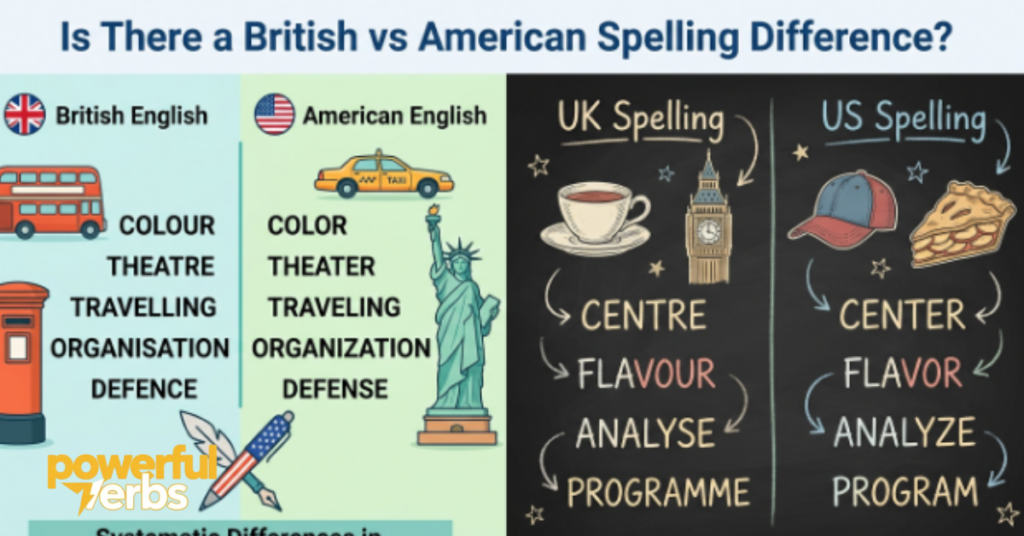
No, and this is one of the rare English words where there’s zero regional variation. Unlike “colour/color” or “organise/organize,” “referral” is spelled exactly the same way in British English, American English, Canadian English, Australian English, and every other major English variant used around the world.
| Region | Accepted Spelling |
| United States | Referral |
| United Kingdom | Referral |
| Canada | Referral |
| Australia | Referral |
| India / Pakistan | Referral |
| International / Global business English | Referral |
Whether you’re writing for a local audience or an international one, the spelling never changes. The only spelling that changes anything here is the wrong one.
Common Misspellings to Watch For
“Referal” is by far the most frequent mistake, but writers also occasionally type a few other variations by accident.
- Refferal — adds an extra “f” instead of the missing “r”
- Referall — moves the doubled letter to the end of the word instead of the middle
- Refferral — combines both mistakes at once
- Referale — adds an unnecessary “e,” sometimes from autocomplete suggestions
Every one of these is incorrect. There is exactly one accepted spelling, and the double “r” always sits right after “refe,” never anywhere else in the word.
If you also mix up i-before-e words, check out our guide on Receive or Recieve for another classic spelling trap.
Words in the Same Family
Once “referral” feels natural, the related forms become much easier to spell too, since they all follow the same doubling pattern from “refer.”
Refer is the base verb, as in “Please refer to page twelve.” Referring is the present participle, as in “She is referring patients to the clinic.” Referred is the past tense, as in “He referred me to a great accountant.” Referrer describes the person or source making the referral, a term used often in marketing and web analytics. Referrals is simply the plural form, as in “The agency processed dozens of referrals this week.”
Every single one of these keeps the doubled “r” before adding its ending. Once you remember that “refer” always preserves that extra “r” when a vowel-starting suffix is attached, you’ll spell the entire word family correctly without having to think twice.
For another quick spelling fix, take a look at Label or Lable.
How to Use “Referral” Correctly in a Sentence
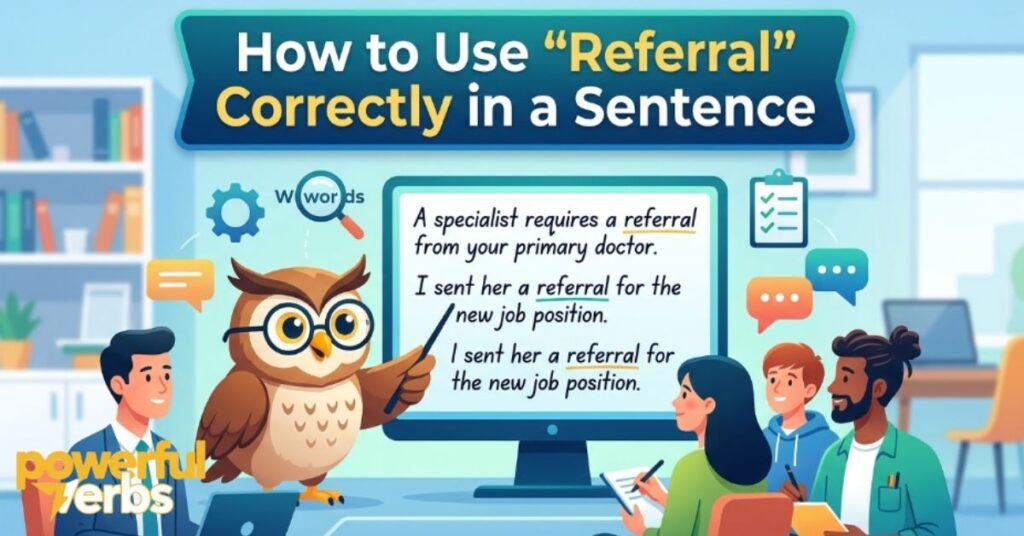
Seeing the word in different real-world contexts makes the correct spelling easier to recall under pressure.
“My manager asked for a referral before she would consider the candidate.” “You need a referral from your GP to see this specialist.” “Our referral program gives both you and your friend a discount on the next purchase.” “The law firm runs almost entirely on client referrals rather than advertising.” “I’ll send you a referral link so you can sign up and get the bonus.”
In each case, the word functions as a noun describing a recommendation, a formal redirection, or a person introduced through someone else’s network. Memorizing one sentence from your own field, whether that’s healthcare, sales, hiring, or customer service, is usually the fastest way to make the correct spelling automatic.
Why Getting This Right Actually Matters
A single missing letter might seem minor, but spelling mistakes like “referal” tend to surface in exactly the documents where credibility matters most: resumes, cover letters, client proposals, medical intake forms, and marketing campaigns. A recruiter scanning a resume, a patient reading a clinic’s website, or a customer evaluating a referral program email will all notice a misspelled, frequently repeated word faster than almost any other kind of error, simply because it appears so often in that type of writing. Getting it right consistently is a small detail that quietly signals attention and professionalism.
A Simple Way to Remember It Forever
If the grammar rule doesn’t stick right away, a memory trick usually does. Picture the word in two pieces: “refer” plus “ral.” Since “refer” already contains one “r” in the middle, all you’re doing is keeping that same letter and adding “ral” on top — you’re never removing anything, only adding three letters. Saying the word out loud slowly, re-FER-ral, with a clear pause on each syllable, also makes that double “r” far harder to forget than reading it silently ever will.
Quick Self-Check
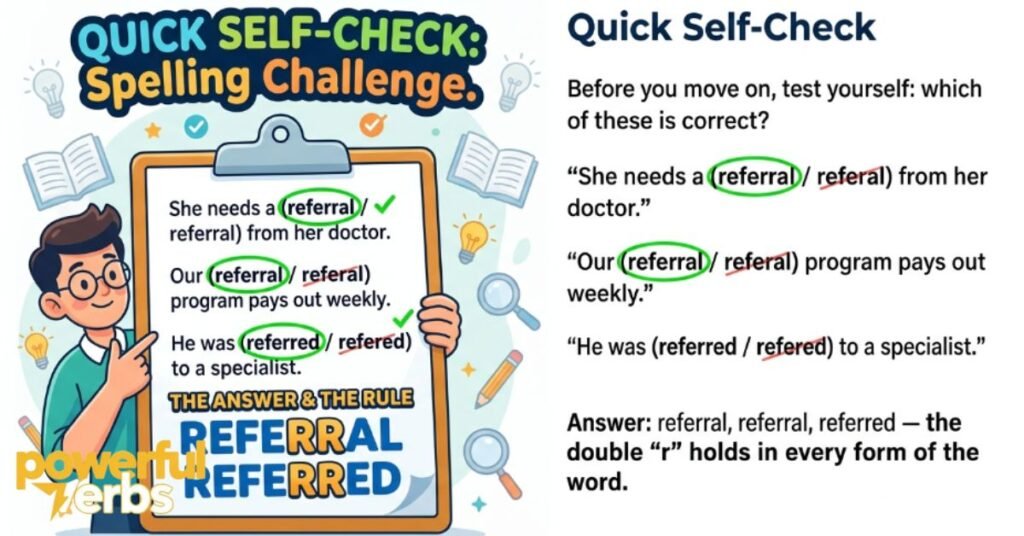
Before you move on, test yourself: which of these is correct?
- “She needs a (referral / referal) from her doctor.”
- “Our (referral / referal) program pays out weekly.”
- “He was (referred / refered) to a specialist.”
Answer: referral, referral, referred — the double “r” holds in every form of the word.
Conclusion
“Referral” is the only correct spelling, in every region, every industry, and every level of formality. “Referal” is simply a typo that happens when a general English spelling pattern gets misapplied to a word that actually follows a more specific rule. Once you understand that “refer” doubles its final “r” before taking a vowel-starting suffix, the correct spelling becomes permanent, with no more guessing, no more second-guessing, and no more typos slipping into resumes, emails, or marketing copy.
FAQs
Is “referal” a real word?
No. “Referal” doesn’t appear in any standard English dictionary. It’s a common misspelling of “referral” and should always be corrected.
How many R’s does “referral” have?
Two. One sits in the middle as part of “refer,” and that same letter is kept when “-ral” is added, giving you re-fer-ral.
Is “referral” spelled differently in British and American English?
No. “Referral” is spelled exactly the same way in British English, American English, and every other major English variant worldwide.
What’s the easiest way to remember the correct spelling?
Think of it as “refer” plus “ral.” Since “refer” already has the double “r” pattern built into its root, you’re only ever adding letters, never removing any.
What does “referral” mean in simple terms?
It means recommending or directing someone, or something, toward another person, service, or option, like a doctor sending a patient to a specialist or a friend recommending a good plumber.
Is “referal” ever acceptable in casual or informal writing?
No. Even in texts, social media captions, or quick emails, “referal” is still incorrect. Informal tone doesn’t change spelling rules, so it’s best to use “referral” consistently everywhere you write.

Liam Johnson is a dedicated language expert with 4 years of professional experience. He specializes in Grammar, Vocabulary, and Sentence structure.
