
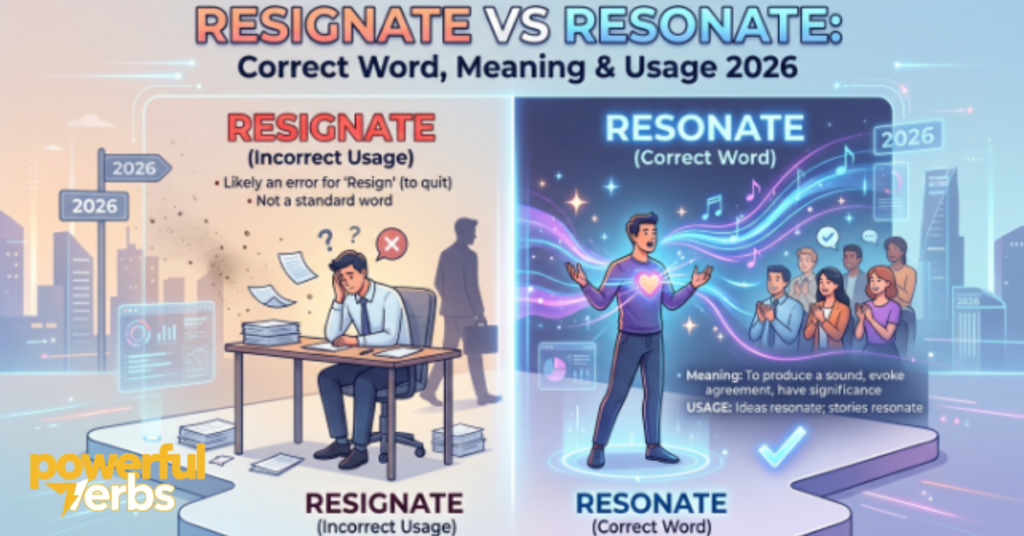
Some word confusions in English are harmless. A person swaps one synonym for another, the meaning survives intact, and nobody notices. The confusion between resignate and resonate is not that kind of mistake.
One of these words is real. It carries meaning, history, emotional depth, and grammatical legitimacy. It appears in dictionaries, academic journals, brand strategies, political speeches, literary criticism, and everyday conversation. It is one of the most evocative verbs in the English language precisely because it captures something difficult to articulate — the feeling that an idea, a story, or a message has struck a chord deep inside you.
The other word does not exist. It has no dictionary entry, no etymological roots, no grammatical function, and no place in any form of correct English writing or speech. Yet it appears constantly — in corporate presentations, social media captions, motivational content, and casual conversation — because it sounds close enough to the real word that many speakers never stop to question it.
This guide removes every trace of that uncertainty. By the time you reach the final section, you will know exactly which word is correct, precisely what it means, where it came from, how to use it across every context, and why getting this right matters far more than most people realize.
The Straight Answer — Is Resignate a Real Word?
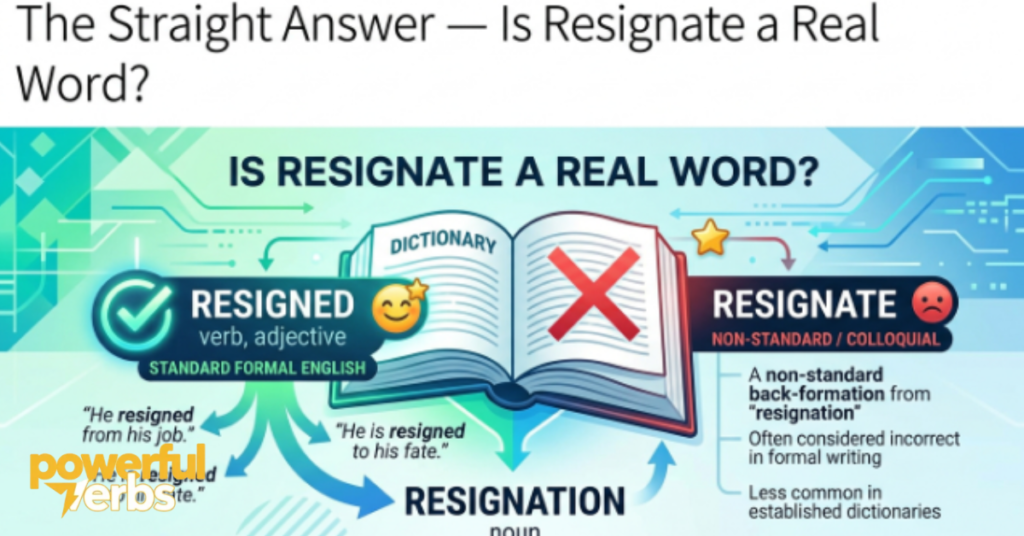
No. Resignate is not a real English word under any circumstances, in any context, in any recognized variety of English — British, American, Australian, or otherwise.
It does not appear in Merriam-Webster. It does not appear in the Oxford English Dictionary. It does not appear in Cambridge, Collins, Macmillan, or any other recognized linguistic authority. Grammar tools flag it as an error. Professional editors remove it. Style guides do not acknowledge it. Academic institutions do not accept it.
The reason resignate feels real to so many people is rooted in how English builds words. Speakers who know the noun resignation assume, understandably, that there must be a corresponding verb — resignate — the same way designate connects to designation, or allocate connects to allocation. This is a logical inference based on real patterns in the language. The problem is that resignation does not follow that pattern. The noun resignation derives directly from the verb resign, not from any intermediate verb form. There is no resignate in the word’s history, and there never has been.
Using resignate in professional writing, formal communication, or published content signals to careful readers that the writer has not verified their word choice. In contexts where credibility and precision matter — journalism, academia, business, legal writing, or public speaking — that signal carries real consequences for how the writer is perceived.
The correct word is resonate. It always has been, and it always will be.
What Does Resonate Actually Mean?
Resonate is a verb of remarkable range. It operates simultaneously in the physical world of sound and in the interior world of human emotion and thought, which is part of what makes it so versatile and so frequently useful.
In its most literal sense, resonate describes what happens when sound vibrates through a space, an object, or a medium in a way that produces a full, rich, sustained quality. A cello string resonates inside the body of the instrument. A voice resonates through a cathedral. A tuning fork resonates when struck because its vibrations match the natural frequency of the surrounding air.
In its figurative sense — which is now the dominant usage in most modern contexts — resonate describes the effect that an idea, a message, an image, a story, or an experience has on a person when it connects deeply with their emotions, values, beliefs, or memories. When something resonates with you, it does not merely reach you on a surface level. It strikes something fundamental. It produces an inner reverberation — an emotional echo — that continues after the initial moment of contact has passed.
This figurative meaning is what makes resonate one of the most powerful verbs available to communicators, writers, marketers, leaders, and speakers. It describes a quality of connection that goes beyond simple agreement or appreciation. When an audience member tells a speaker that their message resonated, they are saying something more profound than “I liked what you said.” They are saying the message touched something real inside them, aligned with something they already believed or felt but had not yet found words for, and left an impression that will persist.
The verb conjugates as resonate, resonates, resonated, and resonating. The related noun is resonance. The adjective form is resonant. All of these are standard, recognized, and widely used in formal and informal contexts across every major English-speaking region.
The Latin Roots Behind Resonate
The history of resonate stretches back more than two thousand years, which is one reason the word carries such weight and stability in modern English. Understanding where it came from makes its meaning even clearer and reinforces why it is the correct word in every situation where resignate is incorrectly used.
Resonate derives from the Latin verb resonare, which meant to sound again, to echo, or to reverberate. That Latin verb is itself a compound of two elements — the prefix re, meaning again or back, and sonare, meaning to sound or to make noise. Sonare is also the ancestor of a wide family of English words including sound, sonic, sonnet, sonata, consonant, and dissonant, all of which carry the core idea of sound and vibration within them.
Resonare appeared in classical Latin texts to describe physical acoustic phenomena — the way sound traveled through spaces, bounced off surfaces, and returned with amplified or altered qualities. Roman architects and engineers actually used principles of resonance when designing amphitheaters and public spaces, ensuring that voices would carry clearly to every corner of the audience.
When the word moved through Old French and into Middle English, it retained its acoustic foundation. The figurative meaning — the sense of emotional or intellectual reverberation — developed gradually through the eighteenth and nineteenth centuries as writers began to use acoustic metaphors to describe the internal experience of hearing something that aligns powerfully with one’s own thoughts and feelings.
By the twentieth century, the figurative meaning had become the primary meaning in most contexts outside of physics and music. Today, when someone says a message resonates, they are drawing on two thousand years of linguistic heritage — a verb born from the physics of sound and transformed over centuries into one of the most precise descriptions of human emotional connection available in the English language.
Resignate, by contrast, has no Latin root, no etymological history, no linguistic evolution, and no heritage of any kind. It is a recent invention produced by mishearing, and it carries nothing behind it.
Why People Say Resignate Instead of Resonate
The persistence of resignate in spoken and written English is a genuinely interesting linguistic phenomenon. It is not simply carelessness. Several well-documented cognitive and social mechanisms work together to keep this non-word alive and spreading.
The most powerful mechanism is analogical reasoning — the brain’s tendency to apply familiar patterns to unfamiliar situations. English is full of noun-verb pairs where a verb ending in -ate produces a noun ending in -ation. Designate produces designation. Allocate produces allocation. Communicate produces communication. Fascinate produces fascination. The brain registers resignation and reaches backward for the verb it assumes must be sitting behind that noun. Since resign does not end in -ate, the brain constructs one that does — resignate — and files it away as a plausible English verb.
A second mechanism is phonetic proximity. In rapid, casual speech, the distinction between resonate and resignate is not always immediately obvious to a listener who is not paying close attention. The first syllable differs — re versus re-sig — but in conversational speech delivered at normal pace, that difference can blur. A listener who catches the ending -nate and constructs a word backward from that ending arrives at resignate rather than resonate.
Social amplification is the third mechanism. Once a public figure, a popular podcast host, a prominent speaker, or a widely shared video uses resignate, that usage is broadcast to large audiences who hear it delivered confidently and in a context that suggests authority. Listeners assume the speaker has verified their word choice and file resignate away as correct. Those listeners repeat it in their own speech, and the error propagates without any single person intending to spread incorrect information.
Infrequent exposure to written resonate reinforces the problem. A person who primarily consumes spoken content and rarely reads formal or literary writing may go years without seeing resonate on a page. Without visual reinforcement of the correct spelling and form, the spoken version they have internalized — which may already be a distorted rendering — becomes their permanent mental reference.
Resignate vs Resonate — The Core Difference Explained
The comparison between resignate and resonate is ultimately a comparison between a word that exists and a word that does not. But understanding the specific dimensions of that difference helps clarify why the error matters and why resonate is not interchangeable with any other term.
Resignate has no definition because it has no entry in any recognized dictionary. It has no accepted grammatical function. It has no established usage history in formal writing. It has no synonyms because there is no meaning to synonymize. It has no antonyms for the same reason. If you use it, you are using a word that exists only as a mistake — a linguistic ghost produced by mishearing and analogical error.
Resonate has a precise, stable, widely accepted definition encompassing both physical sound vibration and figurative emotional or intellectual impact. It has a documented etymological history traceable through Latin, French, and Middle English. It has established grammatical forms across all standard tenses and participial constructions. It has a rich network of synonyms, near-synonyms, and related terms. It appears in dictionaries, style guides, academic papers, literary criticism, brand strategy documents, speeches, and everyday conversation.
The practical consequence of this difference is absolute. In any piece of writing intended to be taken seriously — whether a business proposal, a blog post, a speech, a personal essay, or a social media caption aimed at an educated audience — resonate is the only option. Resignate has no role in any of these contexts and will undermine the credibility of the writing in which it appears.
How Resonate Works as a Verb — Tense, Form & Grammar
Using resonate correctly requires understanding its grammatical behavior across different tenses and sentence structures. The verb is regular, which means it follows standard conjugation patterns without any of the irregularities that complicate verbs like become or arise.
The base form resonate appears in present tense sentences with plural subjects or with first and second person subjects. Stories that capture universal human experiences resonate across cultures and generations. Ideas resonate when they are delivered with clarity and conviction. Authentic voices resonate in ways that polished but hollow performances never can.
The third-person singular present tense is resonates, used when the subject is he, she, it, or any singular noun. A powerful metaphor resonates long after the speech ends. His voice resonates with a quality that commands attention in any room. The campaign resonates because it addresses a concern that has gone unacknowledged for too long.
The simple past tense is resonated, used for completed events firmly located in the past. The documentary resonated with audiences across every demographic when it was first released. Her words resonated with everyone present at that defining moment. The concept resonated immediately because it articulated something the audience had always felt but never found language for.
The present participle is resonating, used in continuous tenses and as a modifier. The message is resonating with voters in ways that early polling did not predict. A resonating performance leaves the audience changed in ways they may not fully understand until days later.
The past participle is resonated, used in perfect tenses. The speech has resonated with audiences for decades. The design had resonated so deeply that it became the visual identity of the entire movement. By the time the campaign ended, the core message had resonated across every target market the organization had identified.
Resonate in Emotional and Figurative Contexts
The figurative use of resonate is where the word earns its reputation as one of the most expressive verbs in contemporary English. It describes a quality of connection that is simultaneously immediate and lasting — the experience of encountering something outside yourself that seems to speak directly to something inside you.
This figurative resonance operates across multiple dimensions simultaneously. An idea can resonate intellectually when it aligns with what a person already believes or when it articulates a truth they have sensed but not yet named. A story can resonate emotionally when its characters, conflicts, and resolutions mirror experiences the reader has lived or fears they might face. A piece of music can resonate aesthetically when its structure, texture, and mood align with the listener’s own emotional state at that moment.
The most memorable speeches in history resonated not simply because the speaker was articulate but because the message connected with something universal in the audience — a shared fear, a common aspiration, a collective grief, or a widely held but rarely spoken belief. When a communicator achieves that level of resonance, the message does not disappear when the speech ends. It continues to reverberate in the minds and conversations of those who heard it, sometimes for years or decades.
Writers who understand this use resonate deliberately. They build toward moments of resonance by establishing emotional context, developing relatable situations, and then introducing an idea or image that crystallizes everything the reader has been feeling. The word resonate in a sentence signals that this kind of deep connection has been achieved — not merely that something was heard or noticed, but that it struck a chord that continued to vibrate.
The company’s commitment to transparency resonated with consumers who had grown weary of corporate messaging that prioritized image over truth. The poem resonated across languages and cultures because it described a feeling of longing that belongs to no single nation or tradition. His apology resonated because it acknowledged specific harm rather than offering a generalized expression of regret.
Resonate in Literal and Scientific Contexts
While the figurative meaning of resonate dominates contemporary usage, the literal acoustic and scientific meaning remains active and important in specific fields. Understanding this dimension of the word rounds out a complete picture of what resonate means and where it operates.
In physics, resonance describes the phenomenon that occurs when an object or system vibrates at a frequency that matches its natural frequency, producing amplified oscillations. A bridge can resonate dangerously when the frequency of wind or foot traffic matches its structural resonance frequency — a phenomenon that has caused several notable engineering disasters. A wine glass resonates when exposed to a sound wave at its specific resonant frequency, which is the principle behind the famous demonstration of a singer’s voice shattering glass.
In music and acoustics, resonate describes the way instruments amplify and sustain sound through the vibration of air columns, strings, membranes, or structural chambers. The wooden body of a guitar resonates when a string is plucked, adding warmth and depth to what would otherwise be a thin, brief tone. A singer’s chest and skull resonate when the voice is produced with proper support and placement, creating the full, rich quality that distinguishes trained from untrained vocal production.
In chemistry and molecular biology, resonance describes the delocalization of electrons across a molecular structure, producing stability that neither contributing structure alone would possess. This meaning has no direct connection to the acoustic or emotional senses of the word but shares the underlying concept of distributed energy creating a more stable or amplified whole.
The literal and scientific senses of resonate inform and enrich the figurative sense. When someone says a message resonated, they are implicitly drawing on the physics of sound — the image of vibrations matching a natural frequency and producing amplified, sustained effects. The metaphor works precisely because it is grounded in a real acoustic phenomenon.
Resonate in Professional and Business Communication
In professional and business contexts, resonate has become one of the most strategically important verbs in the communicator’s vocabulary. Understanding how to use it correctly — and more importantly, how to create communication that genuinely achieves resonance — is a core competency in marketing, leadership, brand strategy, and organizational communication.
Brand messaging resonates when it connects with the values, aspirations, and lived experiences of the target audience rather than simply describing the features of a product or service. The most enduring brand campaigns in history did not simply inform potential customers about what a company sold. They articulated something about who those customers were, what they believed, and what they wanted their lives to represent. That level of connection is resonance in its fullest professional sense.
Leadership communication resonates when a leader demonstrates genuine understanding of the concerns, pressures, and aspirations of the people they lead. A speech that resonates in an organizational context is one that makes employees feel seen, acknowledged, and connected to a purpose larger than their individual role. A speech that fails to resonate — no matter how technically proficient — leaves the audience feeling that the leader does not truly understand their experience.
Marketing research consistently distinguishes between messages that resonate and messages that merely register. A message that registers is one the audience hears and processes cognitively — they understand what is being communicated. A message that resonates goes further, connecting with the audience’s emotional landscape in a way that motivates belief, loyalty, and action. The gap between registering and resonating is the gap between adequate communication and genuinely effective communication.
The product launch resonated with early adopters because it addressed a frustration the market had accepted as unavoidable rather than recognized as a solvable problem. The rebranding did not resonate initially because it prioritized aesthetic novelty over the values the existing customer base had built their loyalty around. Internal communication resonates most powerfully when it treats employees as intelligent adults capable of understanding complexity rather than audiences to be managed with simplified messaging.
Resonate in Literature, Media & Public Speaking
Across creative and public communication contexts, resonate functions as both a critical term and a creative goal. Writers, critics, speakers, and communicators use it to describe a quality of impact that goes beyond technical excellence into genuine human connection.
In literary criticism, resonance describes the quality of a text that continues to produce meaning and emotional response beyond the initial reading. A poem that resonates does not exhaust itself in one encounter. Each time it is read, it produces new layers of meaning because it is connected to something fundamental in human experience. The great novels that continue to resonate centuries after they were written do so because they capture aspects of the human condition that remain true regardless of the cultural or historical distance between the author and the reader.
In film and television criticism, a scene, character, or theme is described as resonating when it achieves an emotional impact that persists after the credits roll. The films most frequently cited as culturally significant are those whose themes resonated across demographic boundaries — reaching audiences regardless of age, background, or prior familiarity with the subject matter.
In public speaking, resonance is the difference between a presentation that the audience appreciates and a speech they remember. Speakers who achieve resonance do so by connecting their message to something universal — a shared human experience, a widely held but rarely articulated feeling, or a truth that the audience recognizes immediately as something they have always known. The technical skills of public speaking — clear structure, confident delivery, appropriate pacing — create the conditions in which resonance can occur, but they do not guarantee it. Resonance requires genuine connection between the speaker’s message and the audience’s inner life.
The novel’s central metaphor resonated across three generations of readers because it captured the experience of displacement with a precision that sociological analysis had never achieved. The documentary resonated in ways that conventional journalism had failed to produce because it gave human faces and individual stories to statistics that audiences had previously processed without emotional engagement.
Sentences That Prove Why Resonate Is Irreplaceable
The full power of resonate becomes clear when you examine sentences built around it and consider whether any other word could do the same work with the same precision and depth.
The memorial’s simple design resonated more deeply with visitors than any elaborate monument could have, because it left space for personal grief rather than imposing a collective interpretation of loss. No synonym — moved, affected, touched, impacted — captures the sustained, reverberating quality of connection that resonated conveys in this sentence.
Her testimony resonated with the jury not because it was emotionally delivered but because every detail she described reflected an experience they recognized as authentic. The word resonated here carries the specific meaning of striking a chord — connecting with something the audience already knew or felt, rather than simply informing them of new facts.
The campaign’s central image resonated across demographic lines that the marketing team had assumed would require entirely different messaging strategies to reach. This sentence uses resonated to describe the surprising breadth of genuine connection — something that registered not just with one intended audience but with multiple audiences simultaneously, because it touched something universal.
The composer understood that a melody resonates when it mirrors the emotional state the listener is already carrying, rather than imposing a new emotional state from the outside. This sentence uses resonate in a way that blends its acoustic and emotional meanings, capturing the physics of matched frequency as a metaphor for the psychology of emotional alignment.
None of these sentences could be improved by replacing resonate or resonated with any other verb. The word is doing work that no synonym replicates exactly — describing a specific quality of connection that is simultaneously immediate and lasting, both heard and felt, both external and internal.
Words Commonly Confused With Resonate
Beyond the resignate confusion, resonate is sometimes used interchangeably with words that are related but not identical in meaning. Understanding these distinctions prevents a different category of error — using resonate when a more precise word would better serve the sentence.
Reverberate is the acoustic near-synonym of resonate. Both describe sound that continues after its initial production, but reverberate emphasizes the physical bouncing of sound waves off surfaces, while resonate emphasizes the amplification that occurs when vibration matches natural frequency. In figurative use, reverberate often describes the spreading consequences of an event — a decision reverberates through an organization — while resonate describes the internal impact on a specific audience.
Connect is sometimes used in contexts where resonate would be more precise. “Her speech connected with the audience” describes a relationship established. “Her speech resonated with the audience” describes a deeper quality of impact — not just connection but alignment at an emotional or intellectual level that produces lasting effect.
Relate appears in similar contexts but carries a different meaning. “I can relate to that experience” describes personal recognition. “That story resonated with me” describes an emotional reverberation that goes beyond simple recognition into a felt response that lingers.
Strike a chord is the closest idiomatic equivalent to the figurative sense of resonate. Both describe the experience of something connecting at a deep, felt level. Resonate is more versatile and more appropriate in formal writing, while strike a chord is more at home in conversational contexts.
Synonyms, Antonyms & LSI Keywords for Resonate
A complete understanding of resonate includes knowing its synonyms, antonyms, and the network of semantically related terms that search engines and skilled readers associate with it.
The closest synonyms to resonate in its figurative sense include: strike a chord, connect deeply, strike home, hit home, ring true, register emotionally, touch deeply, move, stir, affect profoundly, and make an impression. Each of these carries a slightly different shade of meaning, and none is a perfect substitute in every context, but all operate within the same semantic territory.
In its acoustic and literal sense, the closest synonyms include: vibrate, reverberate, echo, ring, sound, oscillate, and amplify.
The antonyms of resonate in its figurative sense include: fall flat, fail to connect, miss the mark, leave cold, alienate, and leave unmoved. These describe the experience of communication that reaches its audience without producing any felt response.
LSI and NLP keywords that strengthen content about resonate and resignate include: correct word choice, English vocabulary, word confusion, commonly misused words, figurative language, emotional impact, linguistic accuracy, word meaning, professional writing, communication skills, English grammar, vocabulary building, word origin, etymology, Latin roots, effective communication, resonant message, and figurative meaning.
How to Write Messages That Genuinely Resonate
Knowing that resonate is the correct word is the first step. Understanding what creates genuine resonance in communication is the second step — and in many ways the more valuable one.
Messages resonate when they begin from a place of authentic understanding rather than strategic calculation. A communicator who has genuinely listened to their audience — who understands not just their demographic characteristics but their actual concerns, aspirations, frustrations, and values — has the raw material for resonant communication. A communicator who has researched their audience without genuinely engaging with their experience can produce messages that seem targeted but feel hollow.
Specificity creates resonance far more reliably than generality. Abstract statements about shared values rarely resonate because they offer the audience nothing to hold onto. Specific details — a concrete example, a precise image, a particular moment — give the audience something tangible that activates their own emotional memory and experience. The specific detail that resonates is always the one that feels representative of a larger truth rather than idiosyncratic to a single situation.
Emotional honesty produces resonance in contexts where polished professionalism cannot. An audience that has been exposed to carefully managed communication throughout their professional lives has developed sophisticated sensitivity to the difference between authentic expression and performed sincerity. A communicator who acknowledges genuine uncertainty, expresses real concern, or admits to a mistake that most would conceal immediately distinguishes themselves from the managed communication environment and creates the conditions for genuine resonance.
Structural clarity amplifies resonance rather than competing with it. A message whose emotional core is clear and whose supporting elements are organized to build toward that core allows the audience to follow without distraction. When structure serves meaning rather than demonstrating the communicator’s organizational sophistication, the emotional content of the message reaches the audience without interference.
Common Mistakes Writers Make With Resonate
Even writers who use resonate correctly sometimes fall into usage patterns that diminish its impact or produce grammatical errors.
Overuse is the most common problem. Resonate is a powerful word precisely because it describes a specific, significant quality of impact. When a writer uses it to describe every positive response — every instance of agreement, every moment of simple comprehension, every piece of content that performed adequately — the word loses its distinguishing power. Reserve resonate for moments of genuine, deep connection rather than using it as a general synonym for effective.
Incorrect preposition pairing produces a subtle but noticeable error. Resonate is correctly paired with the preposition with when describing the audience affected. The message resonated with the audience — not “to the audience” or “for the audience.” The preposition with signals the relational quality of resonance — something that vibrates in alignment with something else — which is why it is the natural and correct choice.
Confusing resonance with mere popularity is a conceptual error that produces inaccurate sentences. A piece of content that goes viral is not necessarily resonant in the precise sense the word describes. Viral content spreads because it is shareable — often because it is entertaining, surprising, or emotionally provocative in a shallow way. Resonant content produces lasting impact because it connects at a level of genuine meaning. The distinction matters when writing critically about communication.
Using resonated when the impact is still ongoing is a tense error. If something is currently producing impact — if its effects are still being felt — the present perfect has resonated or the present tense resonates is more accurate than the simple past resonated, which implies the impact occurred and concluded at a specific point in the past.
see also: Rapport or Rapport? The Spelling Mistake Costing You Credibility
FAQs
Is resignate ever acceptable in informal writing or casual speech?
No. Resignate is not a word in any register of English — formal, informal, or casual. Its use in any context signals a word choice error rather than a stylistic choice, and it is always better replaced with resonate.
What is the noun form of resonate and how is it used?
The noun form is resonance. It describes the quality of producing deep emotional or intellectual impact, or the physical phenomenon of amplified vibration. A speech can have resonance. A piece of music can achieve resonance. The term appears widely in both technical and figurative contexts.
How do I know when to use resonated versus has resonated?
Use resonated for a completed impact located at a specific point in the past. Use has resonated when the impact began in the past and remains relevant or ongoing in the present. The campaign resonated when it launched describes a historical fact. The campaign has resonated with audiences for a decade describes ongoing current relevance.
Can resonate be used without the preposition with?
Yes, in intransitive constructions where no specific audience is named. The message resonated powerfully is grammatically correct. The preposition with becomes necessary when the sentence identifies the specific audience that experienced the resonance — the message resonated with younger voters.
Why does resignate feel so natural to say even though it is not a word?
Because English regularly forms verbs ending in -ate from nouns ending in -ation — designate from designation, allocate from allocation. The brain applies this pattern to resignation and produces resignate. The pattern feels natural because it reflects a real feature of English morphology, but it does not apply to resignation because that word derives from resign rather than from any -ate verb form.
What is the adjective form of resonate and how is it correctly used?
The adjective form is resonant. It describes something that produces or is characterized by resonance — a resonant voice, a resonant message, a resonant image. It can also describe a space that amplifies sound effectively — a resonant chamber, a resonant hall.
Conclusion
The distance between resignate and resonate is not a matter of style, preference, or regional variation. It is the distance between a word that exists and a word that does not — between linguistic precision and linguistic error.
Resonate is one of the most powerful verbs available to anyone who communicates in English. Its range is extraordinary — from the physics of sound vibration to the deepest territories of human emotional experience. Its history stretches back through two thousand years of Latin, French, and English usage, giving it a stability and richness that few words of comparable length can match. Its figurative meaning captures something genuinely difficult to articulate — the experience of encountering something outside yourself that vibrates in alignment with something inside you — and it captures that experience more precisely than any synonym.
Resignate, by contrast, has no history, no meaning, no grammatical function, and no place in any piece of writing that aims to be correct, credible, and clear.
The next time you want to describe a message that struck a chord, a story that moved an audience, an idea that aligned perfectly with what people already believed, or a piece of communication that left a lasting impression — the word you need is resonate. It has always been the right choice, and now you know exactly why.

Liam Johnson is a dedicated language expert with 4 years of professional experience. He specializes in Grammar, Vocabulary, and Sentence structure.
