

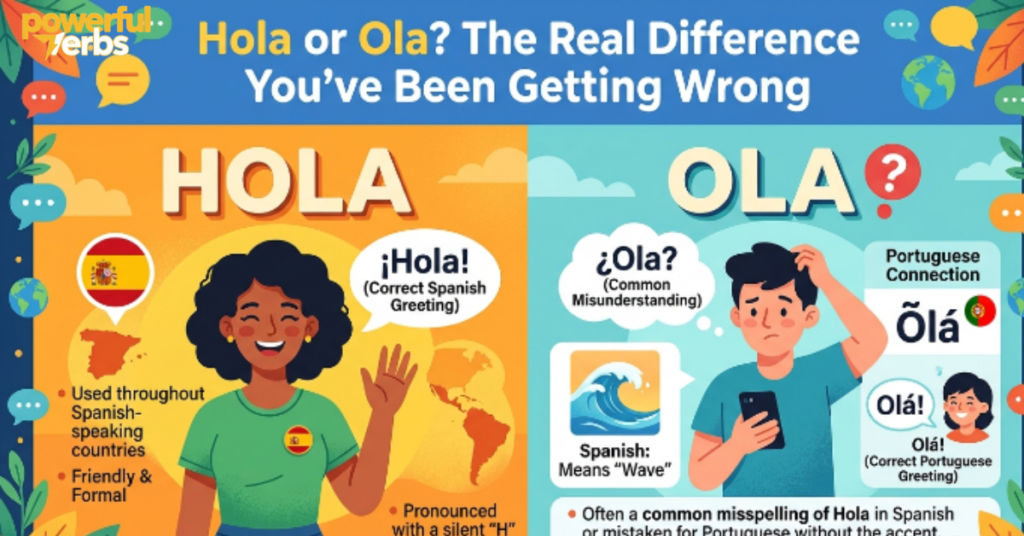
Picture this: you’re texting a Spanish-speaking friend, you type “Hola,” and autocorrect quietly swaps it for “Ola.” Or maybe you’ve seen both spellings floating around online and assumed they were just two ways of writing the same word. They are not, and mixing them up isn’t a harmless typo. It can quietly change the entire meaning of your sentence.
This guide breaks down exactly why these two words look almost identical, sound exactly the same, and yet mean two completely different things, so you never have to guess again.
see also: Stutter or Stutter – Which Form Is Correct? (2026)
Hola vs Ola at a Glance
Hola, spelled with an H, is the Spanish word for hello, used the same way English speakers use “hi” or “hey.” Ola, spelled without an H, means wave, specifically the kind that rolls onto a beach. The two words are pronounced exactly the same way, which is the entire reason this confusion exists in the first place, but their spelling, their grammatical role, and their meaning are completely different.
Where Did “Hola” Come From? A Quick Origin Story
Spanish, like most Romance languages, descended from Latin, and many of its everyday words carry fingerprints of that long evolution. Linguists trace hola back to early interjections used across the Iberian Peninsula to call out to someone or grab their attention, somewhat similar to how English speakers once used “halloo” before it gradually softened into “hello.”
As spoken Latin fractured into regional dialects across Spain, these attention-grabbing calls slowly transformed into a standard greeting. By the time Spanish explorers and settlers carried the language across the Atlantic, hola had already settled into the friendly, all-purpose hello that an entire hemisphere now recognizes instantly.
Why Is the “H” in Hola Completely Silent?
If you are coming from English, the silent H in hola probably feels like a small betrayal. Here is the explanation: many Romance languages, Spanish included, gradually lost the Latin /h/ sound from spoken speech centuries ago, even though the letter often stayed behind in spelling for historical and etymological reasons.
That is exactly why so many common Spanish words begin with a silent H, including hombre, meaning man, hacer, meaning to do, hablar, meaning to speak, and hermano, meaning brother. Hola simply follows the same pattern. The letter sits on the page, but your tongue never actually touches it when you speak.
How to Pronounce Hola the Way Native Speakers Do
Spoken correctly, hola sounds close to “OH-lah,” with a smooth, even rhythm and zero emphasis on the H. English speakers often default to a heavier “HOH-lah,” accidentally pushing air through that silent letter, which instantly signals a non-native accent to fluent listeners.
The fix is simple. Start the word as though it begins with the letter O, glide gently into the L, and keep the stress relaxed rather than punchy. Once you drop the H sound entirely, the word starts rolling off your tongue the way native speakers actually say it.
Hola vs Ola: The Exact Difference You Need to Remember
This is the heart of the entire confusion, and it really comes down to one rule: hola greets, and ola moves.
Hola is an interjection, a word you use to greet someone, the direct equivalent of hello or hi. Ola, on the other hand, is a noun that refers to a wave, almost always the kind of wave you see in the ocean, a lake, or even a crowd, as in “la ola” making its way around a stadium.
Because they are pronounced identically, they qualify as homophones, two words that sound the same but carry entirely separate meanings and spellings. Drop the H by accident in a greeting, and a native Spanish speaker won’t assume you made a typo; they’ll likely just be confused about why you opened a conversation by talking about a wave.
Hola and Ola: Side-by-Side Comparison
| Detail | Hola | Ola |
| Meaning | Hello, a greeting | Wave, in water or a crowd |
| Part of speech | Interjection | Noun |
| Spelling | Begins with a silent H | Has no H at all |
| Example sentence | “Hola, ¿qué tal?” | “La ola rompió contra las rocas.” |
| Common mistake | Dropping the H by accident | Adding an H where none belongs |
Why English Speakers Keep Mixing These Two Words Up
The confusion almost never comes from native Spanish speakers, who learn the distinction early and instinctively. It tends to show up among English speakers, language learners, and casual travelers for one simple reason: English doesn’t have silent H’s that vanish quite this cleanly, so the idea of a letter existing purely for historical reasons feels unfamiliar.
Add autocorrect software that frequently “fixes” hola into ola, along with two very visually similar short spellings, and the mix-up becomes almost predictable. Once you understand that the H carries grammatical weight even though it carries no sound, the confusion tends to disappear for good.
How “Hola” Changes Across the Spanish-Speaking World
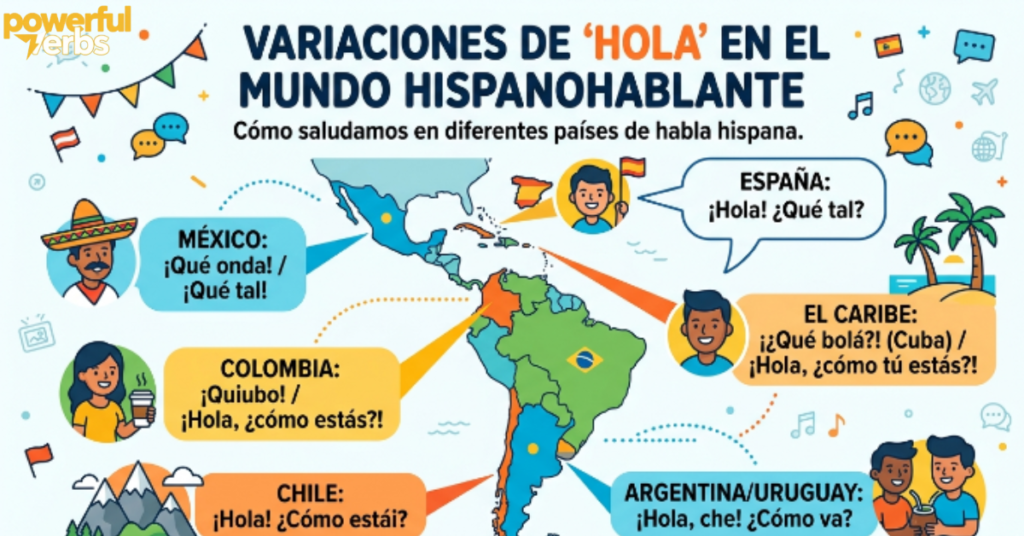
Spanish is spoken across dozens of countries, and while hola remains universally understood, the way people lean on it, stretch it, or pair it with other phrases shifts from region to region.
| Region | How Hola Feels Locally | Common Local Alternative |
| Spain | Crisp and straightforward | “Buenas,” “¿Qué tal?” |
| Mexico | Warm and frequently used | “¿Qué onda?” |
| Argentina | Often drawn out playfully, as in “Holaaa” | “¿Cómo andás?” |
| Colombia | Friendly and upbeat | “¿Qué más?” |
| Caribbean nations | Quick and casual | “¿Qué lo que?” |
Even with all these regional flavors, hola never loses its core identity as the universal Spanish hello, the same way “hi” stays instantly recognizable whether someone is from London, Lagos, or Los Angeles.
Other Spanish Homophones That Trip People Up
Hola and ola are not an isolated case. Spanish has a handful of word pairs that sound identical but diverge completely once you look at the page. Votar, meaning to vote, sounds exactly like botar, meaning to throw something away, a pairing that has caused more than a few embarrassing mix-ups in formal writing. Haber, the verb meaning to have, sounds the same as “a ver,” meaning roughly “let’s see,” and the two get swapped constantly even by native speakers in casual texting.
These pairs exist for the same reason hola and ola do. Centuries of sound simplification stripped away distinctions in pronunciation while spelling held onto the original differences.
Using “Hola” Naturally in English Conversations
Hola has quietly crossed over into everyday English, especially in multicultural cities, bilingual households, and online spaces where Spanish and English blend constantly. Opening a video, a group chat, or a casual meeting with “Hola, everyone!” feels warm, current, and inclusive rather than out of place.
It works especially well in hospitality, tourism, customer service, and education, where greeting a diverse audience with a touch of Spanish signals friendliness without requiring full fluency. The line gets blurry, though, in strictly formal business writing or in rooms where nobody has any connection to Spanish at all; in those settings, sticking with a plain “hello” usually reads as more appropriate.
When You Should Avoid Using “Hola”
Context matters more than the word itself. Dropping hola into a formal cover letter, a legal document, or a first email to a client who has never indicated any connection to Spanish can come across as forced rather than friendly. The same greeting that feels natural in a casual social media caption can feel performative in the wrong setting, so it helps to read the room, or in this case, the inbox, before reaching for it.
How “Hola” Became a Global Greeting Through Pop Culture

Music, television, and social media have done more to spread hola worldwide than any classroom ever could. Reggaeton hits, bilingual sitcom characters, and viral short-form videos have introduced the word to millions of people who may never have studied a single page of Spanish grammar.
Bilingual creators frequently open videos with a casual “Hola, guys,” blending two languages in a single breath, and that small habit, repeated across thousands of channels, has helped cement hola as one of the most recognizable greetings on the internet, regardless of a viewer’s first language.
Quick Memory Trick: Never Confuse Hola and Ola Again
Here’s a simple anchor you can keep forever. H is for Hello. If the word is greeting someone, it needs that silent H sitting at the front, even though you never pronounce it. If the word is describing something rolling across the ocean, crashing on a beach, or moving through a crowd, it loses the H entirely and becomes ola. Greeting keeps the letter; the wave does not.
see also: Receive or Receive: Correct Spelling Guide for 2026
FAQs
Is it Hola or Ola when greeting someone?
It’s always Hola, with a silent H, when you’re saying hello. Ola refers to a wave, not a greeting.
Why does Hola have a silent H if it isn’t pronounced?
Spanish lost the spoken /h/ sound centuries ago, but the letter remained in spelling for historical and etymological reasons, the same pattern seen in words like hablar and hacer.
Do Hola and Ola sound exactly the same when spoken?
Yes, they are homophones, which is exactly why so many people confuse the spelling, even though the meanings have nothing in common.
Can Ola ever mean hello in Spanish?
No. Ola exclusively refers to a wave, whether in the ocean, a lake, or even a stadium crowd. It never functions as a greeting.
Is it appropriate to use Hola in English conversations?
Yes, especially in casual, multicultural, or bilingual settings. It’s best avoided in strictly formal writing where Spanish wouldn’t otherwise fit naturally.
Does Portuguese “Olá” add to the confusion with Hola or Ola?
Often, yes. Portuguese “Olá” looks close to the Spanish “Ola” but actually means hello, which can mislead Spanish learners into assuming the same applies in Spanish.
conclusion
Hola and ola sound like twins but live completely separate lives on the page. One opens a conversation with warmth; the other describes water in motion. The silent H isn’t a random quirk, it’s a small but meaningful marker that tells you exactly which word you’re using. Once that distinction clicks, you won’t second-guess a text, a caption, or a conversation again, and you’ll spell both words with the same easy confidence native speakers use without even thinking about it.

Liam Johnson is a dedicated language expert with 4 years of professional experience. He specializes in Grammar, Vocabulary, and Sentence structure.
