

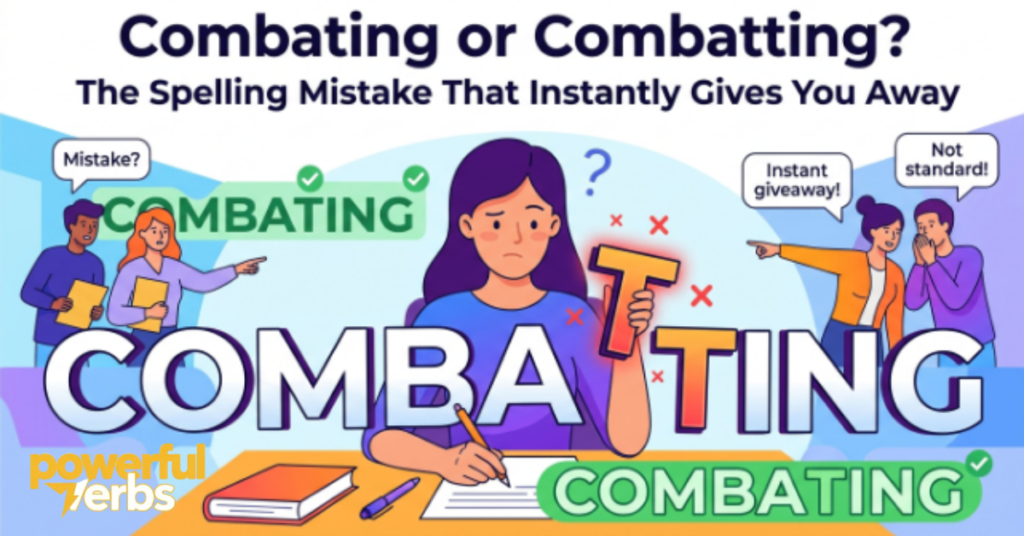
You’re writing a sentence about fighting inflation, fraud, or climate change, and you stop right before typing “-ing.” One T or two? This tiny spelling decision trips up far more writers than you’d expect — and unlike most grammar mistakes, this one isn’t really about right or wrong. It’s about which side of the Atlantic your readers are on.
Get it wrong for your audience, and sharp-eyed readers notice immediately. This guide breaks down exactly why both spellings exist, which one belongs in your writing, and how to make the right call every single time without having to think twice.
Why This Single Letter Causes So Much Confusion

The word at the center of this debate is “combat” — a verb meaning to actively fight against something. When you add “-ing” to form its continuous tense, English grammar has a specific rule for deciding whether the final consonant gets doubled.
The catch is that American and British English apply that rule slightly differently, which is exactly why you’ll see both “combating” and “combatting” floating around online, in news articles, and in published books.
Understanding the Root Word “Combat”
Before tackling the spelling itself, it helps to see how “combat” functions grammatically.
- As a noun: Soldiers braced themselves for combat at sunrise.
- As a verb: Local authorities combat counterfeit goods through stricter regulation.
It’s the verb form that matters here, since adding “-ing” to a verb is exactly where the double-consonant question comes into play.
The Real Rule Behind Doubling Consonants
English has a fairly consistent guideline for when a final consonant doubles before “-ing”: doubling happens when the word ends in a single vowel followed by a single consonant, and the stress lands on that final syllable.
Compare these familiar examples:
| Word | Stress | Result |
| begin | be-GIN | beginning |
| admit | ad-MIT | admitting |
| open | O-pen | opening |
| combat | COM-bat | combating |
Notice that “combat” carries stress on the first syllable, not the last. According to the traditional rule, that means no doubling is required — which is exactly why American English settled on “combating.”
🇺🇸 Combating: The Standard Choice in American English
American spelling conventions tend to favor the streamlined, rule-consistent version, and “combating” fits that pattern perfectly.
Examples:
- Local agencies are combating wildfire risk with new monitoring drones.
- The startup is combating customer churn through better onboarding.
- Researchers are combating antibiotic resistance with novel compounds.
Major American style guides — including AP, APA, and MLA — consistently use the single-T spelling, making “combating” the safe, expected choice for US-based writing.
🇬🇧 Combatting: Widely Accepted in British English
British English doesn’t always apply the stress-based rule as strictly, and historical spelling habits often favored doubled consonants regardless of where the stress fell. As a result, “combatting” remains common and accepted across UK publications.
Examples:
- The council is combatting littering through community clean-up days.
- Charities are combatting homelessness with emergency housing programs.
- The NHS is combatting seasonal flu through expanded vaccination drives.
Both “combatting” and “combating” appear in British writing, though the double-T version remains more traditionally associated with UK style guides like Oxford and Cambridge.
Quick Reference Table: Similar Doubling Patterns
This same US/UK split shows up across several other verbs, so recognizing the pattern helps far beyond just “combat.”
| Word | American Spelling | British Spelling |
| travel | traveling | travelling |
| cancel | canceling | cancelling |
| model | modeling | modelling |
| label | labeled | labelled |
| combat | combating | combatting |
Why American and British Spelling Drifted Apart
Spelling wasn’t always standardized the way it is today. Lexicographer Noah Webster pushed for simplified, phonetically logical American spellings in the early 1800s, deliberately trimming what he considered unnecessary letters from common words.
British English, by contrast, held onto older spelling conventions that predated those reforms. Over time, dictionaries and school systems on each side of the Atlantic locked these differences into place — which is exactly why this single-T-versus-double-T debate still exists today.
Which Spelling Should You Actually Use?
The right choice almost always comes down to your audience, not a universal grammar rule.
- Choose “combating” if you’re writing for American readers, following AP or APA style, publishing on global digital platforms, or aiming for the most internationally recognized spelling.
- Choose “combatting” if you’re writing for British or Commonwealth readers, following UK academic or government style guides, or publishing through outlets that favor traditional British spelling.
If you’re genuinely unsure which audience you’re writing for, “combating” is the safer default — it’s the more globally recognized form and rarely looks out of place, even in British contexts.
Real-World Example: Same Topic, Two Spellings
A US-based nonprofit and a UK-based nonprofit both published reports on workplace stress in the same month. The American report stated that companies were “combating burnout through flexible scheduling,” while the British report described organizations “combatting burnout through mandatory wellness days.”
Neither spelling was incorrect — each simply matched the publication’s regional style guide. The lesson is straightforward: consistency with your audience matters more than picking a single “universal” answer.
Common Mistakes Writers Make (And How to Fix Each One)
- Switching spellings within the same document — pick one form and use it consistently throughout a single piece of writing.
- Assuming “combatting” is simply wrong — it isn’t incorrect, just regionally specific to British English.
- Ignoring your style guide — academic and corporate writing often specifies AP, APA, or Oxford style, which already settles this question for you.
- Forgetting the noun form doesn’t change — “combat” as a noun never doubles regardless of spelling preference.
- Overcorrecting in spell-check — many spell-checkers default to American English and may flag “combatting” even when it’s contextually correct for British writing.
A Simple Trick to Remember Which Spelling to Use
Think of it this way: American English likes things short and efficient — one T, just like “color” instead of “colour” or “traveling” instead of “travelling.” If you’re picturing a streamlined, modern American newsroom, default to the single T. If you’re picturing a traditional British institution, the double T fits right in.
The One Rule That Settles This for Good
Use “combating” for American audiences, global platforms, and AP/APA-style writing. Use “combatting” for British or Commonwealth audiences and traditional UK style guides. When in doubt, “combating” is the safer, more widely recognized default.
see also: Studder or Stutter: The Right Spelling Explained (2026)
FAQs
Is combating or combatting the correct spelling?
Both are correct — combating is standard in American English, while combatting is common in British English.
Why doesn’t combat double its final consonant like other verbs?
Because the stress falls on the first syllable, not the last, which traditionally means no doubling is needed.
Is combatting considered a spelling error in the US?
Not technically wrong, but it’s non-standard for American readers and style guides.
Which spelling works best for an international audience?
Combating is generally the safer choice since it’s more widely recognized across regions.
Are there other words that follow this same American versus British pattern?
Yes, including traveling/travelling, canceling/cancelling, and modeling/modelling.
Does the spelling choice change the meaning of the word?
No, both spellings mean exactly the same thing — the difference is purely regional.
Final Thoughts
The choice between “combating” and “combatting” isn’t about correctness — it’s about matching your spelling to your audience and style guide. Once you know which region you’re writing for, this decision stops being a guessing game and becomes second nature.

Liam Johnson is a dedicated language expert with 4 years of professional experience. He specializes in Grammar, Vocabulary, and Sentence structure.
