

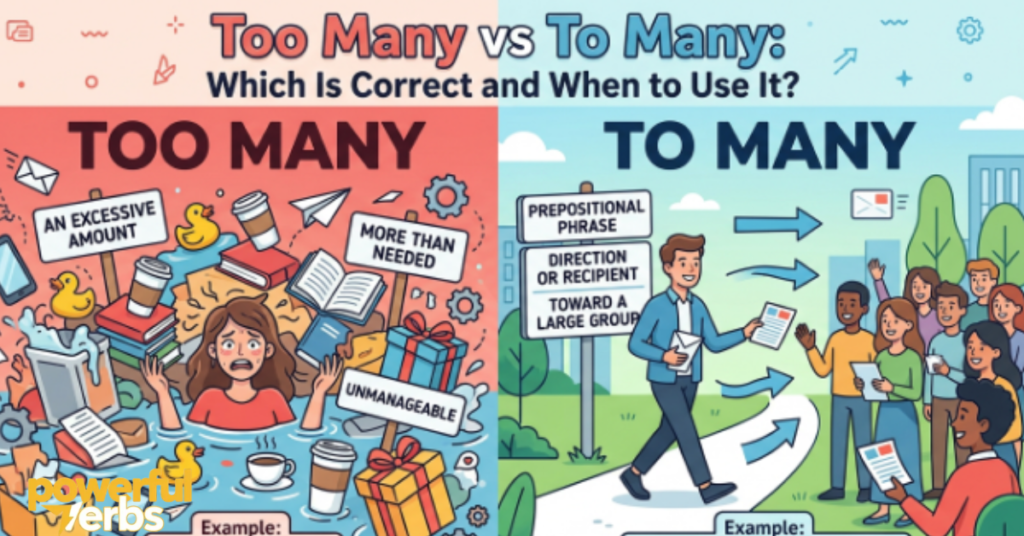
If you have ever typed “to many” and wondered whether it looked right, you are not alone. This is one of the most common spelling slip-ups in the English language, and it trips up both beginners and fluent speakers alike. The two phrases sound exactly the same when spoken aloud, but only one of them is grammatically correct. In this guide, you will learn the clear difference between “too many” and “to many,” why the confusion happens, how to use the correct form in every situation, and how to remember the rule for the rest of your life.
see also: Combating or Combatting? The Spelling Mistake That Instantly Gives You Away
What Does “Too Many” Mean?
“Too many” is a standard English quantifier used to express an excessive number of something. It combines two separate words: “too,” which signals excess or a degree beyond what is acceptable, and “many,” which is a plural quantity word used with countable nouns.
When you say “too many,” you are communicating that the amount of something has crossed a reasonable or comfortable limit. It implies inconvenience, frustration, concern, or overload.
Here are some clear examples of “too many” used naturally in sentences:
- There are too many unread notifications on my phone.
- She made too many assumptions without checking the facts.
- Too many late nights at work can seriously damage your health.
- The teacher gave too many assignments in a single week.
- We ordered too many dishes at the restaurant and wasted half of them.
In every example above, “too many” signals that the quantity has exceeded what is ideal, expected, or acceptable.
What About “To Many” — Is It Ever Correct?
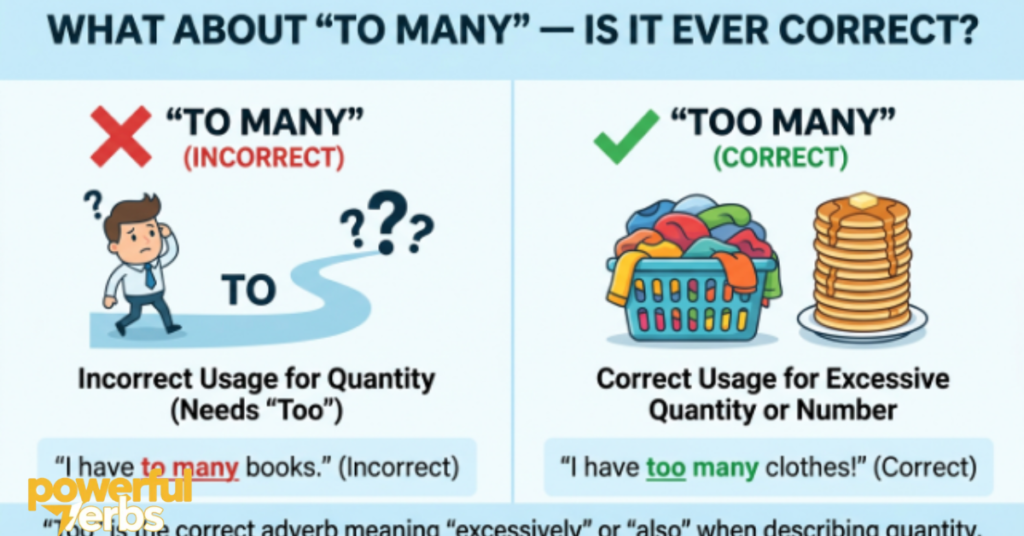
“To many” is almost never grammatically correct when used as a quantity phrase. The word “to” is a preposition or part of an infinitive verb, not a quantity word. It has no ability to express excess or amount on its own.
The only scenario where “to many” appears correctly in writing is when “to” is a preposition naturally followed by the word “many” as part of a separate grammatical structure — not as a fixed phrase meaning excess.
For example:
- “This idea appeals to many people.” — Here, “to” is a preposition and “many” is a pronoun. They are not a fixed phrase.
- “She spoke to many of her colleagues.” — Again, “to” functions as a preposition pointing toward people.
In these cases, “to” and “many” appear next to each other by coincidence of sentence structure, not as a combined quantity phrase. This is completely different from using “too many” to express excess.
The version that is always wrong is using “to many” as a replacement for “too many”:
- She has to many responsibilities.
- There were to many people in the room.
- He received to many complaints.
These are spelling errors. The correct word in each case is “too,” not “to.”
The Core Grammar Rule: Too vs To
Understanding why “too many” is correct starts with understanding the difference between “to” and “too.”
“To” is one of the most common words in English. It functions as a preposition indicating direction, destination, or relationship. It also appears before verbs to form the infinitive form. Examples: go to school, talk to someone, to run, to think.
“Too” is an adverb with two primary functions. First, it means “also” or “as well,” as in “I want some too.” Second, and more relevant here, it means “excessively” or “more than enough,” as in “It is too hot” or “She works too hard.”
When “too” appears before “many,” it amplifies the quantity into excess territory. The double letter “o” in “too” is your signal that something is doubled up — doubled in amount, doubled in intensity, or doubled beyond the normal range.
Think of it this way: two “o”s mean twice as much, which means too much.
Too Many vs Too Much: Knowing the Difference
A related source of confusion for many writers is choosing between “too many” and “too much.” Both express excess, but they apply to different types of nouns.
“Too many” is used with countable nouns — things you can count individually one by one.
“Too much” is used with uncountable nouns — things that exist as a mass or concept that cannot be counted in individual units.
Here is a side-by-side comparison to make this crystal clear:
| Countable Nouns (Too Many) | Uncountable Nouns (Too Much) |
| Too many emails | Too much stress |
| Too many mistakes | Too much sugar |
| Too many meetings | Too much noise |
| Too many cars | Too much traffic |
| Too many questions | Too much information |
The key test is simple: can you put a number directly in front of the noun? If you can say “five emails,” “ten mistakes,” or “three meetings,” then it is countable and you should use “too many.” If you cannot count it individually — like stress, sugar, or traffic — use “too much.”
How to Identify Countable vs Uncountable Nouns Quickly
Choosing between “too many” and “too much” gets easier once you develop a fast instinct for countable versus uncountable nouns. Here are three reliable tests you can apply instantly:
The number test: Can you place a specific number before the noun? “Three dogs” works. “Three water” does not. Dogs are countable; water is uncountable.
The plural test: Can the noun become plural naturally? “Mistakes” is the plural of “mistake,” so it is countable. “Music” has no natural plural form, so it is uncountable.
The article test: Can you say “a” or “an” before the noun to refer to one unit? “A book” works perfectly. “A homework” sounds strange and unnatural. Books are countable; homework is uncountable.
Apply these three tests and you will almost never choose the wrong quantifier again.
Too Few vs Too Many: The Opposite End of the Scale
Just as “too many” expresses an excess of countable things, “too few” expresses a shortage of countable things. These two phrases sit at opposite ends of the same spectrum.
- Too many workers → the team is overstaffed
- Too few workers → the team is understaffed
- Too many calories → eating more than your body needs
- Too few calories → not eating enough to sustain energy
Similarly, for uncountable nouns, “too little” is the opposite of “too much.”
- Too much salt → food is over-seasoned
- Too little salt → food is bland
Understanding both ends of the quantity scale helps you write with precision and nuance, especially in academic writing, professional emails, and reports.
Real-World Examples of “Too Many” in Context
Seeing “too many” used in realistic, everyday situations helps the phrase feel natural rather than technical. Here are examples from different contexts:
In professional communication: We have received too many complaints about delayed shipments this quarter, and the issue requires immediate attention.
In academic writing: The study was limited by too many variables that could not be controlled within the scope of the research.
In casual conversation: I have too many browser tabs open and my laptop is about to give up.
In health and wellness: Too many processed foods in your daily diet can increase the risk of inflammation over time.
In productivity and time management: Scheduling too many tasks in a single day leads to mental fatigue and lower quality output.
Each of these sentences uses “too many” to clearly signal that a limit has been exceeded, whether emotional, physical, professional, or logistical.
Common Errors Writers Make With This Phrase
Beyond the too/to spelling confusion, writers sometimes make other mistakes when using “too many” in sentences. Here are the most frequent ones along with the corrections:
Using “too many” with uncountable nouns: There is too many water in the glass. ✔ There is too much water in the glass.
Omitting “too” entirely by accident: She has many responsibilities to handle alone. ✔ She has too many responsibilities to handle alone. (if excess is the intended meaning)
Confusing “too” with “to” in fast typing: He asked to many questions during the interview. ✔ He asked too many questions during the interview.
Using “too many” with a singular noun: There is too many option to choose from. ✔ There are too many options to choose from.
Awareness of these errors helps you proofread more effectively and catch mistakes before they appear in published or submitted writing.
A Quick Memory Trick That Never Fails
If you always want to write the correct form without second-guessing yourself, use this simple mental shortcut:
Extra O = Extra Amount.
The word “too” has an extra “o” compared to “to.” That extra letter is your reminder that the word signals something extra — an excess, a surplus, more than enough. Whenever you are describing quantity that has gone beyond a comfortable limit, you need that extra “o.” So you always need “too many,” never “to many.”
Another way to test yourself before you type: replace the word in question with “excessively” or “overly.” If the sentence still makes sense, you need “too,” not “to.”
- She has excessively many tasks. → She has too many tasks.
- He went excessively the store. → He went to the store. ✔ (not excess here)
This replacement test works every single time.
Conclusion
The difference between “eventhough” and “even though” comes down to a single space — but that space represents the boundary between incorrect and correct English. “Even though” is a two-word subordinating conjunction with centuries of linguistic history, universal dictionary recognition, and consistent support from every grammar authority. “Eventhough” is a spelling error that has spread through informal digital writing but carries no grammatical legitimacy in any context.
Whether you are writing academic papers, professional emails, creative content, or SEO articles, the rule is absolute and simple: always write “even though” as two separate words. Applying this correction consistently improves the professionalism, clarity, and credibility of everything you write — and it costs nothing more than a single tap of the spacebar.
see also: Resignate vs Resonate: Correct Word, Meaning & Usage 2026
FAQs
Is “to many” ever grammatically acceptable in English?
As a fixed phrase meaning excess, no. The only time “to” and “many” appear together correctly is when “to” is a preposition in a sentence where “many” happens to follow it, such as “she spoke to many people.” That is not the same phrase as “too many.”
Why do so many people write “to many” by mistake?
Because “to” and “too” are homophones — they sound completely identical in spoken English. When people write at speed or without proofreading, the ear takes over from grammar knowledge and the wrong spelling slips in.
Can “too many” be used at the beginning of a sentence?
Yes, absolutely. “Too many responsibilities lead to burnout” is a perfectly grammatical and natural sentence. Starting with “too many” is common in both casual and formal writing.
What is the difference between “too many” and “a lot of”?
Both can be used with countable nouns, but “a lot of” is neutral — it simply describes a large quantity. “Too many” carries a negative judgment — it means the quantity has exceeded what is ideal or manageable. Use “a lot of” when you are being descriptive; use “too many” when you want to express excess or complaint.
Is “too many” formal enough for academic or business writing?
Yes. “Too many” is appropriate in all registers of English — casual conversation, formal essays, business emails, academic papers, and professional reports. It is a standard quantifier with no informal connotations.
How can I stop making this mistake permanently?
Practice reading your sentences aloud and ask yourself: am I expressing excess or direction? If excess, write “too.” Build a habit of pausing on any word you have typed as “to” and asking whether “too” or “two” might be the correct choice in that context. Over time, the correct form will become automatic.

Liam Johnson is a dedicated language expert with 4 years of professional experience. He specializes in Grammar, Vocabulary, and Sentence structure.
