

Understanding noun phrases is one of the most important steps in mastering English grammar. Many students struggle to identify noun phrases in sentences or use them correctly in writing and speaking. This complete guide gives you 150 real examples of noun phrases in sentences, organized by type, with easy explanations, helpful tables, and NLP-friendly vocabulary so you can learn faster and write better English.
What Is a Noun Phrase?
A noun phrase is a group of words that works together as a noun in a sentence. It includes a head noun (the main noun) and one or more modifiers that describe or limit it. A noun phrase can be a subject, object, or complement in a sentence.
Simple example:
- Noun alone → dog
- Noun phrase → the brown dog with a long tail
Noun phrases make your writing more descriptive, precise, and natural. Native English speakers use them constantly, often without realizing it.
Why Learn Noun Phrases?
- They help you write longer, clearer, more detailed sentences
- They improve your IELTS, TOEFL, and English exam scores
- They make your spoken English sound more fluent and natural
- They are the foundation of advanced grammar structures
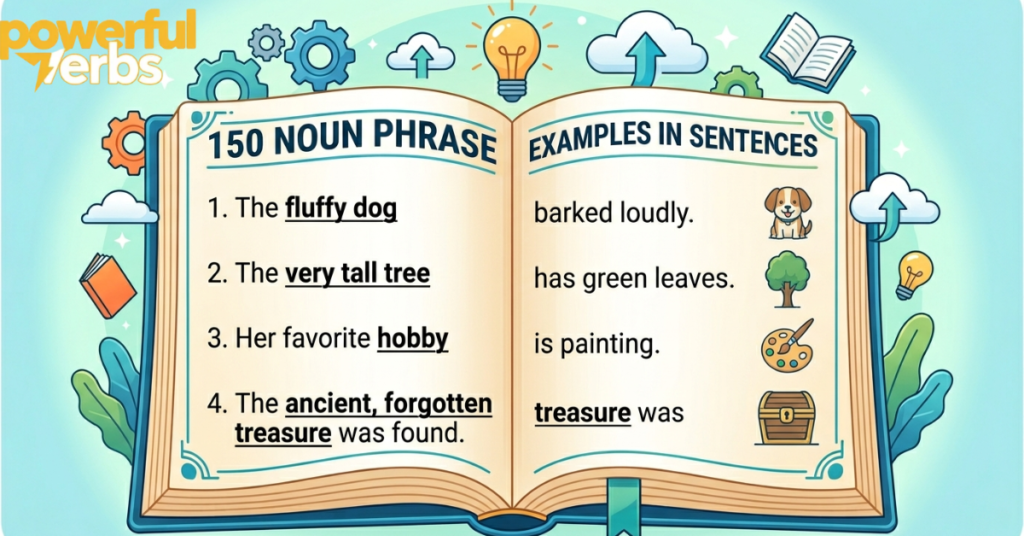
150 Noun Phrase Examples in Sentences
Section 1: Simple Noun Phrases (Basic Level)
These are short, easy noun phrases perfect for beginners. Each noun phrase is used in a complete sentence.
| # | Noun Phrase | Example Sentence |
| 1 | a red apple | She ate a red apple for breakfast. |
| 2 | the old man | The old man walked slowly down the street. |
| 3 | my little sister | My little sister loves drawing colorful pictures. |
| 4 | a wooden chair | He sat on a wooden chair near the door. |
| 5 | the bright sun | The bright sun made everyone feel warm. |
| 6 | a hungry cat | A hungry cat was waiting outside the kitchen. |
| 7 | the blue sky | We looked up at the blue sky all afternoon. |
| 8 | a heavy bag | The student carried a heavy bag to school. |
| 9 | her kind smile | Her kind smile made the room feel welcoming. |
| 10 | a new notebook | He opened a new notebook on the first day of class. |
| 11 | the warm blanket | She wrapped herself in the warm blanket. |
| 12 | a tall building | A tall building stood at the end of the road. |
| 13 | my old shoes | I finally threw away my old shoes last week. |
| 14 | the last bus | We missed the last bus and had to walk home. |
| 15 | a sharp pencil | Always bring a sharp pencil to your exam. |
| 16 | the round table | Everyone sat around the round table together. |
| 17 | a cold breeze | A cold breeze swept through the open window. |
| 18 | his favorite shirt | He wore his favorite shirt to the celebration. |
| 19 | the narrow path | We walked carefully along the narrow path. |
| 20 | a sweet mango | She offered me a sweet mango from her garden. |
Section 2: Expanded Noun Phrases (Intermediate Level)
Expanded noun phrases include more detailed modifiers. These help you write richer, more expressive sentences.
| # | Noun Phrase | Example Sentence |
| 21 | a big red balloon | The child held a big red balloon at the fair. |
| 22 | the tall boy in blue | The tall boy in blue finished the race first. |
| 23 | my old school friend | I recently met my old school friend at the market. |
| 24 | a sweet chocolate cake | She baked a sweet chocolate cake for the birthday party. |
| 25 | the clever student from Grade 6 | The clever student from Grade 6 won the science quiz. |
| 26 | an exciting summer vacation plan | We discussed an exciting summer vacation plan together. |
| 27 | the large room with two windows | The large room with two windows faces the garden. |
| 28 | a dirty dish on the table | I noticed a dirty dish on the table after dinner. |
| 29 | the new shirt from the market | He proudly wore the new shirt from the market. |
| 30 | the famous writer of this book | We invited the famous writer of this book to our school. |
| 31 | a very tired old farmer | A very tired old farmer rested under the tree. |
| 32 | the most popular student in class | The most popular student in class helped others freely. |
| 33 | a beautifully decorated wedding hall | Everyone admired a beautifully decorated wedding hall. |
| 34 | the youngest child in the family | The youngest child in the family always gets extra attention. |
| 35 | an extremely difficult science exam | We all struggled with an extremely difficult science exam. |
| 36 | the only working computer in the lab | The only working computer in the lab was busy all day. |
| 37 | a brand new electric bicycle | Ali bought a brand new electric bicycle last month. |
| 38 | the friendly old shopkeeper near the park | The friendly old shopkeeper near the park knows everyone. |
| 39 | a very long and boring lecture | Nobody liked a very long and boring lecture. |
| 40 | the most beautiful flower in the garden | She picked the most beautiful flower in the garden. |
Section 3: Prepositional Noun Phrases
These noun phrases include a prepositional phrase (a phrase starting with a preposition like in, on, at, with, near, under, from) that acts as a modifier.
| # | Noun Phrase | Example Sentence |
| 41 | the man with the hat | The man with the hat is my neighbor’s uncle. |
| 42 | the book on the shelf | Please return the book on the shelf to the library. |
| 43 | the student in the front row | The student in the front row answered every question. |
| 44 | the car in the garage | The car in the garage belongs to my father. |
| 45 | the house near the lake | We spent the weekend at the house near the lake. |
| 46 | the shop across the street | I buy my groceries at the shop across the street. |
| 47 | the message from my teacher | I received the message from my teacher this morning. |
| 48 | the letter in the drawer | She found the letter in the drawer after many years. |
| 49 | the child under the tree | The child under the tree was reading quietly. |
| 50 | the key in his pocket | He searched for the key in his pocket for a long time. |
| 51 | the bridge over the river | They repaired the bridge over the river last summer. |
| 52 | the picture on the wall | Nobody noticed the picture on the wall had fallen. |
| 53 | the noise from the street | The noise from the street kept everyone awake at night. |
| 54 | the dog beside the gate | The dog beside the gate barked at every passing car. |
| 55 | the light above the door | Please fix the light above the door before evening. |
| 56 | the path through the forest | We followed the path through the forest carefully. |
| 57 | the box under the bed | She hid her diary in the box under the bed. |
| 58 | the woman at the reception | The woman at the reception guided us to our room. |
| 59 | the chair beside the window | He always sits on the chair beside the window. |
| 60 | the smell of fresh bread | The smell of fresh bread filled the whole house. |
Section 4: Possessive Noun Phrases
These noun phrases show ownership or belonging using possessive forms like my, your, his, her, their, our or an apostrophe-s (‘s).
| # | Noun Phrase | Example Sentence |
| 61 | my brother’s bicycle | I borrowed my brother’s bicycle for the morning. |
| 62 | the teacher’s desk | Nobody was allowed to touch the teacher’s desk. |
| 63 | her mother’s cooking | She always praised her mother’s cooking to everyone. |
| 64 | our school’s library | Our school’s library has thousands of interesting books. |
| 65 | his father’s old watch | He inherited his father’s old watch after graduation. |
| 66 | the city’s main hospital | The city’s main hospital received new equipment recently. |
| 67 | their family’s tradition | Celebrating Eid together is their family’s tradition. |
| 68 | the captain’s decision | Everyone accepted the captain’s decision without argument. |
| 69 | my grandfather’s house | We visited my grandfather’s house during the holidays. |
| 70 | the student’s answer | The student’s answer surprised the whole class. |
Section 5: Compound Noun Phrases
Compound noun phrases join two or more nouns or ideas together. They are very common in everyday English.
| # | Noun Phrase | Example Sentence |
| 71 | bread and butter | Bread and butter is a simple but satisfying breakfast. |
| 72 | books and pens | Please keep your books and pens inside your bag. |
| 73 | my brothers and sisters | My brothers and sisters all live in the same city. |
| 74 | questions and answers | The test had twenty questions and answers to complete. |
| 75 | teachers and students | Teachers and students worked together on the project. |
| 76 | chairs and tables | The workers arranged the chairs and tables for the event. |
| 77 | her bag and books | She left her bag and books on the classroom floor. |
| 78 | the dog and the cat | The dog and the cat finally became good friends. |
| 79 | rice and curry | She cooked rice and curry for the entire family. |
| 80 | his parents and grandparents | His parents and grandparents attended the ceremony. |
Section 6: Appositive Noun Phrases
An appositive noun phrase renames or gives more information about another noun right next to it. It is usually separated by commas.
| # | Noun Phrase | Example Sentence |
| 81 | my friend Ahmed | My friend Ahmed helped me pass the exam. |
| 82 | the teacher Mr. Ali | The teacher Mr. Ali explained grammar very clearly. |
| 83 | her sister Amina | Her sister Amina is studying to become a doctor. |
| 84 | the writer Qasim Ali Shah | The writer Qasim Ali Shah motivates millions of people. |
| 85 | my cousin Fatima | My cousin Fatima just moved to a new city. |
| 86 | the president Mr. Khan | The president Mr. Khan addressed the nation on television. |
| 87 | our principal Sir Usman | Our principal Sir Usman organized the annual sports day. |
| 88 | the scientist Dr. Salma | The scientist Dr. Salma won a national award last year. |
| 89 | my neighbor Bilal | My neighbor Bilal lent me his car for the afternoon. |
| 90 | the captain Zain | The captain Zain led his team to victory with confidence. |
Section 7: Gerund Noun Phrases
A gerund noun phrase starts with a verb ending in -ing and acts as a noun in the sentence. Gerunds name an activity or action.
| # | Noun Phrase | Example Sentence |
| 91 | eating too much fast food | Eating too much fast food is harmful to your health. |
| 92 | writing a daily journal | Writing a daily journal helps improve your English skills. |
| 93 | reading classic novels | Reading classic novels broadens your vocabulary naturally. |
| 94 | running every morning | Running every morning keeps your body strong and active. |
| 95 | listening to English podcasts | Listening to English podcasts is great for pronunciation. |
| 96 | learning a new language | Learning a new language opens many doors in life. |
| 97 | swimming in the ocean | Swimming in the ocean was the highlight of our trip. |
| 98 | cooking dinner for the family | Cooking dinner for the family is her favorite activity. |
| 99 | playing cricket with friends | Playing cricket with friends brings him so much joy. |
| 100 | speaking the truth always | Speaking the truth always builds lasting trust with others. |
Section 8: Infinitive Noun Phrases
An infinitive noun phrase starts with to + base verb and works as a noun. These are very common in formal and informal English.
| # | Noun Phrase | Example Sentence |
| 101 | to read books daily | To read books daily is his most important goal. |
| 102 | to learn English fluently | To learn English fluently requires consistent daily practice. |
| 103 | to eat healthy food | To eat healthy food should be everyone’s first priority. |
| 104 | to go to school on time | To go to school on time builds discipline in children. |
| 105 | to be kind to others | To be kind to others costs nothing but means everything. |
| 106 | to stay strong under pressure | To stay strong under pressure is a valuable life skill. |
| 107 | to speak the truth | To speak the truth is braver than most people realize. |
| 108 | to help those in need | To help those in need is a noble act of character. |
| 109 | to save money wisely | To save money wisely requires planning and self-discipline. |
| 110 | to travel the whole world | To travel the whole world was always her biggest dream. |
Section 9: Noun Phrases with Quantifiers
These noun phrases include quantifier words like a piece of, a bunch of, a glass of, some, all, many, a lot of. They indicate amount or quantity.
| # | Noun Phrase | Example Sentence |
| 111 | a glass of cold water | She drank a glass of cold water after the long walk. |
| 112 | a piece of good advice | He gave me a piece of good advice before the interview. |
| 113 | a bunch of fresh flowers | He brought her a bunch of fresh flowers on her birthday. |
| 114 | a bowl of hot soup | She made a bowl of hot soup for the sick patient. |
| 115 | a bag full of books | The librarian carried a bag full of books upstairs. |
| 116 | some interesting ideas | She shared some interesting ideas during the meeting. |
| 117 | a pack of hungry wolves | A pack of hungry wolves howled in the dark forest. |
| 118 | many happy memories | That place brings back many happy memories for her. |
| 119 | a lot of hard work | Success always requires a lot of hard work and patience. |
| 120 | a cup of warm tea | Nothing beats a cup of warm tea on a cold morning. |
Section 10: Advanced Noun Phrases (Complex Level)
These are longer, more complex noun phrases that appear in academic writing, news articles, and advanced English texts.
| # | Noun Phrase | Example Sentence |
| 121 | the rapid growth of modern technology | The rapid growth of modern technology has changed daily life. |
| 122 | a deep sense of personal responsibility | A deep sense of personal responsibility defines true leaders. |
| 123 | the long-term effects of poor sleep | The long-term effects of poor sleep are well documented. |
| 124 | a sudden increase in fuel prices | A sudden increase in fuel prices affected millions of families. |
| 125 | the importance of regular physical exercise | The importance of regular physical exercise cannot be ignored. |
| 126 | a significant decline in reading habits | A significant decline in reading habits worries many educators. |
| 127 | the main cause of environmental pollution | The main cause of environmental pollution is human activity. |
| 128 | a growing demand for skilled workers | A growing demand for skilled workers is reshaping the economy. |
| 129 | the serious consequences of water shortage | The serious consequences of water shortage affect rural areas most. |
| 130 | a strong foundation of academic knowledge | A strong foundation of academic knowledge opens better opportunities. |
Section 11: Noun Phrases as Subject, Object, and Complement
Understanding where noun phrases appear in a sentence helps you use them correctly. Here are examples showing all three roles.
As the Subject (start of sentence):
| # | Noun Phrase (Subject) | Example Sentence |
| 131 | The old brown horse | The old brown horse ran faster than expected. |
| 132 | A group of excited children | A group of excited children entered the classroom together. |
| 133 | My hardworking father | My hardworking father never complains about his long shifts. |
| 134 | The broken water pipe | The broken water pipe flooded the entire street. |
| 135 | Several talented musicians | Several talented musicians performed at the school concert. |
As the Object (after verb):
| # | Noun Phrase (Object) | Example Sentence |
| 136 | a beautiful painting | She created a beautiful painting for the art exhibition. |
| 137 | the most difficult question | He answered the most difficult question correctly. |
| 138 | a very long letter | She wrote a very long letter to her grandmother. |
| 139 | his entire savings | He invested his entire savings in a small business. |
| 140 | the right answer | Nobody could find the right answer for that problem. |
As the Complement (after linking verb):
| # | Noun Phrase (Complement) | Example Sentence |
| 141 | the best player on the team | He is the best player on the team by far. |
| 142 | a truly dedicated teacher | Mrs. Nadia is a truly dedicated teacher who inspires everyone. |
| 143 | the most generous person I know | My aunt is the most generous person I know. |
| 144 | an incredibly talented young artist | Zara became an incredibly talented young artist in two years. |
| 145 | the first person in his family to graduate | He is the first person in his family to graduate. |
Section 12: Everyday Conversational Noun Phrases
These noun phrases are commonly used in daily English conversation, making speech sound natural and fluent.
| # | Noun Phrase | Example Sentence |
| 146 | the right time | This is the right time to make an important decision. |
| 147 | a good idea | Going to bed early is always a good idea. |
| 148 | the wrong place | Unfortunately, we waited at the wrong place. |
| 149 | a long time | It has been a long time since we last met. |
| 150 | the best part | The best part of traveling is meeting new people. |
Types of Noun Phrases — Quick Reference Chart
| Type | Structure | Example |
| Simple | article + noun | a dog |
| Expanded | article + adjective + noun | the big black dog |
| Prepositional | noun + prepositional phrase | the dog near the gate |
| Possessive | possessive + noun | Ali’s dog |
| Compound | noun phrase + and + noun phrase | the dog and the cat |
| Appositive | noun + comma + noun phrase | my pet, the dog |
| Gerund | verb-ing + noun phrase | walking the dog |
| Infinitive | to + verb + noun phrase | to walk the dog |
| Quantifier | quantifier + of + noun | a pack of dogs |
Noun Phrases vs. Nouns — What Is the Difference?
Many learners confuse a noun with a noun phrase. Here is the clear difference:
| Feature | Noun | Noun Phrase |
| Length | Single word | Group of words |
| Example | teacher | my kind English teacher |
| Modifiers | None | Includes adjectives, articles, phrases |
| Information | Basic | Detailed and descriptive |
| Use in sentence | Subject or object | Subject or object (same role) |
How to Identify a Noun Phrase in a Sentence
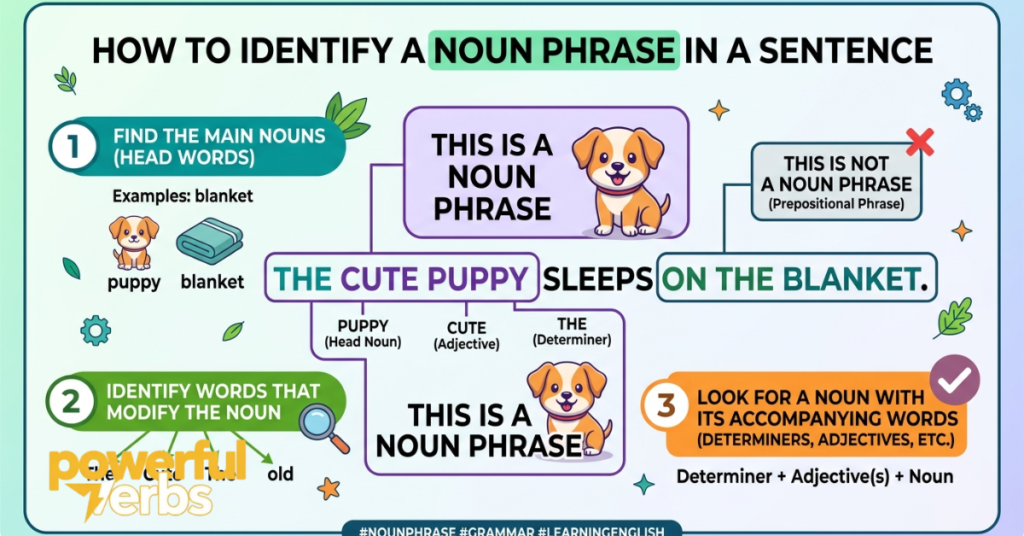
Follow these three simple steps:
Step 1 — Find the main noun (the head noun) in the sentence.
Step 2 — Look for all words that describe, limit, or modify that noun — articles, adjectives, possessives, prepositional phrases, and clauses.
Step 3 — Group all those words together. That entire group is the noun phrase.
Example:
- Sentence: The very talented young student from Lahore won the competition.
- Head noun: student
- Noun phrase: the very talented young student from Lahore
Common Mistakes to Avoid with Noun Phrases
Mistake 1: Forgetting the article
- She bought new car.
- She bought a new car.
Mistake 2: Wrong adjective order
- He wore a cotton beautiful shirt.
- He wore a beautiful cotton shirt.
Mistake 3: Treating a gerund phrase as a verb phrase
- Swimming every morning is exercising. (treated as action, not subject)
- Swimming every morning is a healthy habit. (used as noun phrase subject)
Mistake 4: Separating the noun phrase with wrong punctuation
- The tall, and handsome student answered.
- The tall and handsome student answered.
FAQs
What is a noun phrase with an example?
A noun phrase is a group of words centered on a noun. Example: the tall man with a briefcase — here “man” is the head noun, and the other words describe him.
What is the simplest example of a noun phrase?
The simplest noun phrase is just an article and a noun: a dog, the book, an apple.
Can a single noun be a noun phrase?
Yes! A single noun like water or Ali can function as a noun phrase when it acts as a subject or object in a sentence.
What is the difference between a noun clause and a noun phrase?
A noun phrase does not contain a subject-verb combination, while a noun clause does. Example — Noun phrase: the winning team. Noun clause: whoever wins the match.
How many types of noun phrases are there?
There are several types: simple, expanded, prepositional, possessive, compound, appositive, gerund, infinitive, and quantifier noun phrases.
How do noun phrases help in writing?
They add detail and specificity to your sentences, making your writing more vivid, informative, and engaging for the reader.
What are 5 examples of noun phrases in sentences?
- The golden gate stood at the end of the road.
- She carried a bag full of colorful books.
- The youngest student in the class answered correctly.
- Swimming every morning keeps him energetic.
- To learn English fluently is his greatest ambition.
Summary
In this guide, you learned 150 examples of noun phrases in sentences, covering all major types: simple, expanded, prepositional, possessive, compound, appositive, gerund, infinitive, quantifier, and advanced noun phrases. You also learned how noun phrases function as subjects, objects, and complements, and how to avoid common mistakes.
Practicing noun phrases daily — whether in writing, reading, or speaking — will make your English significantly stronger. Use these 150 examples as a reference whenever you write or study grammar.

Liam Johnson is a dedicated language expert with 4 years of professional experience. He specializes in Grammar, Vocabulary, and Sentence structure.
