

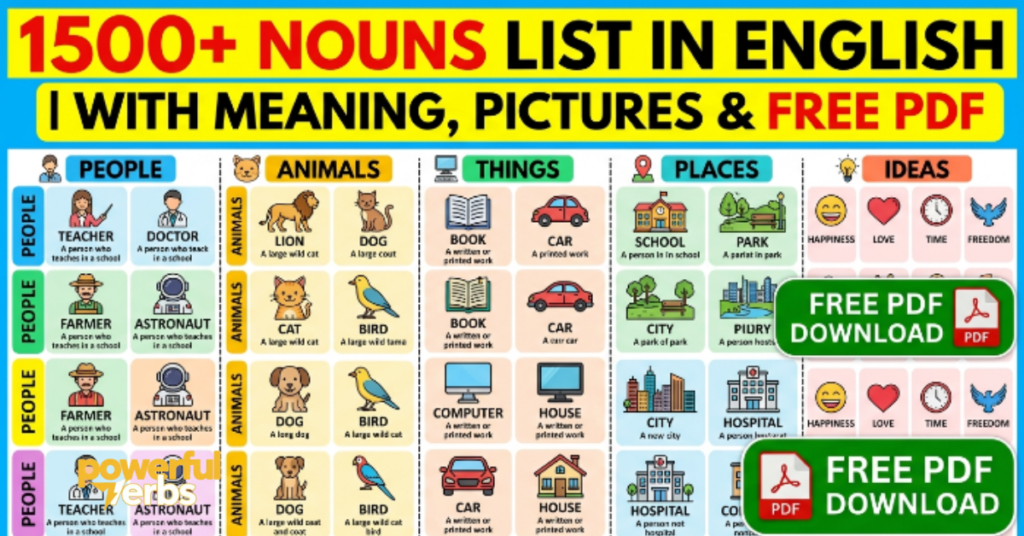
Every English learner faces one common problem — they know many words separately but cannot use them correctly in sentences. Nouns are the starting point of every sentence in English. Without a strong noun vocabulary, writing and speaking become difficult at every level.
This complete guide gives you 1500+ nouns in English with meaning, clear example sentences, and all major types explained in one place. Whether you are a student, teacher, or English learner, this resource will help you build a strong vocabulary foundation quickly and effectively.
What Is a Noun in English?
A noun is a word that names a person, place, thing, animal, or idea. Every sentence in English contains at least one noun. Nouns work as the subject, object, or complement in a sentence.
Examples of nouns in sentences:
- The teacher explains the lesson clearly.
- Islamabad is the capital city of Pakistan.
- Honesty is the best policy in life.
- A flock of birds crossed the evening sky.
Understanding different types of nouns helps learners use English grammar correctly in both written and spoken communication.
Types of Nouns — Complete Guide

English nouns are divided into several important categories. Each type has a specific function in a sentence.
| Type | Definition | Quick Example |
| Common Noun | General name for any person, place, or thing | city, boy, book |
| Proper Noun | Specific name of a particular person or place | London, Ahmed, Google |
| Abstract Noun | Name of a feeling, idea, or quality | courage, happiness, wisdom |
| Concrete Noun | Name of something you can physically sense | apple, chair, water |
| Collective Noun | Name for a group acting as one unit | team, flock, army |
| Countable Noun | Noun that can be counted with numbers | pen, cat, car |
| Uncountable Noun | Noun that cannot be individually counted | milk, rice, air |
| Material Noun | Name of a raw material or substance | gold, wood, cotton |
| Compound Noun | Two or more words combined to form one noun | toothbrush, notebook, airport |
| Possessive Noun | Noun showing ownership or belonging | Ahmed’s, teacher’s, city’s |
Simple Nouns List with Meaning and Examples
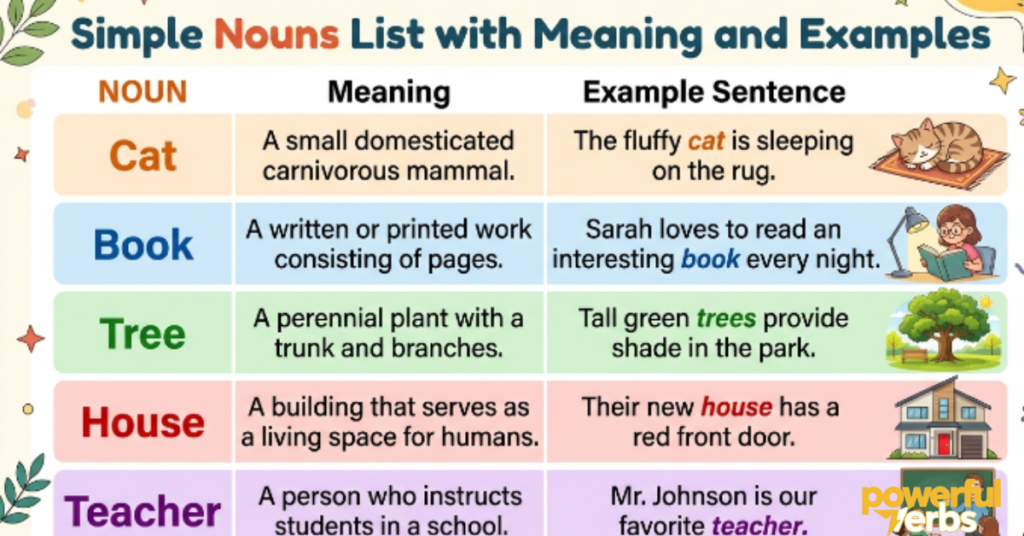
Simple nouns are the most basic naming words in English. They are the first nouns that beginners and young learners should master before moving to advanced categories.
| Noun | Meaning | Example Sentence |
| Apple | A common sweet fruit | I eat a fresh apple after lunch every day. |
| Book | A written or printed work | She reads a storybook before sleeping each night. |
| Pen | A writing instrument | He signed the document with a blue pen. |
| Table | A flat-surfaced piece of furniture | The hot food was placed on the dining table. |
| Chair | A seat with a backrest | She sat on the wooden chair near the window. |
| Bag | A container used for carrying things | My school bag is full of textbooks and notebooks. |
| Car | A four-wheeled motor vehicle | The red car stopped suddenly near the signal. |
| Bus | A large public transport vehicle | We travel to school by bus every morning. |
| Road | A path used for vehicles and people | The main road was busy with traffic at noon. |
| House | A building where people live | Their house has a beautiful garden in front. |
| Door | An entrance or exit panel | Please close the door quietly when you leave. |
| Window | An opening in a wall for light and air | The window lets fresh cool air into the room. |
| Bed | Furniture used for sleeping | The baby fell asleep on the soft bed. |
| Cup | A small container for drinking | She drank warm tea from her favourite cup. |
| Plate | A flat dish used for serving food | He placed the biryani on a clean white plate. |
| Spoon | A utensil used for eating or stirring | She stirred the soup gently with a spoon. |
| School | An institution for learning | The children arrive at school by seven every morning. |
| Teacher | A person who educates others | The teacher explained the grammar topic very patiently. |
| Student | A person who studies at school | Every student completed the assignment on time. |
| Boy | A young male child | The boy played cricket with his friends after school. |
| Girl | A young female child | The girl drew a beautiful flower in her notebook. |
| Man | An adult male person | The man read the newspaper under the shade of a tree. |
| Woman | An adult female person | The woman bought fresh vegetables from the morning market. |
| Baby | A very young child or infant | The baby clapped her hands and smiled brightly. |
| Water | A clear, essential liquid | Always drink clean and filtered water every day. |
| Milk | A white nutritious liquid from animals | The child drinks a warm glass of milk at night. |
| Bread | A baked food made from flour | She eats bread with butter for breakfast each morning. |
| Rice | A common grain used as food | We cook white rice for dinner every evening. |
| Fruit | The edible product of a plant | Fresh fruit is the healthiest snack for growing children. |
| Flower | The colourful part of a plant | The flower in the garden smells wonderfully sweet. |
| Tree | A tall woody plant | A large tree gives cool shade during hot afternoons. |
| Sun | The star at the centre of our solar system | The sun shines brightly over the entire city today. |
| Moon | The natural satellite of the Earth | The moon looked full and round in the clear sky. |
| Star | A bright object visible in the night sky | A single star twinkled through the dark clouds at night. |
| Sky | The space above the Earth | The sky turned deep orange at sunset this evening. |
| Rain | Water falling from clouds | The rain fell gently on the dry fields and roads. |
| Cloud | A mass of water vapour in the sky | A thick white cloud moved slowly across the blue sky. |
| Shoe | A covering worn on the foot | He polished his black shoe before the school function. |
| Shirt | A garment worn on the upper body | He ironed his white shirt carefully before the interview. |
| Hat | A head covering for protection or fashion | The hat protected her face from the harsh afternoon sun. |
| Phone | A device used for communication | Her phone rang loudly during the evening family meal. |
| Clock | A device that shows time | The old clock on the wall still worked perfectly. |
| Watch | A small timepiece worn on the wrist | He glanced at his watch and realised he was late. |
| Toy | An object children play with | The small child played happily with a colourful toy. |
| Box | A container with a lid or sides | The gift was packed inside a decorated cardboard box. |
| Paper | A thin flat material used for writing | Write your full name clearly on the top of the paper. |
Common Nouns List with Example Sentences
Common nouns name general people, places, things, or ideas. They are written in lowercase unless they start a sentence. This is the largest and most frequently used noun category in everyday English.
| Noun | Example Sentence |
| City | The city is filled with tall buildings and busy streets. |
| Country | Our country has a rich history and diverse culture. |
| River | The wide river flows calmly through the green valley. |
| Mountain | The mountain peak was covered with thick white snow. |
| Village | Life in the village is peaceful and full of nature. |
| Market | The morning market was crowded with buyers and sellers. |
| Hospital | The new hospital serves thousands of patients every month. |
| Library | Students study quietly in the library during free periods. |
| Garden | The garden is full of colourful flowers and green plants. |
| Kitchen | She prepares fresh meals in the kitchen every evening. |
| Office | He works in a large office on the fifth floor. |
| Airport | The airport was busy with travellers from every direction. |
| Station | The train station was crowded with passengers and luggage. |
| Bridge | A long bridge connects both sides of the wide river. |
| Factory | The factory produces hundreds of products every single day. |
| Farm | The farmer works hard on his farm from dawn to dusk. |
| Field | Green fields stretch far beyond the edge of the village. |
| Desert | The desert is extremely hot during the afternoon hours. |
| Forest | A thick forest lies behind the small mountain village. |
| Ocean | The deep ocean holds millions of undiscovered living creatures. |
| Island | The small island is surrounded by clear blue water. |
| Lake | Children fish near the calm lake on Sunday mornings. |
| Valley | The valley between the mountains was green and beautiful. |
| Hill | We climbed the hill slowly and enjoyed the view. |
| Cave | The cave was dark, deep, and full of mystery. |
| Doctor | The doctor examined the patient with great care and patience. |
| Nurse | The nurse helped patients throughout the long night shift. |
| Engineer | The engineer designed the new bridge with great skill. |
| Farmer | The farmer irrigated his fields early every single morning. |
| Driver | The bus driver waited patiently for all passengers to board. |
| Pilot | The pilot landed the aircraft smoothly despite the strong wind. |
| Soldier | The brave soldier protected the border through cold winter nights. |
| Scientist | The scientist discovered a new species in the deep rainforest. |
| Artist | The artist painted a beautiful landscape using watercolour. |
| Writer | The writer published her first novel at the age of thirty. |
| Singer | The singer performed beautifully in front of a huge crowd. |
| Player | The player scored the winning goal in the last minute. |
| Coach | The coach trained the team with discipline and dedication. |
| Chef | The chef prepared a special dish for the important guests. |
| Carpenter | The carpenter built a wooden table for the dining room. |
Proper Nouns List with Example Sentences
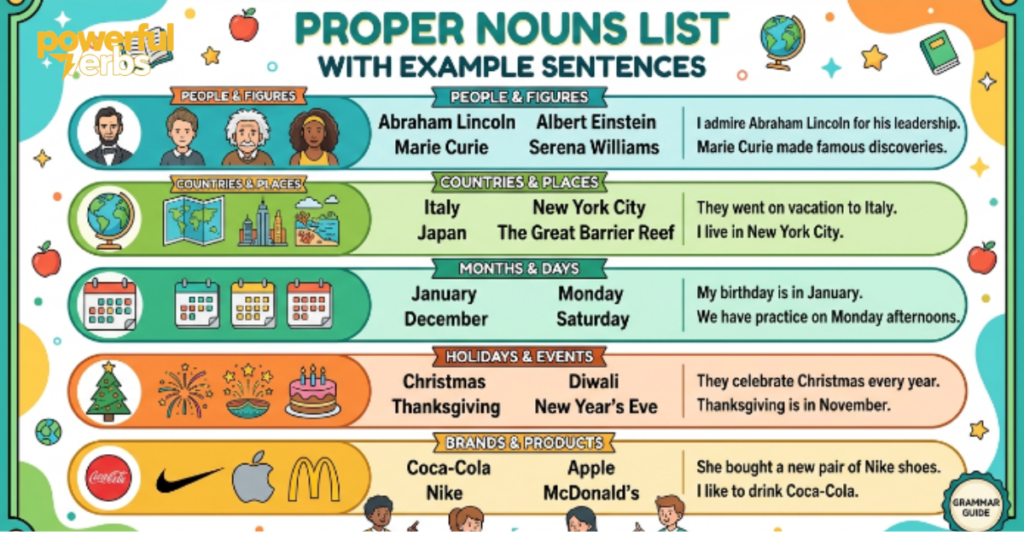
Proper nouns always begin with a capital letter. They refer to specific names of people, places, organisations, brands, events, days, and months.
People Names
| Noun | Example Sentence |
| Ali | Ali scored the highest marks in the science examination. |
| Ahmed | Ahmed helps his younger brother with mathematics every evening. |
| Sara | Sara reads two storybooks every single week without fail. |
| Fatima | Fatima volunteers at the local hospital every Saturday morning. |
| Hassan | Hassan won the first prize in the national drawing competition. |
| Usman | Usman studied engineering at one of the top universities. |
| Zara | Zara teaches English to young children in the nearby school. |
| Omar | Omar played a key role in organising the school science fair. |
Cities and Countries
| Noun | Example Sentence |
| Islamabad | Islamabad is the capital and administrative centre of Pakistan. |
| Karachi | Karachi is the largest city and economic hub of Pakistan. |
| Lahore | Lahore is celebrated for its rich culture, food, and history. |
| London | London is one of the most visited cities in the entire world. |
| Paris | Paris is famous for the Eiffel Tower and French cuisine. |
| New York | New York is known for its iconic skyline and cultural diversity. |
| Tokyo | Tokyo is one of the most advanced and organised cities globally. |
| Dubai | Dubai is a modern city famous for its luxury and architecture. |
| Pakistan | Pakistan is a country with a young population and strong values. |
| Turkey | Turkey connects two continents and has a remarkable history. |
Brands and Organisations
| Noun | Example Sentence |
| Millions of people use Google to search for information daily. | |
| Microsoft | Microsoft produces some of the most widely used software worldwide. |
| Amazon | Amazon delivers products to customers in almost every country. |
| Samsung | Samsung manufactures a wide range of electronic devices globally. |
| Apple | Apple launched a new smartphone model at its annual event. |
| Facebook connects billions of people across every continent. | |
| YouTube | YouTube is the largest video-sharing platform on the internet. |
| Wikipedia | Wikipedia provides free knowledge on millions of different topics. |
Days, Months and Events
| Noun | Example Sentence |
| Monday | Classes resume every Monday after the weekend holiday. |
| Friday | Friday is a blessed day for Muslims around the world. |
| January | January marks the beginning of a fresh new calendar year. |
| Ramadan | Muslims fast from dawn to sunset throughout the month of Ramadan. |
| Eid | Families dress in new clothes and celebrate Eid with great joy. |
| Olympics | Athletes from every nation compete in the Olympics every four years. |
| FIFA | FIFA organises the most-watched football tournament in the world. |
Abstract Nouns List with Meaning and Examples
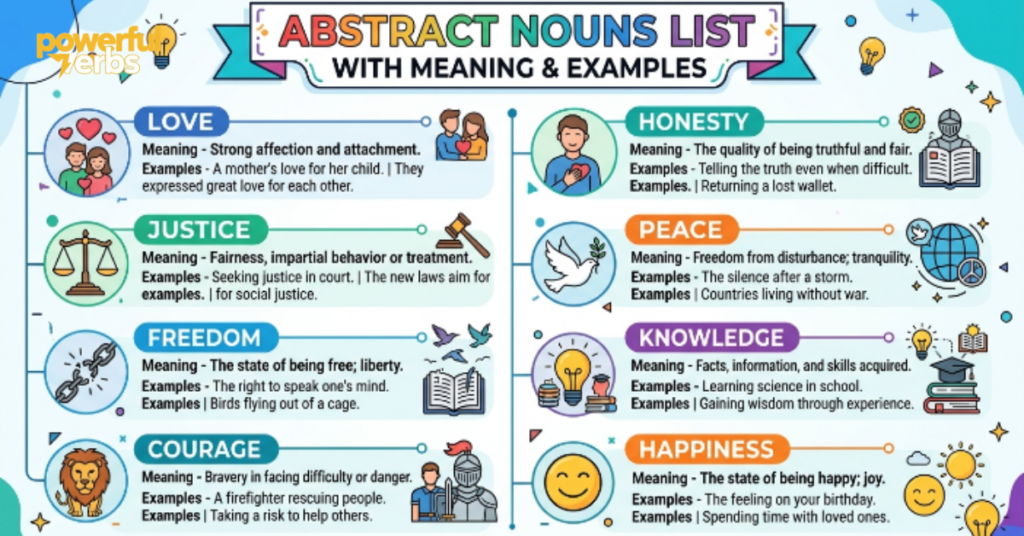
Abstract nouns name feelings, qualities, emotions, and ideas that cannot be seen or physically touched. They play an important role in expressing human thoughts and experiences.
| Noun | Meaning | Example Sentence |
| Love | Deep affection for someone | A mother’s love for her child is the purest feeling on earth. |
| Happiness | A feeling of joy and contentment | True happiness is found in simple everyday moments of life. |
| Sadness | A feeling of sorrow or grief | The sad film brought tears and sadness to everyone in the room. |
| Courage | Bravery in facing difficult situations | The young girl showed remarkable courage during the tough challenge. |
| Patience | The ability to wait calmly | Learning any new skill requires a great deal of patience. |
| Honesty | Being truthful and sincere | Honesty strengthens trust and builds long-lasting relationships. |
| Loyalty | Faithful commitment to someone | A loyal friend stands beside you during the most difficult times. |
| Friendship | A close and caring relationship between people | Their deep friendship has continued for more than twenty years. |
| Trust | Belief in the reliability of someone | Trust is the most important foundation of every relationship. |
| Jealousy | Feeling upset about another person’s success | Jealousy slowly destroys even the strongest of friendships. |
| Pride | A feeling of satisfaction in achievements | She felt great pride when she received the national award. |
| Kindness | Being gentle and generous to others | A single act of kindness can completely change someone’s difficult day. |
| Freedom | The right to act and speak without restriction | Freedom is one of the most precious values in human life. |
| Justice | Fairness in the treatment of all people | Every person deserves equal justice regardless of their background. |
| Wisdom | Deep understanding gained through experience | The elder’s wisdom helped the entire community solve the dispute. |
| Ambition | A strong desire to achieve important goals | Her ambition to become a doctor inspired everyone around her. |
| Creativity | The ability to produce original and imaginative ideas | Creativity allows artists to express what words alone cannot describe. |
| Confidence | A strong belief in one’s own abilities | Confidence grows stronger with every challenge you face and overcome. |
| Determination | A firm decision to achieve something difficult | His determination to succeed never weakened despite many failures. |
| Gratitude | A feeling of thankfulness for something received | Gratitude reminds us to appreciate the blessings we already have. |
| Hope | An optimistic feeling about future outcomes | Hope kept the family strong throughout the most difficult period. |
| Responsibility | A duty or obligation to do something properly | Taking responsibility for your actions shows true maturity and character. |
| Compassion | Concern and care for others who are suffering | The nurse showed compassion to every patient under her care. |
| Inspiration | Something that motivates or encourages action | The champion’s story became an inspiration for the entire generation. |
| Imagination | The ability to form mental images and ideas | A child’s imagination is the most powerful creative tool in existence. |
Concrete Nouns List with Examples
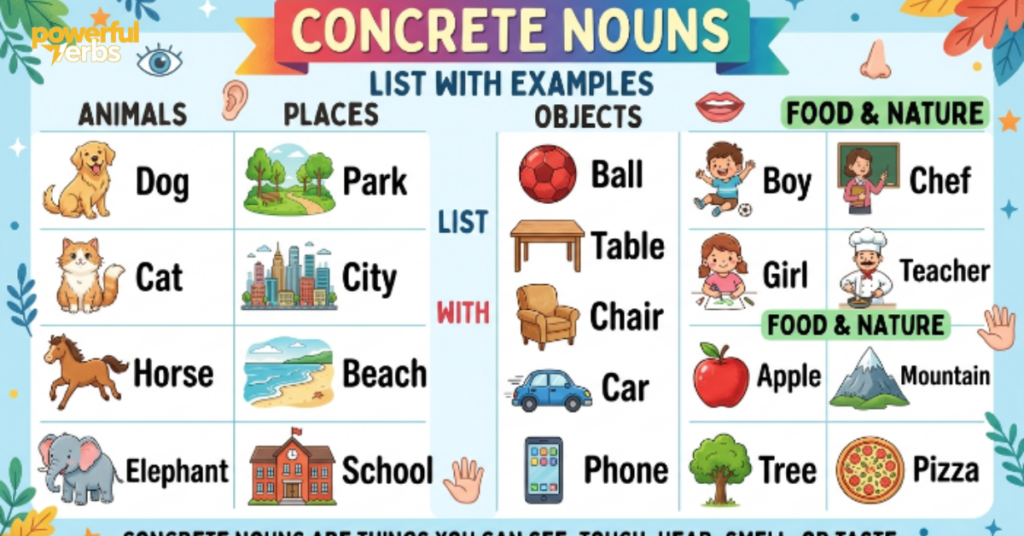
Concrete nouns refer to physical things that can be seen, heard, touched, smelled, or tasted. These are the most tangible words in the English language.
Food and Drink
| Noun | Example Sentence |
| Apple | The apple tasted sweet, crisp, and perfectly fresh. |
| Mango | A ripe mango is juicy, golden, and wonderfully fragrant. |
| Banana | He peels a banana and eats it before morning exercise. |
| Orange | She squeezed three oranges to make a fresh glass of juice. |
| Bread | Warm bread straight from the oven smells absolutely delicious. |
| Rice | We prepare steamed white rice for dinner every evening. |
| Meat | The chef marinated the meat overnight for maximum flavour. |
| Chicken | Grilled chicken with salad is a healthy and balanced meal. |
| Egg | She boiled two eggs and ate them for a protein-rich breakfast. |
| Cake | The birthday cake was beautifully decorated with pink frosting. |
| Chocolate | Dark chocolate contains antioxidants that are beneficial to health. |
| Coffee | He sips hot black coffee every morning before starting work. |
| Tea | My grandmother enjoys a cup of sweet cardamom tea. |
| Juice | Fresh pomegranate juice is refreshing and full of vitamins. |
| Milk | Warm milk before bedtime helps children sleep more peacefully. |
Household Items
| Noun | Example Sentence |
| Sofa | The family sat comfortably on the sofa watching the news. |
| Lamp | The reading lamp on the desk was bright and energy-saving. |
| Mirror | She checked her appearance in the full-length bedroom mirror. |
| Curtain | The thick curtains blocked the early morning sunlight completely. |
| Carpet | The soft carpet in the living room was warm under our feet. |
| Pillow | She fluffed her pillow before settling down to sleep. |
| Blanket | The thick blanket kept her warm throughout the cold winter night. |
| Cupboard | He kept all his books neatly arranged inside the cupboard. |
| Shelf | The bookshelf was filled with novels, textbooks, and dictionaries. |
| Fan | The ceiling fan rotated quickly in the hot summer afternoon. |
Collective Nouns List with Examples
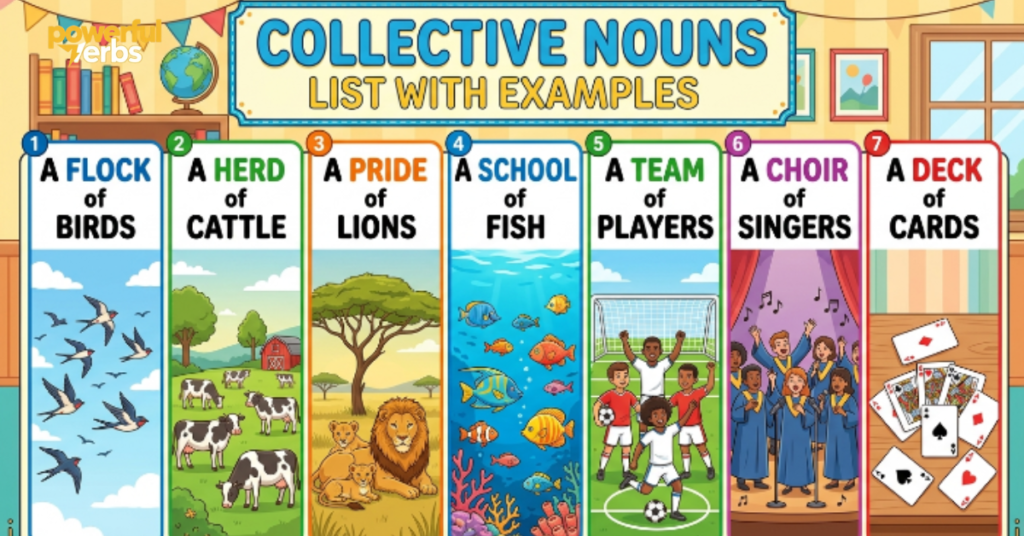
Collective nouns describe a group of people, animals, or things that function together as a single unit. Using collective nouns correctly makes your English sound more natural and fluent.
| Collective Noun | Used For | Example Sentence |
| Team | A group of players | Our school team won the regional cricket championship this year. |
| Family | A group of related people | The whole family gathered around the table for Eid dinner. |
| Class | A group of students | The class listened attentively while the teacher explained the topic. |
| Crowd | A large group of people | A massive crowd gathered near the stadium entrance before the match. |
| Army | A group of soldiers | The army marched through the city in a disciplined formation. |
| Flock | A group of birds or sheep | A large flock of white birds flew across the evening sky. |
| Herd | A group of cattle or elephants | A herd of elephants moved slowly across the dry open plain. |
| Pack | A group of wolves or dogs | A pack of wolves howled loudly in the dense dark forest. |
| Pride | A group of lions | A pride of lions rested peacefully under the large acacia tree. |
| School | A group of fish | A school of silver fish swam gracefully near the coral reef. |
| Colony | A group of ants or bats | A colony of ants carried food grains across the garden path. |
| Fleet | A group of ships or vehicles | A fleet of navy ships sailed through the narrow strait. |
| Choir | A group of singers | The school choir performed a beautiful song at the annual event. |
| Jury | A group of judges | The jury carefully examined all the evidence before announcing a verdict. |
| Committee | A group formed for a specific task | The committee approved the new community development project unanimously. |
| Squad | A small group with a specific role | The rescue squad reached the accident site within ten minutes. |
| Crew | A group working on a vehicle or ship | The flight crew welcomed all passengers warmly before departure. |
| Staff | A group of employees | The entire staff received a certificate of appreciation at the ceremony. |
| Gang | A group working or playing together | A gang of children played football on the empty street. |
| Bunch | A group of items tied together | She carried a fresh bunch of red roses for her teacher. |
| Pair | A set of two matching things | I bought a new pair of running shoes for the sports day. |
| Audience | A group of listeners or viewers | The large audience applauded enthusiastically after the final performance. |
| Panel | A group of expert judges | A distinguished panel of experts evaluated all the submitted research papers. |
| Troop | A group of scouts or soldiers | A troop of scouts went on a three-day camping expedition. |
| Bundle | A group of things tied together | A bundle of newspapers was left at the front gate every morning. |
Countable Nouns List with Examples
Countable nouns can be counted individually and have both singular and plural forms. Numbers and articles can be used directly with countable nouns.
| Singular | Plural | Example Sentence |
| Book | Books | I have five books on my reading list this month. |
| Pen | Pens | She keeps three pens in her pencil case at all times. |
| Chair | Chairs | Six chairs were arranged neatly around the conference table. |
| Car | Cars | Two brand new cars were parked outside the showroom. |
| Apple | Apples | He bought a dozen apples from the fruit market. |
| Egg | Eggs | The recipe requires four eggs and two cups of flour. |
| Bag | Bags | The students carried heavy bags filled with textbooks. |
| Bottle | Bottles | She placed three glass bottles of water in the refrigerator. |
| Cup | Cups | He washed all the cups after the evening tea. |
| Toy | Toys | The children left their toys scattered across the entire floor. |
| Phone | Phones | Both phones were charging on the bedside table overnight. |
| Window | Windows | All the windows were opened to let fresh air in. |
| Tree | Trees | Hundreds of trees were planted along the new highway. |
| Bird | Birds | Twelve birds sat on the electric wire outside our house. |
| Cat | Cats | The two cats chased each other around the small garden. |
Uncountable Nouns List with Examples
Uncountable nouns refer to substances, concepts, or qualities that cannot be counted individually. They do not have a plural form and are never used with numbers directly.
Liquids and Substances
| Noun | Example Sentence |
| Water | Clean drinking water is essential for every living organism. |
| Milk | Fresh milk is delivered to our doorstep every single morning. |
| Oil | The mechanic checked the engine oil level before starting the car. |
| Juice | She poured a tall glass of cold orange juice. |
| Honey | Pure honey has natural antibacterial and healing properties. |
| Butter | Spread a thin layer of butter on the warm toast. |
Concepts and Qualities
| Noun | Example Sentence |
| Knowledge | True knowledge comes from consistent reading and real experience. |
| Information | The website provides reliable and updated information on health topics. |
| Advice | His sincere advice helped me make the right decision. |
| Education | Quality education is the most powerful tool for personal growth. |
| Research | Extensive research was conducted before publishing the final report. |
| Music | Soothing music helps reduce stress and improve mental focus. |
| Art | Art allows people to express emotions that words cannot capture. |
| Traffic | Heavy traffic near the city centre delayed the school bus. |
| Furniture | The new furniture made the living room look elegant and spacious. |
| Equipment | All the laboratory equipment was properly cleaned and stored. |
| Luggage | She packed her luggage carefully the night before the flight. |
| News | The morning news reported significant rainfall across the northern areas. |
Material Nouns List with Examples
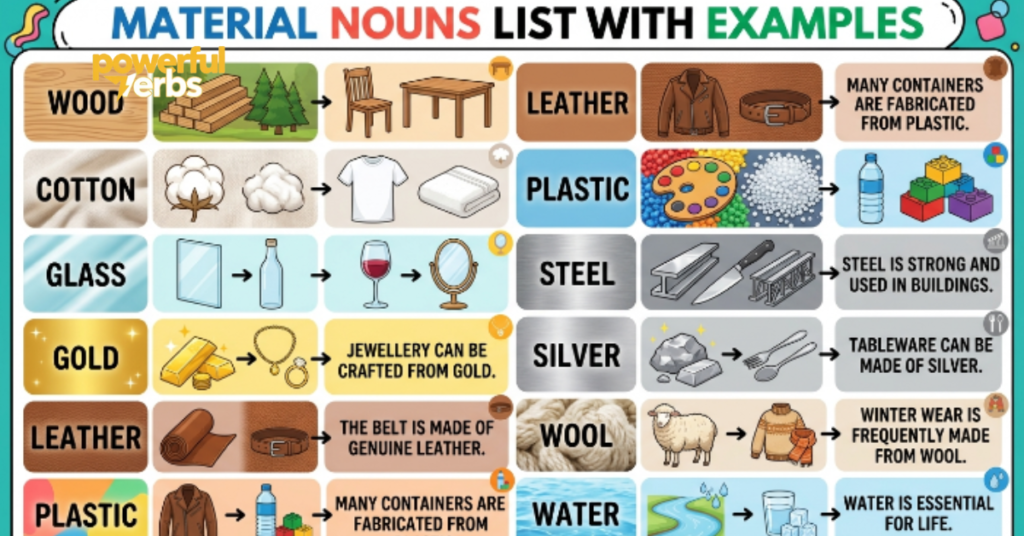
Material nouns name raw materials, metals, fabrics, and natural substances from which other things are made.
Metals and Minerals
| Noun | Example Sentence |
| Gold | The bride wore a beautiful gold necklace at the wedding. |
| Silver | The silversmith crafted an elegant bracelet from pure silver. |
| Iron | Strong iron gates were installed at the entrance of the building. |
| Copper | Copper wire is commonly used in electrical connections and circuits. |
| Steel | The entire bridge was constructed with high-quality reinforced steel. |
| Diamond | A sparkling diamond ring was placed inside the velvet box. |
| Marble | The floors of the grand mosque were made of pure white marble. |
| Platinum | Platinum is rarer and more valuable than gold or silver. |
Natural Materials
| Noun | Example Sentence |
| Wood | The craftsman carved a beautiful frame from solid teak wood. |
| Cotton | Pure cotton fabric is the most comfortable choice in hot weather. |
| Silk | The soft silk curtains added elegance to the entire room. |
| Wool | Her warm woollen sweater was perfect for the cold winter morning. |
| Leather | He bought a genuine leather wallet that would last for years. |
| Bamboo | Bamboo furniture is both eco-friendly and remarkably strong. |
| Clay | The potter shaped the soft clay into a beautiful round pot. |
| Sand | Fine white sand covered the entire length of the peaceful beach. |
Possessive Nouns List with Examples
Possessive nouns show that something belongs to or is associated with someone. They are formed by adding an apostrophe followed by the letter s.
| Possessive Noun | Example Sentence |
| Ahmed’s | Ahmed’s science project won the first prize at the exhibition. |
| Sara’s | Sara’s handwriting is the neatest in the entire classroom. |
| Teacher’s | The teacher’s explanation of the topic was clear and very helpful. |
| Mother’s | My mother’s biryani is the most delicious food I have ever tasted. |
| Father’s | My father’s advice has guided me through every difficult situation. |
| Brother’s | My brother’s bicycle is faster than mine on the long road. |
| Sister’s | My sister’s artwork was selected for the school magazine this year. |
| Doctor’s | The doctor’s instructions must be followed carefully for a full recovery. |
| School’s | The school’s new library has thousands of books on every subject. |
| City’s | The city’s new park has walking tracks, fountains, and play areas. |
| Country’s | The country’s education system is improving rapidly every single year. |
| Friend’s | My friend’s house is just a short walk away from mine. |
| Neighbour’s | The neighbour’s garden is the most beautiful on the entire street. |
| Company’s | The company’s new product received outstanding reviews from customers. |
| Student’s | The student’s hard work throughout the year paid off in the final result. |
Compound Nouns List with Examples
Compound nouns are formed by combining two or more words into a single noun. They can be written as one word, hyphenated, or as two separate words.
One Word Compound Nouns
| Noun | Example Sentence |
| Toothbrush | He replaces his toothbrush every three months as recommended. |
| Toothpaste | She squeezes a small amount of toothpaste onto her brush. |
| Football | The football match between the two schools attracted a large crowd. |
| Basketball | The basketball team practised every evening for the championship. |
| Notebook | I use a separate notebook for each subject at school. |
| Homework | She completed all her homework before dinner without any reminder. |
| Sunlight | The room was filled with warm golden sunlight in the morning. |
| Raincoat | He always carries a raincoat during the unpredictable monsoon season. |
| Bookshelf | The old bookshelf was filled with novels, poetry books, and dictionaries. |
| Hairbrush | She gently ran the hairbrush through her long straight hair. |
| Backpack | His sturdy backpack carried everything he needed for the hiking trip. |
| Sunglasses | She wore dark sunglasses to protect her eyes from the bright sun. |
Two Word Compound Nouns
| Noun | Example Sentence |
| Bus stop | We waited for fifteen minutes at the bus stop in the rain. |
| Post office | She mailed a registered letter from the nearby post office. |
| Police station | The lost child was safely brought to the nearest police station. |
| Swimming pool | The hotel’s swimming pool was large, clean, and perfectly maintained. |
| Coffee table | She placed fresh flowers on the glass coffee table in the lounge. |
| Dining room | The whole family sat together in the dining room for dinner. |
| Living room | The comfortable living room sofa is perfect for afternoon naps. |
| Bank account | He opened a savings bank account for his monthly earnings. |
| Traffic light | The driver waited patiently at the red traffic light. |
| Fire station | The fire station is located just two streets away from our school. |
Nouns List for Kids with Examples
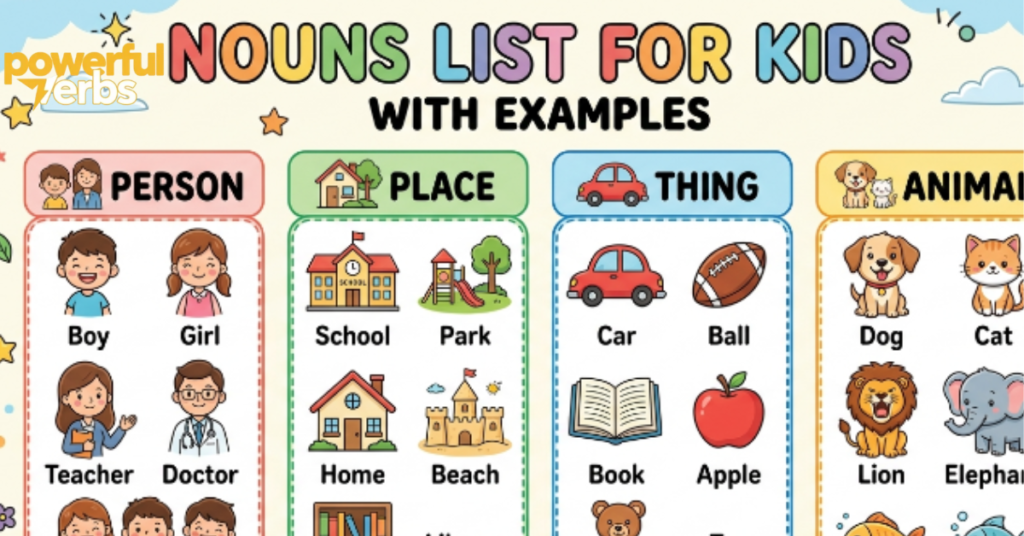
Young learners need simple, fun, and relatable nouns to build their early English vocabulary. These nouns are chosen from everyday life so children can connect them easily to real objects around them.
| Noun | Example Sentence |
| Cat | The fluffy cat curled up and slept near the warm fireplace. |
| Dog | The playful dog chased the ball across the open grassy field. |
| Cow | The brown cow stood quietly in the middle of the green field. |
| Goat | The little goat jumped over the fence and ran into the garden. |
| Hen | The hen laid three fresh eggs in the nest this morning. |
| Duck | The yellow duck swam happily in the small pond near the farm. |
| Rabbit | The white rabbit hopped around the garden and hid under a bush. |
| Elephant | The elephant used its long trunk to pick up bunches of bananas. |
| Lion | A roaring lion is the most powerful animal in the open savanna. |
| Monkey | The clever monkey swung from one branch to another with speed. |
| Butterfly | A colourful butterfly landed gently on the bright yellow flower. |
| Parrot | The green parrot repeated every word it heard very clearly. |
| Fish | The small orange fish swam in circles inside the glass tank. |
| Doll | She tucked her favourite doll into a tiny bed at night. |
| Kite | The red kite soared high in the clear blue windy sky. |
| Balloon | He released a yellow balloon and watched it float into the clouds. |
| Pencil | She sharpened her pencil and began drawing a beautiful house. |
| Eraser | He used the eraser to remove the wrong answer from the paper. |
| Crayon | The child coloured the entire picture using a full box of crayons. |
| Ruler | She drew a perfectly straight line using her wooden ruler. |
| Umbrella | She opened her pink umbrella as soon as the rain started falling. |
| Bicycle | He rode his bicycle carefully along the footpath near the park. |
| Swing | The child laughed loudly while swinging high in the playground. |
| Slide | The children lined up patiently for a turn on the tall slide. |
| Drum | He beat the drum loudly and the whole neighbourhood could hear. |
| Guitar | She played a soft melody on her guitar beside the window at evening. |
| Cake | The birthday cake had five candles and pink cream on top. |
| Cookie | She baked a fresh batch of chocolate chip cookies for the class. |
| Lunchbox | He opened his lunchbox and found his favourite sandwich inside. |
| Storybook | The teacher read a funny storybook aloud to the whole class. |
Nouns — Vocabulary Reference
The following vocabulary terms are closely related to nouns and frequently appear in English grammar discussions. Understanding these terms alongside noun types strengthens overall grammar knowledge.
Related Grammar Terms: subject, object, predicate, article, determiner, pronoun, adjective, noun phrase, gerund, infinitive, clause, sentence structure, singular, plural, gender, number, case
Vocabulary Building Terms: word formation, root words, prefix, suffix, compound words, synonyms, antonyms, homophones, collocations, word family, context clues
Academic English Terms: academic vocabulary, formal writing, topic sentence, supporting details, descriptive language, precise language, clarity, coherence
How to Use Nouns Correctly in English Sentences
Using nouns correctly improves the quality of both written and spoken English. Here are practical rules every learner should follow:
Always use an article before singular countable nouns. For example: a book, an apple, the teacher. Skipping the article is one of the most common mistakes made by beginner learners.
Use capital letters for all proper nouns. Cities, people’s names, countries, brands, and days of the week always begin with a capital letter in English.
Add the correct plural form for countable nouns. Most nouns add -s or -es for plural. Some have irregular plurals such as child/children, man/men, and tooth/teeth.
Never use articles before uncountable nouns. You cannot say a water, a milk, or a happiness. These nouns are always used without a number or indefinite article.
Use possessive apostrophes correctly. For singular nouns, add apostrophe + s. For plural nouns ending in s, add only the apostrophe.
Tips to Build Your Noun Vocabulary Fast
Building a strong noun vocabulary does not happen overnight. Consistent effort and smart practice methods produce the best long-term results.
Read English books and articles daily. Reading exposes you to nouns used naturally in context, which is far more effective than memorising isolated word lists.
Group nouns into categories. Learning nouns in thematic groups such as food, animals, furniture, or emotions helps the brain store and recall them more efficiently.
Write new nouns in sentences. Every time you learn a new noun, write three sentences using it. This habit builds both vocabulary and sentence construction skills together.
Use flashcards with pictures. Visual memory is very powerful for vocabulary retention. Pairing each noun with a picture helps learners remember words much longer.
Practise speaking with new nouns daily. Try using five new nouns in conversation every day. Active use of vocabulary accelerates fluency far more than passive reading alone.
Review previous nouns every week. Regular revision prevents forgetting and ensures that new nouns move from short-term to long-term memory permanently.
Conclusion
This complete collection of 1500+ nouns in English covers every major category that learners need — from simple everyday words to abstract feelings, collective groups, material substances, and compound expressions. Every noun is presented with a clear meaning and a natural example sentence so that understanding and application become easy and immediate.
A strong noun vocabulary is the foundation of confident English communication. Learners who master nouns at this level can write clearer paragraphs, speak more naturally in conversations, and perform significantly better in examinations and professional settings.
Start with the category that interests you most, practise the examples daily, and return to this guide whenever you need a reliable and comprehensive reference for English nouns.
FAQs
What is a noun in English grammar?
A noun is a word that names a person, place, animal, thing, or idea. Every complete English sentence contains at least one noun functioning as the subject or object.
How many types of nouns are there in English?
English grammar recognises ten main types of nouns — common, proper, abstract, concrete, collective, countable, uncountable, material, compound, and possessive nouns.
What are simple nouns for beginners?
Simple nouns are basic everyday naming words that beginners learn first. Examples include cat, book, pen, apple, house, water, and school.
What is the difference between countable and uncountable nouns?
Countable nouns can be individually counted and have plural forms such as one book or three books. Uncountable nouns like water, milk, and knowledge cannot be counted and have no plural form.
How do you form a possessive noun in English?
A possessive noun is formed by adding apostrophe + s to a singular noun. For example, Ahmed’s bag means the bag that belongs to Ahmed. For plural nouns ending in s, only an apostrophe is added.
What are abstract nouns with examples?
Abstract nouns name feelings, emotions, and ideas that cannot be physically seen or touched. Common examples include love, courage, happiness, wisdom, and freedom.
What is a collective noun with an example sentence?
A collective noun names a group acting as one unit. For example, a flock of birds, a team of players, and a herd of cattle are all collective nouns used in English.
How can I improve my noun vocabulary in English?
The most effective methods include reading English books daily, grouping nouns by theme, writing new nouns in sentences, using flashcards with pictures, and revising previously learned nouns every week.

Liam Johnson is a dedicated language expert with 4 years of professional experience. He specializes in Grammar, Vocabulary, and Sentence structure.
