

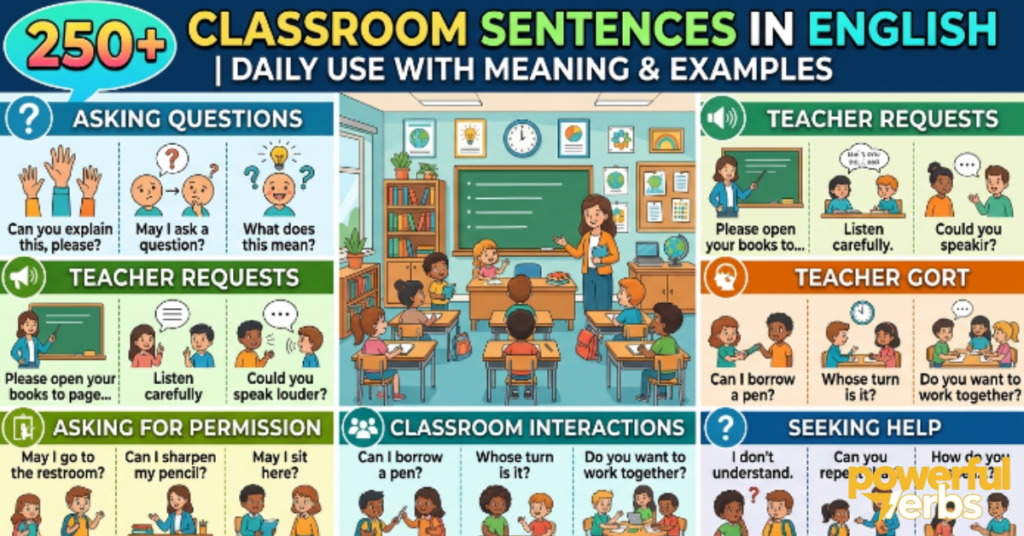
Speaking English inside the classroom feels difficult for many students. They understand the lesson, they know the answer, but when the moment comes to speak, they stay silent. The reason is not lack of knowledge — it is lack of practice with the right sentences.
This complete guide gives you 250+ classroom sentences in English that students use every single day. Every section covers a different classroom situation — from greeting the teacher to asking questions, from requesting help to giving answers. Each sentence is simple, natural, and ready to use immediately.
Whether you are a primary student, a Grade 5 learner, or a high school student improving your spoken English, this resource will help you speak confidently in every classroom situation.
Why Classroom Sentences Matter for Every Student
Many students score well in written tests but struggle to communicate verbally during lessons. This gap between written ability and spoken confidence is one of the biggest challenges in English learning.
Practising classroom sentences solves this problem in a direct and practical way. When students know exactly what to say in each situation, they stop hesitating and start participating. Active participation leads to better understanding, stronger grades, and real confidence in English communication.
Teachers also benefit when students use proper classroom language because it creates a respectful, organised, and productive learning environment for everyone.
Classroom Introduction Sentences in English
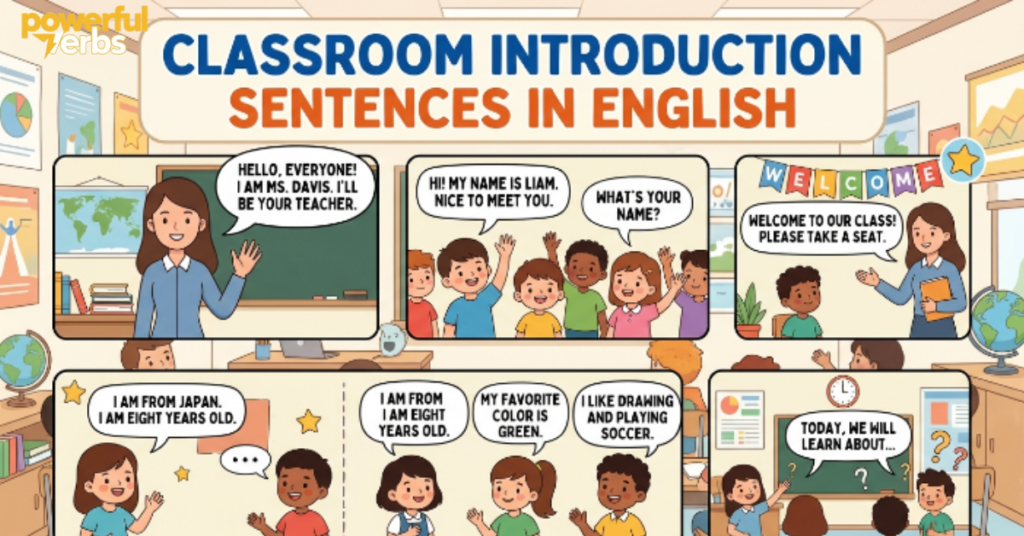
The first step in any new class is introducing yourself. These sentences help students present themselves clearly and confidently in front of teachers and classmates.
- Good morning everyone, my name is Ali and I am glad to be here.
- Hello teacher, I am Ayesha and this is my first day in this class.
- My name is Hassan and I enjoy learning English very much.
- I am Sara and I look forward to learning with all of you.
- Hello classmates, my name is Umar and I am from Lahore.
- Good morning, I am Fatima and my favourite subject is English.
- My name is Ahmad and I enjoy reading books and writing stories.
- I am Zain and I am excited to be a part of this class.
- Hello everyone, my name is Maryam and I like group activities.
- I am Bilal and I want to improve my English speaking this year.
- My name is Noor and I am ready to learn and work hard.
- I am Hamza and I enjoy classroom discussions and debates.
- Good morning teacher, I am Sana and I am happy to meet you.
- My name is Usman and this is my favourite subject in school.
- I am Hira and I enjoy working with my classmates on projects.
- Hello, I am Danish and I like asking questions to learn better.
- My name is Iqra and I am a new student joining this class today.
- I am Farhan and I believe practice makes every skill perfect.
- Good morning, my name is Amna and I enjoy writing and reading.
- I am Saad and I am looking forward to every lesson this term.
Basic Classroom Sentences for Students — Daily Use
These are the most commonly used sentences in any classroom. Every student should memorise these and use them confidently every day.
- May I come in, please?
- Good morning, teacher. How are you today?
- May I sit in the front row, please?
- I am present and ready for the lesson.
- Could you please speak a little more slowly?
- I did not hear that clearly. May I ask you to repeat?
- I do not fully understand this topic. Can you explain it again?
- May I answer the question on the board, please?
- I have completed all my classwork for today.
- Please check my notebook when you have a moment.
- May I go to the washroom, please?
- I forgot my homework at home today. I am sorry.
- May I borrow a pen? I forgot mine today.
- Can I borrow your textbook for a few minutes?
- The bell has already rung, teacher.
- Could you please write that word on the board?
- I am sorry for arriving late today, teacher.
- May I answer this question, please?
- I need a little help understanding this exercise.
- Please repeat the last question one more time.
- I have finished all my work, teacher.
- Please speak a little slowly so I can follow along.
- I have an important question about this chapter.
- I cannot hear clearly from where I am sitting.
- Could we please open our books to page twenty?
- I am present and fully attentive today.
- Please close the door. It is very noisy outside.
- I understand the topic now. Thank you very much.
- Can we begin the lesson now, teacher?
- Please give us a few more minutes to finish this.
Polite Classroom Sentences for Students
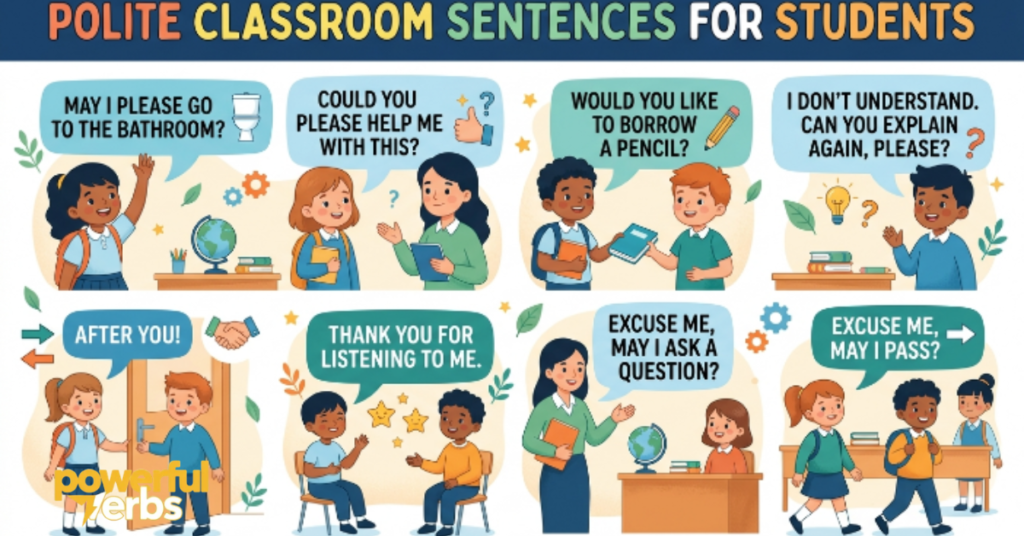
Politeness is one of the most important qualities a student can show in class. These sentences help students communicate respectfully with teachers and classmates in every situation.
- Excuse me, teacher. May I ask a question, please?
- Thank you for explaining that so clearly, teacher.
- I appreciate your patience with all of us today.
- Please allow me one more chance to answer correctly.
- Sorry for the interruption. I have a quick question.
- Could you kindly help me with this exercise, please?
- Thank you so much for your guidance and support.
- I am sorry. I did not mean to disturb the class.
- Would you please repeat the last sentence once more?
- Excuse me, may I share my answer with the class?
- Thank you for checking my work, teacher.
- I am grateful for your detailed explanation today.
- Please forgive me for not completing my homework.
- May I respectfully disagree with that answer?
- I would like to add something to my classmate’s answer.
- Could you please give us an example of that rule?
- Thank you for your time and patience today, teacher.
- I am sorry for speaking out of turn just now.
- Please allow me to explain my answer in full.
- Excuse me, I think I found a different answer here.
Classroom Sentences for Asking Questions
Asking questions is one of the most powerful habits a student can develop. These sentences help students ask questions correctly, clearly, and confidently during any lesson.
- May I ask a question about this topic, teacher?
- Can you explain the meaning of this word, please?
- Could you give us one more example of this grammar rule?
- What does this sentence mean in simple words?
- How do we use this word correctly in a sentence?
- Is this the correct way to write this answer?
- Can you tell us more about this topic in detail?
- Why do we use a comma in this sentence here?
- What is the difference between these two words?
- Could you show us the correct answer on the board?
- Is there another way to write this sentence?
- How many marks will this question carry in the exam?
- Can we discuss this topic a little more before moving on?
- What will we study in the next lesson, teacher?
- Is this going to be covered in the upcoming test?
- Could you please explain the homework instructions again?
- May I ask about the deadline for this assignment?
- What is the main idea of this paragraph, teacher?
- Can you check if my understanding of this is correct?
- How should we present this answer in our notebook?
Classroom Sentences for Giving Answers
Answering questions in class is an important skill. These sentences help students respond to teachers confidently, correctly, and with full sentences instead of single words.
- The answer to this question is twenty-five.
- I think the correct answer is the third option.
- In my opinion, the main idea of this paragraph is hard work.
- According to the text, the event happened in the year 1947.
- The meaning of this word is to move forward quickly.
- I believe the author is trying to say that honesty matters most.
- The correct form of the verb in this sentence is “was.”
- I found the answer in the second paragraph of the chapter.
- The capital city mentioned in the passage is Islamabad.
- I think both answers could be correct depending on the context.
- The sentence is incorrect because the verb does not agree with the subject.
- We need to use the past tense here because the action already happened.
- The correct spelling of this word is c-o-u-r-a-g-e.
- I agree with my classmate’s answer and would like to add one point.
- I respectfully disagree because the text says something different.
- The answer is not given directly but we can find it between the lines.
- I am not completely sure but I think the answer might be this.
- Let me re-read the paragraph before giving my final answer.
- I worked out the answer step by step and got thirty as a result.
- The answer is correct because it matches the rule we studied yesterday.
Classroom Sentences for Requesting Help
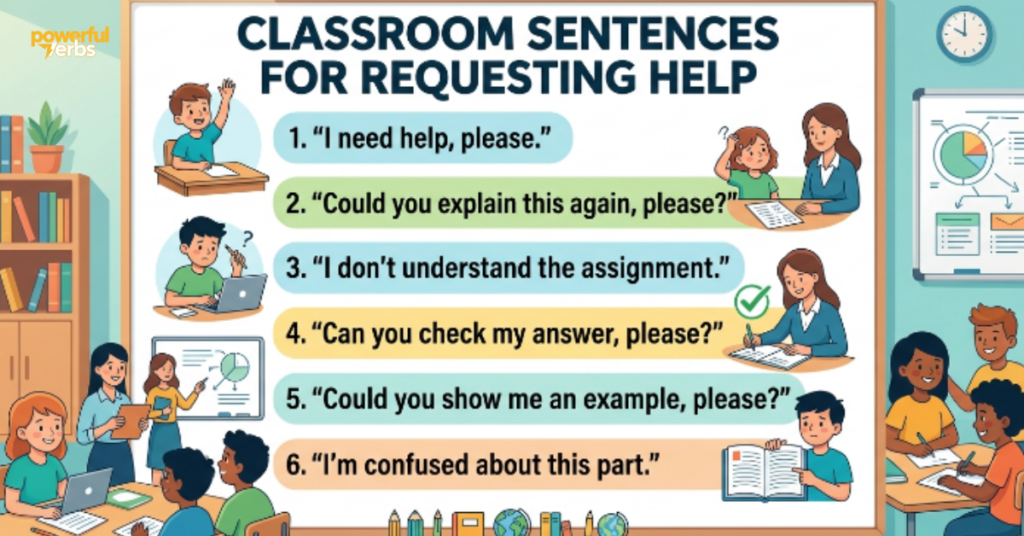
Every student needs help at some point. Knowing how to ask for help correctly shows maturity and a genuine desire to learn.
- Teacher, I am struggling with this question. Can you help me?
- I do not understand how to start this exercise. Please guide me.
- Could you come to my desk and check this for me, please?
- I have read this three times and still feel confused about it.
- Please help me understand the difference between these two answers.
- I think I made an error here. Can you show me the correct method?
- I am finding this topic very difficult. Can we go over it again?
- Could a classmate help me with this exercise during the break?
- I would like some extra practice material for this grammar topic.
- Can you recommend a simple way to remember this rule?
- I need help with the spelling of this word, please.
- Could you explain this diagram more clearly for me?
- I am confused between two options. Which one is correct here?
- Please help me organise my answer before I write it down.
- I want to understand this properly before the exam, teacher.
- Can you give me a hint about how to approach this question?
- I finished the task but I am not confident it is correct.
- Would it be possible to go through my work after class today?
- I need more time to understand this section. Is that acceptable?
- Please help me correct the mistakes in this paragraph, teacher.
Classroom Sentences for Primary Students
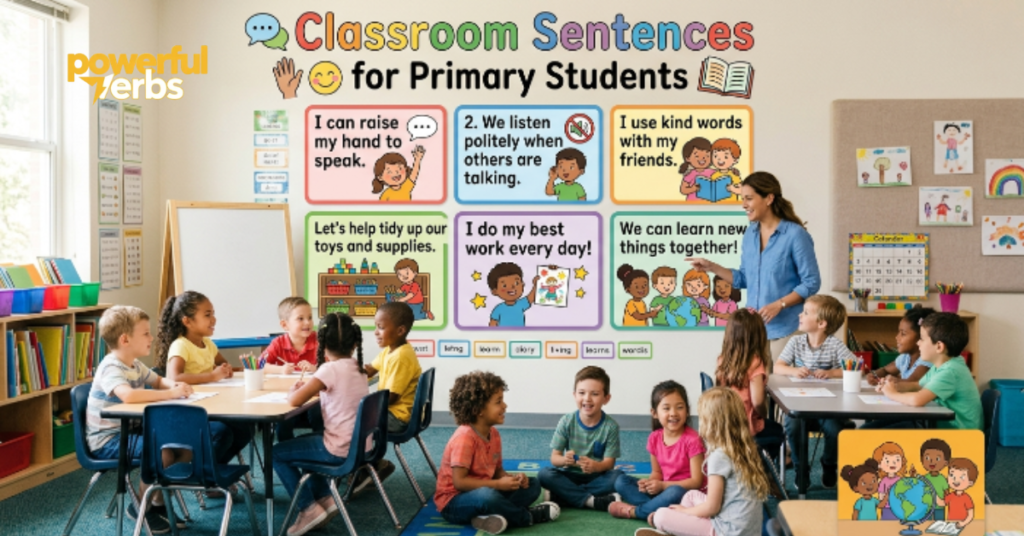
Young learners in primary classes need short, simple, and easy sentences. These classroom expressions are perfect for students in Grade 1 through Grade 4.
- Good morning, teacher!
- I am happy to be in school today.
- May I drink some water, please?
- I like this lesson very much.
- Please help me with this question.
- I am ready to learn today.
- This is my pencil and this is my book.
- I am listening carefully, teacher.
- Please look at my drawing.
- I can read this sentence by myself.
- I wrote my name on the paper.
- I am trying my very best today.
- Please forgive me. I will not do it again.
- I will try harder next time, teacher.
- Thank you for teaching us today.
- May I colour this picture now?
- I finished writing all the letters.
- I like group work with my friends.
- May I sharpen my pencil, please?
- I am done with my exercise book.
Classroom Sentences for Group Work and Activities
Group activities, presentations, and pair work are common in modern classrooms. These sentences help students communicate smoothly during collaborative tasks.
- Let us divide the work equally among everyone.
- I will handle the introduction part of our presentation.
- Can you take notes while I explain our findings?
- I think we should start with the most important point.
- Let us make sure everyone has a role in this activity.
- I agree with your idea. Let us include it in our project.
- Could we rearrange the order of our presentation points?
- I think we need more evidence to support this argument.
- Let us rehearse the presentation once before the final class.
- Can you speak a little louder during the group presentation?
- I will write the conclusion while you prepare the main body.
- Should we use a diagram to explain this part more clearly?
- Let us check each other’s work before we submit it.
- I think the introduction needs to be more detailed and clear.
- Can everyone agree on this final answer before we present?
- We should give each group member equal speaking time.
- I will take the first turn and then pass it on to you.
- Let us respect each other’s ideas during the discussion.
- Can we add one more point to make our answer more complete?
- I think our group has done an excellent job on this task.
Classroom Sentences During Examinations and Tests
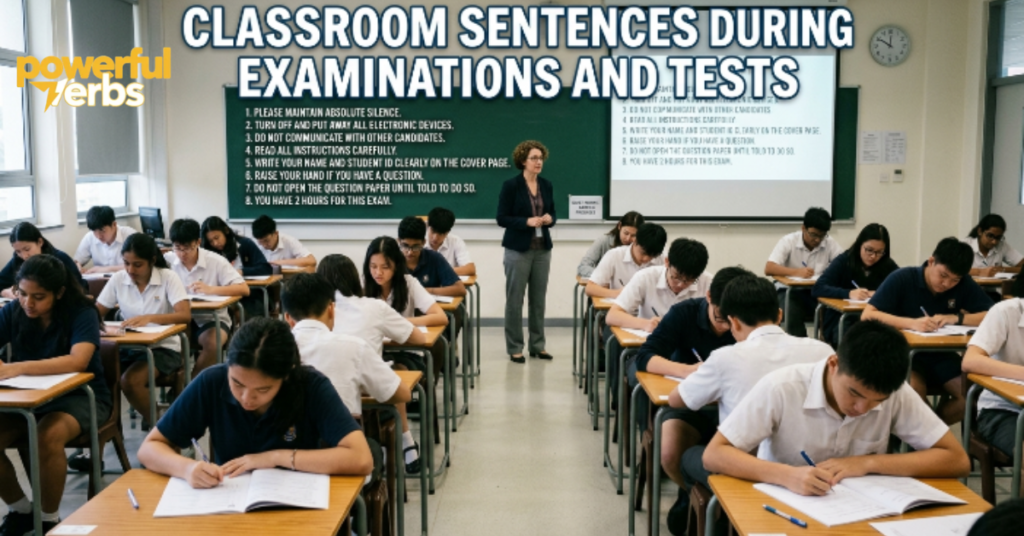
Test days are stressful for many students. These sentences help students communicate calmly and correctly during exams and assessments.
- May I have an extra answer sheet, please?
- My pen has stopped working. May I borrow one, please?
- How much time is remaining for this paper, teacher?
- May I re-read the question paper from the beginning?
- I did not understand question number five clearly.
- Could you please clarify what this question is asking?
- Is it acceptable to use a pencil for this section?
- May I use rough paper for my working and calculations?
- I have completed the paper. May I submit it now?
- Can I go back and check my answers before submitting?
- I accidentally skipped question number eight. Is there time?
- The question on page two seems to have a printing error.
- May I ask for a fresh answer sheet? Mine got torn.
- I am not sure if I answered question three correctly.
- Please confirm whether we need to attempt all questions.
- How many marks does the last question carry, teacher?
- May I underline the key points in my answer?
- Is it necessary to write in full sentences for every answer?
- I have finished and checked my paper thoroughly, teacher.
- Thank you for invigilating our exam with so much patience.
Classroom Sentences for After the Lesson
What happens after the lesson ends is just as important as what happens during class. These sentences help students wrap up, clarify doubts, and prepare for the next session.
- Thank you for today’s lesson, teacher. It was very helpful.
- Could you please tell us what to study for the next class?
- What is the homework assignment for tonight, teacher?
- Is there any reading we should complete before tomorrow?
- May I stay back for a few minutes to ask a question?
- Could you please repeat the page numbers for tomorrow’s work?
- I would like to review my test paper when you have time.
- Can I visit during your free period to get extra help?
- I will revise today’s lesson carefully at home tonight.
- Thank you, teacher. Today’s class was truly enjoyable and useful.
- Could you recommend a good book related to today’s topic?
- I would like to submit my late assignment with your permission.
- Should we prepare a summary of today’s lesson in our notebook?
- Is there any online resource you can suggest for extra practice?
- I want to make sure I fully understood today’s grammar lesson.
- May I take a photograph of the notes on the board, please?
- I will make sure to complete everything before the next class.
- Could you please sign my planner for today’s homework?
- Thank you for your patience and support throughout the lesson.
- I am looking forward to our next lesson tomorrow, teacher.
Classroom Sentences for Expressing Feelings and Opinions
Expressing thoughts, feelings, and personal opinions is an important part of active classroom participation. These sentences help students share what they think and feel about lessons and topics.
- I find this topic very interesting and would love to learn more.
- In my opinion, this is the most important chapter this term.
- I feel that practising daily helps me improve much faster.
- I enjoyed today’s activity more than any previous one this year.
- I think this story teaches us an important life lesson.
- Personally, I believe hard work always leads to success.
- I feel confident about this topic after today’s explanation.
- I think we should have more group discussions in class.
- From my point of view, reading improves English the fastest.
- I agree completely with what my classmate just shared.
- I respectfully disagree because I found a different answer.
- I feel that this exercise was challenging but very rewarding.
- I enjoyed working on this project with my group members.
- I think visual diagrams help me understand grammar more easily.
- I feel proud of the progress I have made this semester.
- In my view, storytelling is the best way to learn new words.
- I am excited about the upcoming English speaking competition.
- I find writing paragraphs easier after practising daily sentences.
- I believe every student can improve with the right amount of practice.
- I feel motivated to study harder after today’s encouraging lesson.
Advanced Classroom Sentences for High School Students
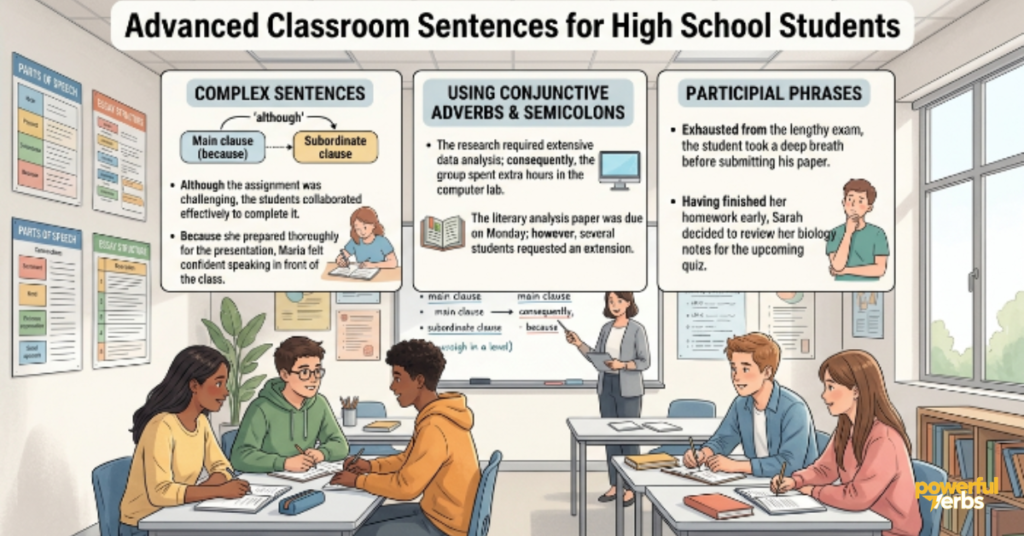
Older students need more sophisticated language for higher-level discussions, debates, and presentations. These sentences are suitable for Grade 8 and above.
- Could we critically analyse the main argument of this text?
- I would like to challenge the assumption made in paragraph three.
- The evidence presented in the article supports this conclusion strongly.
- In contrast to the previous point, this paragraph suggests otherwise.
- The author uses figurative language to emphasise this central idea.
- I would argue that the secondary theme is equally significant here.
- This literary device creates a sense of tension throughout the passage.
- Based on the contextual clues, the meaning of this phrase is clear.
- The data presented in the graph clearly supports our hypothesis.
- I would like to present a counterargument to the point just raised.
- The writer’s tone shifts noticeably from the second paragraph onward.
- This sentence structure creates emphasis and draws the reader’s attention.
- I believe the conclusion of this essay could be strengthened further.
- The vocabulary used here reflects a formal academic writing style.
- Could we compare this theme with the one we discussed last week?
- The main conflict in this story reflects a broader social issue.
- This metaphor effectively conveys the character’s emotional state.
- I would suggest revising the thesis statement for greater clarity.
- The statistical evidence here significantly weakens the opposing argument.
- After careful analysis, I conclude that the author’s message is universal.
Bonus: 10 Extra Powerful Classroom Sentences
- Every question I ask today brings me one step closer to understanding.
- I may not know the answer yet, but I am willing to find it.
- Asking for help is not a weakness — it is a sign of determination.
- I learn something valuable from every single lesson in this classroom.
- My goal this term is to participate more actively in every class.
- I believe consistent effort is more powerful than natural talent alone.
- Listening carefully is the first and most important step to learning well.
- I am committed to improving my English one sentence at a time.
- Every mistake I make in class teaches me something I did not know before.
- I am grateful for every opportunity this classroom gives me to grow.
Classroom English Reference
The following terms and expressions are closely related to classroom communication and English speaking practice. Understanding these alongside classroom sentences builds a complete foundation for academic English.
Classroom Communication Terms: verbal communication, active participation, academic language, formal English, spoken fluency, listening skills, classroom etiquette, peer interaction, teacher-student dialogue
English Learning Terms: sentence structure, vocabulary building, grammar practice, comprehension, spoken English, reading skills, writing skills, pronunciation, confidence building, daily practice
Academic Terms: lesson objectives, homework assignment, group discussion, oral presentation, comprehension questions, critical thinking, peer feedback, academic performance, language development
Practical Tips to Use Classroom Sentences Effectively
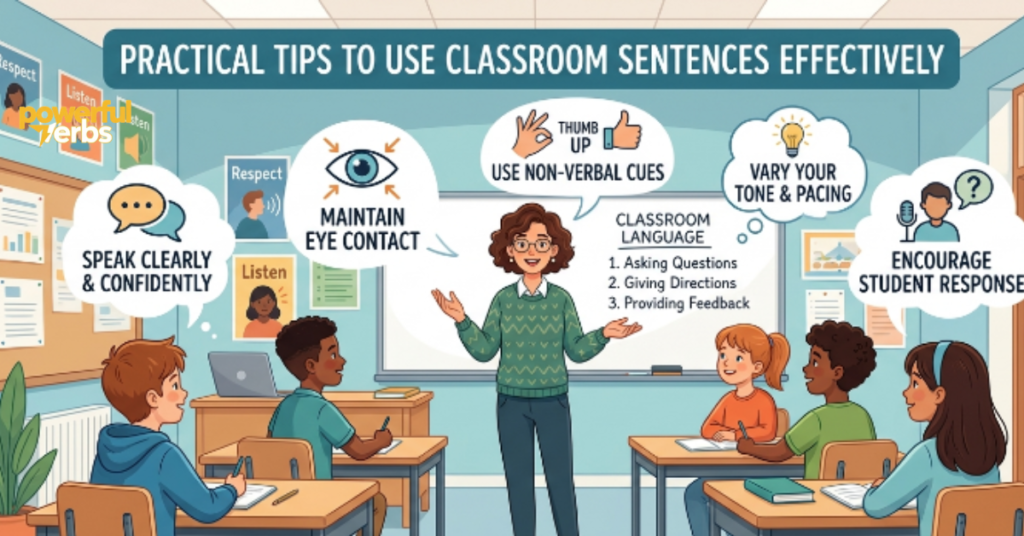
Learning these sentences is only the first step. Using them consistently and correctly in real classroom situations is what produces lasting improvement in English communication.
Practise ten sentences every morning before school. Reading them aloud before class activates your memory and prepares your mind for speaking during the lesson.
Write your three favourite sentences in your notebook each day. Writing reinforces memory far more effectively than reading alone. Choose sentences from different sections every day.
Use at least two new sentences in every class period. Set a personal goal to speak at least twice in each lesson using sentences from this list. Consistency builds confidence faster than any other method.
Practise with a classmate during break time. Take turns playing the role of student and teacher. Use the polite request sentences, question sentences, and answer sentences in a realistic conversation.
Record yourself speaking these sentences. Listening back to your own voice helps you identify pronunciation errors and improve your delivery before using the sentences in front of the class.
Do not fear making mistakes. Every confident English speaker made mistakes at the beginning. Mistakes in class are not failures — they are essential steps in the learning process.
Conclusion
These 250+ classroom sentences in English cover every situation a student faces from the first moment they enter the classroom to the last moment before the bell rings. Every sentence is written in natural, clear English that real students and teachers use in real classrooms every day.
The difference between a student who participates actively and one who stays silent is rarely about knowledge — it is almost always about knowing what to say and having the confidence to say it. These sentences give every student exactly that advantage.
Start with the section that matches your current level, practise daily, and use at least two new sentences in every class. Within a few weeks, speaking English in the classroom will feel natural, easy, and completely within your reach.Your voice matters in every classroom — use it with confidence.
FAQs
What are classroom sentences for students?
Classroom sentences are specific English expressions that students use to communicate during lessons. They cover situations such as greeting the teacher, asking questions, requesting help, giving answers, and participating in group activities.
Why are classroom sentences important for English learners?
Classroom sentences give students a ready vocabulary for real communication situations. Instead of searching for words under pressure, students who know these sentences can focus on the content of the lesson and participate with confidence.
Are these classroom sentences suitable for beginners?
Yes. The sentences in this guide range from very simple primary level expressions to advanced high school level language. Every student from Grade 1 to Grade 12 will find sentences that match their current level and help them improve.
How many classroom sentences should a student practise daily?
Practising ten to fifteen sentences daily produces noticeable improvement within two to three weeks. The key is daily consistency rather than occasional large study sessions.
What is the difference between basic and polite classroom sentences?
Basic classroom sentences cover essential daily communication such as asking to enter, requesting help, and submitting work. Polite classroom sentences add respectful expressions and formal language that show courtesy and maturity in academic settings.
How can teachers use classroom sentences in their lessons?
Teachers can display a set of ten classroom sentences at the start of each week and encourage students to use them actively during class. Regular reinforcement through role play, pair practice, and gentle correction helps students internalise these expressions naturally.
Can classroom sentences help students in exams?
Yes. Students who regularly use full sentences in class develop the habit of writing complete, structured answers in exams. This habit directly improves the quality and marks of written exam responses.

Liam Johnson is a dedicated language expert with 4 years of professional experience. He specializes in Grammar, Vocabulary, and Sentence structure.
