

Learning nouns is the very first step every child takes on the journey to mastering the English language. Whether your little one is just starting school or already reading short sentences, having a strong noun vocabulary unlocks faster reading, clearer writing, and more confident speaking.
This ultimate guide gives children 360 carefully chosen nouns from A to Z, organized by letter, supported by vivid picture-based learning, and explained in the simplest possible way — so every child can understand and remember them easily.
What Is a Noun? A Simple Definition for Kids
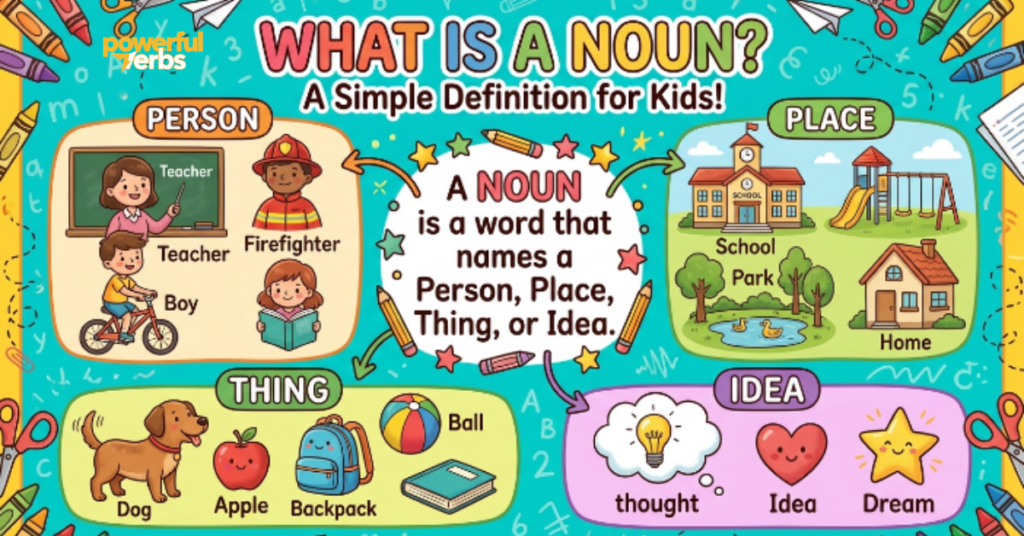
A noun is a naming word. It is the name of a person, place, animal, or thing that we see, touch, feel, or think about every day.
| Type of Noun | What It Names | Examples |
| Person | Someone we know | teacher, doctor, baby |
| Place | Somewhere we go | school, park, hospital |
| Animal | Living creatures | dog, lion, butterfly |
| Thing | Objects around us | chair, pencil, bicycle |
Every sentence needs at least one noun. That is why learning nouns first makes every other part of English much easier to understand.
Why Should Kids Learn Nouns First?
Before children learn verbs, adjectives, or grammar rules, they must know nouns — and for very good reason:
- Nouns help children label the world around them, making communication natural and fast.
- A strong noun vocabulary improves reading comprehension because children already know what the words mean.
- Knowing nouns gives children confidence to form sentences on their own.
- Picture-based noun learning is scientifically proven to boost memory retention in young learners.
- Most standardized English tests for early learners test noun recognition first.
The earlier a child builds a solid list of common nouns, the stronger their entire English foundation becomes.
360 Nouns for Kids A to Z with Pictures
Below is the most complete, picture-friendly noun word list for children — 360 nouns organized from A to Z. Each section includes 10 nouns per letter so every child can learn at a comfortable pace.
A Nouns for Kids
Children encounter these words every single day — at home, at school, and in nature.
- Apple — a round, sweet fruit that grows on trees
- Ant — a tiny insect that lives and works in large groups
- Arm — the body part that connects the shoulder to the hand
- Animal — any living creature that breathes and moves
- Airplane — a large flying vehicle that carries passengers through the sky
- Aunt — the sister of a child’s mother or father
- Arrow — a pointed stick shot from a bow
- Artist — a person who creates paintings, drawings, or sculptures
- Alarm — a device that makes a loud sound to wake someone up
- Apron — a protective cloth worn over clothes while cooking
B Nouns for Kids
These everyday B-words are found in homes, schools, and playgrounds everywhere.
- Ball — a round toy used in many games and sports
- Bat — a wooden or metal stick used to hit a ball
- Bag — a container used to carry books, clothes, or food
- Banana — a long yellow fruit with a sweet taste
- Boy — a male child
- Bird — a feathered animal with wings that can usually fly
- Book — a collection of written pages bound together
- Bottle — a glass or plastic container used for liquids
- Bus — a large vehicle that carries many passengers along fixed routes
- Box — a square or rectangular container with sides and a lid
C Nouns for Kids
C-words are among the most commonly used nouns in early childhood education.
- Cat — a soft, furry pet animal that purrs and meows
- Car — a four-wheeled vehicle powered by an engine
- Cake — a sweet baked food made with flour, sugar, and eggs
- Cow — a large farm animal that gives milk
- Chair — a piece of furniture with four legs designed for sitting
- Cup — a small container with a handle used for drinking
- Child — a young human being, either a boy or a girl
- Clock — a device that shows the current time
- Cloud — a white or gray mass of water droplets floating in the sky
- Candy — a small, sweet treat made with sugar
D Nouns for Kids
These D-words help children describe familiar people, pets, and everyday objects.
- Dog — a loyal pet animal that barks and wags its tail
- Doll — a small toy figure shaped like a person
- Door — a moveable panel used to open or close the entrance to a room
- Duck — a waterbird with a flat beak that quacks
- Drum — a round musical instrument played by hitting it with sticks
- Dress — a one-piece garment worn by girls and women
- Doctor — a trained medical professional who helps sick people get better
- Desk — a flat-topped piece of furniture used for reading and writing
- Dish — a flat container used to hold and serve food
- Diamond — a precious gemstone that sparkles brightly in light
E Nouns for Kids
E-nouns introduce children to nature, the human body, and everyday tools.
- Egg — an oval object laid by birds, reptiles, and some animals
- Ear — the body part on either side of the head used for hearing
- Elephant — the largest land animal, known for its long trunk and big ears
- Engine — a machine that produces power to run a vehicle or device
- Envelope — a paper cover used to send letters through the mail
- Eraser — a small rubber tool used to remove pencil marks
- Eye — the organ in the face used for seeing
- Eagle — a powerful bird of prey with sharp talons and excellent eyesight
- Earth — the planet we live on, covered with land and oceans
- Evening — the part of the day between late afternoon and night
F Nouns for Kids
These F-nouns cover animals, nature, food, and important family members.
- Fish — a water animal with fins and scales that breathes through gills
- Frog — a small green amphibian that jumps and lives near water
- Flower — the colorful, blooming part of a plant
- Fan — a device that moves air to keep a room or person cool
- Fruit — the edible part of a plant that contains seeds
- Fork — a metal eating utensil with pointed prongs
- Father — the male parent of a child
- Fence — a barrier made of wood, metal, or wire that surrounds a space
- Flag — a piece of colored cloth used as the symbol of a country or team
- Feather — the light, soft covering that grows on a bird’s body
G Nouns for Kids
G-nouns bring together animals, outdoor spaces, and things children use at school.
- Goat — a farm animal with horns that is known for eating almost anything
- Girl — a female child
- Gift — something given to another person to make them happy
- Grass — the short green plants that cover lawns and fields
- Game — an activity played for fun, often with rules
- Garden — a piece of land where flowers, vegetables, or trees are grown
- Glass — a transparent material used to make windows, cups, and mirrors
- Glue — a sticky substance used to attach things together
- Gate — a moveable barrier at the entrance of a garden or field
- Ground — the surface of the earth that we walk on
H Nouns for Kids
These important H-words include places, body parts, and animals children love.
- House — a building where a family lives
- Hat — a covering worn on the head for style or protection
- Hen — a female chicken that lays eggs
- Horse — a large, strong animal used for riding and farm work
- Hand — the body part at the end of the arm with five fingers
- Heart — the organ in the chest that pumps blood through the body
- Hill — a raised area of land smaller than a mountain
- Hospital — a large building where sick or injured people receive medical care
- Honey — a sweet, golden liquid made by bees
- Helmet — a hard protective covering worn on the head for safety
I Nouns for Kids
I-words introduce children to science, nature, and abstract ideas.
- Ice — frozen water that is solid and cold to the touch
- Ice cream — a cold, sweet frozen dessert made from milk and sugar
- Island — a piece of land completely surrounded by water
- Ink — a colored liquid used for writing and printing
- Insect — a small creature with six legs and usually one or two pairs of wings
- Iron — a heavy metal tool used to press clothes smooth
- Idea — a thought or plan that comes to mind
- Image — a picture or photograph that shows something visually
- Invitation — a written or spoken request asking someone to attend an event
- Inch — a unit of measurement equal to one-twelfth of a foot
J Nouns for Kids
J-nouns cover food, nature, clothing, and exciting adventure words.
- Jug — a container with a handle and a wide mouth used for pouring liquids
- Jam — a sweet, thick spread made from cooked fruit and sugar
- Jar — a glass container with a wide opening and a lid
- Jeep — a sturdy, powerful vehicle built for off-road driving
- Jacket — a short coat worn over other clothing for warmth
- Juice — a liquid drink made from squeezed fruits or vegetables
- Jewel — a precious stone such as a diamond, ruby, or emerald
- Job — a task or type of work that a person does regularly
- Jungle — a thick, dense forest found in tropical regions
- Journal — a book used for writing personal thoughts and daily experiences
K Nouns for Kids
These K-words introduce children to tools, animals, and kitchen objects.
- Kite — a light frame covered with paper or fabric flown in the wind on a string
- Key — a small metal tool used to open or lock a door
- King — the male ruler of a country or kingdom
- Kid — an informal word for a young child, or the young of a goat
- Kitchen — the room in a house where food is prepared and cooked
- Knee — the joint in the middle of the leg that allows it to bend
- Knife — a sharp-edged metal tool used for cutting food
- Koala — a small, fluffy Australian animal that lives in eucalyptus trees
- Kettle — a metal container used to boil water for making tea or coffee
- Keyboard — a set of keys used to type letters and numbers on a computer
L Nouns for Kids
L-words connect children to nature, animals, learning tools, and mealtimes.
- Lion — a large, powerful wild cat known as the king of the jungle
- Leaf — the flat, green part of a plant that absorbs sunlight
- Lamp — a device that produces light, used in homes and offices
- Leg — the body part used for standing and walking
- Lemon — a sour yellow citrus fruit
- Lake — a large body of still water surrounded by land
- Library — a building filled with books that people can borrow and read
- Lunch — the meal eaten in the middle of the day
- Ladder — a tool with steps used for climbing up and down
- Letter — a written message sent to someone, or a symbol of the alphabet
M Nouns for Kids
These M-nouns are among the most frequently searched vocabulary words for young learners.
- Man — an adult male human being
- Mother — the female parent of a child
- Monkey — a clever, tree-climbing animal with a long tail
- Milk — a white liquid produced by cows and other mammals, rich in calcium
- Moon — the natural satellite that orbits the Earth and glows at night
- Mat — a small flat piece of material placed on the floor
- Mouse — a small furry rodent with a pointed nose and a long tail
- Mountain — a very large natural hill that rises high above the surrounding land
- Mirror — a smooth glass surface that reflects a clear image
- Mango — a juicy tropical fruit with a sweet orange flesh
N Nouns for Kids
N-words introduce children to professions, nature, and classroom objects.
- Nest — a structure built by birds to lay eggs and raise their young
- Nurse — a trained healthcare worker who cares for sick patients
- Nose — the facial feature used for smelling and breathing
- Net — a meshed material used for catching fish, playing sports, or decoration
- Nail — a thin metal pin hammered into wood, or the hard covering on fingertips
- Notebook — a bound set of blank or lined pages used for writing notes
- Night — the dark part of the day when the sun has set
- Newspaper — a printed publication containing news, sports, and information
- Number — a symbol or word used to represent a quantity or value
- Necklace — a decorative chain or string of beads worn around the neck
O Nouns for Kids
O-nouns span oceans, food, animals, and everyday places children recognize.
- Orange — a round, sweet citrus fruit with a bright orange peel
- Owl — a nocturnal bird with large eyes known for its hooting sound
- Ox — a large, strong animal used for pulling heavy loads on farms
- Office — a room or building where people work at desks
- Onion — a round vegetable with layers and a strong smell used in cooking
- Oven — a kitchen appliance used for baking and roasting food
- Ocean — a vast body of saltwater covering most of the Earth’s surface
- Oil — a thick, slippery liquid used for cooking, machines, or skin care
- Object — any physical item that can be seen or touched
- Ostrich — the world’s largest bird, which runs fast but cannot fly
P Nouns for Kids
These P-words are playground favorites, classroom essentials, and kitchen staples.
- Pen — a writing instrument that uses ink to make marks on paper
- Pencil — a writing tool with a graphite core used to draw and write
- Park — a public outdoor space with grass, trees, and play areas
- Pig — a pink farm animal with a curly tail known for rolling in mud
- Plate — a flat dish used to hold and serve food at mealtimes
- Pillow — a soft cushion used to rest the head while sleeping
- Pizza — a round flatbread topped with cheese, tomato sauce, and toppings
- Plant — a living organism with roots, stems, and leaves that grows in soil
- Picture — an image created through drawing, painting, or photography
- Playground — an outdoor area designed for children to play safely
Q Nouns for Kids
Q-words are rare in daily speech, making them extra exciting for young learners to discover.
- Queen — the female ruler of a country or the wife of a king
- Quilt — a thick, warm blanket made by sewing layers of fabric together
- Question — a sentence spoken or written to get information or an answer
- Queue — a line of people or vehicles waiting for their turn
- Quill — a large feather used as a writing pen in ancient times
- Quarter — one of four equal parts of something, or a coin worth 25 cents
- Quiz — a short test or competition that checks knowledge
- Quicksand — wet, loose sand that sucks down anything heavy placed on it
- Quartz — a hard, shiny mineral found in rocks and used in clocks
- Quinoa — a healthy grain-like seed that is packed with protein and nutrients
R Nouns for Kids
R-nouns cover animals, nature, classroom tools, and futuristic concepts children love.
- Rabbit — a small, furry animal with long ears and a fluffy tail
- Rain — water droplets that fall from clouds in the sky
- River — a large, natural stream of water flowing toward a sea or lake
- Road — a wide, paved path used by vehicles for travel
- Ring — a circular band worn on a finger as jewelry
- Ruler — a flat measuring tool marked with units of length
- Room — a separate space inside a building enclosed by walls
- Robot — a machine programmed to perform tasks automatically
- Rose — a beautiful flower with soft petals and a sweet fragrance
- Rainbow — an arc of seven colors formed in the sky after rain
S Nouns for Kids
S-nouns are some of the most important sight words in early English education.
- Sun — the star at the center of our solar system that gives light and warmth
- Star — a glowing ball of gas far away in space visible at night
- School — a building where children go to learn and study
- Sheep — a woolly farm animal raised for its wool and meat
- Shoe — a covering worn on the foot for protection and comfort
- Spoon — a utensil with a round bowl used for eating soups and cereals
- Shirt — a piece of clothing worn on the upper body
- Stone — a hard, solid piece of rock found on the ground
- Swing — a hanging seat suspended by ropes or chains for playing
- Sand — tiny particles of rock found at beaches and in deserts
T Nouns for Kids
T-words are classroom classics and among the most recognized nouns in children’s books.
- Table — a piece of furniture with a flat top supported by legs
- Toy — an object made for children to play with
- Tree — a tall, woody plant with a trunk, branches, and leaves
- Tiger — a large, striped wild cat that is the biggest of the big cats
- Train — a vehicle made of connected carriages that runs on railway tracks
- Teacher — an educated professional who helps children learn in school
- Towel — a thick cloth used to dry the body after bathing
- Tomato — a red, juicy fruit often used as a vegetable in cooking
- Turtle — a slow-moving reptile with a hard shell on its back
- Television — an electronic screen device used to watch programs and videos
U Nouns for Kids
U-words introduce unusual and important vocabulary that expands children’s word bank.
- Umbrella — a folding canopy held above the head for protection from rain
- Uncle — the brother of a child’s mother or father
- Uniform — a set of matching clothes worn by students or workers
- Utensil — a tool used for cooking or eating, such as a spoon or spatula
- Unicorn — a mythical horse-like creature with a single horn on its forehead
- University — a place of higher education where adults study for degrees
- Umbrella bird — a tropical bird with a large crest resembling an umbrella
- Unit — a single item used as a standard measure
- Universe — everything that exists, including all stars, planets, and space
- Urn — a large decorative vase, often used to store ashes or display flowers
V Nouns for Kids
V-nouns introduce geography, music, science, and colorful vocabulary.
- Van — a large vehicle used to carry goods or groups of people
- Vase — a decorative container used to hold flowers or water
- Vegetable — an edible plant part such as carrot, pea, or broccoli
- Village — a small community of homes in a rural area
- Violin — a stringed musical instrument played with a bow
- Visitor — a person who comes to see someone or somewhere
- Voice — the sound produced by a person’s mouth when speaking or singing
- Volcano — a mountain with an opening from which lava and ash erupt
- Video — a recording of moving images stored digitally or on film
- Valley — a low area of land between hills or mountains, often with a river
W Nouns for Kids
These W-words are essential building blocks of everyday English conversation.
- Water — a clear, colorless liquid essential for all living things
- Window — a glass-covered opening in a wall that lets in light and air
- Watch — a small clock worn on the wrist to tell the time
- Wheel — a circular object that rotates on an axle, used in vehicles and machines
- Whale — the largest mammal on Earth, which lives entirely in the ocean
- Wall — a vertical structure made of brick, stone, or wood that encloses a space
- Woman — an adult female human being
- Wolf — a large, wild dog-like animal that lives and hunts in packs
- Wood — the hard material that makes up the trunks and branches of trees
- Wind — the natural movement of air across the Earth’s surface
X Nouns for Kids
X-words are exciting discoveries for young learners just beginning to explore the alphabet.
- Xylophone — a musical instrument with wooden bars struck by mallets
- X-ray — a medical image taken to see inside the human body
- Xenon — a colorless gas found in the atmosphere used in lighting
- Xbox — a popular gaming console used to play video games
- X-axis — the horizontal line on a graph or coordinate system
- Xerus — a type of African ground squirrel with a bushy tail
- Xylitol — a natural sweetener used in sugar-free gum and candy
- X-factor — a special quality in a person that makes them stand out
- Xylem — the tube-like tissue in plants that carries water from roots to leaves
- Xmas — a short, informal form of the word Christmas
Y Nouns for Kids
Y-nouns bridge animal names, food, and everyday activities in an unforgettable way.
- Yarn — a long, twisted thread used for knitting and weaving
- Yak — a large, shaggy ox found in the mountains of Central Asia
- Yard — the outdoor area surrounding a house, or a unit of measurement
- Year — a period of 365 days, or 366 days in a leap year
- Yogurt — a thick, creamy dairy food made from fermented milk
- Yo-yo — a round toy on a string that spins up and down in the hand
- Youth — the period of life when a person is young
- Yeast — a tiny living organism used to make bread rise and dough ferment
- Yacht — a large, elegant sailing boat used for leisure or racing
- Yolk — the round, yellow center of an egg
Z Nouns for Kids
Z-nouns wrap up the alphabet with exciting animals, places, and everyday items.
- Zebra — a wild African animal with distinctive black and white stripes
- Zoo — a public place where wild animals are kept and displayed for visitors
- Zip — the fastening device on bags and clothing that slides open and shut
- Zero — the number that represents nothing or no amount
- Zigzag — a pattern of sharp turns from one side to the other
- Zookeeper — a person whose job is to care for animals in a zoo
- Zone — a defined area set apart for a specific purpose
- Zipper — a fastening device made of two rows of metal or plastic teeth
- Zucchini — a long, green vegetable that grows on a vine
- Zoom — rapid movement toward something, or a video-calling application
Types of Nouns Every Kid Should Know
Once children have mastered the basic noun word list, the next step is understanding different noun types. This builds a stronger grammar foundation for reading and writing.
Common Nouns vs. Proper Nouns
| Common Noun | Proper Noun |
| city | London |
| boy | James |
| river | Amazon River |
| school | Oxford Primary School |
Common nouns name general people, places, or things. Proper nouns name specific, unique ones — and always start with a capital letter.
Concrete Nouns vs. Abstract Nouns
| Concrete Noun | Abstract Noun |
| apple | happiness |
| dog | friendship |
| rain | courage |
| book | knowledge |
Concrete nouns are things children can touch, see, hear, smell, or taste. Abstract nouns name ideas and feelings that cannot be physically touched.
Singular Nouns vs. Plural Nouns
| Singular | Plural |
| cat | cats |
| child | children |
| tooth | teeth |
| box | boxes |
When one becomes many, the noun changes its form. This is called a plural noun.
30 Most Important Nouns for Kids to Learn First
If a young learner is just starting out, these 30 high-frequency nouns appear most often in children’s books, classroom lessons, and everyday conversation:
People: mother, father, teacher, baby, friend, doctor
Animals: dog, cat, bird, fish, cow, rabbit
Places: school, house, park, hospital, market, garden
Things: ball, book, chair, table, bag, pencil, car, bus, water, apple
Mastering these 30 words first gives children an immediate vocabulary boost that transforms their reading and speaking confidence.
Fun Ways to Help Kids Learn Nouns with Pictures
Visual learning accelerates vocabulary development in young children. Here are the most effective methods parents and teachers use:
Noun Flashcards — Print or draw picture cards with the noun written below. Show the card, say the word aloud, and ask the child to repeat it.
Noun Hunt — Walk around the house or classroom and challenge children to point at objects and say their names. Every object they name is a noun.
Story Time Nouns — While reading a picture book, pause and ask children to identify all the nouns on each page.
Noun Sorting Game — Write nouns on small cards and ask children to sort them into four groups: people, places, animals, and things.
Drawing Activity — Call out a noun and ask children to draw it. The act of drawing strengthens word-to-image memory connections.
Alphabet Noun Book — Let children create their own A to Z noun booklet with drawings and handwritten words for each letter.
Noun Worksheets and Practice Activities
These activities reinforce noun learning through writing and critical thinking:
Activity 1 — Fill in the Blank
The ______ sat on the chair. (cat / run / big)
Activity 2 — Circle the Noun
The girl ran to the park and played with a ball.
Activity 3 — Name the Picture
Show a picture of a tree. Ask: “What is this called? Can you write the noun?”
Activity 4 — Noun or Not?
Read words aloud — happy, dog, run, school, quickly, rain — and ask children to raise their hand only when they hear a noun.
Activity 5 — Write 5 Nouns in Each Category
Ask children to write five nouns each for: animals, food, school objects, and outdoor places.
Noun Chart: A to Z Quick Reference Table
| Letter | Nouns |
| A | apple, ant, arm, animal, airplane |
| B | ball, bag, bird, book, bus |
| C | cat, car, cake, clock, cloud |
| D | dog, doll, door, duck, drum |
| E | egg, ear, elephant, eraser, eagle |
| F | fish, frog, flower, fan, feather |
| G | goat, girl, gift, garden, gate |
| H | house, hat, horse, hand, heart |
| I | ice, island, ink, insect, idea |
| J | jug, jam, jacket, juice, jungle |
| K | kite, key, king, kitchen, koala |
| L | lion, leaf, lamp, lake, library |
| M | man, monkey, milk, moon, mango |
| N | nest, nurse, nose, notebook, night |
| O | orange, owl, ocean, onion, ostrich |
| P | pen, park, pig, plate, pizza |
| Q | queen, quilt, quiz, quarter, quartz |
| R | rabbit, rain, river, robot, rainbow |
| S | sun, star, school, sheep, spoon |
| T | table, toy, tree, tiger, train |
| U | umbrella, uncle, uniform, unicorn, universe |
| V | van, vase, vegetable, volcano, valley |
| W | water, window, whale, wolf, wind |
| X | xylophone, x-ray, xenon, xylem, xerus |
| Y | yarn, yak, yogurt, yacht, yolk |
| Z | zebra, zoo, zipper, zone, zucchini |
Conclusion
Building a strong noun vocabulary is the most important first step in any child’s English learning journey. With these 360 carefully selected nouns from A to Z, young learners gain the word power they need to read with confidence, write with clarity, and speak without hesitation.
Revisit this list regularly, combine it with picture-based activities, and watch your child’s vocabulary — and their love of language — grow stronger every single day.
FAQs
What is a noun for kids in simple words?
A noun is a naming word. It is the name of any person, place, animal, or thing — such as mother, school, cat, or chair.
What are the 4 types of nouns for kids?
The four main noun types children learn are common nouns (dog, book), proper nouns (London, Sarah), concrete nouns (apple, table), and abstract nouns (love, courage).
How many nouns are there in English?
English contains over 150,000 nouns, but children only need to master a few hundred common ones to communicate confidently and read fluently.
What are the most common nouns for kids to learn first?
The most important early nouns are mother, father, dog, cat, school, home, ball, book, water, teacher, friend, and food — words children encounter every single day.
What is the difference between a noun and a verb for kids?
A noun names a person, place, animal, or thing. A verb describes an action or state. For example, in “The dog runs,” dog is the noun and runs is the verb.
Why do kids struggle with nouns?
Children often confuse nouns with adjectives or verbs. The easiest way to test a noun is to ask: “Can I put ‘the’ or ‘a’ in front of it?” If yes — the dog, a book, an apple — it is almost certainly a noun.
What are collective nouns for kids?
A collective noun names a group of things or animals — such as a flock of birds, a pack of wolves, a bunch of flowers, or a team of players.
What are abstract nouns that kids can understand?
Simple abstract nouns for young learners include love, fear, joy, hope, friendship, anger, kindness, and courage — words for feelings and ideas children experience daily.

Liam Johnson is a dedicated language expert with 4 years of professional experience. He specializes in Grammar, Vocabulary, and Sentence structure.
