

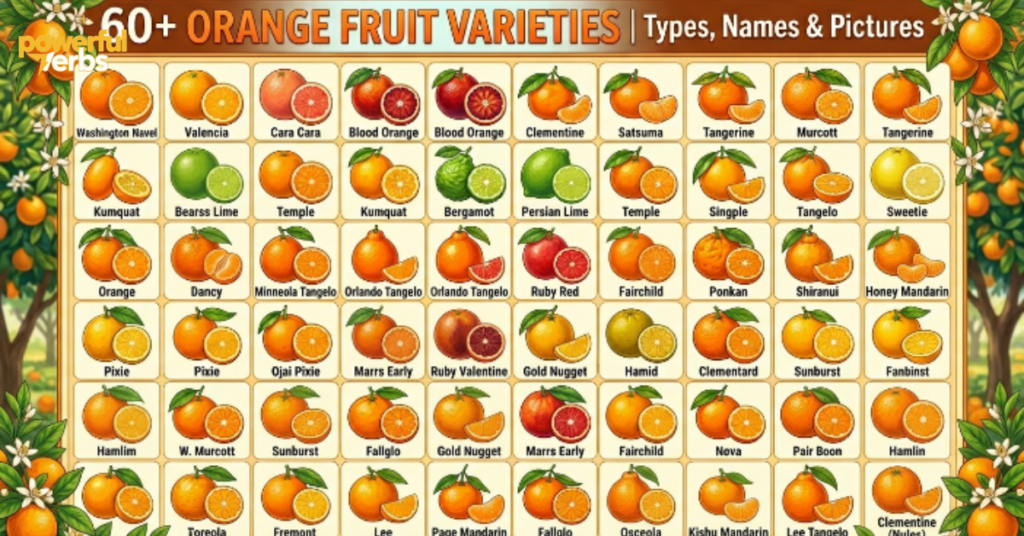
Oranges are among the most widely consumed fruits on the entire planet. From sweet and juicy varieties eaten fresh every morning to bitter aromatic types used in perfumes and cooking, the orange fruit family is far more diverse than most people realise. Each variety carries its own unique flavour profile, colour, texture, origin story, and culinary purpose.
This complete guide explores 60+ orange fruit varieties with their names, detailed descriptions, key attributes, and regional origins. Whether you are a fruit lover, a student of botany, a culinary professional, or simply someone who wants to know more about the oranges at your local market, this resource gives you everything in one place.
What Is an Orange Fruit?
An orange is a citrus fruit belonging to the family Rutaceae and the genus Citrus. It grows on flowering trees in subtropical and tropical climates around the world. The fruit is known for its rounded shape, bright coloured peel, juicy segmented flesh, and refreshing flavour that ranges from intensely sweet to sharply bitter depending on the variety.
Oranges are one of the richest natural sources of vitamin C, dietary fibre, folate, potassium, and powerful antioxidants including flavonoids and carotenoids. Regular consumption supports immune function, cardiovascular health, skin vitality, and digestive wellness.
The origin of the cultivated orange traces back thousands of years to Southeast Asia, particularly the regions of southern China, northeastern India, and Myanmar. From there, trade routes carried orange cultivation westward through Persia, Arabia, and eventually into the Mediterranean world and beyond.
How Are Orange Varieties Classified?
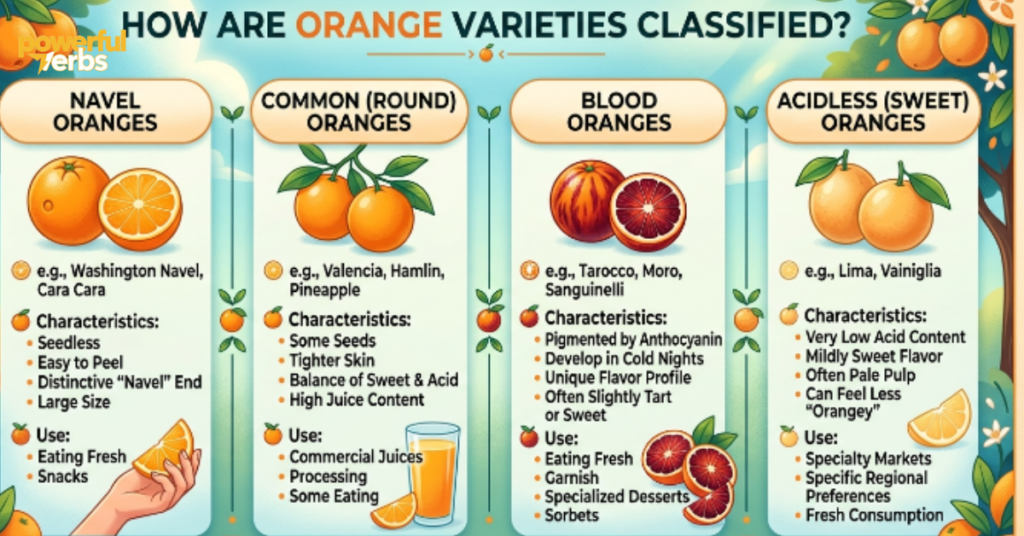
Orange fruit varieties are classified according to several key characteristics that distinguish one type from another.
Genetic background determines whether a fruit is a pure species, a natural mutation, or a deliberate hybrid cross between two or more citrus parents.
Flesh colour separates varieties into standard orange-fleshed types, deep red blood oranges, and pink-fleshed specialty varieties like the Cara Cara.
Sweetness and acidity levels determine whether a variety is best suited for fresh eating, juice production, cooking, marmalade making, or aromatic extraction.
Peel thickness and texture affects how easily an orange can be peeled by hand, how well it travels during transport, and how long it stores after harvest.
Seed content separates seedless varieties preferred for fresh consumption from seeded types often used in processing and juice production.
Harvest season classifies varieties as early season, mid-season, or late season, which determines their availability in markets throughout the year.
Understanding these classifications helps consumers, growers, and culinary professionals choose the right orange variety for every specific purpose.
Types of Sweet Orange Fruit Varieties
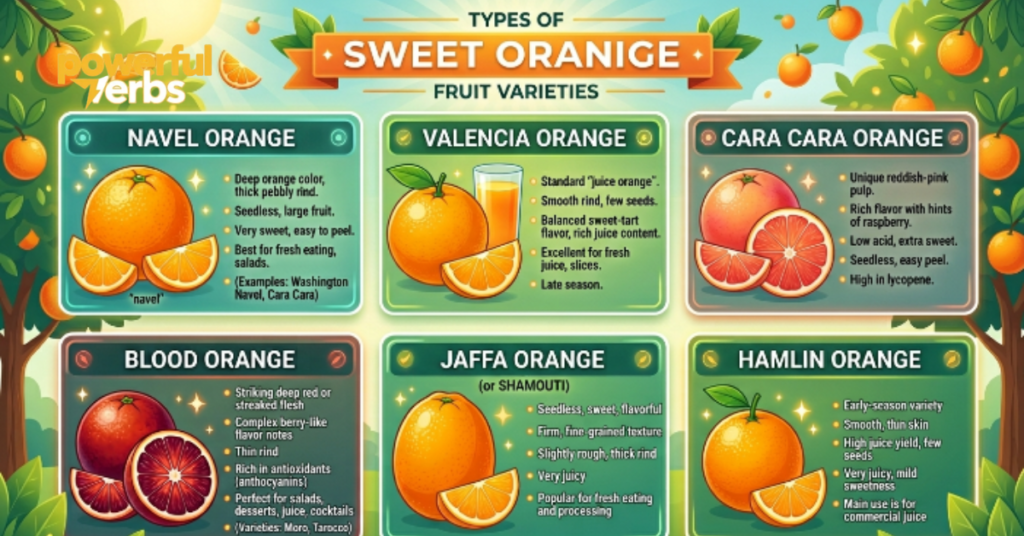
Sweet oranges represent the largest and most widely cultivated group of orange fruits in the world. They are eaten fresh, pressed for juice, added to salads and desserts, and used across countless culinary traditions globally. The scientific name for most sweet orange varieties is Citrus sinensis.
Washington Navel Orange
The Washington Navel orange originated as a natural mutation discovered in Bahia, Brazil, during the nineteenth century. Cuttings were sent to Washington DC and later to California, where the variety transformed American citrus agriculture permanently.
| Attribute | Detail |
| Scientific Name | Citrus sinensis |
| Shape | Round with prominent navel formation |
| Size | Medium to large |
| Average Weight | 180 to 300 grams |
| Skin Colour | Bright deep orange |
| Flesh Colour | Rich orange |
| Seeds | Completely seedless |
| Taste | Sweet with very mild acidity |
| Texture | Firm, juicy, and easy to segment |
| Calories | Approximately 62 per medium fruit |
| Origin Region | Brazil, widely cultivated in California USA |
| Best Use | Fresh eating, salads, snacking |
The seedless nature and easy peeling of Washington Navel oranges made them the gold standard for fresh orange consumption across North America and Europe for over a century.
Hamlin Orange
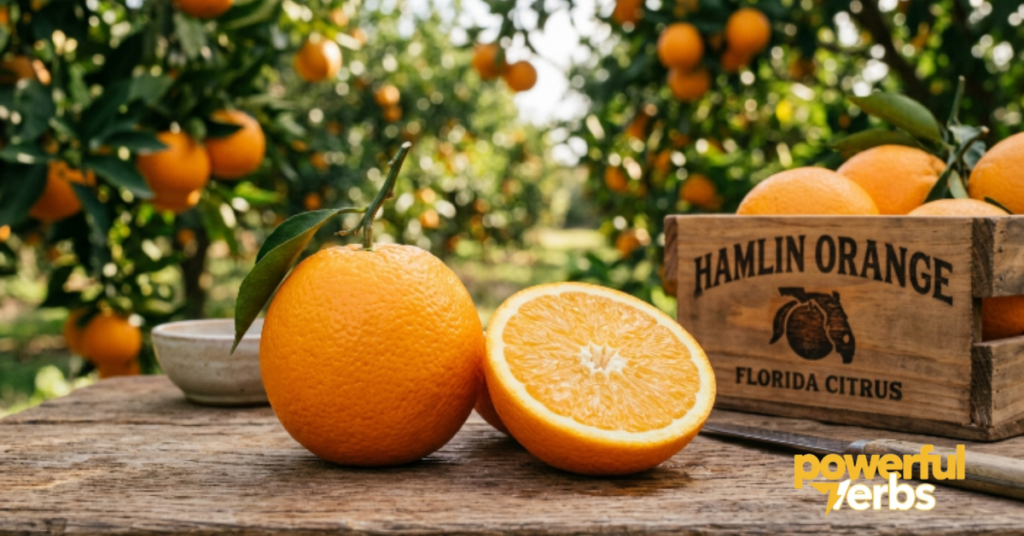
Hamlin oranges were first identified in Florida in the late nineteenth century on a grove belonging to A.G. Hamlin. They became one of the earliest varieties to ripen each season and remain a backbone of the American orange juice industry.
| Attribute | Detail |
| Scientific Name | Citrus sinensis |
| Shape | Round and symmetrical |
| Size | Medium |
| Average Weight | 160 to 220 grams |
| Skin Colour | Light to pale orange |
| Flesh Colour | Pale orange |
| Seeds | Very few or none |
| Taste | Mildly sweet and clean |
| Texture | Soft and extremely juicy |
| Calories | Approximately 60 per fruit |
| Origin Region | Florida, USA |
| Best Use | Juice production, fresh eating |
Hamlin oranges are valued by juice producers for their consistent sweetness, high water content, and early harvest timing that extends the juice season from autumn through early winter.
Pineapple Orange
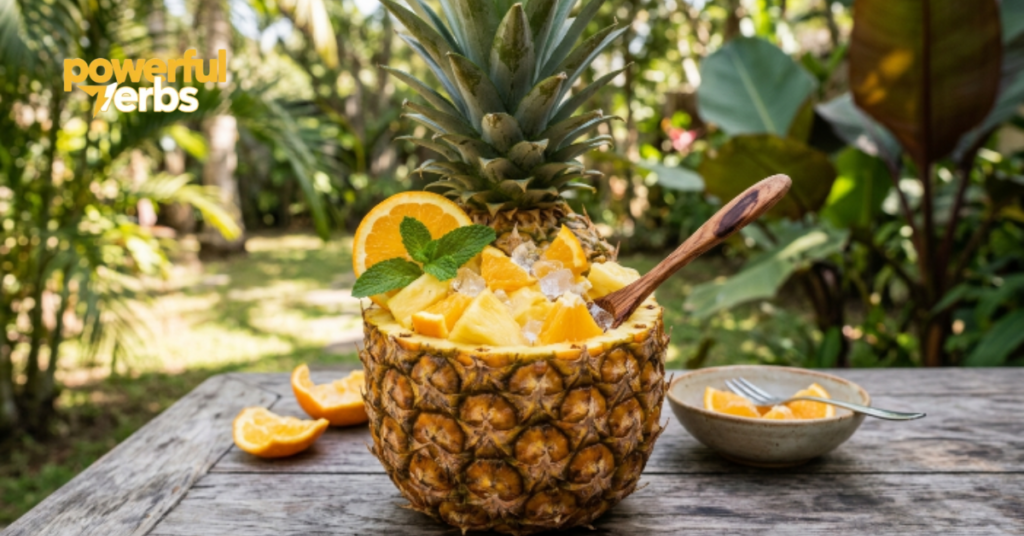
The Pineapple orange earned its distinctive name not from any actual pineapple flavour but from a subtle tropical aroma that emerges from its freshly cut segments. This variety became commercially important in Florida during the early twentieth century juice industry era.
| Attribute | Detail |
| Scientific Name | Citrus sinensis |
| Shape | Round |
| Size | Medium |
| Average Weight | 170 to 240 grams |
| Skin Colour | Orange with slight surface texture |
| Flesh Colour | Bright orange |
| Seeds | Several seeds present |
| Taste | Sweet with a pleasant tangy edge |
| Texture | Juicy with soft defined segments |
| Calories | Approximately 65 per fruit |
| Origin Region | Florida, USA |
| Best Use | Juice production, fresh eating |
Despite containing seeds, Pineapple oranges remain popular for their outstanding juice quality and distinctive aromatic profile that sets them apart from other mid-season varieties.
Jaffa Orange
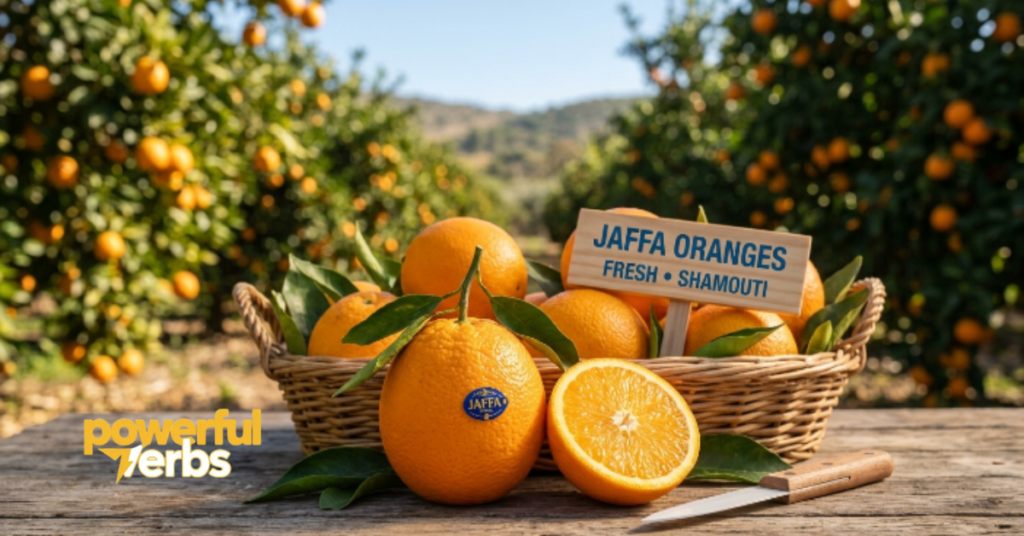
Jaffa oranges developed their fame through the ancient port city of Jaffa on the Mediterranean coast, from where they were exported across Europe throughout the nineteenth and early twentieth centuries. Their notably thick peel protected the fruit during long sea voyages, making them pioneers of international fruit trade.
| Attribute | Detail |
| Scientific Name | Citrus sinensis |
| Shape | Oval to round |
| Size | Medium |
| Average Weight | 180 to 260 grams |
| Skin Colour | Deep vibrant orange |
| Flesh Colour | Bright orange |
| Seeds | Very few |
| Taste | Sweet and well-balanced |
| Texture | Firm with rich juicy pulp |
| Calories | Approximately 64 per fruit |
| Origin Region | Mediterranean coast, Israel |
| Best Use | Fresh eating, export markets |
Jaffa oranges remain a premium variety in European markets where their name carries strong historical recognition and consumer trust built over many generations.
Maltaise Sweet Orange
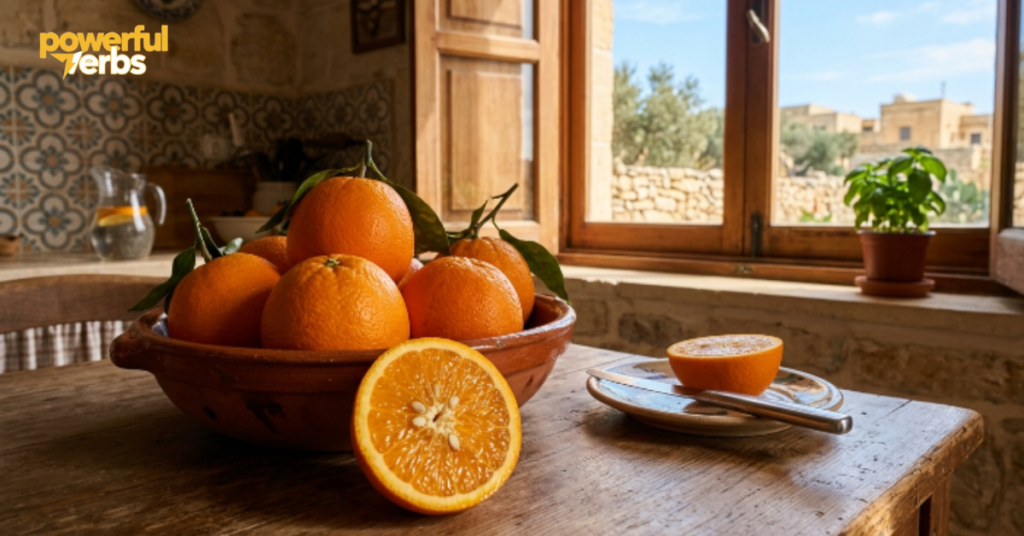
The Maltaise orange is a refined sweet variety traditionally cultivated across North Africa and the southern Mediterranean coastline. It is celebrated for its intensely fragrant flesh and rich sweetness that surpasses many other sweet orange varieties.
| Attribute | Detail |
| Scientific Name | Citrus sinensis |
| Shape | Round and smooth |
| Size | Medium |
| Average Weight | 160 to 230 grams |
| Skin Colour | Orange with a natural sheen |
| Flesh Colour | Deep orange |
| Seeds | Few to moderate |
| Taste | Rich, full sweetness |
| Texture | Tender and wonderfully juicy |
| Calories | Approximately 63 per fruit |
| Origin Region | North Africa, Southern Europe |
| Best Use | Fresh eating, desserts |
Parson Brown Orange
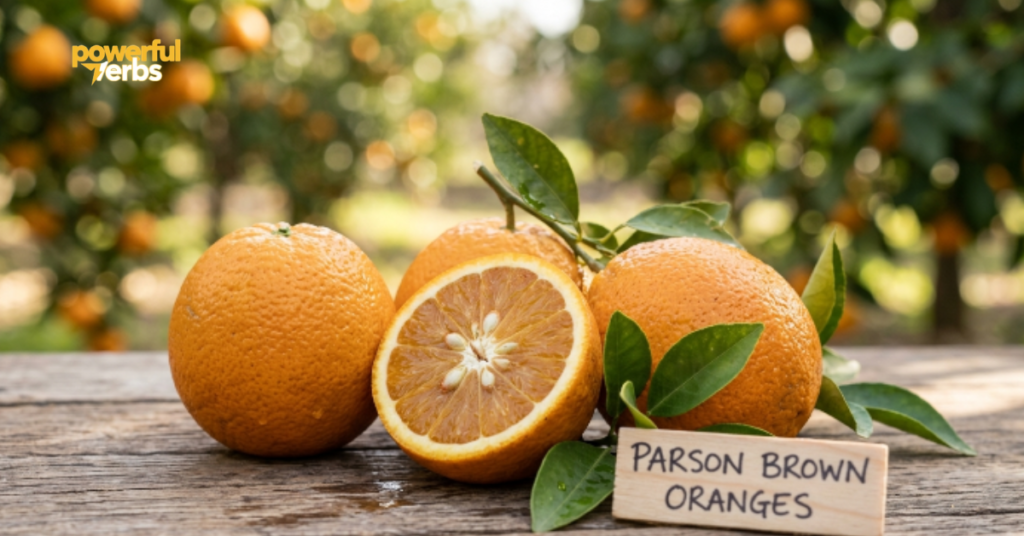
Parson Brown is one of the oldest named orange varieties in Florida’s citrus history. It was named after a minister who discovered the tree growing on his property in the 1870s. It is an early-season variety valued for beginning the fresh orange harvest.
| Attribute | Detail |
| Scientific Name | Citrus sinensis |
| Shape | Round |
| Size | Medium |
| Average Weight | 160 to 220 grams |
| Skin Colour | Orange, sometimes with green patches |
| Flesh Colour | Pale orange |
| Seeds | Moderate number |
| Taste | Mildly sweet |
| Texture | Juicy with a soft bite |
| Calories | Approximately 59 per fruit |
| Origin Region | Florida, USA |
| Best Use | Early season juicing |
Marrs Orange
Marrs oranges originated in Texas during the 1920s and are among the few orange varieties that grow successfully in cooler climates. They ripen very early in the season and produce exceptionally sweet juice.
| Attribute | Detail |
| Scientific Name | Citrus sinensis |
| Shape | Round and slightly oblate |
| Size | Medium |
| Average Weight | 150 to 210 grams |
| Skin Colour | Light orange |
| Flesh Colour | Pale orange |
| Seeds | Very few |
| Taste | Very sweet with low acidity |
| Texture | Juicy and tender |
| Calories | Approximately 58 per fruit |
| Origin Region | Texas, USA |
| Best Use | Fresh eating, juice |
Salustiana Orange
Salustiana is a Spanish sweet orange variety widely cultivated in the Valencia region. It is prized for its nearly seedless flesh and high juice content, making it extremely popular in European fresh markets and juice industries.
| Attribute | Detail |
| Scientific Name | Citrus sinensis |
| Shape | Round to slightly flattened |
| Size | Medium to large |
| Average Weight | 180 to 270 grams |
| Skin Colour | Smooth bright orange |
| Flesh Colour | Orange |
| Seeds | Nearly seedless |
| Taste | Sweet and refreshing |
| Texture | Very juicy and smooth |
| Calories | Approximately 61 per fruit |
| Origin Region | Valencia, Spain |
| Best Use | Fresh eating, juice production |
Shamouti Orange
The Shamouti orange, also known as the Jaffa orange’s close relative, was developed in Palestine during the nineteenth century. It became an important export variety for the Middle Eastern citrus industry and is still widely grown across the region today.
| Attribute | Detail |
| Scientific Name | Citrus sinensis |
| Shape | Oval |
| Size | Large |
| Average Weight | 200 to 300 grams |
| Skin Colour | Bright orange |
| Flesh Colour | Orange |
| Seeds | Few |
| Taste | Pleasantly sweet |
| Texture | Firm and juicy |
| Calories | Approximately 66 per fruit |
| Origin Region | Palestine, Middle East |
| Best Use | Fresh eating, export |
Rhode Red Valencia Orange
Rhode Red Valencia is a deeper-coloured mutation of the standard Valencia orange. It produces more intensely coloured juice and has a slightly sweeter flavour profile, making it increasingly popular in premium juice markets.
| Attribute | Detail |
| Scientific Name | Citrus sinensis |
| Shape | Round |
| Size | Medium |
| Average Weight | 170 to 240 grams |
| Skin Colour | Deep orange-red |
| Flesh Colour | Deep orange |
| Seeds | Few |
| Taste | Sweet with rich depth |
| Texture | Very juicy |
| Calories | Approximately 64 per fruit |
| Origin Region | Florida, USA |
| Best Use | Premium juice production |
Blood Orange Varieties
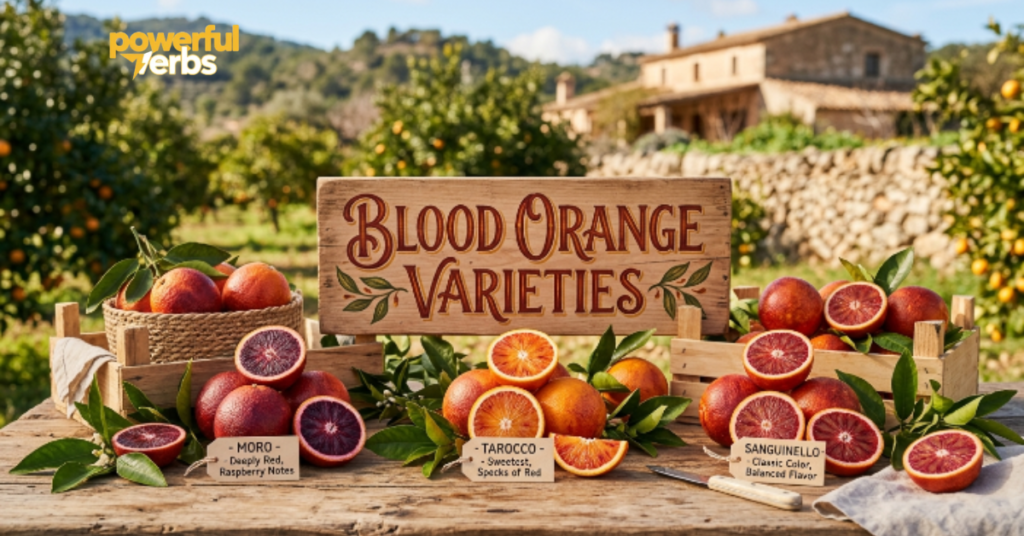
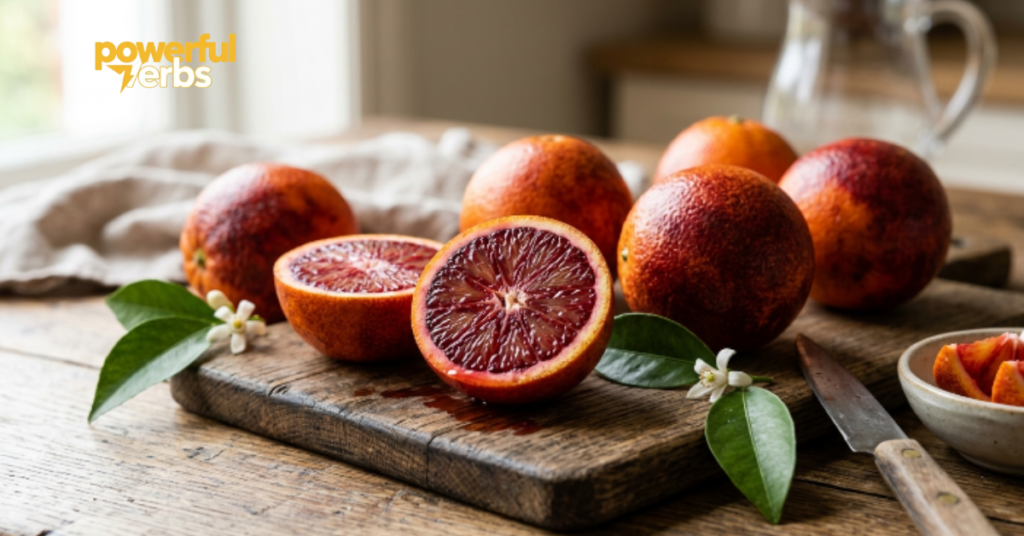
Blood oranges represent one of the most visually striking categories in the entire citrus world. Their deep red or maroon flesh is produced by anthocyanins, which are powerful antioxidant pigments that develop in response to cool night temperatures during the ripening period. Blood oranges thrive in Mediterranean climates where warm sunny days are followed by noticeably cool evenings.
Moro Blood Orange
The Moro blood orange is the darkest-fleshed variety in the blood orange family. It originated in Sicily and produces flesh so deeply pigmented that it appears almost purple-red when fully ripe. The flavour is bold and complex with distinct berry-like undertones.
| Attribute | Detail |
| Scientific Name | Citrus sinensis |
| Shape | Round |
| Size | Medium |
| Average Weight | 170 to 250 grams |
| Skin Colour | Orange with a deep crimson blush |
| Flesh Colour | Very deep red to near purple |
| Seeds | Very few |
| Taste | Sweet with tart berry undertones |
| Texture | Juicy and tender |
| Calories | Approximately 70 per fruit |
| Origin Region | Sicily, Italy |
| Best Use | Fresh eating, juice, cocktails, garnishes |
Tarocco Blood Orange
Tarocco blood oranges are widely regarded as the sweetest variety in the blood orange category. They are less intensely pigmented than Moro but produce exceptionally high juice volume. Tarocco is the most commercially important blood orange variety in Italy.
| Attribute | Detail |
| Scientific Name | Citrus sinensis |
| Shape | Round to slightly oval |
| Size | Medium to large |
| Average Weight | 180 to 260 grams |
| Skin Colour | Orange with light red streaking |
| Flesh Colour | Orange-red |
| Seeds | Very few to none |
| Taste | Exceptionally sweet and balanced |
| Texture | Very juicy with smooth segments |
| Calories | Approximately 65 per fruit |
| Origin Region | Sicily, Italy |
| Best Use | Fresh eating, premium juice |
Sanguinello Blood Orange
Sanguinello blood oranges ripen later in the season than both Moro and Tarocco. Their smooth skin carries a gentle reddish blush and their flesh develops a lighter but still appealing red colouration. This variety is frequently used in salads, desserts, and decorative culinary presentations.
| Attribute | Detail |
| Scientific Name | Citrus sinensis |
| Shape | Round |
| Size | Medium |
| Average Weight | 160 to 230 grams |
| Skin Colour | Orange with a reddish hue |
| Flesh Colour | Red-orange |
| Seeds | Very few |
| Taste | Mildly sweet with gentle tartness |
| Texture | Soft and juicy |
| Calories | Approximately 60 per fruit |
| Origin Region | Spain |
| Best Use | Salads, desserts, fresh eating |
Arnold Blood Orange
Arnold blood oranges are a lesser-known variety cultivated primarily in the United States. They produce moderate red pigmentation and a well-balanced sweet-tart flavour that makes them suitable for both fresh consumption and juice blending.
| Attribute | Detail |
| Scientific Name | Citrus sinensis |
| Shape | Round |
| Size | Medium |
| Average Weight | 160 to 220 grams |
| Skin Colour | Orange with faint red blush |
| Flesh Colour | Orange with red streaks |
| Seeds | Few |
| Taste | Sweet and mildly tart |
| Texture | Juicy |
| Calories | Approximately 62 per fruit |
| Origin Region | United States |
| Best Use | Fresh eating, juice blending |
Navel Orange Varieties
Navel oranges are identified by the distinctive secondary fruit formation at the blossom end of the fruit that resembles a human navel from the outside. This characteristic feature develops because of a genetic mutation that causes a small undeveloped secondary fruit to form inside the main fruit. All navel oranges are completely seedless, which makes them the preferred choice for fresh eating worldwide.
Cara Cara Navel Orange
The Cara Cara orange was discovered in 1976 on the Hacienda Cara Cara estate in Venezuela as a natural mutation growing on a Washington Navel orange tree. Its surprising pink-red flesh immediately distinguished it from every other navel variety in existence.
| Attribute | Detail |
| Scientific Name | Citrus sinensis |
| Shape | Round with navel |
| Size | Medium |
| Average Weight | 180 to 260 grams |
| Skin Colour | Standard orange |
| Flesh Colour | Pink to deep rose-red |
| Seeds | Completely seedless |
| Taste | Sweet with subtle berry and cherry notes |
| Texture | Juicy and exceptionally smooth |
| Calories | Approximately 70 per fruit |
| Origin Region | Venezuela, widely grown in California USA |
| Best Use | Fresh eating, fruit salads, gourmet presentations |
Lane Late Navel Orange
Lane Late oranges were selected in Australia for their exceptional ability to remain on the tree for extended periods without losing sweetness or quality. This late-maturing characteristic allows growers to supply fresh navel oranges well into summer when most other varieties have finished their season.
| Attribute | Detail |
| Scientific Name | Citrus sinensis |
| Shape | Round |
| Size | Medium to large |
| Average Weight | 200 to 280 grams |
| Skin Colour | Bright orange |
| Flesh Colour | Deep orange |
| Seeds | Completely seedless |
| Taste | Sweet and mild |
| Texture | Firm and consistently juicy |
| Calories | Approximately 68 per fruit |
| Origin Region | Australia, widely grown in California USA |
| Best Use | Extended fresh market, snacking |
Barnfield Navel Orange
Barnfield is a mid-late season navel variety developed in California that produces large, attractive fruit with excellent eating quality. It bridges the gap between the early Washington Navel harvest and the late Lane Late season.
| Attribute | Detail |
| Scientific Name | Citrus sinensis |
| Shape | Round with well-defined navel |
| Size | Large |
| Average Weight | 210 to 290 grams |
| Skin Colour | Bright deep orange |
| Flesh Colour | Rich orange |
| Seeds | Seedless |
| Taste | Sweet and full-flavoured |
| Texture | Firm and very juicy |
| Calories | Approximately 69 per fruit |
| Origin Region | California, USA |
| Best Use | Fresh eating, premium retail |
Navelate Orange
Navelate is a late-season Spanish navel variety selected for its high juice content and smooth attractive skin. It performs exceptionally well in Mediterranean climates and has become an important commercial variety across Spain and Portugal.
| Attribute | Detail |
| Scientific Name | Citrus sinensis |
| Shape | Round |
| Size | Medium |
| Average Weight | 180 to 250 grams |
| Skin Colour | Smooth deep orange |
| Flesh Colour | Orange |
| Seeds | Seedless |
| Taste | Sweet and refreshing |
| Texture | Juicy with a clean finish |
| Calories | Approximately 65 per fruit |
| Origin Region | Spain |
| Best Use | Fresh eating, juice |
Valencia Orange Varieties
Valencia oranges are the undisputed kings of the global juice industry. They mature later than most other orange types, which means they are available during the spring and summer months when other varieties have already finished their season. Their remarkably high juice content, combined with a balanced sweetness and thin peel, makes them irreplaceable in commercial and home juice production alike.
Valencia Late Orange
Valencia Late is the most commercially significant orange variety in the entire world when measured by juice production volume. It originated in the Valencia region of Spain before being introduced to Florida and California where it found its greatest commercial success.
| Attribute | Detail |
| Scientific Name | Citrus sinensis |
| Shape | Round |
| Size | Medium |
| Average Weight | 170 to 240 grams |
| Skin Colour | Orange, sometimes with a green re-greening effect |
| Flesh Colour | Deep orange |
| Seeds | Very few |
| Taste | Sweet, refreshing, and full-flavoured |
| Texture | Extremely juicy |
| Calories | Approximately 65 per fruit |
| Origin Region | Spain, widely grown in Florida and California USA |
| Best Use | Commercial juice production, fresh eating |
Delta Valencia Orange
Delta Valencia is a modern improved selection of the standard Valencia developed specifically to perform better in warmer growing conditions. It maintains its sweetness more consistently than traditional Valencia varieties in high-temperature growing regions.
| Attribute | Detail |
| Scientific Name | Citrus sinensis |
| Shape | Round |
| Size | Medium |
| Average Weight | 180 to 250 grams |
| Skin Colour | Bright orange |
| Flesh Colour | Orange |
| Seeds | Very few |
| Taste | Sweet with low acidity |
| Texture | Juicy and soft |
| Calories | Approximately 66 per fruit |
| Origin Region | Florida, USA |
| Best Use | Commercial juice, warm climate cultivation |
Midknight Valencia Orange
Midknight Valencia was developed in South Africa and represents one of the finest modern improvements to the Valencia orange family. It is nearly completely seedless, which gives it a significant advantage over standard Valencia varieties in fresh market sales.
| Attribute | Detail |
| Scientific Name | Citrus sinensis |
| Shape | Round |
| Size | Medium |
| Average Weight | 175 to 245 grams |
| Skin Colour | Smooth deep orange |
| Flesh Colour | Orange |
| Seeds | Nearly seedless |
| Taste | Sweet and balanced |
| Texture | Very juicy |
| Calories | Approximately 64 per fruit |
| Origin Region | South Africa |
| Best Use | Fresh eating, premium juice |
Bitter Orange Varieties
Bitter oranges occupy a completely different culinary and commercial space from their sweet counterparts. Their flesh is far too sour and intensely bitter for comfortable fresh consumption, but their aromatic peel oils, floral extracts, and acidic juice make them extraordinarily valuable in the perfume industry, the pharmaceutical world, traditional medicine, and the production of liqueurs, marmalades, and specialty sauces.
Seville Orange
The Seville orange is the most famous bitter orange variety in the world. It traces its origins to Southeast Asia and arrived in Spain via Arab traders during the medieval period. The city of Seville became so associated with this variety that the orange took its name permanently.
| Attribute | Detail |
| Scientific Name | Citrus aurantium |
| Shape | Round to slightly flattened |
| Size | Medium |
| Average Weight | 150 to 220 grams |
| Skin Colour | Deep orange with textured surface |
| Flesh Colour | Orange |
| Seeds | Many seeds |
| Taste | Strongly bitter and intensely acidic |
| Texture | Firm with relatively dry pulp |
| Calories | Approximately 65 per fruit |
| Origin Region | Spain |
| Best Use | Marmalade, liqueurs, cooking sauces |
Bergamot Orange
The Bergamot orange is one of the most commercially valuable citrus fruits in the world despite being virtually unknown in most fresh fruit markets. Its extraordinary value comes from the cold-pressed essential oil extracted from its peel, which is the defining flavouring agent of Earl Grey tea and a fundamental ingredient in high-end perfumery.
| Attribute | Detail |
| Scientific Name | Citrus bergamia |
| Shape | Round to slightly pear-shaped |
| Size | Small to medium |
| Average Weight | 120 to 200 grams |
| Skin Colour | Yellow-orange when fully ripe |
| Flesh Colour | Pale greenish-orange |
| Seeds | Few |
| Taste | Intensely bitter with a remarkable floral aroma |
| Texture | Slightly dry and firm |
| Calories | Approximately 50 per fruit |
| Origin Region | Calabria, Southern Italy |
| Best Use | Essential oil extraction, tea flavouring, perfumery |
Bigarade Orange
The Bigarade orange is an ancient bitter orange variety that was the dominant cultivated orange in Europe before sweet oranges were introduced. It served as one of the primary ancestors of many modern citrus varieties through centuries of deliberate and accidental hybridisation.
| Attribute | Detail |
| Scientific Name | Citrus aurantium |
| Shape | Round |
| Size | Medium |
| Average Weight | 160 to 240 grams |
| Skin Colour | Orange with a noticeably rough textured surface |
| Flesh Colour | Orange |
| Seeds | Many seeds |
| Taste | Sharply bitter and sour |
| Texture | Dense pulp with low juice content |
| Calories | Approximately 62 per fruit |
| Origin Region | Europe, Middle East |
| Best Use | Perfumery, flavouring, historical cultivation |
Chinotto Orange
The Chinotto is a small bitter orange variety closely related to Citrus aurantium. It is native to China but has been cultivated in Italy and the Mediterranean for centuries. Chinotto juice and peel are used to flavour a famous Italian soft drink that bears the same name.
| Attribute | Detail |
| Scientific Name | Citrus myrtifolia |
| Shape | Small and round |
| Size | Small |
| Average Weight | 60 to 100 grams |
| Skin Colour | Deep orange |
| Flesh Colour | Orange |
| Seeds | Several |
| Taste | Very bitter with aromatic complexity |
| Texture | Firm and juicy |
| Calories | Approximately 45 per fruit |
| Origin Region | China, cultivated in Italy and Mediterranean |
| Best Use | Soft drinks, liqueurs, flavouring |
Mandarin Type Oranges
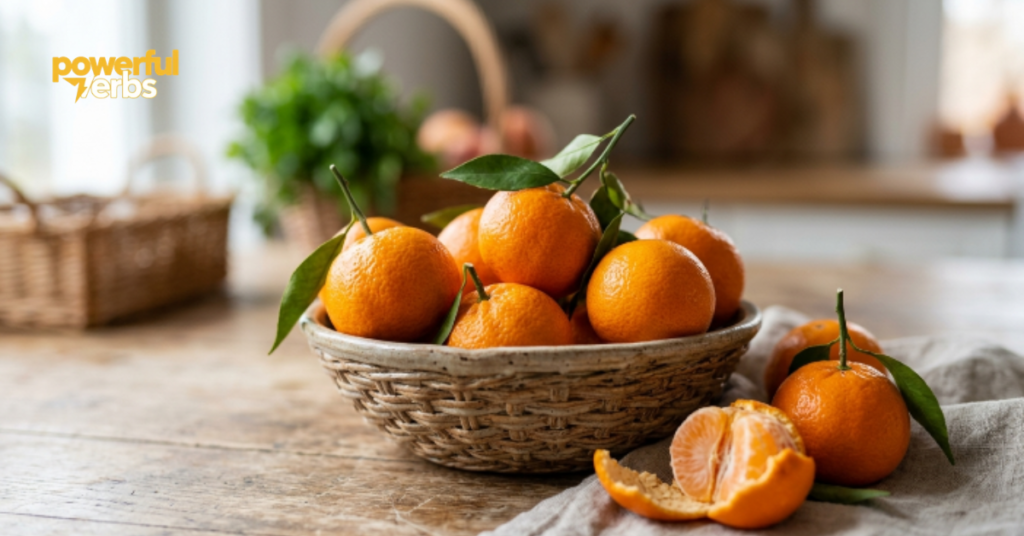
Mandarins are a distinct citrus species closely related to oranges that are commonly grouped with orange varieties due to their similar appearance and flavour profiles. They are characterised by their smaller size, thinner and looser peel, higher sweetness, and lower seed count compared to standard oranges. Their ease of peeling makes them universally popular as convenient snacking fruits for all ages.
Clementine
Clementines are the most widely recognised mandarin variety in Western markets. They originated in Algeria in the early twentieth century, reportedly as a natural hybrid discovered by Father Clément Rodier in the garden of his orphanage near Oran.
| Attribute | Detail |
| Scientific Name | Citrus reticulata |
| Shape | Small and round |
| Size | Small |
| Average Weight | 85 to 110 grams |
| Skin Colour | Deep bright orange |
| Flesh Colour | Orange |
| Seeds | Few to none |
| Taste | Sweet and mild |
| Texture | Tender and juicy |
| Calories | Approximately 45 per 100 grams |
| Origin Region | Algeria, widely cultivated in Spain and Morocco |
| Best Use | Snacking, children’s lunchboxes, salads |
Satsuma
Satsuma mandarins are native to the Satsuma province of Japan and have been cultivated there for at least seven centuries. They are among the most cold-tolerant citrus varieties, which allows them to be grown in climates unsuitable for most other citrus fruits.
| Attribute | Detail |
| Scientific Name | Citrus reticulata |
| Shape | Small, round, slightly flattened |
| Size | Small |
| Average Weight | 95 to 120 grams |
| Skin Colour | Light orange, sometimes with a greenish tinge |
| Flesh Colour | Orange |
| Seeds | Completely seedless |
| Taste | Sweet with very low acidity |
| Texture | Juicy and extremely tender |
| Calories | Approximately 45 per 100 grams |
| Origin Region | Japan, cultivated in Spain, USA, and South Africa |
| Best Use | Snacking, fresh eating, festive gifts |
Tangerine
Tangerines are a broader category of mandarins named after the Moroccan city of Tangier through which they were historically exported to European markets. They tend to have a slightly richer, more complex flavour than standard clementines.
| Attribute | Detail |
| Scientific Name | Citrus reticulata |
| Shape | Round, slightly flattened |
| Size | Small to medium |
| Average Weight | 100 to 150 grams |
| Skin Colour | Deep reddish-orange |
| Flesh Colour | Orange |
| Seeds | Few |
| Taste | Sweet with a slightly spicy edge |
| Texture | Juicy with a satisfying bite |
| Calories | Approximately 53 per 100 grams |
| Origin Region | Morocco, widely cultivated globally |
| Best Use | Fresh eating, juice, cooking |
Murcott Mandarin
The Murcott, also known as the Honey Tangerine, is a mandarin variety discovered in Florida in the 1920s. Its exceptionally high sugar content gives it a rich honeyed sweetness that earned it its popular secondary name.
| Attribute | Detail |
| Scientific Name | Citrus reticulata |
| Shape | Round |
| Size | Medium |
| Average Weight | 130 to 180 grams |
| Skin Colour | Orange-red |
| Flesh Colour | Deep orange |
| Seeds | Moderate |
| Taste | Intensely sweet and honey-like |
| Texture | Juicy and rich |
| Calories | Approximately 55 per 100 grams |
| Origin Region | Florida, USA |
| Best Use | Fresh eating, premium snacking |
Dancy Tangerine
Dancy tangerines were once the most commercially important tangerine variety in the United States. Named after Colonel Francis Dancy who first cultivated them in Florida in 1867, they have a distinctive spicy-sweet flavour and deep reddish-orange peel.
| Attribute | Detail |
| Scientific Name | Citrus reticulata |
| Shape | Round, slightly necked at the stem |
| Size | Small to medium |
| Average Weight | 100 to 140 grams |
| Skin Colour | Deep reddish-orange |
| Flesh Colour | Orange |
| Seeds | Several |
| Taste | Spicy-sweet with a slight tartness |
| Texture | Juicy |
| Calories | Approximately 52 per 100 grams |
| Origin Region | Florida, USA |
| Best Use | Fresh eating, holiday gifting |
Hybrid Orange Varieties
Hybrid orange varieties result from the deliberate or natural crossbreeding of two or more different citrus species. These varieties often combine the best characteristics of their parent fruits, such as the sweetness of a mandarin with the juice content of a standard orange, or the easy peeling of a tangerine with the size of a grapefruit. Hybrid varieties have greatly expanded the range of flavours and forms available to consumers worldwide.
Tangelo
The Tangelo is a hybrid between a tangerine or mandarin and either a grapefruit or a pomelo. It combines the sweet-tart flavour of its tangerine parent with the large size and juiciness contributed by the grapefruit side of its lineage.
| Attribute | Detail |
| Scientific Name | Citrus reticulata × Citrus paradisi |
| Shape | Round to slightly oval |
| Size | Medium |
| Average Weight | 150 to 200 grams |
| Skin Colour | Bright orange |
| Flesh Colour | Orange |
| Seeds | Few |
| Taste | Sweet-tart and complex |
| Texture | Juicy and tender |
| Calories | Approximately 55 per 100 grams |
| Origin Region | United States, especially Florida |
| Best Use | Fresh eating, juice, salads |
Minneola Tangelo
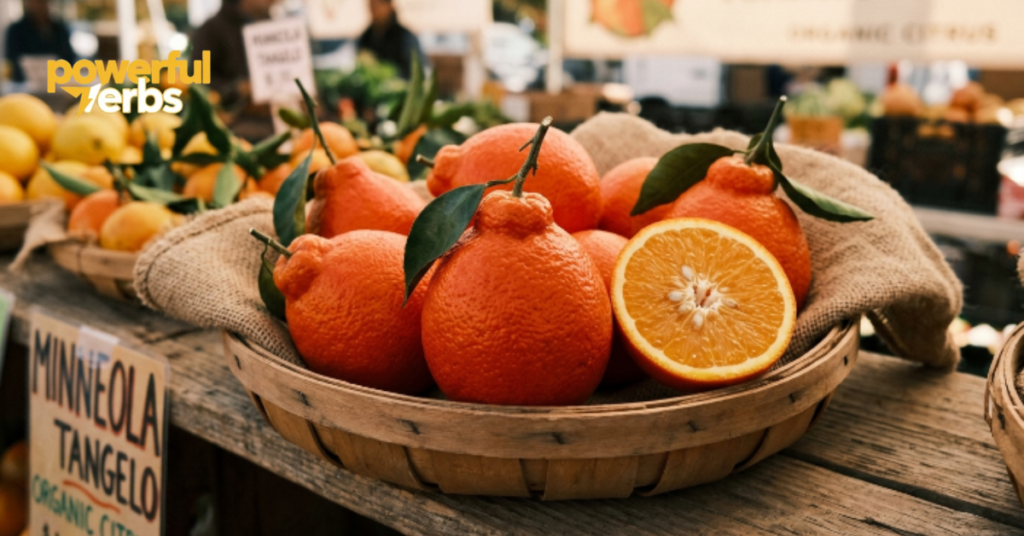
The Minneola is a specific tangelo variety created by crossing a Dancy tangerine with a Duncan grapefruit at the USDA Horticultural Research Station in Orlando. Its distinctive bell-shaped form with a prominent stem-end neck earned it the affectionate nickname “Honeybell.”
| Attribute | Detail |
| Scientific Name | Citrus reticulata × Citrus paradisi |
| Shape | Bell-shaped with a distinctive neck |
| Size | Medium to large |
| Average Weight | 170 to 220 grams |
| Skin Colour | Bright orange-red |
| Flesh Colour | Orange |
| Seeds | Few |
| Taste | Sweet with a pleasing tangy note |
| Texture | Juicy and soft |
| Calories | Approximately 60 per 100 grams |
| Origin Region | Florida, USA |
| Best Use | Fresh eating, desserts, juice |
Orlando Tangelo
The Orlando tangelo was developed alongside the Minneola at the same USDA research facility. It is rounder and milder in flavour than the Minneola and requires cross-pollination with another citrus variety to produce a good crop.
| Attribute | Detail |
| Scientific Name | Citrus reticulata × Citrus paradisi |
| Shape | Round |
| Size | Medium |
| Average Weight | 150 to 200 grams |
| Skin Colour | Orange |
| Flesh Colour | Orange |
| Seeds | Moderate when cross-pollinated |
| Taste | Mildly sweet |
| Texture | Juicy |
| Calories | Approximately 54 per 100 grams |
| Origin Region | Florida, USA |
| Best Use | Fresh eating, home gardens |
Temple Orange
The Temple orange is a natural hybrid believed to be a cross between a tangerine and a sweet orange. It was discovered in Jamaica and introduced to Florida in the early twentieth century where it became commercially important.
| Attribute | Detail |
| Scientific Name | Citrus reticulata × Citrus sinensis |
| Shape | Round to slightly flattened |
| Size | Medium |
| Average Weight | 160 to 220 grams |
| Skin Colour | Deep reddish-orange |
| Flesh Colour | Deep orange |
| Seeds | Several |
| Taste | Rich, spicy-sweet, and complex |
| Texture | Juicy with firm segments |
| Calories | Approximately 63 per 100 grams |
| Origin Region | Jamaica, commercially grown in Florida |
| Best Use | Fresh eating, specialty markets |
Ugli Fruit
The Ugli fruit is a naturally occurring hybrid of a grapefruit, orange, and tangerine that was discovered growing wild in Jamaica. Despite its rough, wrinkled, and unattractive exterior appearance that inspired its unusual name, the flesh inside is remarkably sweet and juicy.
| Attribute | Detail |
| Scientific Name | Citrus reticulata × Citrus paradisi |
| Shape | Irregular, lumpy oval |
| Size | Large |
| Average Weight | 300 to 500 grams |
| Skin Colour | Greenish-yellow to orange, rough and wrinkled |
| Flesh Colour | Yellow-orange |
| Seeds | Few |
| Taste | Sweet with a mild grapefruit tang |
| Texture | Very juicy |
| Calories | Approximately 45 per 100 grams |
| Origin Region | Jamaica |
| Best Use | Fresh eating, juice |
Additional Orange Varieties — Extended Reference List
The following varieties complete the 60+ orange fruit reference guide. Each plays a role in regional agriculture, culinary traditions, or specialty markets around the world.
| Variety Name | Type | Origin | Key Characteristic |
| Bahia Orange | Sweet | Brazil | Original Washington Navel source tree |
| Fukumoto Navel | Navel | Japan | Early season with deep orange skin |
| Atwood Navel | Navel | California, USA | Very large fruit with excellent flavour |
| Powell Navel | Navel | Australia | Late season with high juice content |
| Chislett | Valencia | Australia | Improved yield variety |
| Campbell Valencia | Valencia | USA | Commercial juice production selection |
| Amber Sweet | Hybrid | USA | Cross between early orange and Clementine |
| Pixie Tangerine | Mandarin | California, USA | Late season, nearly seedless, very sweet |
| W. Murcott | Mandarin | USA | Improved Murcott with fewer seeds |
| Encore Mandarin | Mandarin | California, USA | Very late season, rich sweet flavour |
| Page Mandarin | Hybrid | USA | Cross of Minneola and Clementine |
| Fallglo | Hybrid | Florida, USA | Early season, easy peeling |
| Sunburst Tangerine | Hybrid | Florida, USA | Bright colour, sweet-tart flavour |
| Lee Mandarin | Mandarin | Florida, USA | Good cold tolerance |
| Nova Mandarin | Hybrid | Florida, USA | Cross of Clementine and Orlando tangelo |
| Robinson Tangerine | Hybrid | Florida, USA | Early season commercial variety |
| Fremont Mandarin | Hybrid | California, USA | Cross of Clementine and Ponkan |
| Osceola Tangelo | Hybrid | Florida, USA | Early season, easy peeling |
| Seminole Tangelo | Hybrid | Florida, USA | Very juicy, tart flavour profile |
Nutritional Benefits of Orange Fruit Varieties
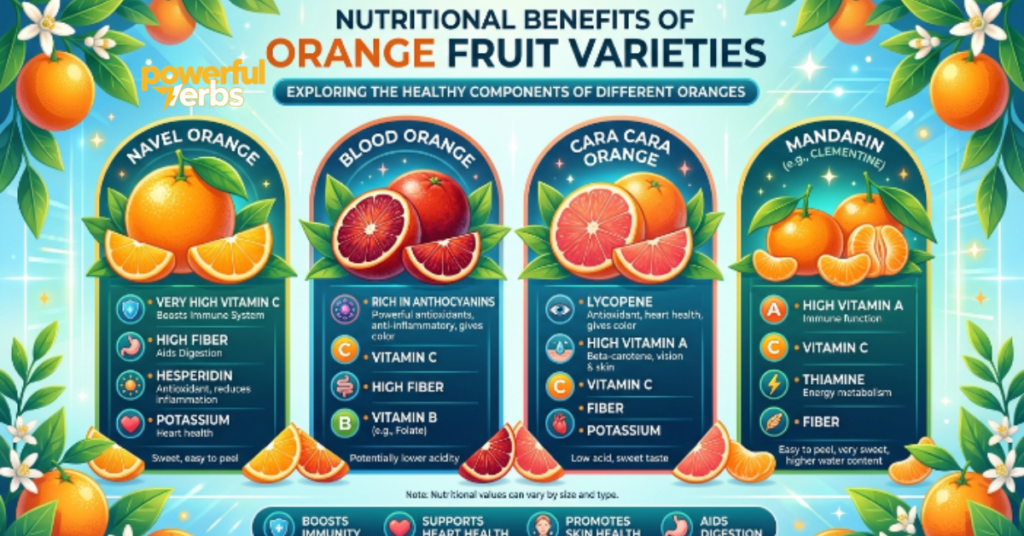
All orange varieties, regardless of type, share a core set of impressive nutritional qualities that make them among the most health-promoting fruits available anywhere in the world.
Vitamin C content is the most celebrated nutritional feature of all oranges. A single medium orange provides between 70 and 90 milligrams of vitamin C, which meets or exceeds the full daily requirement for most adults. Vitamin C is essential for immune system function, collagen synthesis, wound healing, and iron absorption from plant-based foods.
Dietary fibre found abundantly in orange flesh and pith supports healthy digestive function, helps maintain stable blood sugar levels, reduces cholesterol absorption, and promotes the growth of beneficial gut bacteria.
Flavonoids and antioxidants present in oranges, including hesperidin, narirutin, and naringenin, have demonstrated anti-inflammatory, cardiovascular protective, and cancer-preventive properties in extensive scientific research.
Folate in oranges supports cellular division and DNA synthesis, making oranges particularly valuable during pregnancy and periods of rapid growth.
Potassium contributes to healthy blood pressure regulation and proper muscle and nerve function throughout the body.
Blood oranges contain the additional benefit of anthocyanins, the same antioxidant pigments found in blueberries and blackberries, which provide enhanced protection against oxidative stress and inflammation.
How to Select the Best Orange at the Market
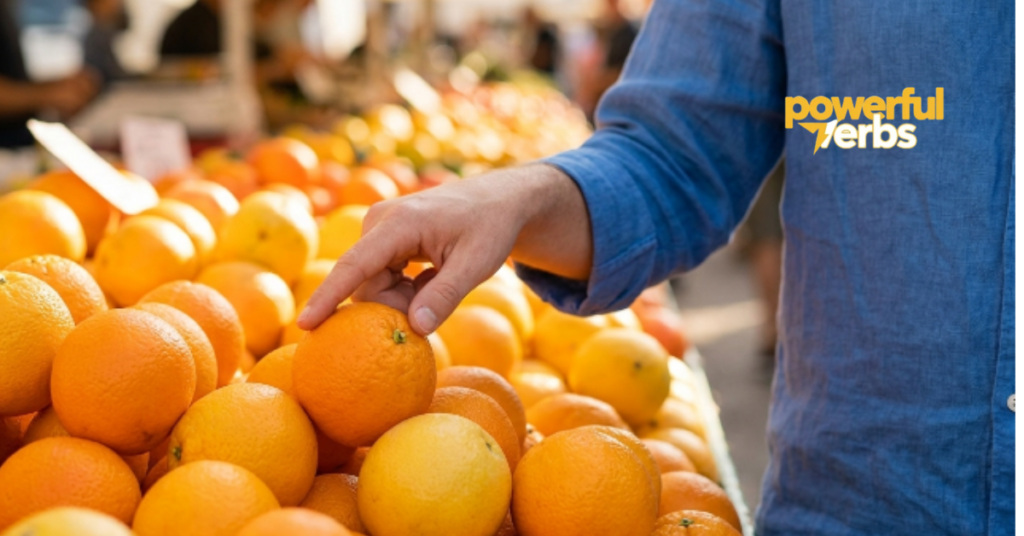
Choosing a high-quality orange requires paying attention to several sensory cues that indicate ripeness, juice content, and freshness.
Weight relative to size is the single most reliable indicator of juice content. A truly juicy orange feels noticeably heavy for its size. Always choose the heaviest orange you can find in any given size group.
Skin firmness should be consistent without soft spots, wrinkled patches, or areas of mould. Minor surface blemishes or colour irregularities do not affect internal quality in most varieties.
Colour does not always indicate ripeness. Valencia oranges commonly develop a green re-greening effect on their skin as temperatures warm after ripening, yet remain perfectly sweet and ripe inside. Judge by weight and firmness rather than skin colour alone.
Aroma from the stem end of a ripe orange should be distinctly fragrant and citrusy. A complete absence of aroma often indicates that the fruit was harvested too early or stored incorrectly for too long.
Avoid hollow-feeling oranges. Gently squeeze the fruit and listen for any hollow sound or feeling that indicates the flesh has dried and separated from the peel during extended storage.
Culinary Uses of Different Orange Varieties
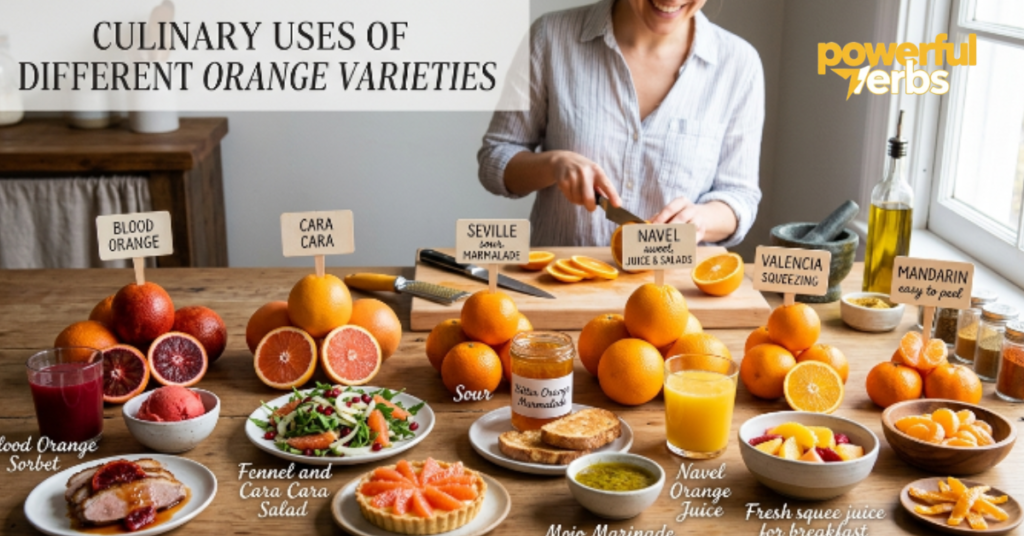
Different orange varieties serve different culinary purposes based on their juice content, sweetness, acidity, and aromatic characteristics.
Fresh eating is best served by seedless navel varieties like Washington Navel, Cara Cara, and Lane Late, as well as easy-peeling mandarins including Clementine and Satsuma.
Juice production relies almost entirely on Valencia varieties due to their exceptional juice volume and consistent sweetness. Hamlin oranges serve the early season juice market before Valencia varieties ripen.
Marmalade and preserves traditionally use Seville and other bitter orange varieties whose high pectin content and complex bitter-sweet flavour create superior preserves compared to sweet orange varieties.
Cooking and savoury applications benefit from the acidity and aromatic oils of bitter oranges and the balanced flavour of Jaffa and Shamouti varieties in sauces, marinades, and glazes.
Cocktails, mocktails, and beverages showcase the dramatic colour of blood orange varieties like Moro and Tarocco alongside the complex flavour of Bergamot in specialty drinks and culinary preparations.
Perfumery and aromatherapy rely almost exclusively on Bergamot, Neroli derived from bitter orange blossoms, and petitgrain oil from bitter orange leaves for their distinctive and valuable aromatic profiles.
Orange Varieties from A to Z — Quick Reference
| # | Variety Name | Category |
| 1 | Amber Sweet | Hybrid |
| 2 | Arnold Blood Orange | Blood Orange |
| 3 | Atwood Navel | Navel |
| 4 | Bahia Orange | Sweet |
| 5 | Barnfield Navel | Navel |
| 6 | Bergamot Orange | Bitter |
| 7 | Bigarade Orange | Bitter |
| 8 | Campbell Valencia | Valencia |
| 9 | Cara Cara Navel | Navel |
| 10 | Chinotto Orange | Bitter |
| 11 | Clementine | Mandarin |
| 12 | Dancy Tangerine | Mandarin |
| 13 | Delta Valencia | Valencia |
| 14 | Encore Mandarin | Mandarin |
| 15 | Fallglo Tangerine | Hybrid |
| 16 | Fremont Mandarin | Hybrid |
| 17 | Fukumoto Navel | Navel |
| 18 | Hamlin Orange | Sweet |
| 19 | Jaffa Orange | Sweet |
| 20 | Lane Late Navel | Navel |
| 21 | Lee Mandarin | Mandarin |
| 22 | Maltaise Sweet Orange | Sweet |
| 23 | Marrs Orange | Sweet |
| 24 | Midknight Valencia | Valencia |
| 25 | Minneola Tangelo | Hybrid |
| 26 | Moro Blood Orange | Blood Orange |
| 27 | Murcott Mandarin | Mandarin |
| 28 | Navelate Orange | Navel |
| 29 | Nova Mandarin | Hybrid |
| 30 | Orlando Tangelo | Hybrid |
| 31 | Osceola Tangelo | Hybrid |
| 32 | Page Mandarin | Hybrid |
| 33 | Parson Brown Orange | Sweet |
| 34 | Pineapple Orange | Sweet |
| 35 | Pixie Tangerine | Mandarin |
| 36 | Powell Navel | Navel |
| 37 | Rhode Red Valencia | Valencia |
| 38 | Robinson Tangerine | Hybrid |
| 39 | Salustiana Orange | Sweet |
| 40 | Sanguinello Blood Orange | Blood Orange |
| 41 | Satsuma | Mandarin |
| 42 | Seminole Tangelo | Hybrid |
| 43 | Seville Orange | Bitter |
| 44 | Shamouti Orange | Sweet |
| 45 | Sunburst Tangerine | Hybrid |
| 46 | Tangelo | Hybrid |
| 47 | Tangerine | Mandarin |
| 48 | Tarocco Blood Orange | Blood Orange |
| 49 | Temple Orange | Hybrid |
| 50 | Ugli Fruit | Hybrid |
| 51 | Valencia Late Orange | Valencia |
| 52 | W. Murcott | Mandarin |
| 53 | Washington Navel Orange | Navel |
| 54 | Chislett Valencia | Valencia |
| 55 | Fremont Mandarin | Hybrid |
| 56 | Bahia Orange | Sweet |
| 57 | Bigarade Orange | Bitter |
| 58 | Dancy Tangerine | Mandarin |
| 59 | Fallglo Tangerine | Hybrid |
| 60 | Barnfield Navel | Navel |
| 61 | Arnold Blood Orange | Blood Orange |
| 62 | Chinotto Orange | Bitter |
| 63 | Midknight Valencia | Valencia |
| 64 | Navelate Orange | Navel |
Conclusion
This comprehensive guide to 60+ orange fruit varieties demonstrates the extraordinary diversity hidden within a fruit category that many people assume contains only a handful of types. From the dramatic deep red flesh of a Moro blood orange to the bell-shaped elegance of a Minneola Tangelo, from the ancient bitterness of a Seville orange to the honeyed sweetness of a Murcott Mandarin, the world of orange fruits offers a range of flavours, colours, and culinary possibilities that continues to expand through ongoing horticultural research and discovery.
Understanding the differences between orange varieties allows consumers to make better choices at markets, helps cooks select the right variety for every culinary purpose, and gives students of botany and nutrition a richer appreciation of one of the world’s most important and beloved fruit groups.
Every orange variety on this list has its own origin story, its own flavour personality, and its own unique place in the rich global history of citrus cultivation. Explore them, taste them, and discover which varieties become your personal favourites.
FAQs
What are the main types of orange fruit varieties?
Orange fruit varieties are grouped into six main categories — sweet oranges, blood oranges, navel oranges, Valencia oranges, bitter oranges, and mandarin types. Each category contains multiple individual varieties with distinct flavours, colours, and culinary uses.
Which orange variety is the sweetest?
The Murcott Mandarin, also called the Honey Tangerine, is considered one of the sweetest of all orange varieties. Among standard sweet oranges, the Cara Cara Navel and the Tarocco Blood Orange are both renowned for exceptional sweetness.
What is the best orange variety for fresh eating?
Washington Navel, Cara Cara Navel, and Lane Late Navel oranges are universally regarded as the finest varieties for fresh eating due to their seedless flesh, easy peeling, and outstanding flavour.
Which orange variety produces the most juice?
Valencia Late oranges produce the highest juice volume of any commercial orange variety, which is why they dominate global orange juice production. Hamlin oranges lead the early season juice market before Valencia varieties are ready.
What makes blood oranges different from regular oranges?
Blood oranges contain anthocyanins, which are powerful antioxidant pigments that develop in response to cool night temperatures during the ripening period. These pigments give blood oranges their distinctive red or maroon flesh colour and add subtle berry-like flavour notes.
Are bitter oranges edible?
Bitter orange varieties like Seville oranges are technically edible but extremely unpleasant to eat fresh due to their intense bitterness and acidity. They are widely used in marmalade production, liqueur manufacturing, cooking sauces, perfumery, and pharmaceutical applications where their aromatic oils and natural compounds are highly valued.
What is the difference between a mandarin and an orange?
Mandarins belong to the species Citrus reticulata while most common oranges belong to Citrus sinensis. Mandarins are generally smaller, easier to peel, sweeter, and lower in acidity than standard oranges. Many popular varieties marketed as oranges, including Clementines, Satsumas, and Tangerines, are technically mandarin varieties.
Which orange variety is best for marmalade?
Seville oranges are the traditional and universally preferred choice for marmalade production. Their high natural pectin content, intense bitter flavour, and aromatic peel create a superior marmalade that cannot be replicated using sweet orange varieties.
How many orange varieties exist in the world?
Horticultural researchers and citrus specialists have identified and catalogued more than 600 distinct orange and orange-related citrus varieties worldwide, though only a small fraction of these are cultivated commercially on a significant scale.
What are the healthiest orange varieties?
Blood orange varieties, particularly Moro blood oranges, offer the broadest spectrum of health benefits because they contain all the standard orange nutrients plus anthocyanins. Among sweet oranges, the Cara Cara Navel contains unusually high levels of lycopene and beta-cryptoxanthin in addition to standard vitamin C.

Liam Johnson is a dedicated language expert with 4 years of professional experience. He specializes in Grammar, Vocabulary, and Sentence structure.
