

Similes are one of the most elegant tools in a writer’s arsenal, painting vivid pictures by drawing unexpected connections between seemingly unrelated things. By using “like” or “as” to bridge the familiar and the unfamiliar, similes transform ordinary descriptions into memorable images that resonate with readers long after they’ve finished.
From Shakespeare’s timeless comparisons to modern song lyrics, similes help us see the world through fresh eyes. Whether you’re crafting a novel, polishing a poem, or simply want to add more color to your everyday writing, understanding how similes work—and seeing them in action—can elevate your prose from merely informative to truly captivating.
Let’s explore what makes a simile tick, along with over 50 examples that showcase their power and versatility.
What is a Simile?
A simile is a figure of speech that directly compares two different things using the words “like” or “as.” Unlike metaphors, which state that one thing is another, similes make the comparison explicit. This literary device helps readers visualize abstract concepts, emotions, or unfamiliar ideas by linking them to something concrete and relatable.
Example:
- “Her smile was as bright as the sun” likens a smile to the sun’s brightness, helping readers immediately grasp its warmth and radiance.
- “He fought like a lion” compares someone’s fighting style to a lion’s fierceness, conveying courage and strength.
- “The baby’s skin was as soft as silk” uses a familiar texture (silk) to describe the delicate softness of infant skin.
Meaning of “As Beautiful As”
The phrase “as beautiful as” is one of the most common simile structures, used to convey exceptional beauty by comparing it to something universally recognized as lovely or striking. This construction allows writers to be specific about what kind of beauty they’re describing—whether it’s delicate, dramatic, natural, or ethereal—by choosing the right comparison object.
Example:
- “As beautiful as a sunset” suggests vibrant colors, natural splendor, and fleeting perfection.
- “As beautiful as a rose in bloom” evokes classic, delicate beauty with romantic undertones.
- “As beautiful as a starlit sky” conveys vast, mysterious beauty that inspires wonder and awe.
How ‘As Beautiful As’ Works in a Sentence
The “as beautiful as” simile follows a simple but powerful formula that makes comparisons clear and vivid. Understanding this structure helps you craft compelling similes that enhance your writing and leave a lasting impression on your readers.
As + adjective + as + noun/pronoun/object
The basic structure places “as” before and after the adjective, creating a comparison framework that’s immediately recognizable to readers.
- Example: The ocean was as calm as glass.
- Example: Her eyes were as green as emeralds.
- Example: The room was as cold as ice.
The first “as” introduces the degree of comparison, while the second “as” signals that the comparative object is coming next.
- Example: He ran as fast as lightning.
- Example: The baby slept as peacefully as an angel.
- Example: The story was as old as time itself.
The adjective (“beautiful”) describes the quality being compared, and can be replaced with other descriptive words like “bright,” “soft,” or “fierce.”
- Example: The pillow was as soft as a cloud.
- Example: Her smile was as bright as the sun.
- Example: He was as brave as a lion.
The noun, pronoun, or object that follows the second “as” serves as the standard of comparison—something readers can easily visualize or understand.
- Example: The snow was as white as paper.
- Example: His hands were as rough as sandpaper.
- Example: The cake was as sweet as honey.
This symmetrical structure creates rhythm and balance in sentences, making comparisons feel natural and effortless to read.
- Example: She moved as gracefully as a dancer.
- Example: The wind howled as loudly as a wolf.
- Example: The answer was as clear as crystal.
Example:
The garden was as beautiful as a painting hanging in a museum.
Examples of ‘As Beautiful As’ Similes
- As beautiful as a sunrise over the ocean
- As beautiful as a butterfly’s delicate wings
- As beautiful as freshly fallen snow
- As beautiful as a perfectly bloomed orchid
- As beautiful as a rainbow after the storm
- As beautiful as diamonds sparkling in candlelight
- As beautiful as a swan gliding across a lake
- As beautiful as a handwritten love letter
- As beautiful as autumn leaves in full color
- As beautiful as a cherished childhood memory
In Literature
Writers use “as beautiful as” similes to create vivid imagery and emotional depth in their work.
Example in literature:
- “She walks in beauty, like the night / Of cloudless climes and starry skies” – Lord Byron uses this simile to compare a woman’s beauty to the serene magnificence of a clear, star-filled night, suggesting both elegance and mystery.
- “Her beauty made me glad as a flower” – D.H. Lawrence employs this comparison to capture how encountering beauty can fill someone with the same natural joy and vitality that flowers represent in nature.
- “She was as beautiful as the silent night” – This classical simile compares feminine beauty to the peaceful stillness of nighttime, evoking tranquility, grace, and an almost ethereal quality that transcends the ordinary.
In Poetry
Poets rely on “as beautiful as” similes to evoke emotion and paint vivid pictures with minimal words.
Example in poetry:
- “O my Luve is like a red, red rose / That’s newly sprung in June” – Robert Burns compares his love to a fresh rose, symbolizing passion, vitality, and the peak of natural beauty.
- “As beautiful as dawn breaking over mountains” – This poetic comparison captures the awe-inspiring moment when light first touches the peaks, representing hope and new beginnings.
- “Beautiful as the moon’s soft glow on water” – Poets use this simile to convey gentle, reflective beauty that’s both calming and mesmerizing, much like moonlight’s ethereal quality.
In Everyday Language
People use “as beautiful as” similes in casual conversation to express admiration and make their descriptions more memorable.
Example in everyday language:
- “That dress is as beautiful as anything I’ve seen in the store” – A simple shopping compliment that emphasizes exceptional appeal.
- “The weather today is as beautiful as it gets” – A common way to express perfect conditions.
- “Your garden is as beautiful as a professional landscape” – An everyday compliment comparing personal effort to professional-level work.
Why Use the ‘As Beautiful As’ Simile?
- Creates vivid imagery – Similes help readers visualize exactly what you’re describing by connecting it to something they already know and can picture in their minds.
- Adds emotional depth – Comparing beauty to meaningful objects or experiences evokes feelings beyond simple description, making your writing more impactful and memorable.
- Makes abstract concepts concrete – Beauty can be subjective and hard to define, but similes ground it in tangible comparisons that everyone can understand.
- Enhances reader engagement – Unexpected or creative comparisons surprise readers and keep them interested in your writing, preventing descriptions from feeling flat or generic.
- Strengthens your writing voice – The comparisons you choose reveal your unique perspective and style, helping you develop a distinctive voice.
- Simplifies complex descriptions – Instead of using multiple adjectives or lengthy explanations, a well-chosen simile conveys beauty efficiently and elegantly in just a few words.
- Makes writing more memorable – Readers are more likely to remember “as beautiful as a cathedral at sunrise” than simply “very beautiful,” giving your words lasting impact.
Tips for Writing Your Own ‘As Beautiful As’ Similes
Crafting effective similes takes practice, but following these guidelines will help you create comparisons that resonate with readers and elevate your writing.
Examples:
- Choose familiar comparisons – Use objects or experiences your audience knows well, like “as beautiful as a summer sunset” rather than obscure references they might not understand.
- Be specific, not generic – Instead of “as beautiful as a flower,” try “as beautiful as a wild rose growing through a crack in concrete” to create a more unique and meaningful image.
- Match the tone to your context – Romantic writing might use “as beautiful as a love song,” while nature writing could employ “as beautiful as untouched wilderness.”
- Avoid clichés – Steer clear of overused comparisons like “beautiful as a picture” and seek fresh, original ways to describe beauty that surprise and delight readers.
- Consider all five senses – Think beyond visual beauty to include “as beautiful as wind chimes in a breeze” (sound) or “as beautiful as the scent of jasmine” (smell).
- Test your comparisons – Read your simile aloud to see if it flows naturally and truly captures what you’re trying to convey, revising if it feels forced or unclear.
- Draw from personal experience – Your own memories and observations often yield the most authentic comparisons, like “as beautiful as my grandmother’s garden in July.”
Table of Creative ‘As Beautiful As’ Similes
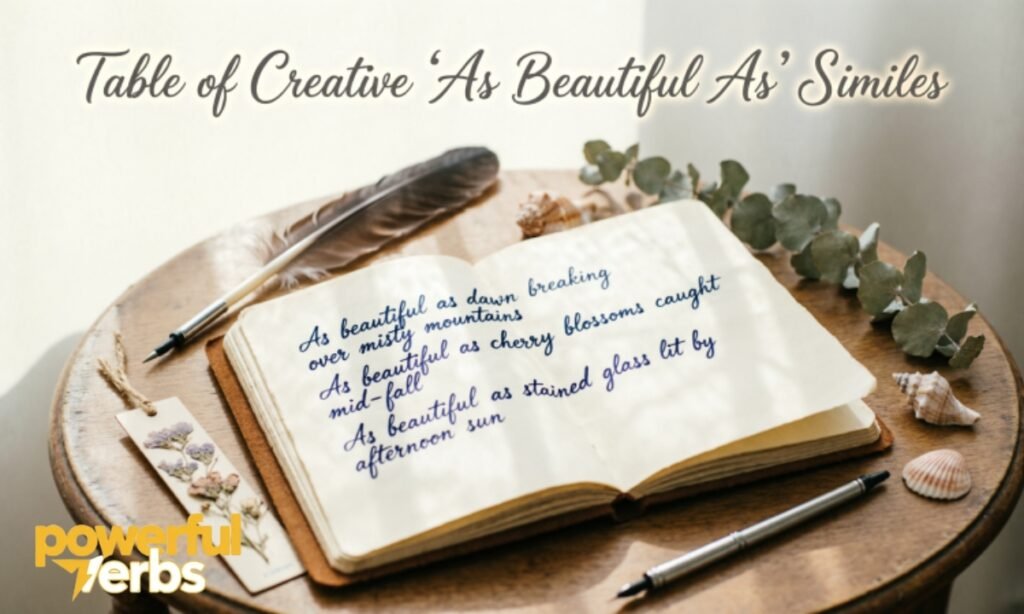
| Simile | What It Conveys |
| As beautiful as a cathedral’s stained glass in morning light | Colorful, sacred, awe-inspiring beauty |
| As beautiful as the first bloom after winter | Hope, renewal, delicate emergence |
| As beautiful as handwritten poetry | Intimate, personal, crafted beauty |
| As beautiful as a violin’s melody | Graceful, moving, emotionally resonant |
| As beautiful as frost patterns on a window | Intricate, delicate, naturally formed |
| As beautiful as a lighthouse in the storm | Strong, guiding, steadfast beauty |
| As beautiful as old books on wooden shelves | Timeless, knowledge-filled, classic charm |
Common Mistakes to Avoid
- Using overused clichés – Phrases like “as beautiful as a picture” or “as beautiful as an angel” have lost their impact through repetition. Seek fresh, original comparisons that surprise your readers.
- Making illogical comparisons – Ensure your comparison actually relates to beauty. “As beautiful as a hammer” doesn’t work because hammers aren’t typically associated with beauty.
- Being too vague – “As beautiful as something nice” or “as beautiful as a thing” fails to create any imagery. Specificity is key to effective similes.
- Overloading your writing – Using too many similes in a short passage can overwhelm readers and dilute their impact. Use them strategically for maximum effect.
- Forcing unnatural comparisons – If a simile feels awkward or requires too much explanation, it’s not working. The best similes feel effortless and immediately clear.
- Ignoring your audience – A comparison to obscure technical equipment won’t resonate with general readers, while overly simple comparisons might bore sophisticated audiences.
- Mixing incompatible tones – Don’t use humorous comparisons in serious writing or overly formal similes in casual contexts. Match your comparison to your overall tone.
Conclusion
The “as beautiful as” simile is a timeless writing tool that transforms ordinary descriptions into vivid, memorable images. By comparing beauty to familiar objects, experiences, and moments, you help readers not just understand but truly see and feel what you’re describing. Whether you’re writing poetry, crafting a story, or simply want to add more color to your everyday language, mastering this simple structure opens up endless creative possibilities.
The key to great similes lies in being specific, original, and authentic. Draw from your own observations and experiences, avoid tired clichés, and always ask yourself: Does this comparison genuinely capture what I’m trying to convey? With practice and attention, you’ll develop an instinct for crafting similes that resonate with readers and bring your writing to life. So go ahead—experiment, play with language, and discover just how beautiful your words can be.
Frequently Asked Questions
What is a simile for beautiful?
A simile for beauty uses “like” or “as” to compare beauty to something else, such as “as beautiful as a sunset” or “beautiful like a rose in bloom.”
How do you use “as beautiful as” in a sentence?
Simply place “as beautiful as” before a noun to create a comparison, like “The garden was as beautiful as a painting” or “Her voice was as beautiful as a songbird’s melody.”
What are some examples of beautiful similes?
Common examples include “as beautiful as a starry night,” “as beautiful as a butterfly,” “as beautiful as freshly fallen snow,” and “as beautiful as a summer sunrise.”
What is the difference between a simile and a metaphor?
A simile uses “like” or “as” to make comparisons (“beautiful as a rose”), while a metaphor states something is something else (“she is a rose”) without using comparison words.
Can you give me 5 similes about beauty?
Five examples are: as beautiful as a rainbow, as beautiful as ocean waves, as beautiful as moonlight, as beautiful as a diamond, and as beautiful as spring blossoms.
What makes a good “as beautiful as” simile?
A good simile uses specific, vivid comparisons that readers can easily visualize, avoids clichés, and genuinely captures the type of beauty you’re describing.
How do poets use beauty similes?
Poets use similes of beauty to create emotional depth and vivid imagery, such as Robert Burns’ “O my Luve is like a red, red rose,” which expresses romantic passion.
What are some unique similes for beautiful?
Unique examples include “as beautiful as frost patterns on glass,” “as beautiful as a violin’s first note,” or “as beautiful as candlelight dancing on water.”
Why do writers use similes instead of just saying beautiful?
Similes make descriptions more specific, memorable, and emotionally resonant by showing readers exactly what kind of beauty is being described rather than leaving it vague.
What are common mistakes when writing beauty similes?
Common mistakes include using overused clichés like “beautiful as a picture,” making illogical comparisons, being too vague, or forcing unnatural comparisons that don’t flow well.

Liam Johnson is a dedicated language expert with 4 years of professional experience. He specializes in Grammar, Vocabulary, and Sentence structure.
