

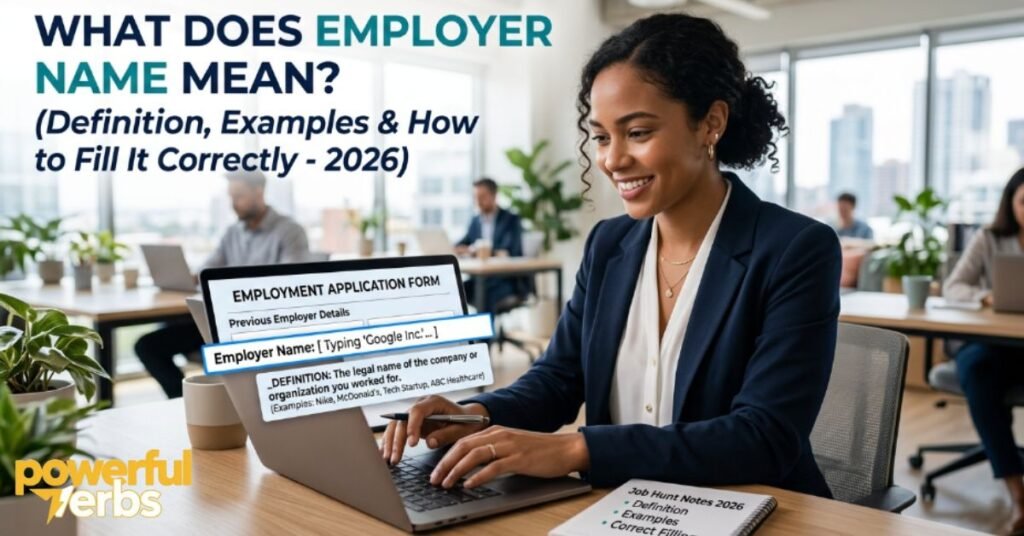
When you fill out a form, apply for a job, or open a bank account, you often see a box that says “Employer Name.” Many people get confused and don’t know exactly what to write there. This guide will explain everything about the employer name in simple, easy words.
This article covers the full meaning of the employer name, where you see it, how to write it correctly, and what to do in special cases like freelancing or unemployment. By the end, you will feel confident filling in any form that asks for your employer’s name.
Introduction
What “Employer Name” Means in Everyday Life
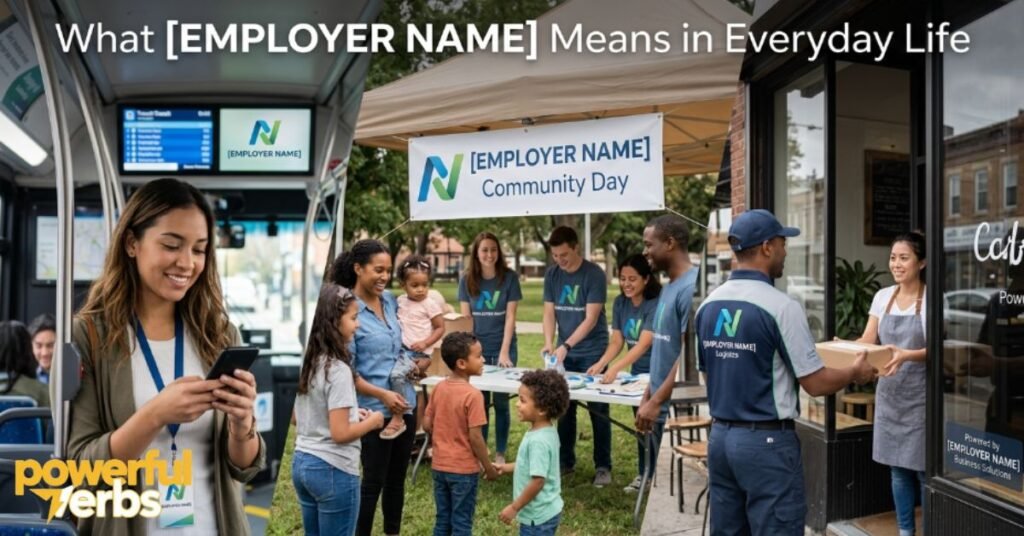
An employer’s name is simply the name of the company or person who pays you for your work. It is the organization where you work or have worked in the past. Every working person has an employer’s name connected to their job.
Where People Usually See It
You see the employer name box on job application forms, bank account forms, insurance documents, and government paperwork. It appears almost everywhere you need to prove your employment status. It is one of the most common fields on any official form.
What This Guide Will Cover
This guide will explain the definition, importance, correct format, and special cases of the employer name. It also includes real examples, a table, and answers to the most common questions. Everything is written in simple English, so anyone can understand it easily.
What Does Employer Name Mean?

Simple Explanation
Your employer’s name is the name of the company, business, or individual who hired you and gives you a salary or wage. If you work at a hospital called “City General Hospital,” that is your employer’s name. It is basically the answer to the question, “Who do you work for?”
Official / Legal Meaning
In legal and official terms, the employer name refers to the registered or legal name of the entity that employs you. This means the exact name written on your contract, payslip, or tax documents. It is not a nickname or a short form—it is the full official name used in records.
Why Employer Name Is Important
Identification
The employer name helps organizations identify which company you belong to. It tells banks, insurance companies, and government offices who is responsible for your employment. Without a correct employer name, your records can get mixed up with someone else’s.
Legal Accuracy
When you fill out government or legal forms, the employer name must match official documents exactly. Even a small spelling mistake can cause delays or rejections. Courts, tax offices, and embassies all check employer names against official records.
Verification Purposes
Many organizations verify your employment by contacting your employer directly. They use the employer name to find the right company and confirm your job. If the name is wrong, the verification process fails, and your application may be rejected.
Where You Need to Write Employer Name

Job Application Forms
When you apply for a new job, companies ask for your previous employer’s name. This helps them understand your work history and background. It also allows them to contact your past employer for a reference check.
Insurance & Policy Documents
Health insurance, life insurance, and car insurance forms all ask for your employer’s name. Insurance companies use it to connect your policy to your workplace benefits. Some insurance plans are linked directly to your employer, so the name must be correct.
Bank & Financial Forms
Banks ask for your employer’s name when you apply for a loan, credit card, or account upgrade. It helps them assess your financial stability and employment status. A wrong employer name can delay your loan approval or cause issues with your credit check.
Government Documents
Visa applications, tax returns, national ID forms, and social security documents all require your employer’s name. Government offices use it to track your employment and tax contributions. Mistakes on government forms can cause serious legal problems.
How to Write an Employer Name Correctly

Full Legal Name vs Short Name
Always write the full legal name of your employer unless the form specifically asks for a short name. For example, write “International Business Machines Corporation” instead of just “IBM” if the form needs legal accuracy. However, on casual forms or resumes, a well-known short name is usually fine.
Avoiding Common Mistakes
- Do not write your job title instead of the company name
- Do not use a nickname or an informal name of the company
- Do not leave the field blank if you are currently employed
- Do not copy from memory—always check your official documents
- Do not abbreviate unless the form allows it
Formatting Tips
- Use proper capitalization for every word in the name
- Match the spelling exactly as it appears on your contract or payslip
- If the company name includes “Ltd,” “Inc,” or “Corp,” include it
- Keep the name consistent across all forms you fill out
- If unsure, check the company’s official website or letterhead
Examples of Employer Name
Simple Examples
The employer name is simply the name written on your salary slip or job contract. If your boss’s business is called “Green Valley Farms,” that is your employer’s name. It can be a big company, a small shop, or even a single person’s name.
Real-World Examples
- A teacher working at “Beacon Light Academy”—the employer name is Beacon Light Academy
- A nurse at “Al-Shifa General Hospital”—employer name is Al-Shifa General Hospital
- A software developer at “TechNova Solutions Pvt. Ltd.”—the employer name is TechNova Solutions Pvt. Ltd.
- A shopkeeper’s assistant at “Ahmed Brothers Traders”—the employer name is Ahmed Brothers Traders
- A driver working for “FastTrack Logistics Company”—employer name is FastTrack Logistics Company
Table: Employer Name Examples
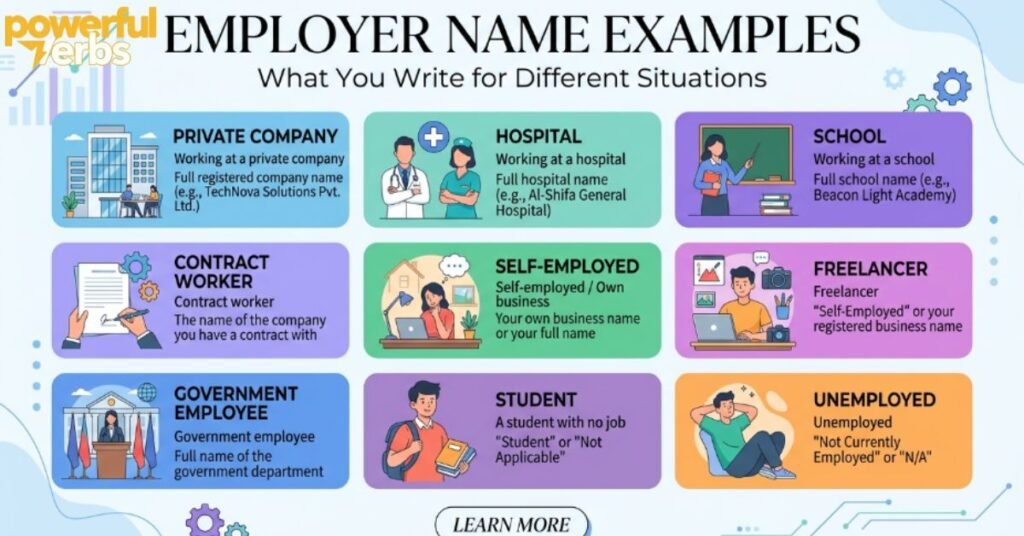
| Situation | What You Write as Employer Name |
| Working at a private company | Full registered company name (e.g., TechNova Solutions Pvt. Ltd.) |
| Working at a hospital | Full hospital name (e.g., Al-Shifa General Hospital) |
| Working at a school | Full school name (e.g., Beacon Light Academy) |
| Self-employed / Own business | Your own business name or your full name |
| Freelancer | “Self-Employed” or your registered business name |
| Unemployed | “Not Currently Employed” or “N/A” |
| A student with no job | “Student” or “Not Applicable” |
| Government employee | Full name of the government department |
| Remote worker for a company | The company’s full legal name |
| Contract worker | The name of the company you have a contract with |
What to Write in Special Cases
If You Are Self-Employed
If you own your own business, write the registered name of your business as the employer name. If your business has no official name, write your own full name followed by “Self-Employed.” For example: “Muhammad Ali — Self-Employed” or “Ali’s General Store.”
If You Are a Freelancer
Freelancers can write “Self-Employed” or “Freelancer” in the employer name field. If you have a registered business name for your freelance work, use that instead. Some forms also accept the name of the platform you work through, like “Upwork” or “Fiverr,” but check the form’s instructions first.
If You Are Unemployed
If you are not working at the moment, write “Not Currently Employed” or simply “N/A” (Not Applicable). Never leave this field blank without explanation, as it may confuse. Some forms have a checkbox for unemployed status, so use that if available.
If You Are a Student
Students who are not working can write “Student” or “Not Applicable” in the employer name field. If you have a part-time job while studying, write the name of your part-time employer instead. Always check whether the form is asking about your current or most recent employer.
If You Work Remotely
Remote workers should write the full legal name of the company they work for, just like office workers. Working from home does not change who your employer is — the employer is still the company that pays your salary. Use the company’s official registered name, not just its website name or brand name.
Employer Name in Resume vs Official Documents
Differences
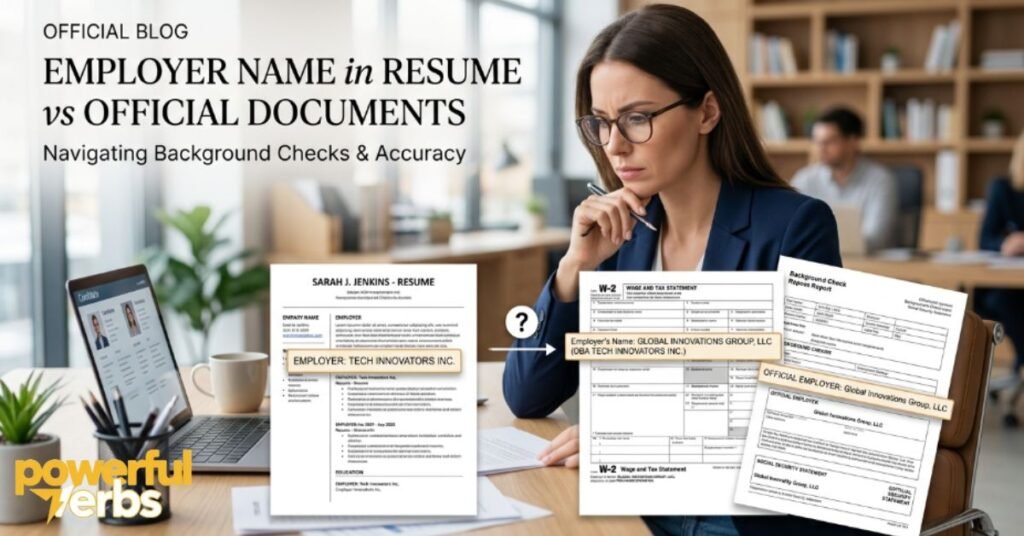
On a resume, it is generally acceptable to use a well-known short form of a company name, such as “Google” instead of “Google LLC.” However, on official government, legal, or banking forms, always use the full registered name. The context of the form determines how formal your employer’s name needs to be.
When to Shorten vs Full Name
- On a resume or LinkedIn profile, a short, commonly known name is fine
- On a visa or passport application—always use the full legal name
- On a bank loan form—use the name exactly as on your payslip
- On a tax document—match the name on your official employment contract
- On a job reference letter—use the full official company name
Employer Name vs Related Terms
Employer Name vs Company Name
The employer name and company name are often the same thing, but not always. If you work for a branch or subsidiary, your employer might be the branch’s legal name, not the parent company. For example, you may work for “Unilever Pakistan Ltd.”—that is your employer’s name, even though the parent is “Unilever PLC.”
Employer Name vs Organization Name
“Organization name” is a broader term that includes nonprofit groups, schools, government bodies, and NGOs. “Employer name” is more specific to the entity that pays your salary. On most forms, they are used interchangeably, but technically, they can be different.
Employer Name vs Job Title
Your job title is your role or position, like “Teacher,” “Accountant,” or “Driver.” Your employer name is the company or person who hired you for that role. These are two completely different fields and should never be confused with each other.
Is Employer Name the Company or a Person?

In most cases, your employer name refers to a registered company. However, this is not always true. If you work directly for an individual rather than a business, the employer name field should carry that person’s name instead.
Situation | Employer Name
Corporate job | ABC Corporation
Household staff (nanny, driver, cook) | Mr. John Smith
Personal assistant to an individual | The employer’s full legal name
Freelancer with no agency | Self-Employed
Understanding the Apostrophe in “Employer’s Name”
Many forms write the field as “Employer’s Name” instead of “Employer Name,” and this often confuses people. The apostrophe simply shows possession — it means the name belonging to the employer. There is no difference in meaning between “Employer Name” and “Employer’s Name”; it is purely a grammatical variation, similar to how a rehireable or rehirable spelling debate comes down to formatting convention rather than meaning.
The apostrophe simply shows possession — it means the name belonging to the employer. There is no difference in meaning between “Employer Name” and “Employer’s Name”; it is purely a grammatical variation, not unlike the confusion people have between in effect and in affect, where the correct choice depends on grammatical function rather than casual usage.
Employer Business Name vs Employer Name
Some forms specifically ask for your “employer business name” rather than just “employer name.” These two terms usually refer to the exact same thing — the registered business identity of the company that employs you. The distinction only matters if your employer trades under a different brand name than its official registration. In that case, use the legally registered name, not the customer-facing brand, much like distinguishing between a vender or vendor on a formal invoice — the correct legal spelling matters more than the commonly used version.
Name and Address of Employer
Certain government and financial forms combine two fields into one instruction: “name and address of employer.” This simply requires both pieces of information together — your employer’s official name followed by their physical business address. Missing either part can cause the form to be rejected or delayed during verification.
Common Questions People Have
Is Employer Name the Same as Company Name?
In most cases, yes — the employer name is the same as the company name. But if you work through a staffing agency, your employer might be the agency, not the company where you actually work. Always use the name of whoever officially pays your salary and is listed on your contract.
How to Find Your Employer Name if You’re Unsure?
- Check your salary slip or payslip—the employer name is usually at the top
- Look at your employment contract or offer letter
- Check your employee ID card or badge
- Visit your company’s official website and look for the legal or registered name.
- Ask your HR department for the official company name
Can I Use an Abbreviation?
You can use an abbreviation only if the form specifically allows it or if the abbreviation is the official registered name. For example, “IBM” is actually the company’s legal name, so that is acceptable. But writing “PIA” instead of “Pakistan International Airlines Corporation” on a legal form could cause problems.
What if I Enter the Wrong Employer Name?
If you realize you entered the wrong employer name, contact the organization that received the form as soon as possible. Explain the mistake and ask for a correction or amendment. On important documents like visa applications or loan forms, a wrong employer name can lead to rejection or legal complications.
Common Mistakes to Avoid
Using Nickname Instead of Legal Name
Many companies are known by a short nickname in daily life, but their legal name is different. For example, a company known as “City Mart” might be legally registered as “City Mart Retail Solutions Pvt. Ltd. ” Always use the official legal name on formal forms and documents.
Spelling Errors
Even one wrong letter in the employer name can cause problems during verification. Spell the company name exactly as it appears on your contract or official documents. It is always better to copy the name directly from a reliable source rather than write it from memory.
Writing Job Title Instead
Some people accidentally write their job title — like “Engineer” or “Manager” — in the employer name field. This is a very common mistake, especially on handwritten forms. Always re-read the field label carefully before writing anything.
Multilingual Understanding
Meaning in Urdu / Hindi
اردو میں “Employer Name” کا مطلب ہے آپ کے آجر کا نام — یعنی وہ کمپنی یا شخص جو آپ کو تنخواہ دیتا ہے۔ ہندی میں اسے “नियोक्ता का नाम” کہتے ہیں۔ آسان الفاظ میں، یہ وہ جگہ ہے جہاں آپ کام کرتے ہیں اور جہاں سے آپ کو پیسے ملتے ہیں۔
Simple Explanation for Non-English Users
If English is not your first language, just remember this: employer name = the name of the place where you work. It is not your name, not your job title, not your department. It is simply the name of the company or business that employs you and pays your salary every month.
Tips for Filling Forms Easily
Double-Check Documents
Before filling out any form, keep your payslip, employment contract, or offer letter in front of you. These documents have the exact correct employer name already printed on them. Taking one minute to check saves a lot of problems later.
Match Official Records
- Your employer’s name on every form should match your contract exactly
- If your company changed its name, use the current registered name
- For past employers, use the name that was registered when you worked there
- Check the spelling of “Ltd,” “Inc,” “Corp,” or “Pvt.” carefully
- If you have multiple jobs, list the primary employer unless asked for all
Keep Consistency Everywhere
Once you write the employer name correctly on one form, note it down somewhere safe. Use the same spelling and format on every other form you fill out. Inconsistency in the employer name across different documents can raise red flags during verification or background checks.
Quick Summary
Short Recap of Key Points
- Employer name = the official name of the company or person who employs you
- Always use the full legal name on formal and official documents
- Check your payslip or contract to confirm the correct name
- Self-employed people write their business name or “Self-Employed.”
- Unemployed people write “Not Currently Employed” or “N/A.”
- Never write your job title in the employer name field
- Spelling must be exact and consistent across all documents
- On resumes, a well-known short name is usually acceptable
- On government and legal forms, always use the complete registered name
- When in doubt, ask your HR department or check the company’s official website
Conclusion
Understanding what an employer’s name means and how to write it correctly is a small but important skill. It affects your job applications, loans, insurance, visa approvals, and many other important things in life. A correct employer name helps you get verified quickly and avoid unnecessary delays.
Always take a moment to double-check your employer’s name before submitting any form. Use official documents as your reference, keep the spelling consistent, and match the legal name every time. This one simple habit can save you from a lot of confusion and trouble in the future.
Frequently Asked Questions
1. What does “employer name” mean on a job application form?
“Employer name” refers to the official name of the company or business where you work or have previously worked—for example, “Google LLC” or “Amazon.com, Inc.”
2. How do I fill in the employer name field correctly on a resume or form?
Always write the full legal or commonly recognized business name of your employer, such as “Microsoft Corporation,” rather than abbreviations or nicknames like “MS” or “the tech company.”
3. What should I put as my employer name if I am self-employed or freelance?
If you’re self-employed, write your registered business name, your own full name, followed by “Self-Employed,” or “Freelancer”—for example, “John Smith—Self-Employed Consultant.”
4. Is the employer name the same as the company name on official documents?
Yes, in most cases, the employer name and the company name are the same—it is the legal or trading name of the organization that pays your salary and issues your employment contract.
5. What do I write for the employer name if I worked for a staffing or temp agency?
Write the name of the staffing or temp agency that officially employed you, such as “Adecco Staffing,” and optionally note the client company in brackets—e.g., “Adecco Staffing (Placed at Ford Motor Company).”
6. How do I find the correct employer name for a background check or government form?
Check your payslip, employment contract, or tax documents like a W-2 or P60—the legal employer name printed there is the most accurate and officially recognized version to use.
7. What is the difference between the employer name and the employer of record?
The employer name is simply the business you work for day-to-day, while the employer of record is the legal entity officially responsible for your payroll, taxes, and compliance—these can sometimes be two different organizations.
8. Can I use a parent company name instead of a subsidiary as my employer name?
It is best to use the specific subsidiary or division you actually work for, such as “Instagram, Inc,” rather than “Meta Platforms, Inc.,” unless your contract or payslip explicitly lists the parent company as your employer.
9. What should I write for the employer name if the company has changed its name since I worked there?
Write the name of the company you had during your employment period, followed by a note in brackets if helpful—for example, “Twitter, Inc. (now X Corp)”—so hiring managers or verifiers can easily recognize it.
10. Why is it important to write the correct employer name on a visa or immigration application?
Immigration authorities verify your employment history against official records, so an incorrect or informal employer name can cause delays, rejections, or fraud flags—always match it exactly to what appears on your official employment or tax documents.

Liam Johnson is a dedicated language expert with 4 years of professional experience. He specializes in Grammar, Vocabulary, and Sentence structure.
