

Learning numbers in English is one of the most important and useful skills for students. Whether you are counting objects, reading prices, or telling your age, numbers are everywhere in daily life. This article will take you step by step from 1 to 100 simply and easily.
Introduction: Learning Numbers from 1 to 100
Numbers are the building blocks of math and communication. Every student needs to know how to read, write, and say numbers correctly. In this lesson, you will learn counting from 1 to 100, understand spelling rules, and practice with fun exercises.
Why Learning Numbers Is Important
Numbers help us in every area of life. We use them to count money, check the time, measure things, and keep scores. Without knowing numbers, even simple daily tasks become very difficult.
What Students Will Learn in This Lesson
In this lesson, students will learn to spell numbers correctly in English words. They will also understand the patterns that make learning numbers easier and faster.
Simple Overview of Counting System
The English counting system is built on patterns. Once you learn the basics, you can figure out any number on your own.
What Are Numbers? (Basic Understanding)
Definition of Numbers
Numbers are symbols or words we use to count and measure things. They tell us “how many” or “how much” of something there is.
How We Use Numbers in Daily Life
We use numbers all the time without even thinking about it. From waking up at 7 o’clock to paying $5 for a snack, numbers guide our whole day.
Real-World Examples
- Money: “I have twenty dollars.”
- Time: “School starts at eight o’clock.”
- Counting: “There are thirty students in my class.”
Number System Overview (0–100 Journey Map)
How Numbers Are Built Step by Step
Numbers start from 0 and grow by adding one more each time. The system is very logical, and each group of numbers follows its own pattern.
Place Value Introduction
Place value means the position of a digit tells its value. In the number 45, the “4” means “forty” and the “5” means “five.”
Step 1: Understanding Single Digits (1–9)
List of Digits
One, two, three, four, five, six, seven, eight, nine.
How Counting Starts
Counting begins at one and goes up by adding one more each time. These nine digits are the base of the entire number system.
Simple Examples
- 1 apple = one apple
- 5 cats = five cats
- 9 books = nine books
Step 2: The Role of Zero (0)
Why Zero Is Important
Zero means nothing or none, but it plays a huge role in building bigger numbers. Without zero, we cannot write numbers like 10, 20, or 100.
How Zero Changes Number Value
When you add a zero after a digit, the value becomes ten times bigger. For example, 1 becomes 10, and 10 becomes 100.
Examples
| With Zero | Value |
| 1 + 0 = 10 | Ten |
| 2 + 0 = 20 | Twenty |
| 1 + 00 = 100 | One Hundred |
Step 3: Teen Numbers (10–19)
Special Spelling Rules
The teen numbers from 13 to 19 follow a pattern by adding “-teen” to the base digit. However, 11 and 12 are special and do not follow this rule.
Common Patterns
- 13 = thirteen, 14 = fourteen, 15 = fifteen, 16 = sixteen, 17 = seventeen, 18 = eighteen, 19 = nineteen
Difficult Numbers Explained
- 11 = Eleven (no pattern, must memorize)
- 12 = Twelve (no pattern, must memorize)
- 13 = Thirteen (not “threeteen”)
- 15 = Fifteen (not “fiveteen”)
Step 4: Building Tens (20–90)
Tens Chart Explanation
| Number | Word |
| 20 | Twenty |
| 30 | Thirty |
| 40 | Forty |
| 50 | Fifty |
| 60 | Sixty |
| 70 | Seventy |
| 80 | Eighty |
| 90 | Ninety |
Pattern-Based Learning
Most tens are formed by adding “-ty” to the number. For example: six → sixty, seven → seventy, eight → eighty, nine → ninety.
Pronunciation Tips
Note that “forty” is NOT spelled “fourty.” Also, fifty comes from “five,” and eighty comes from “eight.”
Step 5: Combining Numbers (21–99)
How Numbers Are Formed
Numbers from 21 to 99 are made by combining a tens word and a units word. For example, 25 = twenty + five = twenty-five.
Hyphen Rule
Always use a hyphen (-) between the tens and units words. This is a grammar rule in English. Examples: thirty-one, forty-seven, sixty-three.
Easy Examples
- 21 = twenty-one
- 35 = thirty-five
- 78 = seventy-eight
- 99 = ninety-nine
Numbers Chart (1 to 100)
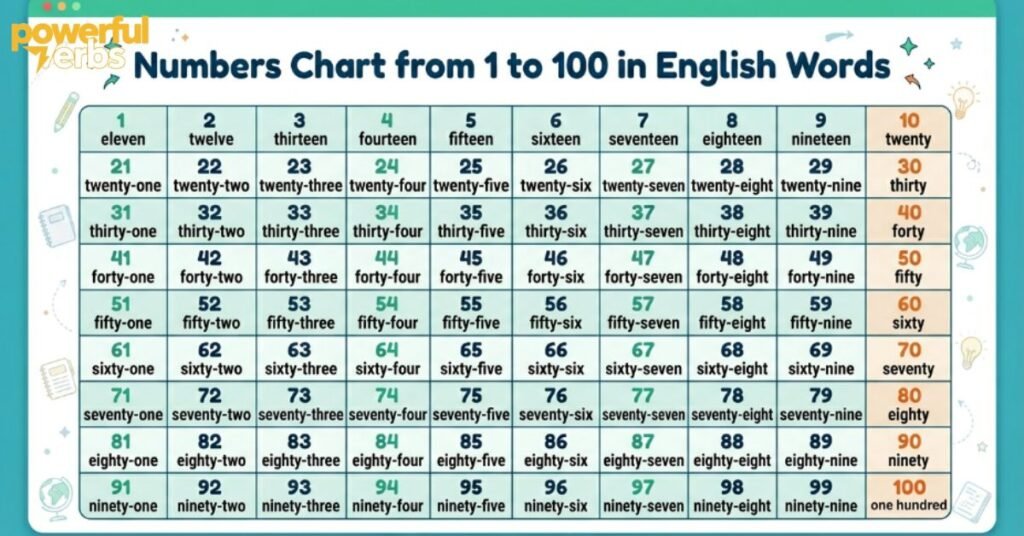
Full Counting Table
| 1 – One | 2 – Two | 3 – Three | 4 – Four | 5 – Five |
| 6 – Six | 7 – Seven | 8 – Eight | 9 – Nine | 10 – Ten |
| 11 – Eleven | 12 – Twelve | 13 – Thirteen | 14 – Fourteen | 15 – Fifteen |
| 16 – Sixteen | 17 – Seventeen | 18 – Eighteen | 19 – Nineteen | 20 – Twenty |
| 21 – Twenty-one | 22 – Twenty-two | 23 – Twenty-three | 24 – Twenty-four | 25 – Twenty-five |
| 26 – Twenty-six | 27 – Twenty-seven | 28 – Twenty-eight | 29 – Twenty-nine | 30 – Thirty |
| 31 – Thirty-one | 32 – Thirty-two | 33 – Thirty-three | 34 – Thirty-four | 35 – Thirty-five |
| 36 – Thirty-six | 37 – Thirty-seven | 38 – Thirty-eight | 39 – Thirty-nine | 40 – Forty |
| 41 – Forty-one | 42 – Forty-two | 43 – Forty-three | 44 – Forty-four | 45 – Forty-five |
| 46 – Forty-six | 47 – Forty-seven | 48 – Forty-eight | 49 – Forty-nine | 50 – Fifty |
| 51 – Fifty-one | 52 – Fifty-two | 53 – Fifty-three | 54 – Fifty-four | 55 – Fifty-five |
| 56 – Fifty-six | 57 – Fifty-seven | 58 – Fifty-eight | 59 – Fifty-nine | 60 – Sixty |
| 61 – Sixty-one | 62 – Sixty-two | 63 – Sixty-three | 64 – Sixty-four | 65 – Sixty-five |
| 66 – Sixty-six | 67 – Sixty-seven | 68 – Sixty-eight | 69 – Sixty-nine | 70 – Seventy |
| 71 – Seventy-one | 72 – Seventy-two | 73 – Seventy-three | 74 – Seventy-four | 75 – Seventy-five |
| 76 – Seventy-six | 77 – Seventy-seven | 78 – Seventy-eight | 79 – Seventy-nine | 80 – Eighty |
| 81 – Eighty-one | 82 – Eighty-two | 83 – Eighty-three | 84 – Eighty-four | 85 – Eighty-five |
| 86 – Eighty-six | 87 – Eighty-seven | 88 – Eighty-eight | 89 – Eighty-nine | 90 – Ninety |
| 91 – Ninety-one | 92 – Ninety-two | 93 – Ninety-three | 94 – Ninety-four | 95 – Ninety-five |
| 96 – Ninety-six | 97 – Ninety-seven | 98 – Ninety-eight | 99 – Ninety-nine | 100 – One Hundred |
Examples in Daily Life
Money Counting
- “This toy costs forty-five dollars.”
- “I saved ninety-nine cents.”
Age Examples
- “My grandmother is seventy-two years old.”
- “My little brother is eight years old.”
Time and Classroom Usage
- “There are thirty days in September.”
- “Our school has fifty-six students in grade three.”
Rules and Patterns of Number Writing
Basic Rules
Spelling Rules: Write numbers exactly as they sound. Teen numbers end in “-teen,” and tens numbers end in “-ty.”
Hyphen Rules: Always put a hyphen between tens and units. Example: twenty-one, sixty-four, ninety-nine. Never write them without a hyphen.
Pattern Recognition
Repeating Tens Pattern: Every tens word stays the same when you add units. Twenty stays “twenty” in twenty-one, twenty-two, twenty-three, and so on.
Unit Addition Pattern: You just add the units word after the tens word with a hyphen. Forty + two = forty-two. Simple!
Spelling Tips
Common Mistakes: Students often write “fourty” instead of “forty” or “ninteen” instead of “nineteen.” Double-check these tricky words.
Easy Memorization Tricks: Group the numbers in sets of ten and practice one group each day. Repetition is the best way to remember spellings.
Common Mistakes to Avoid
Wrong Spelling of Teen Numbers: Never write “threeteen”—it is “thirteen.” Never write “fiveteen”—it is “fifteen.” These are special spellings.
Missing Hyphens: Writing “twenty one” without a hyphen is incorrect. Always write “twenty-one.” The hyphen is part of the grammar rule.
Confusion Between Numbers: Many students mix up 40 (forty) and 14 (fourteen), or 60 (sixty) and 16 (sixteen). Remember: the bigger numbers (40, 60) end in “-ty.”
Practice Section: Let’s Count Together!
A. Fill in the Blanks
Fill in the missing number word:
- 13 = thir_______
- 40 = ___________
- 57 = fifty-_______
- 88 = eighty-_______
- 100 = one _______
B. Write the Word Form
Write these numbers in words:
- 24 = ___________
- 39 = ___________
- 61 = ___________
- 75 = ___________
- 99 = ___________
C. Write the Number Form
Write the number for each word:
- Forty-six = ___
- Eighty-three = ___
- Nineteen = ___
- Thirty = ___
- Sixty-seven = ___
Answer Key
A Part Answers
- 13 = thirteen
- 40 = forty
- 57 = fifty-seven
- 88 = eighty-eight
- 100 = one hundred
B Part Answers
- 24 = twenty-four
- 39 = thirty-nine
- 61 = sixty-one
- 75 = seventy-five
- 99 = ninety-nine
C Part Answers
- Forty-six = 46
- Eighty-three = 83
- Nineteen = 19
- Thirty = 30
- Sixty-seven = 67
Mini Quiz: Test Your Number Skills
Short MCQs
1. How do you write 40 in words?
- a) Fourty
- b) Forty ✓
- c) Fortee
- d) Fourtee
2. Which number comes between 15 and 17?
- a) Fourteen
- b) Eighteen
- c) Sixteen ✓
- d) Thirteen
3. How do you write 33 in words?
- a) Thirty three
- b) Thirty-three ✓
- c) Thirtythree
- d) Thirthy-three
4. What is the correct spelling of 15?
- a) Fiveteen
- b) Fifthteen
- c) Fifteen ✓
- d) Fiftteen
5. Which of these uses the hyphen correctly?
- a) Seventy five
- b) Seventy-five ✓
- c) Seventyfive
- d) Seventy – five
Fun Challenge Questions
- Write the word form of your age.
- What is 50 + 22? Write the answer in words.
- Which number comes before eighty-nine?
Creative Activity: The “100 Numbers Adventure”
Story-Based Learning Activity
Imagine you are on a treasure hunt. You must find 100 gold coins hidden around your school. Every time you find coins, write how many you found in English words. For example: “I found twenty-three coins near the library.”
Engaging Classroom or Homework Task
Draw a map of your school or home. Label at least ten spots on the map with a number written in words. Share your map with a classmate and read the numbers out loud to each other.
Fun Facts About Numbers
Numbers are more interesting than you might think! The number zero was invented in ancient India and changed math forever. The word “eleven” comes from an old Germanic word meaning “one left over” after ten.
Humans use the base-10 system (counting in groups of ten) because we have ten fingers. It is the most natural and easy system for the human brain to use for everyday counting.
Summary: You Are Now a Number Champion!
You have learned numbers from 1 to 100, understood spelling rules, practiced with exercises, and discovered fun facts. Now you can read, write, and say any number from one to one hundred with confidence.
Keep practicing every day, and numbers will become your best friend in English. You are a true Number champion—great job!
Bonus Section: Practice Daily Plan
| Day | Practice Goal |
| Day 1 | Practice numbers 1–20 (spelling only) |
| Day 2 | Practice numbers 21–50 (write + say out loud) |
| Day 3 | Practice numbers 51–100 (fill in blanks) |
| Day 4 | Do the Mini Quiz without looking at notes |
| Day 5 | Complete the 100 Numbers Adventure activity |
| Day 6 | Review all common mistakes and correct them |
| Day 7 | Teach the number rules to a friend or family member |
Conclusion
Numbers from 1 to 100 are not hard once you learn the patterns and rules. With the chart, exercises, and tips in this article, every student can master number spelling in English.
Practice a little every day, and you will never forget these numbers. You now have everything you need to become a confident and skilled number reader in English!
Frequently Asked Questions
1. What does the numbers chart from 1 to 100 look like when written out in English words?
A numbers chart from 1 to 100 in English words starts with one, two, three, and continues through ten, twenty, thirty, up to one hundred, listing every number spelled out in full.
2. How do you write the numbers 1 to 100 in English words for kids learning to count?
Children can learn by grouping numbers—one to ten, then eleven to twenty, then using patterns like twenty-one, twenty-two, all the way to one hundred, to make memorization easier.
3. What are the correct spellings of all numbers from 1 to 100 in English?
Numbers 1–20 have unique spellings (e.g., eleven, twelve, thirteen), while 21–99 follow a hyphenated pattern like twenty-one, forty-five, ninety-nine, and 100 is written as one hundred.
4. What is the spelling of the number 40—is it “forty” or “fourty” in the English numbers chart?
The correct spelling is “forty”—not “fourty.” This is one of the most commonly misspelled numbers in any English words chart from 1 to 100.
5. How do you say and spell the numbers from 11 to 19 in English words?
The numbers 11 to 19 are called the teens and include eleven, twelve, thirteen, fourteen, fifteen, sixteen, seventeen, eighteen, and nineteen—each with a unique spelling that doesn’t follow a simple pattern.
6. Which numbers between 1 and 100 are spelled with a hyphen in English?
All compound numbers from 21 to 99—except multiples of ten—are hyphenated in English, such as twenty-one, fifty-six, and eighty-three, following standard grammar rules.
7. What are the multiples of ten from 1 to 100 written out in English words?
The multiples of ten are: ten, twenty, thirty, forty, fifty, sixty, seventy, eighty, ninety, and one hundred—these are key anchor words on any numbers chart in English.
8. How can a numbers chart from 1 to 100 in English words help with spelling and literacy?
A visual numbers chart helps students recognize spelling patterns, build number-word association, and improve literacy by connecting numerals to their written English equivalents in an easy-to-reference format.
9. What is the difference between cardinal and ordinal numbers on an English numbers chart from 1 to 100?
Cardinal numbers (one, two, three) show quantity, while ordinal numbers (first, second, third) show position or order—both are important forms found in a complete English numbers reference chart.
10. Where can teachers find a printable numbers chart from 1 to 100 in English words for classroom use?
Teachers can find free printable number word charts on educational websites like Teachers Pay Teachers, Twinkl, and K5 Learning — perfect for classroom walls, worksheets, and early literacy activities.

Liam Johnson is a dedicated language expert with 4 years of professional experience. He specializes in Grammar, Vocabulary, and Sentence structure.
