

The correct spelling is shiny, not “shiney.” Every major dictionary — Merriam-Webster, Cambridge, and Oxford — lists only “shiny” as a valid English word. “Shiney” is a common misspelling that results from a misunderstanding of a basic English spelling pattern: dropping the silent “e” before adding “-y.”
If you remember nothing else from this guide, remember this: shine → shiny, never “shiney.”
see also:300+ Adjectives to Describe a Person: Positive, Negative & Neutral With Examples
Why People Confuse Shiney and Shiny
The mix-up between “shiney” and “shiny” isn’t random — it follows a predictable pattern in how English speakers process spelling. Many learners assume that since the base word “shine” contains an “e,” that letter should carry over when an ending is attached. This logic feels intuitive, but English spelling doesn’t work that way for words ending in a silent “e.”
Autocorrect tools, casual texting habits, and phonetic guessing all contribute to “shiney” showing up in informal writing. Search engines see thousands of queries every month from people typing “shiney” simply because the word sounds like it should have an “e” in it. It doesn’t.
The Spelling Rule That Settles It

English has a long-standing rule for words that end in a silent “e”: when you add a suffix that starts with a vowel — like “-y,” “-ing,” or “-able” — the silent “e” is dropped first.
Here’s the transformation broken down step by step:
Base word: shine (a verb meaning to give off light) Step one: remove the silent “e” → shin Step two: attach the suffix “-y” → shiny Final result: shiny (an adjective describing brightness or gloss)
Keeping the “e” and simply tacking on a “y” produces “shiney,” which breaks this rule and isn’t recognized as standard English in any reputable dictionary.
More Words That Follow the Same Pattern

This isn’t a one-off rule invented for “shiny.” Dozens of common English adjectives are built the exact same way. Seeing the pattern repeated across unrelated words makes it much easier to internalize.
| Base Word | Rule Applied | Resulting Adjective |
| Smoke | Drop “e,” add “y” | Smoky |
| Taste | Drop “e,” add “y” | Tasty |
| Haze | Drop “e,” add “y” | Hazy |
| Grease | Drop “e,” add “y” | Greasy |
| Spice | Drop “e,” add “y” | Spicy |
| Bone | Drop “e,” add “y” | Bony |
| Shine | Drop “e,” add “y” | Shiny |
Once this table clicks, the temptation to write “shiney” tends to disappear, because the brain starts recognizing the silent-e pattern automatically across all similar words.
What Shiny Actually Means
“Shiny” is an adjective used to describe a surface, object, or quality that reflects light brightly, often because it is smooth, polished, clean, or new. It’s one of the most versatile descriptive words in everyday English, showing up in casual conversation, product marketing, and creative writing alike.
Depending on context, “shiny” can describe:
- A polished or glossy surface, such as a waxed car or a marble countertop
- Something freshly cleaned, like dishes straight out of the dishwasher
- Light-emitting or reflective objects, including stars, jewelry, and metal
- An informal sense of newness or excitement, as in “a shiny new gadget”
This range of meaning is part of why the word appears so frequently in product descriptions, travel writing, and storytelling — it conveys both a literal visual quality and a subtle emotional impression of freshness.
How to Pronounce Shiny
Phonetically, “shiny” is written as /ˈʃaɪ.ni/, which breaks down into two syllables:
- First syllable — “shy”: rhymes with “fly,” “sky,” and “try”
- Second syllable — “nee”: rhymes with “see,” “tree,” and “free”
The stress falls entirely on the first syllable, giving the word a quick, light rhythm: SHY-nee. There is no version of the pronunciation that justifies inserting an extra “e” sound in the spelling — the silent “e” rule applies purely to written form, not to how the word sounds aloud.
Shiny in a Sentence: Real Usage Examples
Seeing the word in context across different settings helps confirm correct usage and natural phrasing.
Everyday conversation:
- The kitchen floor was so shiny I could see my reflection in it.
- My little brother got a shiny new bicycle for his birthday.
- The dog’s coat looked shiny after its bath.
Workplace and business writing:
- The startup unveiled a shiny prototype at the trade show.
- Investors were drawn to the shiny packaging before reading the actual proposal.
- The newly renovated office had shiny glass walls throughout.
Descriptive and creative writing:
- Moonlight made the river look shiny and silver.
- The pirate’s chest was filled with shiny gold coins.
- Her shiny eyes lit up the moment she saw the surprise.
Incorrect versions to avoid:
- ~~The kitchen floor was so shiney~~
- ~~My little brother got a shiney new bicycle~~
- ~~The dog’s coat looked shiney~~
Shiny vs Shiney at a Glance
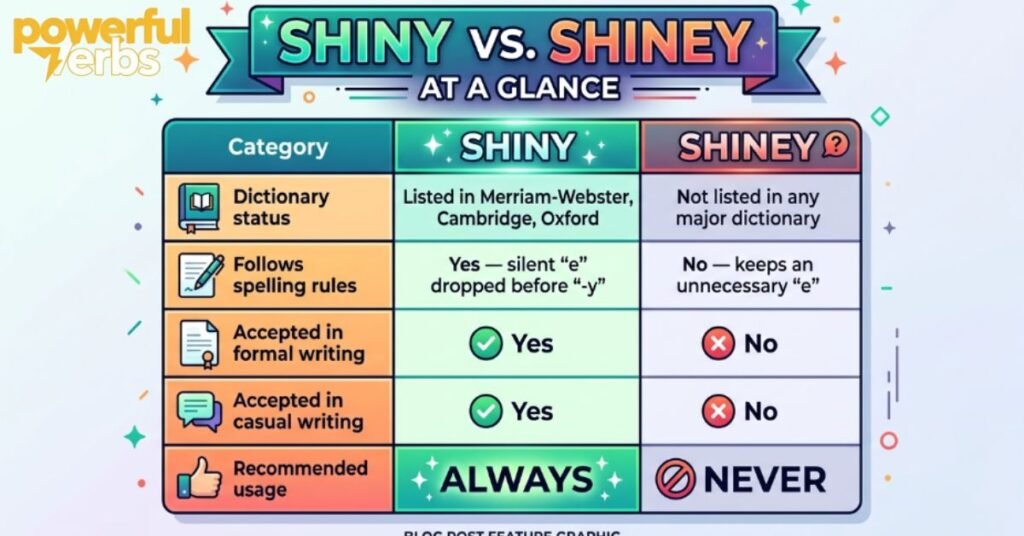
| Category | Shiny | Shiney |
| Dictionary status | Listed in Merriam-Webster, Cambridge, Oxford | Not listed in any major dictionary |
| Follows spelling rules | Yes — silent “e” dropped before “-y” | No — keeps an unnecessary “e” |
| Accepted in formal writing | Yes | No |
| Accepted in casual writing | Yes | No |
| Recommended usage | Always | Never |
Mistakes Writers Make With This Word
A few recurring errors show up again and again in casual writing, student essays, and even some published web content.
Tacking on an extra letter out of habit. Because “shine” has an “e,” some writers assume the adjective form should too. This overlooks the silent-e dropping rule that governs dozens of English words.
Mixing it up with “shinny.” This is an entirely different word referring to climbing something by gripping with arms and legs, or to a casual, informal style of ice hockey. It has no relationship to brightness or gloss.
Switching spellings mid-document. Inconsistent spelling — using “shiny” in one paragraph and “shiney” in another — signals carelessness to readers and can hurt credibility in professional or published writing.
Where the Word Shiny Comes From
“Shiny” traces back to Old English roots connected to “scinan,” meaning to give off light. Over centuries, the verb “shine” evolved into modern English, and the adjective form “shiny” followed naturally once English spelling conventions around silent “e” and suffixes became standardized. Related words sharing the same root include “shine” (verb and noun), “shining” (present participle), and “sunshine” (compound noun), all of which trace back to the same core idea of emitting or reflecting light.
Synonyms for Shiny and When to Use Each One

While “shiny” works in almost any context, certain synonyms carry more precise connotations depending on what you’re describing.
| Synonym | Best Context | Example |
| Glossy | Printed material, photographs, lips | The brochure had a glossy finish. |
| Polished | Wood, metal, shoes after care | He kept his boots polished and spotless. |
| Lustrous | Hair, fabric, pearls | Her lustrous hair shimmered under the lights. |
| Gleaming | Soft, steady shine | The gleaming lighthouse guided the ship home. |
| Radiant | A glowing person or expression | The bride looked radiant on her wedding day. |
| Sparkling | Jewelry, glass, water | The sparkling chandelier lit up the hall. |
| Burnished | Aged or treated metal | The burnished copper kettle sat on the shelf. |
Choosing the right synonym can make descriptive writing more precise, but “shiny” remains the safest, most universally understood choice for general use.
Is Shiney Used Anywhere at All?
No major English-speaking region — American, British, Canadian, or Australian — recognizes “shiney” as a standard or regional spelling variant. Unlike words such as “colour” vs. “color,” where regional dialects genuinely differ, “shiny” has no accepted alternate spelling anywhere in the English-speaking world. Any appearance of “shiney” in print or online is treated as a typographical error rather than a legitimate variant.
Quick Facts Worth Knowing
- The root verb “shine” has existed in English for well over a thousand years.
- “Shiny” can function informally to mean “new” or “exciting,” as in “a shiny new opportunity.”
- The same silent-e-drop rule applies to dozens of common adjectives, not just “shiny.”
- Despite frequent misspelling in search queries, “shiney” has never appeared in any edition of a major English dictionary.
“Shiny” in Gaming Culture

Beyond everyday descriptions, “shiny” has taken on a specific, beloved meaning in gaming — most notably in the Pokémon franchise. A “shiny Pokémon” is an extremely rare, alternately colored version of a regular creature, and catching one is considered a major achievement among players. This usage has become so widespread that “shiny” now functions almost as its own noun within gaming communities (“I finally caught a shiny!”). Whether you’re describing a polished countertop or a rare in-game creature, the spelling never changes — it’s always shiny, never “shiney,” regardless of context. Writers describing hobbies, product reviews, or personal interests should keep this consistent, the same way choosing precise, varied language matters when building out something like a list of 200 adjectives to describe yourself — accuracy and consistency in word choice reflect attention to detail everywhere, not just in gaming forums.
“Shiny Object Syndrome” — A Common Idiom
“Shiny” also appears in a widely used business and productivity idiom: shiny object syndrome. This phrase describes the tendency to get distracted by exciting new ideas, tools, or opportunities before finishing what you already started — like a magpie chasing something glittery instead of staying focused. You’ll hear it often in entrepreneurship, marketing, and personal-development writing: “He suffers from shiny object syndrome, jumping from one business idea to the next.” Understanding idiomatic uses like this one adds real depth to your vocabulary, much the same way knowing precise professional terminology — like what does employer name mean on a job form — helps you navigate both formal and informal writing with more confidence and clarity.
see also:Complete List of Pink Fruits: 45 Names with Pictures, Facts & Surprising Benefits
Conclusion
“Shiny” is the only correct spelling recognized across every major English dictionary, while “shiney” remains nothing more than a widespread typo born from a misunderstanding of the silent-e spelling rule. Once you connect “shine” to other familiar pairs like “smoke→smoky” or “taste→tasty,” the pattern becomes second nature, and the urge to add an extra “e” disappears for good. Whether you’re writing a product description, a casual message, or a formal report, sticking with “shiny” keeps your writing accurate, polished, and credible.
FAQs
Is it spelled shiney or shiny?
It’s spelled “shiny.” The version with an extra “e” is a common misspelling and isn’t recognized by any standard dictionary.
Why isn’t there an e in shiny?
Because “shine” ends in a silent “e,” that letter is dropped before adding the suffix “-y.” This same pattern applies to many other English words.
What part of speech is shiny?
Shiny is an adjective. It describes nouns by indicating that something reflects light or has a glossy, bright appearance.
Does shiny have a different meaning in casual speech?
Yes. Beyond describing reflective surfaces, “shiny” is sometimes used informally to mean something new, exciting, or appealing, such as a “shiny new phone.”
What’s a good synonym for shiny?
Glossy, polished, gleaming, lustrous, and radiant are all strong alternatives, each suited to slightly different contexts like fabric, metal, or facial expression.
Can shiny be used in professional or academic writing?
Yes, “shiny” is fully appropriate in formal contexts. It’s a standard English adjective with no informal or slang restrictions attached to it.

Liam Johnson is a dedicated language expert with 4 years of professional experience. He specializes in Grammar, Vocabulary, and Sentence structure.
