

Most people use these two phrases interchangeably — but one of them does not exist in the English language. If you have ever typed “take affect” in an email, a report, or a social media post, you were using the wrong word every single time.
The correct phrase is take effect, and this guide will show you exactly why — with real examples, memory tricks, and a breakdown that even advanced English writers will find useful.
See also: Is “Good Morning” One Word? Here’s the Definitive Answer
What Is the Difference Between “Effect” and “Affect”?
Before understanding why “take effect” is correct, you need to know how “effect” and “affect” function differently in English grammar.
Effect is almost always a noun. It refers to a result, outcome, or consequence of something.
Affect is almost always a verb. It means to influence, change, or have an impact on something.
Here is the simplest way to remember this:
- “The medicine had a positive effect.” → effect = the result (noun)
- “The medicine affected his sleep.” → affected = what it did (verb)
This single distinction is the foundation of why “take effect” is grammatically correct and “take affect” is not.
Why “Take Effect” Is Correct (and “Take Affect” Is Always Wrong)
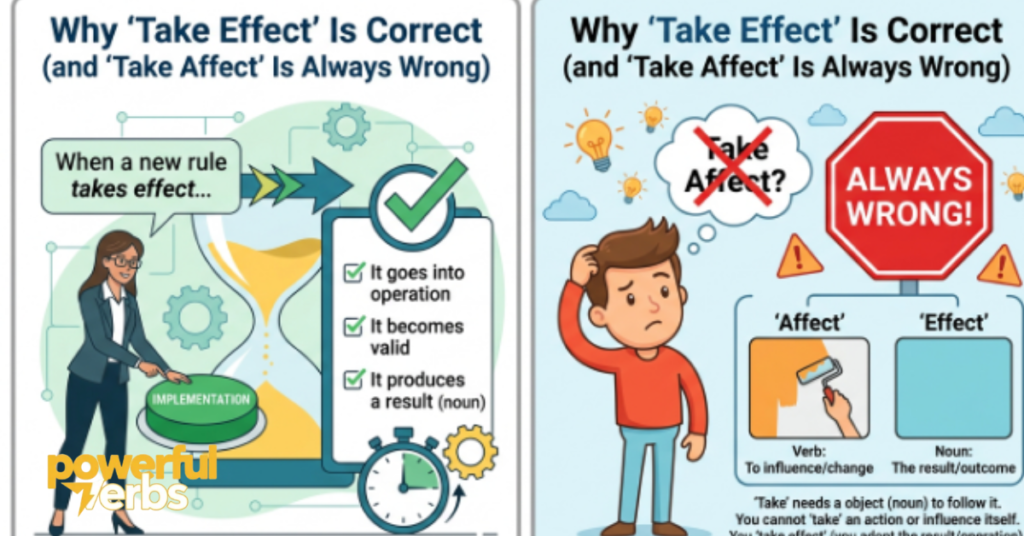
The verb “take” is a transitive verb. That means it requires a noun as its object — something you can “take.”
When you say “take effect,” the word “effect” acts as a noun meaning a result or outcome. You are saying that a change, law, medicine, or policy begins to produce its result. That is grammatically sound.
When you say “take affect,” you are placing a verb after another verb. “Affect” does not function as a noun in standard everyday English. You cannot “take” a verb. The construction simply does not work.
Think of it this way: you can “take a break,” “take a risk,” or “take a stand” — all nouns. In the same pattern, you “take effect” — because “effect” is the noun.
What Does “Take Effect” Mean?
“Take effect” is an idiomatic English phrase that means to become active, operational, or to begin producing results. It is used across many contexts — legal, medical, business, and everyday speech.
In legal and government contexts, it means a law, regulation, or policy becomes enforceable:
The new traffic laws take effect on the first of January.
The executive order took effect immediately after it was signed.
In medical and health contexts, it means a drug or treatment starts working:
This painkiller should take effect within twenty minutes.
The antibiotic began to take effect after the third dose.
In business and workplace contexts, it means a decision, change, or policy starts being applied:
The revised salary structure takes effect from next quarter.
All remote work guidelines took effect after the company announcement.
In technology contexts, it means a setting, update, or configuration becomes active:
Restart your device for the new settings to take effect.
The software patch took effect without requiring a reboot.
30 Real-World Examples of “Take Effect” Used Correctly

Seeing the phrase used naturally in sentences is the best way to internalize correct usage. Every example below is grammatically correct.
The travel ban took effect at midnight on Friday.
How long does it take for allergy medication to take effect?
The price increase will take effect starting next month.
New data privacy regulations take effect across the European Union.
The ceasefire agreement took effect at dawn.
Changes to the school curriculum will take effect in September.
The new hiring policy takes effect immediately.
Environmental protection rules took effect after years of debate.
The interest rate hike will take effect in the third quarter.
When does my gym membership take effect?
The trade agreement took effect after both countries signed it.
Security protocols took effect across all company branches.
The vaccine takes effect approximately two weeks after the final dose.
Board-approved budget cuts took effect without delay.
Your subscription plan takes effect upon successful payment.
The revised import duties will take effect by year-end.
The stress management techniques began to take effect after two weeks.
New airport security measures took effect following the government review.
The updated terms of service take effect thirty days after notification.
Flood warnings take effect at 6 PM this evening.
Common Mistakes to Avoid
Here are the incorrect versions you will often see in casual writing. Do not repeat these errors:
The law will take affect tomorrow.
When does the medicine take affect?
The policy took affect as soon as it was announced.
These changes will take affect next week.
The security update took affect after the restart.
Every single example above should use “effect” — not “affect.”
Memory Tricks That Actually Work
The RAVEN Rule
RAVEN stands for: Remember Affect Verb, Effect Noun.
Affect = the action word (verb). Effect = the end result (noun).
Since “take” needs a noun after it, you always use “effect.”
The “The” Test
Put the word “the” in front of it. If it sounds natural, it is a noun — use “effect.”
“The effect” — sounds correct. ✓
“The affect” — sounds wrong in this context. ✗
If “the” works, write “take effect.”
The E-for-End-Result Trick
Both “effect” and “end result” start with E. Whenever you mean the result of something, go with the E-word: effect.
Special Cases Worth Knowing
Can “effect” ever be a verb?
Yes — but only in formal, elevated writing. When used as a verb, “effect” means to bring something about or to cause something to happen:
The new director hopes to effect meaningful change in the organization.
This usage is rare and appears mostly in legal or academic writing. It does not change the fact that “take affect” is always wrong. Even in this edge case, it is “take effect” — not “take affect.”
Can “affect” ever be a noun?
Yes — but only in psychology. In clinical contexts, “affect” (pronounced with stress on the first syllable) refers to outward emotional expression:
The psychologist noted that the patient displayed a flat affect.
This specialized meaning has nothing to do with the phrase “take effect” or “take affect.”
“Take Effect” vs. “Go Into Effect” — Are They the Same?
Yes. Both phrases carry the same meaning and can be used interchangeably. “Go into effect” is slightly more common in legal and governmental language, while “take effect” appears more broadly across all writing styles.
The law takes effect next week. ✓
The law goes into effect next week. ✓
Both are correct. Both use “effect” — never “affect.”
see also:I Analyzed Puting vs Putting: Here’s the Real Difference
Other Correct Phrases That Use “Effect”
Once you understand that “effect” is a noun meaning result or consequence, you will also get these common phrases right:
“Have an effect on” — to influence something.
“In effect” — currently active or valid.
“Side effects” — unintended consequences, especially of medications.
“For effect” — done deliberately for dramatic impact.
“To no effect” — producing no result.
“Cause and effect” — the relationship between an action and its outcome.
FAQs
Is it “take effect” or “take affect”?
Always “take effect.” The word “effect” is a noun here, and the verb “take” requires a noun after it. “Take affect” places two verbs together, which is grammatically incorrect.
What does “take effect” mean in simple terms?
It means something starts working or becomes officially active — whether that is a medicine, a law, a policy, or a system update.
Can I use “take effect” in formal writing?
Absolutely. It is the standard, accepted phrase in legal documents, business communications, medical instructions, journalism, and academic writing.
Why do so many people write “take affect” by mistake?
Because “effect” and “affect” sound identical when spoken. They also both relate to change and results, which adds to the confusion. Most people were never taught a clear rule for telling them apart.
What is the past tense of “take effect”?
The past tense is “took effect.” For example: “The regulation took effect last month.” You can also say “has taken effect” for the present perfect form.
Are “take effect” and “kick in” the same thing?
Yes, in casual speech. “The medicine kicked in” and “the medicine took effect” carry the same meaning. “Kick in” is informal; “take effect” is appropriate in both formal and informal contexts.
Final Word
There is no situation in standard English where “take affect” is correct. The phrase simply does not exist as a valid grammatical construction. Whether you are writing a legal contract, a workplace memo, a health article, or a casual text, the phrase you need is always take effect — with an E.
If you remember just one rule: take needs a noun, effect is a noun, and affect is a verb. That single fact makes the right choice obvious every time.

Liam Johnson is a dedicated language expert with 4 years of professional experience. He specializes in Grammar, Vocabulary, and Sentence structure.
