

If you’ve ever typed “rehireable” into an HR form, paused, deleted it, and typed “rehirable” instead, you’ve run into one of English’s quieter spelling traps. The word shows up constantly in performance reviews, exit paperwork, and recruiter inboxes, yet almost no major style guide addresses it directly. This guide settles the rehireable or rehirable question with real dictionary backing, explains what the word actually means inside a hiring process, and shows you exactly how to use it without a second thought.
see also:Take Effect or Take Affect? The Real Difference Explained
The Quick Answer: Which Spelling Should You Actually Use?

Here’s the short version: neither rehireable nor rehirable has its own listing in Merriam-Webster, Dictionary.com, or Collins. What you will find instead is the root adjective hirable, with hireable recorded as its accepted variant carrying the same definition and pronunciation. Once you attach the prefix re- to either spelling, that same flexibility carries straight through.
That means rehirable lines up with the form dictionaries treat as primary, while rehireable matches the variant spelling that has appeared in print since at least the 1860s. Both are grammatically sound, and both will be understood instantly by any HR professional, recruiter, or hiring manager. The rule that actually matters is internal consistency: pick one spelling for your document, resume, or company template, and stick with it every time it appears.
What Does “Rehireable” (or “Rehirable”) Actually Mean?
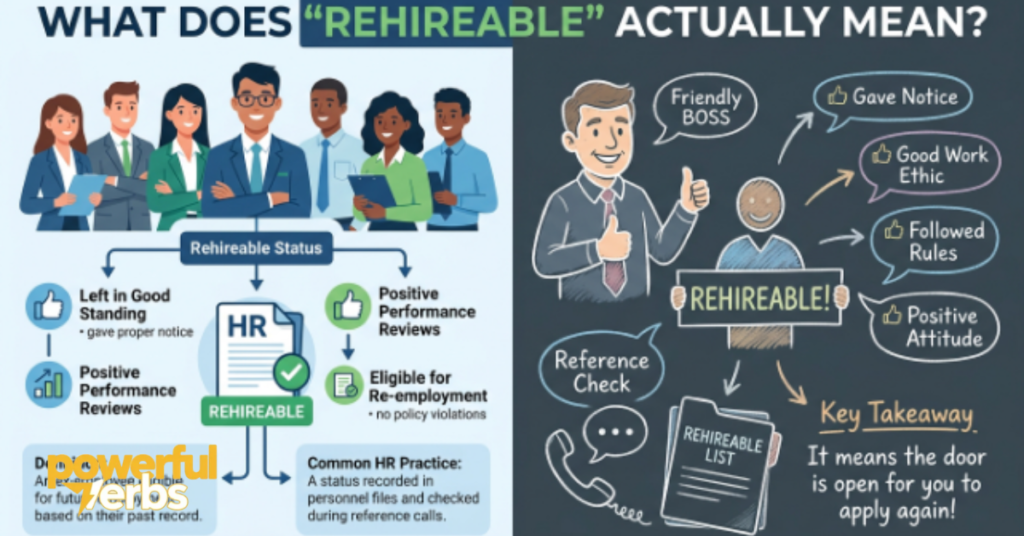
Strip away the spelling debate and the meaning is simple. The word describes whether a former employee qualifies to be considered for a role at the same company again. It is a status, not a guarantee — being rehireable doesn’t promise a new offer, it simply means nothing on that person’s record would automatically disqualify them from applying in the future.
You’ll most often run into the term inside HR systems, where it appears as a flag or dropdown field tied to an employee’s exit record. Managers also use it informally: “She’s definitely rehireable, she just relocated for her partner’s job.” In every case, the underlying idea stays the same — eligibility for future employment, based on how a previous tenure ended.
see also: 150+ Verbs with O in English
Breaking the Word Apart: Re- + Hire + -able
Word formation explains most of the confusion. Start with hire, a verb meaning to employ someone. Add the prefix re-, meaning “again,” and you get rehire — to employ someone a second time. From there, the suffix -able attaches to turn the verb into an adjective meaning “capable of” or “fit for.”
This is the same pattern behind dozens of common adjectives: manageable, debatable, removable, noticeable. English doesn’t apply one fixed rule when a verb ends in a silent e and a suffix beginning with a vowel gets added. Sometimes the e drops (use → usable, move → movable). Sometimes it stays, usually to protect a pronunciation detail (manage → manageable, notice → noticeable, where dropping the e would harden a soft sound). And sometimes, as with hire, English simply tolerates both outcomes — which is exactly why rehirable and rehireable coexist instead of one version quietly disappearing.
see also: 60 Sentences of Used To with Meaning, Rules, and Examples
What Dictionaries Actually Say (Not Just Grammar Blogs)

A quick search for “rehireable or rehirable” turns up dozens of articles, and an unsettling number of them flatly contradict each other — some insist rehirable is the only acceptable form, others insist the exact opposite, and almost none of them point to an actual dictionary entry.
Here’s what the dictionaries themselves show: Merriam-Webster lists hirable as its headword, with hireable noted as a recognized variant sharing the identical definition and pronunciation. Dictionary.com and Collins follow the same pattern. The Oxford English Dictionary traces hireable back to the 1860s, which means the “extra e” version isn’t a modern typo — it has well over a century of documented use behind it.
Neither rehirable nor rehireable appears as its own separate dictionary entry, because the word is a workplace coinage built on top of an existing adjective rather than a distinctly defined term. That distinction matters: you’re not choosing between a correct word and an incorrect one, you’re choosing between two long-standing spellings of the same root.
Rehirable vs Rehireable at a Glance
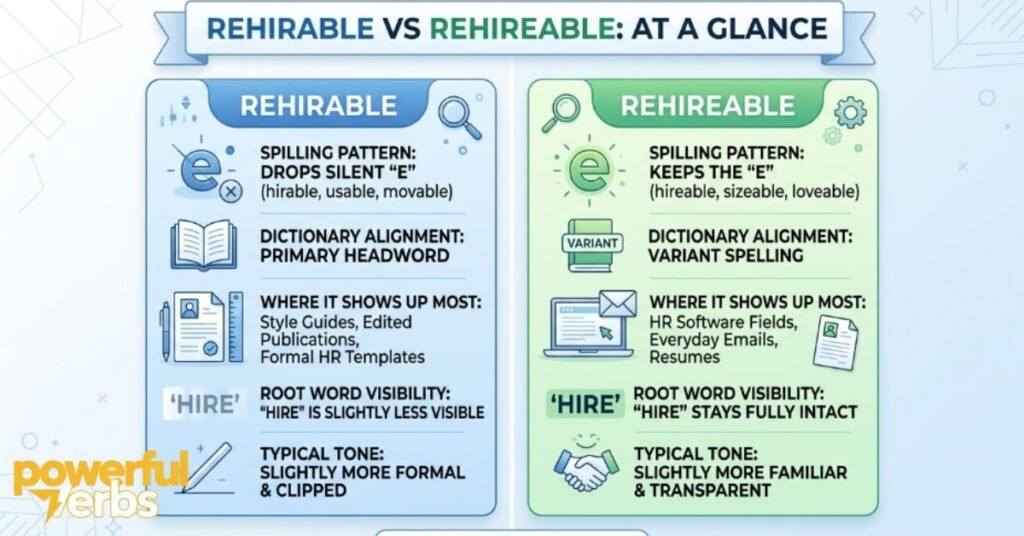
Once you understand where each spelling comes from, the comparison becomes far less confusing:
| What to Compare | Rehirable | Rehireable |
| Spelling pattern | Drops the silent e, matching hirable, usable, movable | Keeps the e, matching hireable, sizeable, loveable |
| Dictionary alignment | Mirrors Merriam-Webster’s primary headword for the root word | Mirrors the dictionary-listed variant spelling |
| Where it shows up most | Style guides, edited publications, formal HR templates | HR software fields, everyday emails, resumes |
| Root word visibility | “Hire” is slightly less visible at a glance | “Hire” stays fully intact and easy to spot |
| Typical tone | Slightly more formal and clipped | Slightly more familiar and transparent |
Neither column represents an error. Treat this less like a right-or-wrong chart and more like a style choice, similar to choosing “judgment” over “judgement.”
Why So Many Grammar Guides Contradict Each Other

It’s worth pausing on this, because it explains a lot of the noise you’ll find online. Most short-form grammar articles are written to answer a search query with a single, confident, black-and-white rule, since that’s what tends to read cleanly. But the rehireable or rehirable question isn’t actually black-and-white — it inherited its flexibility from hirable and hireable, two spellings that have peacefully coexisted in English dictionaries for more than 150 years.
So when one source tells you rehirable is “the only correct spelling” and another insists rehireable is “the only correct spelling,” both are oversimplifying a word that was always allowed to go either way. Understanding that nuance is more useful than memorizing either rule, because it also explains why your spellchecker, your coworkers, and even competing style guides won’t always agree with each other.
Using the Word Correctly in Real Workplace Writing
Regardless of which spelling you choose, the word functions the same way grammatically — as an adjective placed after a form of “to be” or directly before a noun. In a performance review, you might write that an employee remains rehireable based on her contributions over the past three years. In an exit interview summary, a manager might note that a departing employee is not currently rehireable due to a documented policy violation. On a reference check form, a previous employer might simply mark a box reading rehireable: yes or rehireable: no.
Recruiters use the word slightly differently, often as a direct screening question — asking a former manager whether a candidate is rehireable before extending a new offer. However it’s used, the word always answers one specific question: would this organization consider this person again, rather than commenting on their general skill or talent.
How It’s Pronounced
Here’s something most articles on this topic get wrong: pronunciation doesn’t actually change between the two spellings. Whether you write rehirable or rehireable, both are spoken the same way — ree-HY-ruh-bul — with the silent e doing exactly what silent letters are supposed to do: staying silent. There’s no extra syllable hiding in the longer spelling, and no shortcut hiding in the shorter one. If you can already say “hirable” out loud, you know how to say either version — just add the same “re” sound you’d use at the start of “rewrite” or “redo.”
What Actually Makes a Former Employee “Rehireable”?

Spelling aside, the more useful question for most readers is what actually determines this status. Companies typically base it on a handful of concrete factors: how the employment ended (a voluntary resignation with proper notice looks very different from a termination for cause), whether the person met performance expectations during their tenure, whether they followed company policy and conduct standards, and whether they left the relationship in good standing rather than burning bridges on the way out.
Many HR systems, including platforms like Workday, BambooHR, and SAP SuccessFactors, store this as a literal eligibility flag tied to an employee’s record. Some companies go a step further and maintain what’s commonly known as a “Do Not Rehire,” or DNR, list — reserved for employees who left under circumstances serious enough to permanently disqualify them. Being left off that list is, in most companies, functionally the same as being marked rehireable.
The Boomerang Employee Trend
There’s a reason this word has become more common over the last few years: companies are actively rehiring former staff far more often than they used to. Employees who leave and later return are now commonly called “boomerang employees,” and HR teams increasingly treat them as a genuine talent strategy rather than a fallback option. A former employee already understands a company’s systems, culture, and expectations, which usually means a shorter ramp-up period and a lower onboarding cost compared to hiring someone entirely new.
This shift is exactly why rehire status matters more than it used to. It’s no longer just a box buried in an offboarding form — it’s increasingly treated as a real asset inside a company’s future hiring pipeline, sometimes tracked through dedicated alumni networks that organizations maintain specifically to stay in touch with people worth bringing back.
As boomerang hiring keeps growing, expect the word rehireable to show up even more often — in exit interviews, HR software, and everyday workplace conversation alike.
Mistakes That Go Beyond Spelling
Spelling isn’t the only place this word trips people up. A few other habits are worth dropping. Adding an unnecessary hyphen, as in re-hireable or re-hirable, is one of them — English generally doesn’t hyphenate the prefix re- unless skipping it would create a confusing double vowel or change the meaning entirely, the way re-cover differs from recover, and that concern doesn’t apply here.
Another common slip is treating “rehireable” as a synonym for “reinstated” or “rehired.” Eligibility and action are two different things, and an employee can remain fully rehireable for years without ever actually being brought back.
The last habit worth dropping is switching spellings mid-document. If an offer letter template uses rehirable in one paragraph and rehireable in the next, it reads as careless even though both spellings are individually correct, so it’s worth a quick search-and-check before anything goes out.
If workplace vocabulary like this interests you, our list of 50 hard English words covers plenty more terms worth knowing.
American English vs British English
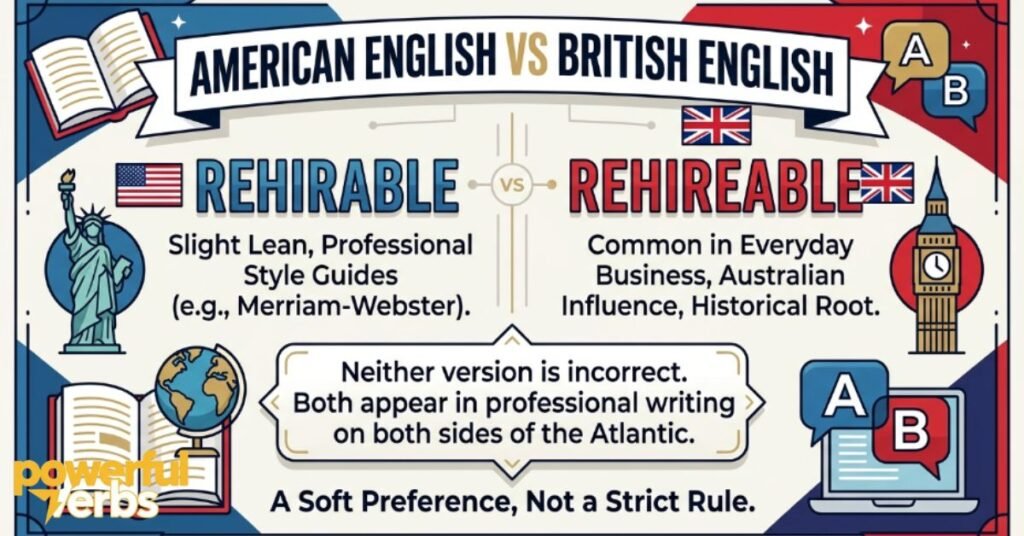
Unlike clear-cut pairs such as colour and color, this word doesn’t split neatly along a US/UK line. Both spellings appear in American and British professional writing. If there’s a lean at all, it’s a soft one: American style guides, which generally favor the more streamlined Merriam-Webster headword, tend slightly toward rehirable, while rehireable shows up a bit more often in everyday British and Australian business writing, partly because hireable has been documented in the UK since the 19th century. Neither version looks out of place in either country’s formal correspondence.
A 10-Second Check Before You Publish or Send
Before finalizing anything, run through one quick check: does your company’s HR system or applicant tracking software already use one spelling in its dropdown menus or templates? If so, match it, since internal consistency matters more than personal preference between dictionary variants.
If you’re starting from scratch with no existing precedent, rehirable is the slightly safer default for formal writing, simply because it mirrors the spelling dictionaries list first. Either way, the goal stays the same: pick one spelling and use it identically every time it appears.
Whichever spelling you land on, the goal is the same: making sure “rehireable” reads as a confident, deliberate choice rather than a guess.
Conclusion
The rehireable or rehirable debate isn’t really a story about right and wrong. It’s a story about two legitimate spellings of the same workplace adjective, inherited from a root word that English dictionaries have allowed to go both ways for more than a century.
Whichever version you choose, what actually matters to your reader is the meaning behind it: a clear, professional signal about whether someone could step back into your company down the road. Spell it consistently, use it with confidence, and let the substance of your HR writing do the real work.
FAQs
Is “rehireable” a real word?
Yes. It’s built from the recognized adjective hireable using standard English word-formation rules, and it’s widely understood in HR and recruiting contexts even though it doesn’t have its own separate dictionary entry.
Is “rehirable” a real word too?
Also yes. It follows the same pattern as hirable, the form Merriam-Webster lists as its primary headword, which makes it just as legitimate as the alternative spelling.
What does “not rehireable” mean on an employee’s record?
It signals that a company wouldn’t currently consider that person for future employment, usually because of how their previous role ended, a policy violation, or a performance issue documented during their exit.
Does the spelling change between American and British English?
Not officially. Both spellings appear in each variety of English, though rehirable leans slightly more American and rehireable shows up a bit more often in British and Australian writing.
Is there a simpler way to express the same idea?
Yes. Many companies use the phrase “eligible for rehire” instead, which sidesteps the spelling question entirely while communicating exactly the same meaning.
Can someone move from “not rehireable” back to “rehireable” later on?
In many companies, yes. Rehire status isn’t always permanent; it can be reviewed and updated if enough time passes or new information changes how the original exit is viewed.

Liam Johnson is a dedicated language expert with 4 years of professional experience. He specializes in Grammar, Vocabulary, and Sentence structure.
