

Have you ever stopped mid-sentence wondering whether to write stared or starred? You are not alone. These two words look almost identical and sound similar in fast speech — but their meanings are completely different. One describes the act of looking at something intently, while the other refers to marking, rating, or featuring something. Using the wrong one changes your entire sentence. This guide will clear up the confusion once and for all.
Quick Answer: Stared = past tense of “stare” — to look at something intently or fixedly. Starred = past tense of “star” — to mark with a star, to feature in a leading role, or to highlight something important. These two words are not interchangeable. Using the wrong one completely changes your sentence meaning.
see also:Complete List of Pink Fruits: 45 Names with Pictures, Facts & Surprising Benefits
Why Do So Many People Confuse Stared and Starred?
English is full of words that look nearly identical but carry completely different meanings. Stared and starred are a perfect example of this. Both words end in “-ared” and “-arred,” and in fast or casual speech, the pronunciation difference is subtle enough to cause real confusion.
Writers — especially English learners and even native speakers — frequently type one when they mean the other. This confusion shows up in emails, social media posts, academic essays, movie reviews, and professional documents. The result is always the same: a sentence that means something completely unintended.
Understanding the difference between these two words is not just about grammar. It is about communicating clearly and being taken seriously as a writer. This guide breaks everything down so you never mix them up again.
Origin and Etymology: Where Did These Words Come From?

Stared comes from the Old English word starian, which meant to gaze rigidly or look with fixed attention. This word has Germanic roots and has been used in the English language for over a thousand years. The idea behind it has always been the same — a steady, intense look directed at something or someone.
Starred comes from the Old English word steorra, meaning “star.” Over time, “star” evolved from a noun (a celestial body) into a verb meaning to mark something with a star symbol, to feature someone prominently, or to assign star-based ratings. The word eventually took on the meaning of performing as the lead in a film, show, or production.
Both words have deep roots in Old English but evolved along entirely separate paths — one tied to vision, the other tied to stars and prominence.
see also:60+ Cooking Verbs with Meanings, Pictures & Examples
What Does Stared Mean? Full Explanation with Examples
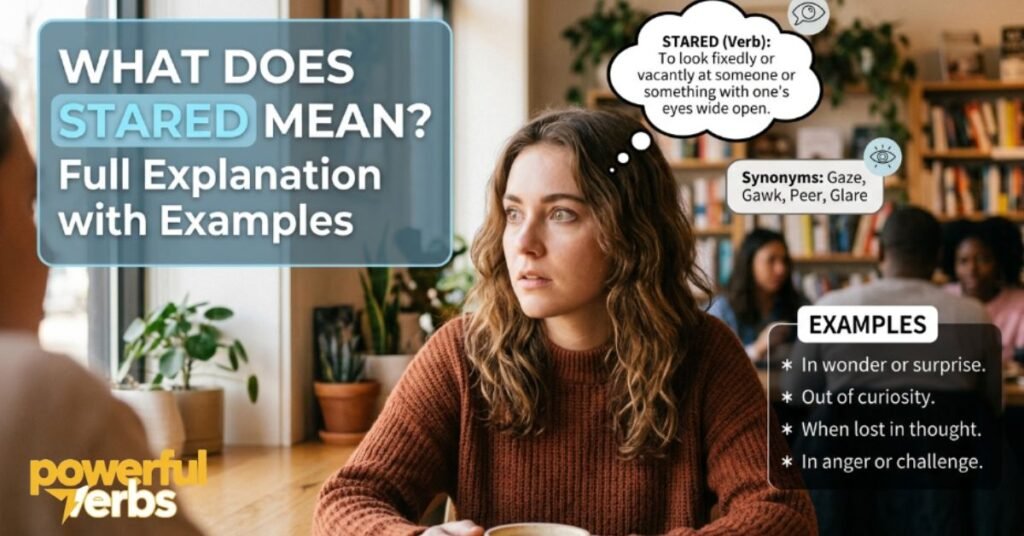
Stared is the simple past tense and past participle of the verb “stare.” When someone stares at something, they are looking at it steadily, intensely, and often for an extended period. The act of staring usually suggests deep focus, surprise, shock, admiration, confusion, or emotional involvement.
It describes a visual action — something a person or animal does with their eyes.
Examples of Stared Used Correctly:
She stared at the blank page for twenty minutes before writing a single word.
The entire crowd stared at the performer as he walked onto the stage.
He stared at the message on his phone, unable to believe what he had just read.
The dog stared at its reflection in the mirror with great curiosity.
They stared at each other in silence after the argument ended.
Key Point: If the sentence involves someone looking at something, the correct word is always stared.
What Does Starred Mean? Full Explanation with Examples

Starred is the simple past tense and past participle of the verb “star.” This word carries three distinct meanings, and all of them are completely unrelated to the act of looking.
Meaning One — To Feature in a Leading Role:
When an actor, performer, or public figure starred in something, they appeared as the main character or headliner of that production.
The young director starred in her own short film alongside two professional actors.
He starred in over thirty films during his career before retiring from acting.
Meaning Two — To Mark Something with a Star Symbol:
In digital communication, emails, documents, notes, or messages can be starred. This means you have placed a star marker on them to flag their importance for future reference.
She starred the email from her manager so she would not forget to reply.
I starred that article to read it again over the weekend.
Meaning Three — To Assign a Star Rating:
Something can be starred when given a rating expressed in stars, such as in restaurant or hotel reviews.
The critic starred the performance with five out of five.
The hotel was starred at four stars by the international travel board.
Key Point: If the sentence involves highlighting, rating, featuring, or marking — the correct word is always starred.
Stared vs Starred: Pronunciation Guide
This is where much of the confusion begins. The two words do sound similar, especially in rapid or informal speech.
Stared is pronounced: /stɛərd/ — rhymes with “cared,” “dared,” and “shared.”
Starred is pronounced: /stɑːrd/ — rhymes with “barred,” “scarred,” and “jarred.”
The vowel sound is different. Stared has a shorter, front-vowel sound, while starred has a deeper, open “ah” sound. Listening carefully to these two words out loud is one of the fastest ways to train your ear to tell them apart.
Common Mistakes People Make with Stared and Starred
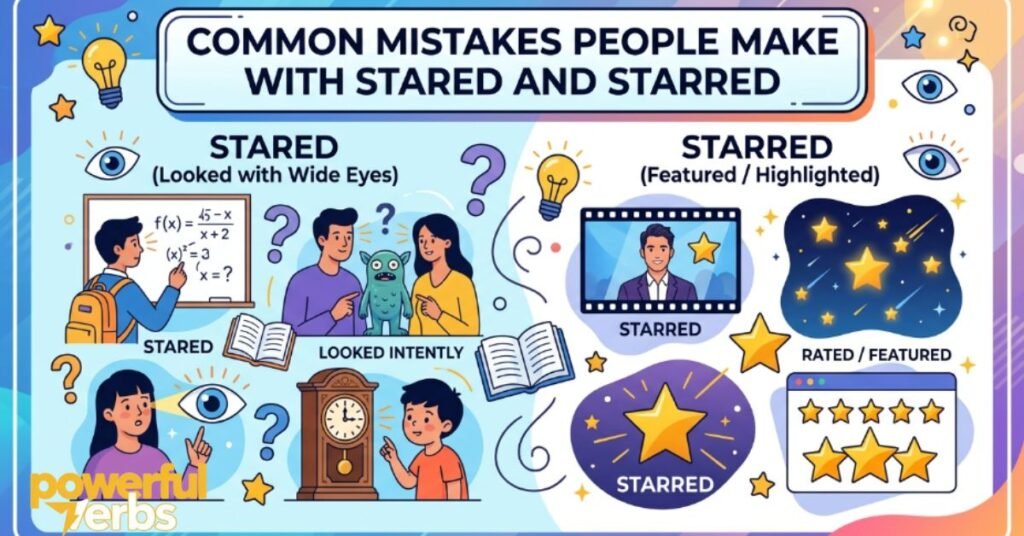
Mistake One — Using Stared When You Mean Starred:
Incorrect: She stared the email to read it later. Correct: She starred the email to read it later.
Incorrect: The chef stared in the new cooking show. Correct: The chef starred in the new cooking show.
Mistake Two — Using Starred When You Mean Stared:
Incorrect: He starred at the sunset until it disappeared. Correct: He stared at the sunset until it disappeared.
Incorrect: She starred blankly at the wall for a long time. Correct: She stared blankly at the wall for a long time.
Mistake Three — Mixing Them Up in Reviews or Ratings:
Incorrect: The restaurant was stared with three stars by the food critic. Correct: The restaurant was starred with three stars by the food critic.
Mistake Four — Confusing Them in Movie or Show Descriptions:
Incorrect: The film stared two Academy Award winners. Correct: The film starred two Academy Award winners.
Each of these errors completely changes what the sentence means. Readers may understand the intent, but the mistake leaves a negative impression on your writing quality.
Staring vs Starring vs Stared vs Starred — All Four Forms Compared
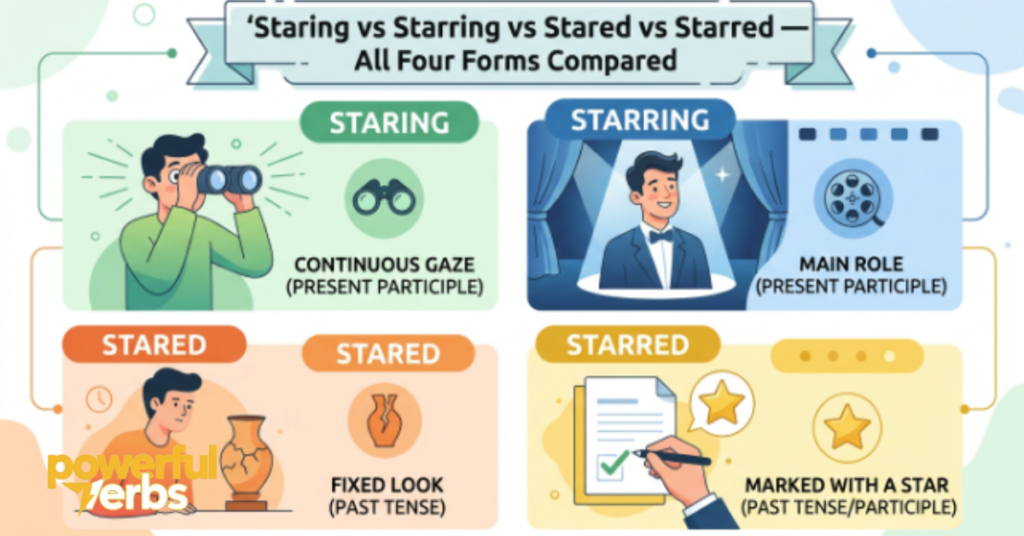
Many people also struggle with the present participle forms of these words. Here is a clear breakdown of all four related terms.
Staring is the present participle of “stare.” It describes the ongoing action of looking intently at something right now or over a period of time. Example: She was staring at the horizon and thinking about the future.
Starring is the present participle of “star.” It describes the ongoing action of featuring in or headlining a production. Example: The new drama series starring that actor begins airing next month.
Stared is the past tense of “stare.” It describes a completed action of looking intently. Example: He stared at the math problem and still could not solve it.
Starred is the past tense of “star.” It describes a completed action of featuring, marking, or rating. Example: She starred the notification so she would remember to act on it.
The pattern is clear: words built from “stare” always relate to vision, while words built from “star” always relate to prominence, importance, or marking.
Memory Tricks That Actually Work
If you find yourself second-guessing which word to use, try these simple techniques that make the difference stick.
Trick One — Eyes Stare, Stars Shine: Associate “stared” with your eyes. You use your eyes to stare. Associate “starred” with an actual star — something that shines, marks, or stands out.
Trick Two — The Double R Rule: Starred has a double “r” because it comes from “star” plus “-red.” If the meaning involves a star symbol, a rating, or a role in a production, the word needs that double “r.”
Trick Three — Replace the Word Mentally: Ask yourself — can I replace this word with “looked at”? If yes, use stared. Can I replace it with “marked with a star” or “appeared in”? If yes, use starred.
Trick Four — Think of Real Examples: Think of email apps where you mark messages with a gold star. That action is starring. Think of someone frozen in shock, unable to look away. That person is staring.
Synonyms: Words You Can Use Instead
If you want more variety in your writing, both words have natural substitutes depending on tone and context.
For stared, consider: gazed, glared, observed, peered, or fixated. Each carries a slightly different emotional shade — “glared” implies anger, while “gazed” feels softer and more thoughtful.
For starred, consider: featured, headlined, highlighted, or spotlighted. These work especially well in entertainment or professional writing where repeating “starred” too often can feel repetitive.
Choosing the right synonym works the same way choosing between commonly confused words does — context decides everything, much like knowing whether to write high school or highschool depends on the formality and style guide you’re following rather than a fixed universal rule.
Stared and Starred in Different Contexts
Academic and Formal Writing:
In formal essays or research papers, precision matters more than anywhere else. Confusing these words in academic writing signals carelessness.
Correct: The researcher stared at the data for hours before noticing the pattern. Correct: The professor starred the most relevant sources in her bibliography.
Workplace and Professional Communication:
Emails and professional messages are a common source of these errors. Using the wrong word in a workplace context can make your writing appear sloppy or unprofessional.
Correct: I starred that conversation to follow up with the client tomorrow. Correct: The team stared at the presentation screen waiting for the file to load.
Social Media Captions and Informal Writing:
Even in casual writing, using the correct word matters. Incorrect usage on social media can attract unwanted attention for the wrong reasons.
Correct: We stared at the northern lights for almost an hour. Correct: He starred in the video that went completely viral this week.
Film and Entertainment Reviews:
Incorrect: The thriller stared two of the most iconic actors of the decade. Correct: The thriller starred two of the most iconic actors of the decade.
Digital Apps and Technology:
Starred items in Gmail, Apple Notes, Slack, and other apps refer to items marked with a star for priority or reference. Never use “stared” in this context.
Correct: He starred the message so it would appear at the top of his inbox.
“Starred” as a Compound Adjective
There’s one more pattern worth knowing: “starred” frequently appears as part of a compound adjective, placed directly before the noun it describes. Common examples include “a Michelin-starred restaurant,” “a five-starred hotel,” or “a highly-starred review.” In this construction, “starred” functions attributively — meaning it modifies the noun that follows it, rather than acting as a standalone verb. This pattern is standard in both British and American English, and it explains why phrases like “Michelin-starred chef” sound completely natural despite “starred” technically being a past-tense verb form. “Stared” never works this way; you won’t find a natural compound adjective built from it, since staring describes an action rather than a status or achievement — a distinction similar to how eyeing vs eying comes down to which spelling convention a style guide adopts, rather than any flexibility in how the word functions grammatically.
Quick Practice: Test Yourself
Try filling in the blank with either “stared” or “starred” before checking the answer.
- She __ at the door, waiting for someone to knock. (stared)
- He __ in three award-winning films this decade. (starred)
- The chef’s restaurant was __ by every major food critic. (starred)
- They __ at the wreckage in stunned silence. (stared)
- I __ that email so I wouldn’t lose track of it. (starred)
If you got all five correct, the distinction has fully clicked — the sentence’s meaning, not its sound, is always your reliable guide.
British English vs American English: Is There Any Difference?
No. There is no difference in how British and American English spell or use these words. Both varieties of the language follow the same rules for stared and starred. The meanings, spellings, and grammatical rules are identical across all major English-speaking regions, including Australian English and Canadian English.
Quick Reference Comparison Table
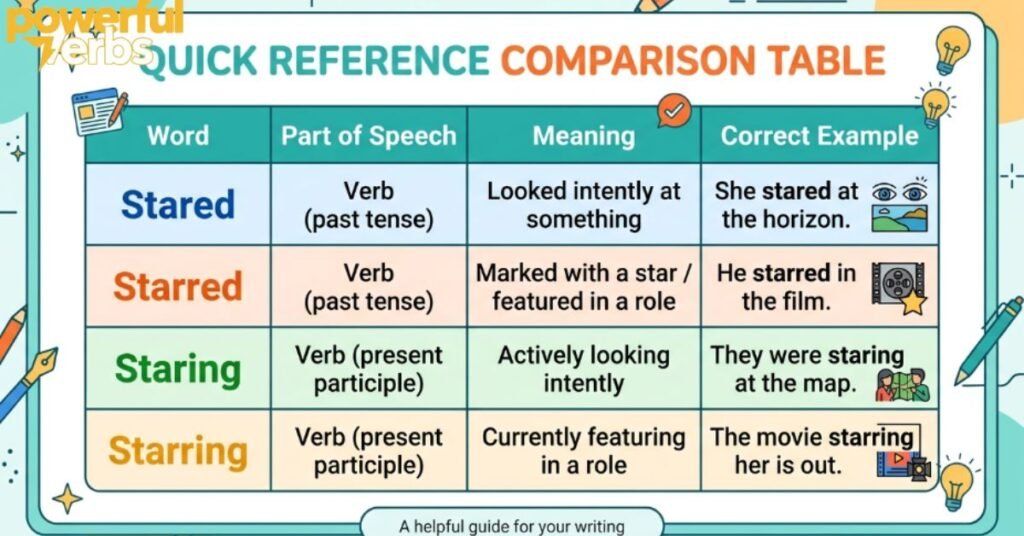
| Word | Part of Speech | Meaning | Correct Example |
| Stared | Verb (past tense) | Looked intently at something | She stared at the horizon. |
| Starred | Verb (past tense) | Marked with a star / featured in a role | He starred in the film. |
| Staring | Verb (present participle) | Actively looking intently | They were staring at the map. |
| Starring | Verb (present participle) | Currently featuring in a role | The movie starring her is out. |
Conclusion
Stared and starred may look similar on the page and sound similar in conversation, but they serve entirely different purposes in the English language. Stared belongs to the world of vision — it describes the act of looking at something with focus and intensity. Starred belongs to the world of prominence and marking — it describes the act of featuring in a role, flagging something for attention, or assigning a star-based rating.
Mastering this distinction will make your writing more precise, more professional, and more credible. Whether you are drafting a work email, writing a film review, crafting a social media caption, or producing formal academic content, using the correct word matters every single time.
Now that you understand the full history, meaning, grammar rules, and real-world application of both words, you have everything you need to use them with complete confidence going forward.
FAQs
Can stared and starred be used interchangeably in any situation?
No. These words have completely separate meanings and cannot replace each other in any context. Stared always refers to the act of looking at something. Starred always refers to marking, featuring, or rating.
Is starred only used for movies and emails?
No. Starred is used anytime something is marked with a star — restaurant ratings, hotel classifications, document flagging, priority inbox labels, social bookmarks, and theatrical credits all use the word starred.
Why does starred have a double “r” but stared does not?
Stared comes from “stare” + “-d,” so the single “r” from the base word remains. Starred comes from “star” + “-red,” and English spelling rules require doubling the final consonant before adding a vowel suffix when the preceding vowel is short and stressed. This is why star becomes starred.
Is it ever correct to say “stared in a movie”?
No. This is always incorrect. The correct phrase is “starred in a movie.” The word stared describes a visual action with the eyes and has nothing to do with film or performance.
How can I quickly check which word to use when writing fast?
Ask yourself this: does the sentence describe the act of looking? If yes, use stared. Does it describe a star symbol, a rating, or a performance role? If yes, use starred.
Are staring and starring also different words?
Yes, completely. Staring is the present participle of stare and describes ongoing visual attention. Starring is the present participle of star and describes an ongoing performance or leading role. The same rules that apply to stared and starred apply to their present participle forms.

Liam Johnson is a dedicated language expert with 4 years of professional experience. He specializes in Grammar, Vocabulary, and Sentence structure.
