

If you’ve ever paused mid-sentence wondering whether to type eyeing or eying, you’re dealing with one of English’s most common “double spelling” puzzles. Both forms exist, both are used by native speakers, and both show up in newspapers, novels, and everyday conversation. Yet the moment you have to write one down, doubt creeps in.
This guide breaks down the real difference between eyeing and eying — where each spelling comes from, how dictionaries treat them, when to use which one, and how to avoid the small mistakes that trip up even confident writers.
see also: High School or Highschool: Correct Spelling, Rules & Examples (2026)
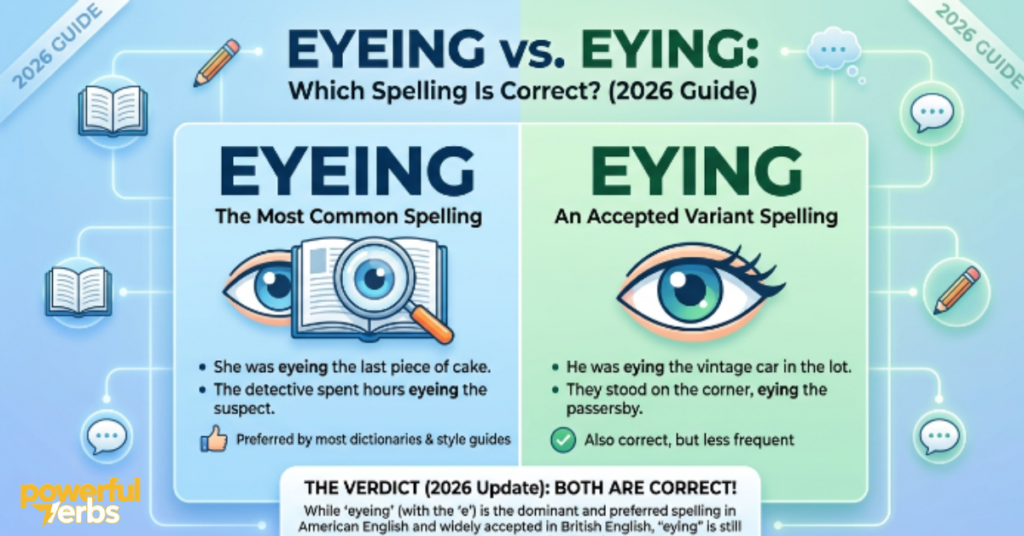
Quick Answer: Eyeing or Eying?
- Eyeing is the more widely accepted spelling and dominates American English, journalism, and online content.
- Eying is a recognized variant, more frequently seen in British and Commonwealth English.
- Both words carry the exact same meaning: watching, observing, or considering something with interest.
- Neither form is a “typo” — they’re regional spelling preferences, not grammar errors.
If you only remember one rule from this article, remember this: choose eyeing for safety, eying for tradition.
Where Does the Word Come From?
The root word is eye, the noun referring to the organ of sight. English speakers eventually turned this noun into a verb — to eye — meaning to watch someone or something closely, often with curiosity, suspicion, or desire.
When a verb ends in a silent e, standard English spelling practice drops that e before attaching the -ing suffix:
- believe → believing
- argue → arguing
- write → writing
Following this pattern strictly, eye should become eying. That’s exactly how the spelling rule produces this form.
So Why Does “Eyeing” Exist at All?
Here’s the twist: eye is only three letters long, and dropping the e leaves behind ey-, which doesn’t visually resemble the original word anymore. Many writers and editors found eying harder to recognize at a glance, so an alternative spelling emerged that keeps the full root intact:
- eye + ing = eyeing
This double-e version preserves the word’s identity, making it instantly readable. Over decades, eyeing became the dominant form in everyday writing, while eying survived as a secondary, slightly more formal or traditional spelling — particularly in British usage.
Eyeing vs Eying: Is There Any Difference in Meaning?
No. There is zero semantic difference between the two. Whichever spelling you pick, the word still conveys:
- Looking at something attentively or with interest
- Watching someone with suspicion or curiosity
- Considering, wanting, or planning to acquire something
- Keeping close visual attention on a target
The spelling you choose has nothing to do with tone, formality of meaning, or intent — it only affects how the word looks on the page.
American English vs British English: Regional Preference
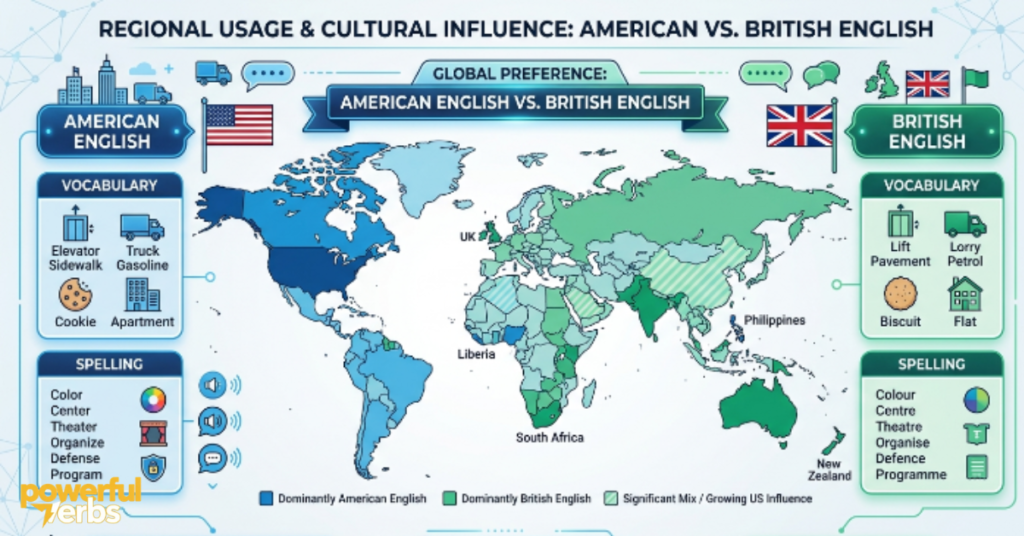
Dictionary data and corpus studies consistently show a regional split:
| Region | Preferred Spelling | Typical Usage |
| United States | Eyeing | News articles, business writing, marketing copy |
| United Kingdom | Eying (also accepts Eyeing) | Literary writing, traditional journalism |
| Canada / Australia | Mixed, leaning toward Eyeing | Influenced by American media |
| Global digital content | Eyeing | SEO content, blogs, social media |
Major dictionaries — including Merriam-Webster and the Oxford English Dictionary — list both spellings, but they flag eyeing as the more frequently used form across global English today, including in the UK’s own modern publications.
How to Use “Eyeing” in a Sentence
- The startup is eyeing international expansion next year.
- He kept eyeing the dessert table all evening.
- Analysts are eyeing the central bank’s next interest rate decision.
- The toddler was eyeing the toy on the top shelf.
How to Use “Eying” in a Sentence
- The negotiator sat quietly, eying every move across the table.
- Critics have long been eying the director’s next project.
- The hawk circled, eying its prey from above.
- She was eying a career change for months before acting on it.
Notice that the sentences are interchangeable — swap one spelling for the other, and the meaning stays identical.
see also: Cancelled vs Canceled: Which Spelling Is Correct? (2026 Guide)
Common Mistakes Writers Make
- Assuming one spelling is “wrong.” Neither form is incorrect; treating one as a mistake is itself the mistake.
- Mixing both spellings in the same document. Consistency matters more than which form you pick — switching mid-article looks careless to editors and readers.
- Misspelling with extra letters, such as eyeingg, eyeng, or eyeingh. These are simply typos, not accepted variants.
- Confusing “eyeing” with plain “seeing.” Seeing is passive and automatic; eyeing implies deliberate attention, intention, or interest — for example, I saw the painting versus I was eyeing the painting (meaning you wanted it).
- Using it only to mean “looking.” The word frequently implies wanting, planning, or considering — as in the company is eyeing a merger, meaning they’re actively considering one.
Synonyms and Related Expressions
Because eyeing/eying often implies interest or intent rather than neutral observation, these related words and phrases share overlapping meaning:
- Watching closely
- Observing
- Scrutinizing
- Keeping an eye on
- Eyeing up (informal, especially in British English, often romantic or appraising in tone)
- Sizing up
- Contemplating
- Considering
- Coveting
Understanding these alternatives helps you choose the right word when eyeing or eying feels too repetitive in a paragraph.
Eyeing/Eying in Real-World Writing Contexts
Business and Finance: “Investors are eyeing emerging markets after the policy shift.” Financial journalism uses this word constantly to describe interest in opportunities, mergers, or market shifts.
News Headlines: “Government eyeing new trade regulations” — headline writers favor this word because it’s short, active, and signals anticipation without confirming an outcome.
Casual Conversation: “I’ve been eying that jacket for weeks” — used informally to express ongoing desire or attention toward something.
Creative Writing: Novelists often use eying to add a slightly literary or tense tone, especially in suspense or thriller scenes where a character is watching another with caution.
Other English Words With Two Accepted Spellings
If this dual-spelling situation feels unusual, it isn’t unique to eye. English has several similar pairs, mostly split along American–British lines:
- Aging vs Ageing
- Judgment vs Judgement
- Dialing vs Dialling
- Traveling vs Travelling
In each case, both forms are correct; the choice depends on regional convention and the style guide you’re following.
Which Spelling Should You Choose?
- Writing for a global or American audience, blog, resume, or business document → use eyeing.
- Writing for a British, Irish, or traditional literary audience → eying is equally acceptable and often preferred.
- Unsure which audience you’re addressing → default to eyeing, since it’s the more universally recognized form online and in print today.
- Working on a single document, essay, or website → pick one spelling and stay consistent throughout for a polished, professional result.
conclusion
The debate between eyeing and eying isn’t really a debate at all — it’s a simple case of two valid spellings shaped by regional habit rather than grammatical rule. Both come from the same root, carry the same meaning, and are accepted by major dictionaries.
When in doubt, eyeing is the safer, more recognizable choice for most modern writing, while eying remains a legitimate option rooted in traditional English spelling conventions.
FAQs
Is “eying” considered a spelling mistake?
No, it’s a fully recognized spelling listed in major dictionaries, especially common in British English.
Why is “eyeing” used more often than “eying” today?
Because it keeps the root word “eye” visually intact, making it easier to read and recognize, which is why most modern publications default to it.
Do “eyeing” and “eying” have different pronunciations?
No, both are pronounced identically, regardless of which spelling is written.
Can I use either spelling in academic or professional writing?
Yes, but pick one spelling and use it consistently throughout the same document for a clean, professional impression.
Is “eyeing” only used for literal looking, or can it mean wanting something?
It frequently implies desire, interest, or intention, such as a company eyeing a new market or a person eyeing a promotion.
Are there other English words with two correct spellings like this?
Yes, pairs like “aging/ageing” and “judgment/judgement” follow the same American-versus-British spelling pattern.

Liam Johnson is a dedicated language expert with 4 years of professional experience. He specializes in Grammar, Vocabulary, and Sentence structure.
