


Typing a word fast, hearing it in conversation, or sounding it out in your head can all lead to the same small trap: writing studder when the word you actually mean is stutter. If your spellchecker keeps underlining “studder” in red, that’s not a glitch — it’s confirming that the spelling doesn’t exist in standard English.
This guide breaks down the correct spelling, explains exactly why so many people get tripped up by the “t” versus “d” sound, walks through the word’s history, and shows you how to use it naturally in speech-related, medical, educational, and everyday writing — without a single second of doubt.
see also: 150 Examples of Noun Phrases in Sentences with Pictures
Quick Answer
Correct spelling: stutter Incorrect spelling: studder
There is no context, dialect, or English-speaking country where “studder” is the accepted form. Every major dictionary — Merriam-Webster, Oxford, Cambridge, and Collins — lists only stutter.
- He started to stutter when the interviewer asked a tough question.
- The therapist specializes in childhood stutters.
- He has a studder that gets worse under pressure.
Why “Studder” Feels Right (Even Though It Isn’t)
This mix-up isn’t random — there’s a real linguistic reason behind it, and understanding it makes the correct spelling much easier to remember for good.
Flapping of the “t” sound. In casual American and Canadian speech, the double “t” in the middle of a word often softens into a quick “d”-like tap (think of how “butter,” “matter,” and “later” can sound like “budder,” “madder,” and “layder”). Your ear hears a “d,” so your hand types one.
Spelling by sound rather than by rule. Many learners — and plenty of native speakers — write words the way they sound rather than the way they’re built. Since “stutter” is pronounced closer to “stud-er” in fast speech, “studder” feels like a logical guess.
Visual similarity to real words. Words like “studded,” “stud,” and “shudder” share letters and rhythm with “stutter,” and the brain sometimes blends familiar patterns together.
Autocomplete confusion. Some users assume a search engine or spellchecker “fixing” their word to stutter must mean both versions are acceptable, when in fact it’s simply correcting an error.
None of these reasons make “studder” correct — they just explain why the mistake is so common.
Where the Word Stutter Comes From
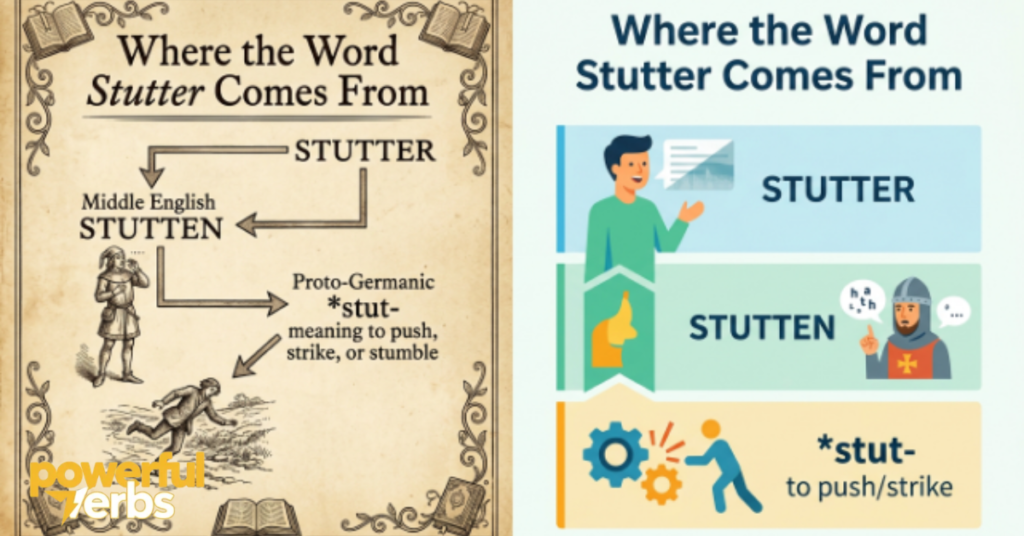
The word traces back to Middle English stutten, related to the Old English root meaning to strike against or to stumble repeatedly. Over centuries, this evolved through Germanic language influence into the modern form stutter, which has always carried the same core meaning: speaking with involuntary pauses, repeated sounds, or blocked syllables.
Because the word developed from a consistent linguistic root, its spelling has remained stable. “Studder” has never appeared as a recognized historical variant — it’s purely a modern phonetic slip-up, not an alternate or outdated spelling.
Stutter: Noun and Verb
One reason this word shows up so often in writing is that it works two ways, and getting both forms right matters for clear communication.
As a verb — describing the action of speaking with hesitation:
- She tends to stutter before important meetings.
- Don’t stutter; take a breath and start again.
As a noun — naming the condition or instance itself:
- He’s had a stutter since childhood.
- A sudden stutter in his voice gave away his nervousness.
Related forms follow the same spelling pattern: stuttering, stuttered, stutterer.
Studder vs. Stutter: Side-by-Side Comparison
| Category | Studder | Stutter |
| Found in dictionaries | No | Yes |
| Accepted in academic writing | No | Yes |
| Used in speech-language pathology | No | Yes |
| Recognized by spellcheck tools | No | Yes |
| American English | Incorrect | Correct |
| British English | Incorrect | Correct |
| Australian / Canadian English | Incorrect | Correct |
As the table shows, there’s no regional dialect where the alternate spelling becomes acceptable — this is a universal rule across every English-speaking country.
Stutter vs. Similar Words: Stammer, Dysfluency, and More
Because stutter relates to speech and communication, it’s often used alongside (or confused with) related vocabulary. Knowing these terms helps you write about the topic more precisely:
- Stammer — Common in British English as a near-synonym for stutter, referring to the same speech pattern.
- Speech disfluency — A clinical, umbrella term covering stutters, stammers, and other interruptions in fluent speech.
- Speech impediment — A broader phrase that can include stuttering along with other articulation difficulties.
- Block, repetition, prolongation — Specific speech-language pathology terms describing the different ways a stutter can present itself.
Using these related terms naturally throughout your writing (rather than repeating “stutter” over and over) makes content read more naturally and signals topical depth to both readers and search engines.
How to Use Stutter Correctly in Real Writing
In emails and professional messages: He may stutter slightly when presenting, so allow extra time for questions.
In news and journalism: Researchers found that early speech therapy significantly helps children who stutter.
In social media captions: Public speaking already feels stressful — and it’s even harder when you stutter.
In academic and formal writing: The study examines speech fluency patterns in adults who stutter under social pressure.
In healthcare and therapy content: Speech-language pathologists assess the frequency and severity of a stutter before designing a treatment plan.
Across every one of these contexts, only one spelling ever appears — and that consistency is exactly why “stutter” reads as professional and trustworthy, while “studder” instantly signals a typo.
A Simple Memory Trick
If you only remember one thing from this guide, make it this: stutter has a “tt,” just like the word “letter.” Both words double the same consonant in the same position, and both are pronounced with that soft tap sound that tricks people into hearing a “d.” Picture the phrase “write a letter, not a studder” — it’s a small, slightly silly trick, but it works.
Conclusion
The mix-up between studder and stutter comes down to how the word sounds rather than how it’s actually built. Pronunciation can soften that double “t,” but the spelling itself has stayed fixed for centuries, across every English-speaking region and writing style. Whenever you’re describing hesitant, repeated, or blocked speech, the only spelling to trust is stutter — confirmed by dictionaries, accepted in medical and academic writing, and recognized everywhere from casual texts to formal reports.
see also: 50+ Types of Construction Vehicles with Names and Pictures
FAQs
Is “studder” a real word in any dictionary?
No, it does not appear in any major English dictionary and is always treated as a misspelling of stutter.
Why does stutter sound like it has a “d” in it?
Because of a pronunciation pattern called flapping, where a double “t” softens into a quick “d”-like sound in casual speech.
Is stutter used differently in British and American English?
No, the spelling is identical in both, though British English sometimes prefers the related word “stammer.”
Can stutter be both a noun and a verb?
Yes, it works as a verb (“he stutters”) and as a noun (“he has a stutter”).
Does spelling it as “studder” affect professional or medical writing?
Yes, using the wrong spelling in health, education, or professional content can hurt credibility and clarity.
What’s the easiest way to remember the correct spelling?
Link it to a familiar word with the same double-letter pattern, like “letter” or “butter,” to lock in the “tt.”

Liam Johnson is a dedicated language expert with 4 years of professional experience. He specializes in Grammar, Vocabulary, and Sentence structure.
