

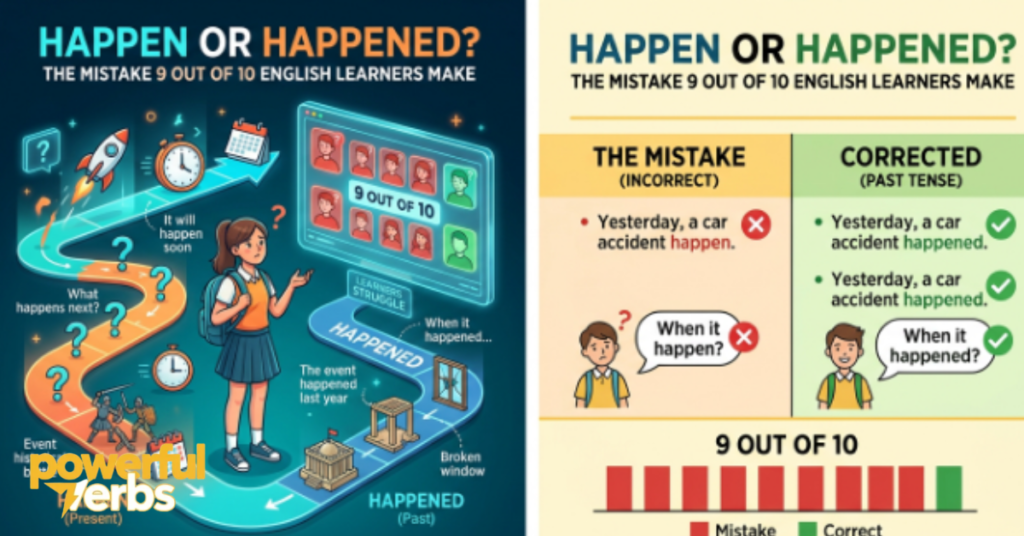
If you’ve ever paused mid-sentence wondering whether to say “what happen” or “what happened,” you’re not alone. This single grammar mix-up is one of the most common errors among English learners worldwide — and surprisingly, even confident speakers slip into it without noticing.
The good news? Once you understand the simple rule behind it, you’ll never make this mistake again. This guide breaks down exactly why “happen” and “happened” trip people up, how English tense actually works, and how to sound naturally correct in every conversation, email, or exam.
Why Your Brain Tricks You Into Saying “What Happen”
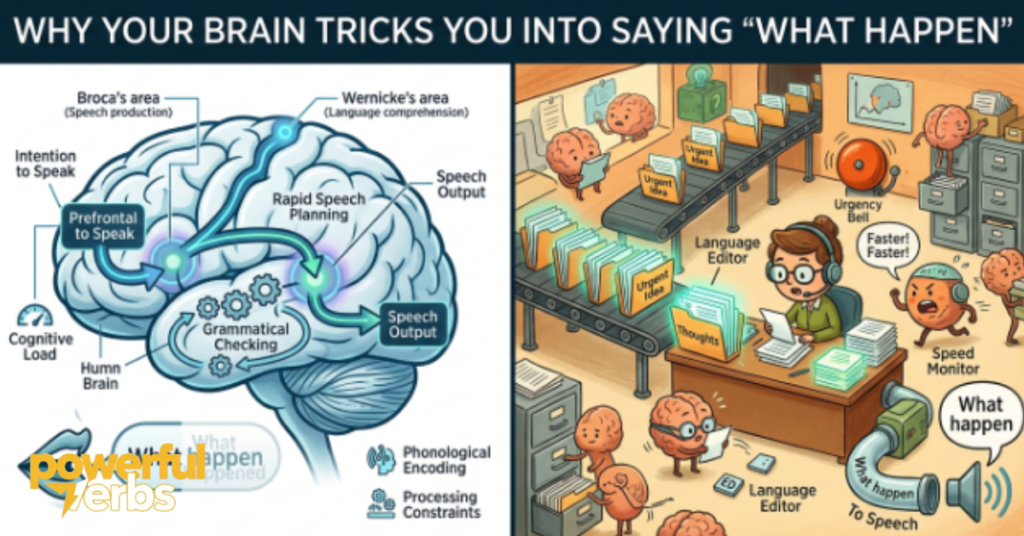
Spoken English moves fast. Native speakers often blur word endings, swallow sounds, and shorten phrases for speed. When someone rushes through a sentence like “Whatchu happen yesterday?”, the past-tense ending can disappear entirely in pronunciation — even though it’s still there in writing.
Learners who pick up English mainly through movies, music, or casual conversation often absorb this shortened rhythm without realizing that the written form requires the full verb. Add to that the fact that many other languages don’t mark past tense the same way English does, and the confusion makes complete sense.
But sounding natural in speech and being grammatically accurate are two different things — and this guide focuses on getting both right.
The Tense Rule Nobody Explained to You Properly
English verbs change form depending on when an action happens. This is called tense, and it’s the backbone of clear communication.
- Present tense — describes habits, facts, or things happening now
- Past tense — describes actions that are already finished
- Future tense — describes actions that haven’t happened yet
Whenever you ask about something that has already occurred, English grammar requires the past-tense form of the verb. That’s the entire secret behind this mistake — “happened” carries that past-tense signal, while “happen” does not.
Meet the Verb “Happen” — Every Form You Need
| Form | Used For | Example Sentence |
| happen | base form / general truths | Accidents happen when you least expect them. |
| happens | present, singular subjects | It happens every single year. |
| happened | completed past actions | Something strange happened last night. |
| happening | ongoing or current actions | What’s happening right now? |
| has/have happened | present perfect, recent past | A lot has happened since we last spoke. |
One reassuring fact: “happen” is a completely regular verb. Unlike irregular verbs such as “go/went” or “see/saw,” it simply adds -ed to form the past tense. There’s no unusual spelling to memorize — just the basic rule applied consistently.
Why “What Happen” Breaks the Rules of English Grammar
The issue with “what happen” isn’t subtle — it’s a missing past-tense marker. Since the question refers to something already finished, the verb must reflect that completed action.
- ❌ What happen at the party last night?
- ✅ What happened at the party last night?
- ❌ What happen to your car?
- ✅ What happened to your car?
To a native ear, “what happen” sounds incomplete — almost like the sentence stopped halfway through. That missing -ed is doing more grammatical work than most learners realize.
The Hidden Reason “What Happened” Doesn’t Need “Did”
Here’s a detail most grammar guides skip entirely: not every question needs the helper verb “did.”
English questions fall into two categories:
- Subject questions ask who or what performed the action. No auxiliary verb is needed because the question word itself is the subject.
- Object questions ask about the result of an action performed by someone else. These require “did,” “does,” or “is.”
“What happened?” is a subject question — “what” represents the event itself, not something acted upon. That’s why adding “did” creates an error:
- ❌ What did happened?
- ✅ What happened?
Compare this with a true object question like “What did you eat?” — here, “did” is necessary because “you” is the subject performing the action.
Casual Talk vs. Formal English: Where the Line Is
Confusion between “happen” and “happened” almost always comes from blending spoken habits with written expectations.
- In texting or relaxed conversation, shortened forms might slip by unnoticed: “Yo, what happen, man?”
- In emails, reports, interviews, or academic writing, accuracy is non-negotiable: “What happened during the incident?”
Recognizing which mode you’re in — casual or formal — helps you adjust automatically, the same way a native speaker does without thinking twice.
Side-by-Side: Wrong vs. Right in Everyday Situations
| Situation | Incorrect | Correct |
| Texting a friend | What happen last night? | What happened last night? |
| Job interview | Can you explain what happen at your last job? | Can you explain what happened at your last job? |
| Classroom discussion | What happen during the war? | What happened during the war? |
| Customer support email | We’re sorry, what happen with your order? | We’re sorry, what happened with your order? |
| Social media caption | Guess what happen today | Guess what happened today |
| News headline | What happen at the summit | What happened at the summit |
The Most Common Slip-Ups Learners Make (And the Fix)
- Dropping the past-tense ending entirely — ❌ What happen to you? → ✅ What happened to you?
- Adding an unnecessary “did” — ❌ What did happened? → ✅ What happened?
- Mixing tenses within one sentence — ❌ Yesterday, what happens? → ✅ Yesterday, what happened?
- Copying spoken speech patterns directly into writing — fast talk drops sounds; formal writing never should.
- Assuming “happen” is irregular — it isn’t; the standard -ed rule always applies.
A Memory Trick That Makes This Mistake Disappear
Here’s a simple way to lock this in permanently: “If it’s over, give it the ‘ed’ cover.”
Anytime you’re describing something that has already finished — a party, a meeting, an accident, a phone call — your brain should automatically reach for “happened.” If the action is still unfolding or hasn’t started, you stick with “happen” or “happening.”
This tiny mental checkpoint takes seconds to apply and works in nearly every situation you’ll encounter.
The One Rule That Solves Everything
- Present or general truth → happens
- Action in progress right now → happening
- Action already completed → happened
Master this single distinction, and the confusion between “what happen” and “what happened” disappears for good.
FAQs
Is “what happen” ever grammatically correct?
No. Standard English always requires “what happened” for completed past events, regardless of context.
Why doesn’t “what happened” need the word “did”?
Because it’s a subject question — “what” already represents the action, so adding “did” becomes redundant.
Is “happen” an irregular verb?
No, it’s regular. The past tense is formed simply by adding -ed, just like “walk” becomes “walked.”
Can I use “what happen” while texting casually?
You might see it in very informal chats, but it’s still incorrect grammar and best avoided in writing.
What’s the simplest way to remember this rule?
If the event is finished, use “happened.” If it’s ongoing or general, use “happen” or “happening.”
Does this rule apply to all past-event questions, not just “what happened”?
Yes — any question about a completed action follows the same past-tense logic, such as “what occurred” or “what took place.”
Final Thoughts
The difference between “what happen” and “what happened” comes down to one small but powerful rule: completed actions always require the past tense. Once this clicks, you’ll stop second-guessing yourself in conversations, emails, and exams alike.
Small grammar details like this one are often what separate confident English speakers from hesitant ones. Keep this rule in mind, and “what happened” will become second nature.
see also: Too Many vs To Many: Which Is Correct? (Grammar Guide)

Liam Johnson is a dedicated language expert with 4 years of professional experience. He specializes in Grammar, Vocabulary, and Sentence structure.
