

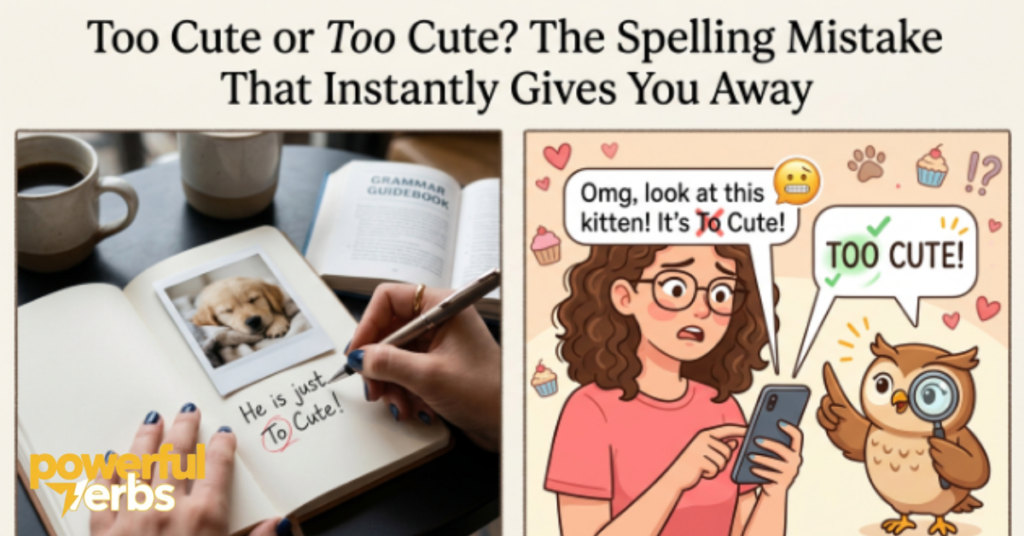
A tiny one-letter slip can change how people see your writing in seconds. If you have ever typed a caption, a comment, or a message and paused, unsure whether to write too cute or too cute, you are not alone. This single mix-up is one of the most common English spelling errors found in everyday digital writing, and it quietly signals carelessness even when the rest of your sentence is perfect.
This guide breaks the confusion down completely, explains the grammar in plain language, and gives you a permanent way to remember which spelling is correct, so the mistake never sneaks into your writing again.
see also: “Shown” or “Showed”? Past Tense vs Past Participle Explained Simply
The Quick Answer
The correct spelling is too cute.
Too cute is not a real or grammatically valid phrase in English. It does not exist as a correct expression in any standard sentence structure.
So whenever you want to describe something adorable, charming, or heart-meltingly sweet, the only correct choice is: too cute
Keep that one rule in mind, and the rest of this guide will help it stick for good.
Why This Particular Mix-Up Happens So Often

English is full of words that sound identical but carry completely different jobs in a sentence. Linguists call these homophones, and they are one of the biggest sources of writing errors among native speakers and language learners alike.
The trio responsible for most of the confusion here is:to too two
All three are pronounced the same way out loud, which means your ears give you zero clues about which spelling belongs on the page. Your brain has to rely on meaning and function instead of sound, and that is exactly where mistakes creep in.
Add in fast typing on a phone keyboard, autocorrect that does not always catch grammar context, and the casual pace of texting or social captions, and it becomes easy to see why to cute vs too cute trips up so many people.
Breaking Down the Word “Too”
“Too” functions as an adverb, which means its job is to add extra detail to another word in the sentence, usually describing degree, extent, or addition.
It carries two main meanings:
Meaning one: also or as well Example: She loved the gift too.
Meaning two: excessively or to a very high degree Example: The soup was too salty. Example: This box is too small for all my books.
When “too” sits in front of an adjective like cute, it intensifies that adjective. It pushes the meaning from simply cute to extremely, overwhelmingly cute.
Breaking Down the Word “Cute”
“Cute” is an adjective, a describing word used for things that strike us as charming, sweet, dainty, or endearing.
People commonly attach “cute” to:
Newborn babies Puppies and kittens Small, round-faced animals Soft toys and plush characters Tiny handwriting or doodles Playful outfits or accessories
On its own, “cute” already expresses fondness. Once “too” joins it, the feeling intensifies dramatically, turning a simple compliment into an emotional reaction.
Why “To Cute” Breaks Grammar Rules
The word “to” (single o) serves entirely different grammatical roles, and none of them allow it to sit directly in front of a standalone adjective the way “too” does.
“To” is used to show direction or destination. Example: We drove to the city.
“To” is also used right before a verb to form an infinitive. Example: I love to dance. Example: She wants to travel.
Notice that “to” always connects to a place or a verb, never to an adjective acting alone in a description of intensity. That is precisely why a sentence like “This puppy is too cute” fails grammatically. There is no rule in English that lets “to” boost an adjective the way “too” does.
The fix is simple: swap the single-o “to” for the double-o “too,” and the sentence becomes grammatically sound.
Side-by-Side Comparison
| Phrase | Grammatically Correct | Real Meaning |
| Too cute | Yes | Extremely adorable or charming |
| To cute | No | Has no valid meaning in standard grammar |
This comparison makes the distinction permanent in your mind: double o equals correct, single o equals error.
Natural Examples of “Too Cute” in Everyday Sentences
Seeing the phrase used naturally helps the correct version stick faster than memorizing a rule alone.
That golden retriever puppy is too cute for words. Her toddler’s giggle is too cute to describe. This matching pajama set looks too cute on the shelf. The way he waved back was too cute. That tiny coffee mug shaped like a cat is too cute. Her doodles in the margin are too cute. The bakery’s heart-shaped cookies are too cute to eat.
Each sentence uses “too” to amplify “cute,” pushing the description from pleasant to irresistible.
Where You Will See “Too Cute” Most Often
This phrase thrives in casual, emotionally expressive spaces rather than formal writing.
On Instagram captions under puppy or baby photos In Facebook comment threads reacting to adorable pet videos In group chats responding to a friend’s new haircut or outfit In product reviews describing packaging or design
The phrase carries warmth, excitement, and affection, which is exactly why it spreads so widely across casual digital spaces.
Does “Too” Always Mean Something Positive?
Not always. “Too” can also flag a problem or an excess, separate from describing cuteness.
This jacket is too tight. The meeting ran too long. That joke was too soon.
In these cases, “too” signals that something has crossed a comfortable limit. With “too cute,” though, the tone is almost always affectionate, sometimes even meaning something is so adorable it feels emotionally overwhelming in the best way, as in “that kitten video is too cute to handle.”
A Memory Trick That Actually Sticks
Here is a simple way to lock in the correct spelling permanently.
Picture the two “o” letters in “too” as two tiny eyes, wide open in surprise at something adorable. That visual mirrors the emotional reaction “too cute” describes.
Extra letter, extra feeling. One “o” is plain old “to.” Two “o” letters give you the heightened, emotional, “too cute” reaction you are going for.
Once this image clicks, you will stop second-guessing the spelling.
More Practice Sentences
Seeing wrong and right versions side by side reinforces the rule through repetition.
Incorrect: That kitten is too cute to put down. Correct: That kitten is too cute to put down.
Incorrect: Her new haircut is too cute. Correct: Her new haircut is too cute.
Incorrect: This onesie is too cute for the baby shower. Correct: This onesie is too cute for the baby shower.
The pattern becomes automatic with enough repetition, even without consciously thinking about grammar rules.
Why a One-Letter Mistake Matters More Than You Think
It is easy to dismiss this as a minor typo, but spelling accuracy shapes how readers judge your credibility within seconds.
A misspelled homophone in a caption, comment, or email can quietly suggest carelessness, even if your message is otherwise thoughtful. In professional emails, blog content, and website copy, accuracy reflects attention to detail. Search engines also factor writing quality into how content gets evaluated and ranked, so cleaner grammar can support better visibility for written content online.
Small details like this one carry more weight than they first appear to.
“Too Cute” in Casual Versus Formal Writing
“Too cute” is grammatically correct in every context, but its tone leans casual and conversational.
You will hear it constantly in daily speech, texting, and social captions. In more formal writing, such as professional reports or polished articles, writers often reach for alternatives like remarkably charming, exceptionally endearing, or delightfully adorable.
Still, there is nothing grammatically wrong with using “too cute” in formal writing. It simply carries a relaxed, friendly tone that fits casual contexts more naturally.
Telling To, Too, and Two Apart for Good
Since all three words sound identical, here is a clear side-by-side reference.
“To” shows direction or pairs with a verb. Example: I am walking to the store.
“Too” means also, or signals excess and intensity. Example: I am hungry too. Example: It is too late.
“Two” is simply the number 2. Example: I adopted two kittens last spring.
With this breakdown in mind, a phrase like “to cute” clearly has no grammatical home. “To” cannot intensify an adjective, which leaves “too cute” as the only correct option.
The Emotional Layer Behind “Too Cute”
Grammar aside, this phrase carries genuine feeling. People reach for “too cute” when something triggers a rush of warmth, delight, or affection that a plain “cute” cannot fully capture.
It shows up when:
Someone reacts to a baby’s first laugh A pet does something unexpectedly charming A small, thoughtful detail catches someone off guard
Language is never just rules on a page. It carries emotion, and “too cute” is one of those phrases built entirely around that emotional spark.
Quick Self-Test
Try filling in the blanks before checking the answers below.
This puppy is ___ cute to resist. I want to come along ___. We are driving ___ the beach this weekend. She has ___ cats and one dog.
Answers: too, too, to, two.
If all four came naturally, the distinction has officially clicked.
conclusion
The mix-up between too cute or too cute comes down to one simple, permanent rule.
Too cute is correct. Too cute is a spelling error with no valid grammatical use.
Whenever you want to describe something as irresistibly adorable, reach for the double-o version: too cute. Lock in that one detail, and this common slip will never show up in your writing again.
see also: “Knaw” or “Gnaw”? The One Spelling Rule You Need to Know
FAQs
Is “to cute” ever grammatically acceptable?
No, it does not function correctly in any standard English sentence.
What does “too cute” actually mean?
It means extremely adorable, charming, or endearing.
Why do “to” and “too” get confused so often?
Because they are pronounced exactly the same, spelling has to rely on meaning rather than sound.
Is “too cute” suitable for formal writing?
It is grammatically correct everywhere, though it leans casual rather than formal in tone.
Can “too cute” ever sound negative?
Rarely. It almost always expresses affection, though “too” alone can signal excess in other contexts.
What is the easiest way to remember the correct spelling?
Picture two “o” letters as wide eyes reacting to something adorable, since “too” carries the extra emotional weight.

Liam Johnson is a dedicated language expert with 4 years of professional experience. He specializes in Grammar, Vocabulary, and Sentence structure.
