

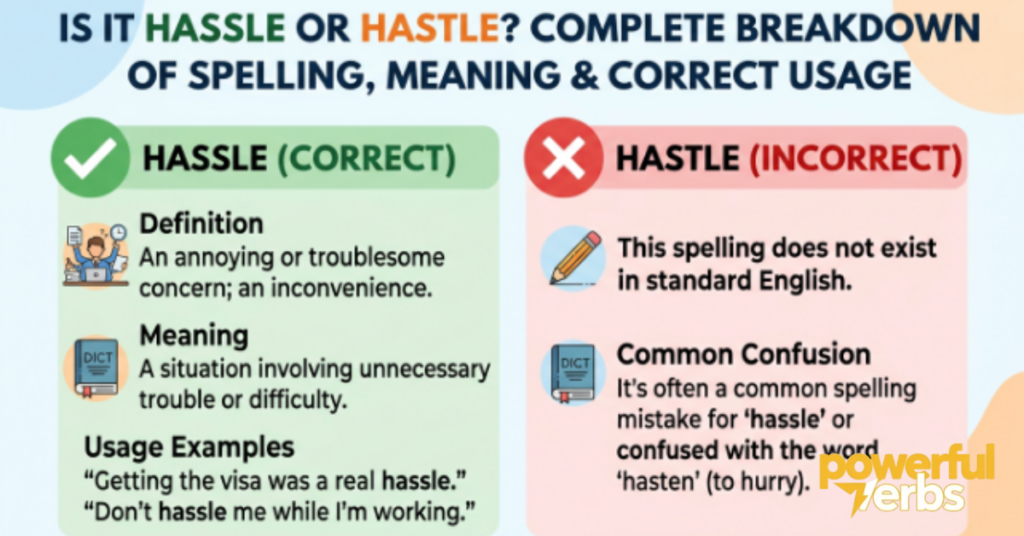
English spelling has a reputation for being unpredictable, and words like “hassle” prove exactly why. At first glance, the word looks like it should follow the same pattern as “hustle,” “bustle,” or “castle,” all of which contain a silent or softened consonant cluster. That visual similarity is precisely what leads thousands of writers, both native and non-native English speakers, to type “hastle” instead of “hassle” every single day.
The confusion is not a sign of poor vocabulary. It is a sign that English orthography does not always match pronunciation, and the human brain tries to find patterns where none exist. In 2026, this spelling mistake remains one of the most searched grammatical questions online, which tells you just how widespread and persistent the confusion truly is.
This guide resolves that confusion completely. By the time you finish reading, you will know the correct spelling, the full meaning, the grammatical behavior, the historical roots, and the correct usage of “hassle” across professional, academic, and casual writing contexts. Every section is designed to go deeper than any competitor resource and give you knowledge that actually sticks.
What Is the Correct Spelling: Hassle or Hastle?

The answer is definitive and not open to debate. “Hassle” is the correct spelling. “Hastle” is a misspelling that does not exist in any recognized dictionary, style guide, or academic reference in the English language.
If you look up “hastle” in Merriam-Webster, Oxford English Dictionary, Cambridge Dictionary, or Macmillan, you will find nothing. The word simply does not exist as a legitimate entry in standard English. No grammar textbook, no style manual, and no authoritative writing resource acknowledges “hastle” as an alternate or acceptable variant.
The correct spelling follows this exact pattern: H-A-S-S-L-E. Two s letters, no t, ending in le. Any deviation from this pattern produces an error. When you write “hastle,” “hassel,” “hassell,” or “hassals,” you are producing a misspelling regardless of context or intent.
Why So Many People Write “Hastle” Instead of “Hassle”
Understanding why the mistake happens is just as important as knowing the correct form, because that understanding makes the correction permanent rather than temporary.
The most powerful cause is phonetic analogy. English contains a significant cluster of words that end in the sound “sull” or “sul” but are spelled with a silent or near-silent t: hustle, bustle, rustle, jostle, castle, whistle, and wrestle. The human brain is a pattern-recognition machine, and after processing words like these, it naturally assumes “hassle” must follow the same structural logic. The brain inserts a t that was never there.
A second cause is auditory processing during speech. When “hassle” is spoken at a natural conversational pace, the double s sound blurs slightly into the following syllable, creating an audio impression that resembles “has-tull.” Anyone who has heard the word more than they have read it is especially vulnerable to this misperception.
A third cause is the rapid spread of misspellings through digital content. When one popular website or social media account uses “no hastle returns” or “hastle-free guarantee,” that misspelling reaches thousands of readers who process it as the correct form, because familiarity creates perceived legitimacy. The brain treats frequency as correctness, which is why incorrect spellings can become entrenched in communities over time.
A fourth cause relates to typing speed and autocomplete behavior. On mobile devices and word processors that learn from user behavior, “hastle” may have been typed so often by other users that it gets suggested or even auto-corrected back to the wrong version, reinforcing the mistake mechanically.
Finally, double-letter anxiety plays a role. English writers sometimes feel uncertain about double letters and avoid them subconsciously. The double s in “hassle” gets dropped or transformed in the process of uncertain recall, producing “hastle” as a simplified output.
The Complete Meaning of Hassle: Noun and Verb
“Hassle” is a versatile English word that functions grammatically as both a noun and a verb. Its core semantic territory covers the experience of inconvenience, irritation, unnecessary difficulty, and the act of bothering or pressuring another person.
As a noun, hassle refers to a situation, task, process, or experience that is more difficult, annoying, or time-consuming than it should be. It carries emotional weight beyond just difficulty. Something is a hassle not merely because it is hard but because it involves friction, delay, bureaucracy, repetition, or unwanted effort.
As a verb, hassle means to persistently bother, pressure, pester, or disturb someone, typically in a way that makes them feel uncomfortable, rushed, or harassed. The verb form implies ongoing or repeated action rather than a single instance of interruption.
Both uses share the same emotional core: the feeling that something or someone is creating unnecessary, frustrating friction in your experience.
How Hassle Functions as a Noun in Everyday English
When hassle operates as a noun, it describes a concrete experience or category of experience. You can precede it with articles, intensifiers, and adjectives. You can say “a hassle,” “such a hassle,” “a major hassle,” “the whole hassle,” or “no hassle at all.”
The noun form appears in both informal speech and semiformal writing, especially in consumer-facing business language, travel writing, customer service communication, and personal narrative. It rarely appears in highly formal academic writing, where synonyms like “inconvenience,” “impediment,” or “difficulty” are preferred.
Some examples that demonstrate its natural noun usage include: the visa application process was a complete hassle from beginning to end; switching internet providers turned into a month-long hassle; the new software update removed a hassle that had frustrated users for years; nobody wants the hassle of dealing with incorrect billing twice in the same quarter.
In each of these cases, the word does not merely describe difficulty. It describes difficulty compounded by frustration, inefficiency, or the feeling that the difficulty was avoidable.
How Hassle Functions as a Verb in Everyday English
The verb form of hassle is direct and expressive. To hassle someone means to persistently pester, pressure, or bother them, often for something they are unwilling to provide, with an implication of repetition or aggression.
The verb is conjugated regularly: hassle, hassles, hassled, hassling. It is transitive, meaning it takes an object. You hassle someone. You do not simply hassle in the abstract.
Natural verb usage sounds like this: the sales team was hassling prospects three times a week without any result; she asked her colleagues to stop hassling her about the deadline while the project was still in progress; the landlord hassled the tenants about minor repairs they had no legal obligation to make; management hassled the developers for a feature that had not even been approved by the design team.
The verb form is more informal than its noun counterpart and is used most frequently in spoken language, dialogue in fiction, and casual written communication. In professional contexts, writers typically replace it with “pressure,” “pester,” or “pursue aggressively.”
The Etymology and Historical Origin of Hassle
The word hassle entered the documented English language during the mid-twentieth century, with its earliest recorded appearances in American English slang from the 1930s and 1940s. Its precise origin remains a subject of linguistic debate, but several credible etymological theories exist.
One theory traces the word to a blend of “haggle” and “tussle.” Haggle refers to arguing over price or terms, while tussle refers to a physical or verbal struggle. The merger of these two concepts into “hassle” would produce a word that encompasses both argument and struggle, which matches its early semantic range.
A second theory connects hassle to a dialectal or regional English term for “to pant” or “to breathe heavily,” suggesting a physical exertion metaphor that evolved into a more general sense of effortful struggle. This theory has fewer adherents but remains in circulation.
A third etymology points toward the Scots English word “hassel,” used historically to mean “to hack” or “to saw clumsily,” suggesting a metaphorical extension from laborious physical cutting to laborious effort in general.
By the 1950s and 1960s, hassle had become a firmly established American English slang term associated with confrontations, conflicts, and bureaucratic difficulties. By the 1970s it had crossed into mainstream usage and was appearing regularly in print journalism, fiction, and informal business communication. Today it is a fully standard English word used globally across all varieties of the language.
Semantic Field and Related Vocabulary
For writers and content creators working in SEO, understanding the semantic field around “hassle” helps produce content that search engines recognize as authoritative and contextually relevant. The following vocabulary represents the NLP and LSI ecosystem of this word.
Direct synonyms in the noun form include: inconvenience, annoyance, bother, trouble, aggravation, nuisance, difficulty, ordeal, frustration, and complication. Each of these shares semantic territory with hassle but carries slightly different connotations. “Ordeal” is more dramatic. “Nuisance” is lighter. “Aggravation” emphasizes emotional intensity. “Complication” focuses on complexity rather than emotion.
Direct synonyms in the verb form include: pester, bother, badger, hound, harry, nag, pressure, harass, disturb, and pursue. “Harass” is significantly more serious and carries legal connotations in many contexts. “Badger” implies persistence through annoyance. “Nag” suggests repetitive low-level irritation.
Antonyms relevant to the noun form include: ease, simplicity, convenience, straightforwardness, efficiency, and smoothness. Antonyms for the verb form include: leave alone, accommodate, assist, and support.
Compound and modified forms that appear frequently in consumer and business English include: hassle-free, no-hassle, hassle-free experience, hassle-free returns, hassle-free process, hassle-free booking, and hassle-free guarantee. These compound uses are especially significant for SEO because they represent the high-search-volume commercial applications of the word.
Contextual co-occurrence terms that signal relevance include: bureaucracy, red tape, paperwork, waiting, delays, customer service, returns, travel, commute, approval process, and subscription cancellation. When “hassle” appears near these terms, it is functioning in its most natural semantic environment.
How to Use Hassle Correctly in Different Contexts
Context determines both the appropriateness and the tone of “hassle” in writing. Understanding the register of your context prevents the word from feeling out of place.
In customer experience and marketing writing, hassle is not only appropriate but highly effective. Phrases like “hassle-free returns,” “no-hassle cancellation,” and “a completely hassle-free setup process” communicate ease and consumer-friendliness with immediacy. These uses are persuasive because they directly address the consumer’s fear of friction.
In personal narrative and conversational writing, hassle operates naturally as a way to express relatable frustration. Describing the hassle of changing a flight, renewing a license, or setting up new technology immediately connects with readers who have experienced similar friction. The informality of the word is an asset in this context because it sounds human.
In workplace communication, hassle appears most often in the noun form when describing process inefficiencies. A manager might describe approval chains as a hassle, or a team member might note that a particular tool adds hassle to a workflow that should be streamlined. The verb form is less common in professional writing but acceptable in direct conversation.
In fiction and dialogue writing, hassle is invaluable for characterization. Characters who use “hassle” in their speech tend to sound grounded, practical, and slightly impatient with complexity. It adds authenticity to voices that belong to everyday, non-pretentious people.
In academic and formal writing, hassle should generally be avoided in favor of more neutral synonyms. Academic prose prefers “inconvenience,” “impediment,” or “friction” when describing the same phenomenon.
Proven Memory Tricks to Never Misspell Hassle Again
Spelling confidence comes from reliable mental anchors, not from willpower alone. The following techniques give you multiple pathways to the correct spelling so that even under pressure or speed, your brain retrieves the right form.
The double-s bridge technique asks you to think of hassle as a word with a bridge in the middle made of two s letters. Imagine the word split as HA + SS + LE. The bridge of double s is what makes the word structurally stable. If you remove one of those letters, the bridge collapses, and the word becomes wrong.
The word family method connects hassle to its inflected forms: hassles, hassled, hassling, hassle-free. Notice that every single form of this word contains a double s and no t. If you can recall any one of these forms clearly, you can reconstruct the base word accurately.
The business phrase anchor takes advantage of a phrase you likely see often in commercial contexts: “hassle-free.” Major retailers, airlines, subscription services, and banks use this phrase millions of times per year. Not one of them writes “hastle-free,” because it would look instantly wrong in a professional context. Anchor your spelling to that phrase, and you will never insert a rogue t again.
The elimination trick works by having you start with what the word is not. It is not “hastle” because hastle is not a dictionary word. It is not “hassel” because that adds an extra vowel. It is not “hassell” because the le ending is always singular. Once you eliminate the wrong versions, “hassle” is what remains.
The rhyme scheme approach pairs “hassle” with “tassel.” Both words end in -ssel or a phonetically similar pattern, and tassel is spelled with a double s that writers rarely question. If tassel has double s, hassle has double s.
Common Errors Writers Make with Hassle (And How to Fix Them)
The most common error is the core misspelling itself: “hastle” in place of “hassle.” This appears in product descriptions, blog posts, social media captions, customer reviews, and even published journalism. The fix is always the same: remove the t and restore the second s.
A secondary error involves confusion about the verb form. Some writers produce “to hassel” or “to hassell” when conjugating the verb, treating it as if the base form were spelled differently. The verb hassle is spelled identically to the noun. Hassle, hassles, hassled, hassling. No letter changes.
A third error involves treating “hassle-free” as two words or omitting the hyphen in compound adjective position. When “hassle-free” precedes a noun, standard style requires a hyphen: “a hassle-free experience,” not “a hassle free experience.” When it follows a linking verb, the hyphen is typically dropped: “the process was hassle free.”
A fourth error involves register mismatch. Using “hassle” in a legal contract, a scientific paper, or formal correspondence introduces an inappropriately informal tone. In those contexts, replace it with “inconvenience,” “difficulty,” or “impediment.”
Hassle in Professional, Academic, and Casual Writing
Professional writing makes frequent use of hassle in its compound form. “Hassle-free” has become a standard marketing language that signals consumer-centric design. The word’s directness and familiarity make it one of the most efficient ways to communicate the removal of friction in a product or service experience.
Academic writing almost universally avoids hassle in favor of formal synonyms. If you are writing an essay, a research paper, or a scholarly report, replace hassle with inconvenience, obstruction, burden, complication, or difficulty depending on your specific meaning.
Casual writing thrives on hassle. In blog posts, personal essays, text messages, emails between friends, and social media content, hassle is one of the most natural ways to express frustration with unnecessary complexity. It reads as authentic and relatable because it belongs to the spoken register that casual writing tries to emulate.
Real-World Sentence Examples Across Multiple Contexts
“Switching to the new billing system turned out to be far more of a hassle than the IT team had initially predicted.”
“She did not want to hassle the receptionist about an appointment that could easily be rescheduled online.”
“The application promised a hassle-free onboarding experience, and for the first time, that promise actually held up.”
“After three failed attempts to reach customer support, the entire return process felt like a manufactured hassle.”
“He had been hassling his roommate about the unpaid electricity bill for nearly two weeks before bringing it up formally.”
“Filing for a reimbursement used to be a hassle involving five paper forms, two manager signatures, and a ten-day wait.”
“The new self-checkout machines were supposed to reduce hassle, but the error rate created more frustration than they solved.”
“Nobody wants to start their Monday morning dealing with the hassle of a frozen work account and an unresponsive IT desk.”
“Her travel agent specialized in hassle-free international itineraries that accounted for every visa requirement in advance.”
“The contractor kept hassling the homeowner for a deposit before the contract had even been reviewed by both parties.”
“What began as a minor hassle with a duplicate charge turned into a three-month dispute with the bank’s fraud department.”
“Simplifying the checkout process is the single most effective way to eliminate the kind of hassle that drives cart abandonment.”
see also: To Fast or Too Fast: Which Is Correct? (Easy Grammar Guide)
FAQs
Is “hastle” ever acceptable in any form of English writing?
No, “hastle” is never acceptable in any recognized variety of English writing. It is a misspelling without dictionary support, and using it in professional, academic, or published content will undermine your credibility with readers who know the correct form.
What part of speech is hassle, and can it be used as an adjective?
Hassle functions as a noun and a verb. It is not used as a standalone adjective, but it forms compound adjectives when hyphenated, most commonly in the phrase “hassle-free,” which describes something designed to involve minimal inconvenience or friction.
How do you conjugate the verb “to hassle” correctly?
The verb hassle follows regular conjugation: present tense “hassle” or “hassles,” past tense “hassled,” continuous form “hassling,” and infinitive “to hassle.” No spelling changes occur across these forms; the double s is consistent throughout.
What are the most professional synonyms for hassle in formal writing?
In formal or academic writing, the most appropriate synonyms for hassle as a noun include inconvenience, difficulty, complication, burden, impediment, and friction. For the verb form, consider pressure, pester, harass, or pursue, keeping in mind that “harass” carries significantly stronger and legally relevant connotations.
Why does “hassle” look like it should have a silent t like “hustle” or “castle”?
The visual resemblance to words like hustle, castle, and wrestle is one of the main reasons the misspelling “hastle” persists. Those words belong to a different etymological family that features a silent or softened t in the consonant cluster. Hassle entered English through a different route and was never part of that spelling pattern, but the brain’s tendency to apply known rules to new words creates the false expectation of a t.
Is “hassle-free” always hyphenated?
The standard rule is to hyphenate “hassle-free” when it appears before a noun as a compound modifier, as in “hassle-free service” or “a hassle-free return policy.” When it follows a linking verb and does not directly precede the noun it modifies, the hyphen is often dropped, as in “the process was hassle free.” Different style guides vary slightly on this point, so following your publication’s preferred style guide is the safest approach.
Conclusion
The spelling question that brought you here has a clear, permanent answer: it is always “hassle,” never “hastle.” The word has been part of the English language for nearly a century, and in that time it has never been spelled with a t. Understanding why the confusion happens, what the word genuinely means, how it behaves grammatically, and where it belongs in different writing contexts gives you a complete command of this word rather than just a correction you will forget next week.
Use the memory techniques, recognize the semantic field, and trust the simple structural fact that “hassle” contains a double s and nothing else unusual. Whether you are writing marketing copy, a personal blog, workplace communication, or fiction, you now have everything you need to use this word accurately, confidently, and effectively every single time.

Liam Johnson is a dedicated language expert with 4 years of professional experience. He specializes in Grammar, Vocabulary, and Sentence structure.
