

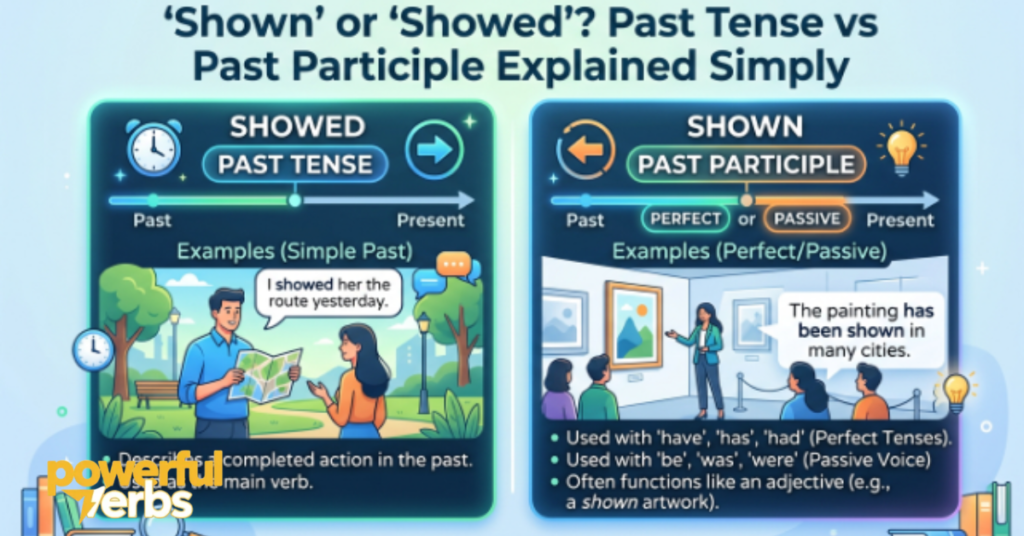
If you’ve ever paused mid-sentence wondering whether to write “I have showed” or “I have shown,” you’ve run into one of English’s most common irregular verb traps. The confusion is completely understandable, but the rule behind it is short enough to remember permanently in just a few minutes. “Showed” is the simple past tense. “Shown” is the past participle, and it always needs a helping verb like has, have, or had. Let’s break this down clearly, with real examples, so you’ll never second-guess this pair again.
see also: PMO Meaning in Chat: Definition, Uses & Real Examples
Understanding the Verb “Show”

“Show” belongs to a group of irregular verbs in English, meaning it doesn’t follow the standard “add -ed” pattern for every tense. Instead, it has three distinct forms:
- Base form: show
- Simple past: showed
- Past participle: shown
Examples illustrating each form:
- I show my badge at the entrance. (present)
- I showed my badge yesterday. (simple past)
- I have shown my badge many times before. (past participle)
Recognizing which form fits depends entirely on the structure of your sentence.
When to Use “Showed”
“Showed” works on its own, with no helping verb required. It’s used whenever you’re describing a completed action tied to a specific point in the past — words like “yesterday,” “last month,” or “in 2023” are common clues.
Examples:
- She showed her ID at the front desk.
- The teacher showed us how to solve the equation.
- They showed the documentary at last week’s event.
Whenever the timing is clear and the action is finished, “showed” stands alone without needing any extra support.
When to Use “Shown”
“Shown” never appears by itself. It must always follow a helping verb — has, have, or had — to form a grammatically correct sentence.
Common structures:
- has shown
- have shown
- had shown
Examples:
- She has shown remarkable improvement this semester.
- We have shown our findings to the entire committee.
- He had shown signs of fatigue before the race even started.
If you spot has, have, or had anywhere nearby, “shown” is the form you need — never “showed.”
A Quick Way to Test Which Word You Need
Ask yourself one simple question: is there a helping verb attached to this sentence?
- If yes → use shown
- If no, and the time is clearly in the past → use showed
This single test resolves almost every situation where the two words get confused.
“Have Showed” vs “Have Shown” — Settling the Debate
| Phrase | Grammatically Correct? | Example |
| have shown | Yes | “I have shown my work to the panel.” |
| have showed | No | Considered a grammar error in standard English |
Even though some speakers casually say “have showed” in relaxed conversation, formal and standard English always require “have shown.”
Why “Shown” Matters in Perfect Tenses
Perfect tenses are used to connect a past action to the present moment, or to another point in the past. This is exactly where “shown” plays its role.
Present perfect: has/have + shown — “She has shown great dedication this year.”
Past perfect: had + shown — “He had shown interest in the role long before the interview.”
These tenses convey a sense of experience, result, or relevance, rather than simply stating that something happened once in the past.
Side-by-Side Comparison
| Word | Tense | Need a Helper Verb? | Example |
| showed | Simple past | No | “She showed me the photos.” |
| shown | Past participle | Yes | “She has shown me the photos.” |
“Shown” in Passive Voice
Beyond perfect tenses, “shown” also appears frequently in passive voice constructions, where the focus shifts to the action itself rather than who performed it.
Examples:
- The results were shown during the press conference.
- New evidence has been shown to support the theory.
- The footage was shown to the jury before the verdict.
“Showed” never fits into passive constructions like these — only “shown” does.
Common Mistakes Writers Make
| Incorrect | Correct |
| I have showed the report to my manager. | I have shown the report to my manager. |
| She has showed real talent lately. | She has shown real talent lately. |
| The data has been showed clearly. | The data has been shown clearly. |
Every one of these mistakes follows the identical pattern — swapping “showed” for “shown” the moment a helping verb enters the sentence.
Why This Distinction Matters in Professional Writing
Small grammar slips like “have showed” can quietly undermine the credibility of an email, report, or presentation. Consider this real-world scenario: an employee writes, “I have showed the files to the client,” and their manager has to pause and mentally correct it before fully trusting the rest of the message.
Switching to “I have shown the files to the client” instantly reads as more polished, confident, and professional — without changing the meaning at all.
Other Irregular Verbs That Follow the Same Pattern
“Show” isn’t alone in having three distinct forms. Several other common English verbs behave the exact same way:
- write → wrote → written
- take → took → taken
- see → saw → seen
- speak → spoke → spoken
Once you understand the logic behind “show, showed, shown,” these related verbs become much easier to use correctly as well.
A Simple Memory Trick
Here’s a quick phrase to keep in mind: “helpers need shown.”
Whenever has, have, or had shows up in a sentence, your brain should immediately default to “shown.” If there’s no helper verb at all, and the timing is clearly in the past, “showed” is your answer instead.
Quick Self-Check
Try filling in the blanks with the correct form:
She ___ her project last week. They have ___ remarkable progress. He ___ me the email this morning. The results have been ___ to the board.
Answers: showed, shown, showed, shown.
conclusion
Whenever a sentence describes a finished action tied to a specific past moment, the correct word is shown, used entirely on its own. The moment a helping verb like has, have, or had enters the sentence, the correct word switches to shown without exception.
This single distinction — simple past versus past participle — explains every instance where these two words get mixed up. Once you internalize the test of checking for a helper verb, choosing correctly becomes almost automatic. Remember the broader pattern too: show, showed, shown follows the same irregular structure as write, wrote, written.
Apply this consistently across emails, reports, and everyday conversation, and your writing will instantly read as more accurate and professional. With this rule fully understood, you’ll never hesitate between shown and showed again.
see also: What Does “/s” Mean Online? Simple Guide to Sarcasm Tag
FAQs
Is “showed” ever incorrect to use?
Yes, it’s incorrect whenever a helping verb like has, have, or had is present in the sentence — in that case, “shown” is required instead.
Can “shown” stand alone without a helper verb?
No, “shown” always needs has, have, had, or a passive voice construction to be grammatically correct.
Why does “have showed” sound wrong to careful readers?
Because standard English grammar requires the past participle “shown” after any form of have, making “have showed” a recognized error.
Which form is used in passive voice sentences?
“Shown” is used in passive voice, such as “The evidence was shown to the committee.”
What’s an easy way to remember which word to use?
Check for a helping verb — if you see has, have, or had nearby, choose “shown”; otherwise, use “showed.”
Are there other verbs that follow this same three-form pattern?
Yes, verbs like write-wrote-written, take-took-taken, and see-saw-seen all follow an identical irregular structure.

Liam Johnson is a dedicated language expert with 4 years of professional experience. He specializes in Grammar, Vocabulary, and Sentence structure.
