

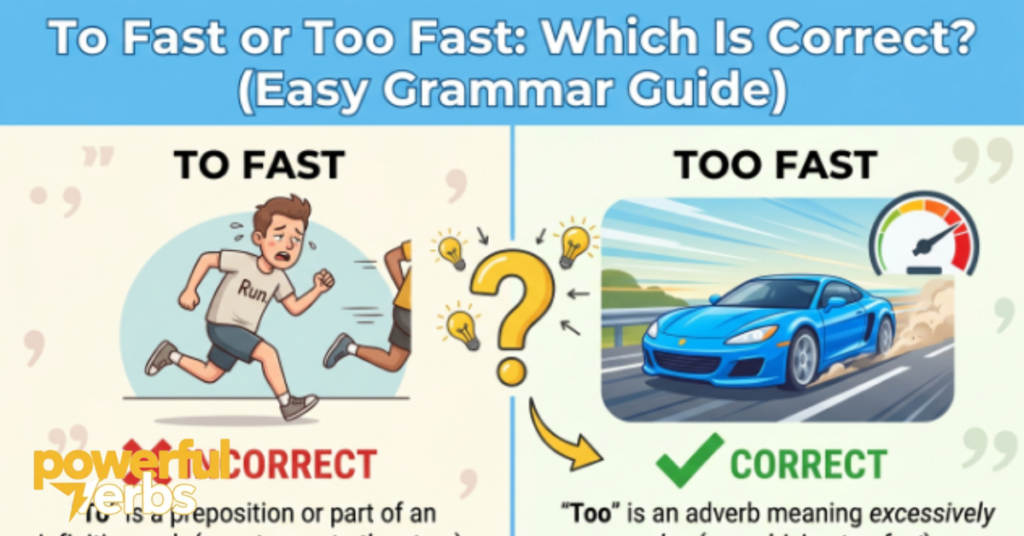
English learners trip over to fast and too fast more often than almost any other word pair, and the reason is simple: they sound exactly the same out loud. One small letter changes the entire meaning of a sentence, which is why this pair shows up constantly in spelling checklists, ESL classrooms, and grammar quizzes.
This guide breaks the confusion down in plain language, with real examples, memory tricks, and a quick test at the end so you never second-guess yourself again.
see also: 800+ Collective Nouns List for People, Animals and Things
Quick Answer
To fast is a verb phrase that means choosing not to eat, usually for health, religious, or medical reasons. Too fast is an adverb phrase that describes excessive speed — something happening faster than it should.
If your sentence is about skipping food, write to fast. If your sentence is about speed, write too fast.
That one-line rule solves the problem in almost every situation you’ll encounter.
Why These Two Words Get Mixed Up

“To” and “too” are homophones — words that sound identical but carry different jobs in a sentence. Add the word “fast,” and you get two phrases that are pronounced the same way but mean completely different things. Add the fact that most people learn language by ear before they learn it by spelling, and the mix-up becomes almost inevitable.
The good news: once you understand what each word actually does in a sentence, the confusion disappears for good.
Breaking Down the Word “To”
The word to is a small but powerful connector in English. It typically does one of two jobs:
- It functions as a preposition showing direction, destination, or purpose (“She walked to the market”).
- It functions as an infinitive marker, pairing with a base verb to express an action or intention (“He wants to learn,” “They agreed to wait”).
Neither of these uses carries any sense of excess or surplus. “To” is about direction and intention, nothing more.
Breaking Down the Word “Too”
Too is an adverb with two main meanings:
- It signals excess — more of something than is needed, wanted, or appropriate (“The soup is too salty”).
- It can also mean “also” or “as well” (“I’m hungry too”).
Notice the spelling trick here: too has an extra letter “o,” and it also expresses an extra amount of something. That visual cue is one of the easiest ways to remember which spelling to use.
What “Fast” Means on Its Own
Before combining it with “to” or “too,” it helps to remember that fast can play three different grammatical roles:
- As an adjective: “a fast train”
- As an adverb: “she types fast”
- As a verb: “he chose to fast”
This last meaning — fast as a verb meaning to abstain from eating — is the key to understanding “to fast” correctly.
When to Use “To Fast”
Use to fast whenever the sentence describes a deliberate decision to stop eating, whether for religious observance, a medical procedure, intermittent fasting routines, or personal discipline.
Examples:
- She chose to fast during Ramadan as an act of devotion.
- The nurse told him to fast for eight hours before his blood test.
- Many athletes experiment with intermittent fasting and decide to fast for sixteen hours a day.
- He promised himself to fast from social media for a week, not just from food.
In every example above, “to fast” pairs with a verb of intention — chose, told, decide, promised — because it’s functioning as an infinitive describing an action someone commits to.
When to Use “Too Fast”
Use too fast whenever the sentence describes a pace, speed, or rate that exceeds what is safe, expected, or comfortable.
Examples:
- He was driving too fast on the icy road.
- The instructor spoke too fast for the beginners to follow.
- Prices in that neighborhood are rising too fast for most buyers.
- Don’t read the contract too fast — you might miss a clause.
In each case, “too fast” modifies a verb (driving, spoke, rising, read) and tells the reader that the action happened at an excessive or undesirable speed.
To Fast vs. Too Fast: Side-by-Side Comparison
| Feature | To Fast | Too Fast |
| Part of speech | Verb phrase (infinitive) | Adverb phrase |
| Core meaning | Choosing not to eat | Excessive speed |
| Typical context | Religion, health, discipline | Driving, learning, pacing |
| Sample sentence | He decided to fast on Mondays. | She talks too fast for me to follow. |
| Memory cue | “To” = direction/purpose | “Too” = extra “o” = extra amount |
Real-World Contexts Where These Phrases Appear
Fasting and health routines. Doctors, nutritionists, and religious leaders all use “to fast” when discussing eating restrictions, whether it’s a 12-hour overnight fast before surgery or a multi-day religious observance.
Traffic and road safety. “Too fast” appears constantly in safety warnings, traffic tickets, and driving lessons — anywhere speed becomes a hazard rather than an asset.
Learning and skill development. Teachers and coaches often warn students against moving too fast through material, since rushing tends to skip foundational steps.
Everyday pacing of life. People also use “too fast” emotionally — describing relationships, careers, or major life changes that feel rushed: “Everything happened too fast after the wedding.”
Common Mistakes (and How to Fix Them)
A few sentences trip people up again and again. Here’s how to correct them:
- “I will too fast tomorrow for the procedure.” → “I will to fast tomorrow for the procedure.” (Wrong — should be “I will fast tomorrow,” since “to” isn’t needed after “will.”)
- “He drives to fast on the highway.” → “He drives too fast on the highway.”
- “She decided too fast for the appointment.” → “She decided to fast for the appointment.”
Notice that the safest fix is always to ask what the sentence is really describing: an action of not eating, or a description of speed.
Two Fast Ways to Check Yourself
The “very” swap test. Replace the word with “very” in your head. If “very fast” still makes sense, you need too fast. If it sounds wrong, you’re probably talking about to fast.
The extra-letter trick. “Too” has an extra “o,” and it represents something extra — extra speed, extra noise, extra anything. If your sentence is about an excessive amount of something, reach for the version with the extra letter.
A Quick Self-Test
Fill in the blank with to or too:
- The doctor asked her ___ fast before the scan.
- You’re walking ___ fast for me to keep up.
- They chose ___ fast for the entire weekend retreat.
- He spoke ___ fast and lost the audience.
Answers: to, too, to, too
Other Word Pairs That Cause Similar Confusion
This isn’t the only homophone trap in English. A few others worth bookmarking:
- Your vs. you’re — possession vs. a contraction of “you are”
- There vs. their vs. they’re — location, possession, and a contraction
- Affect vs. effect — a verb of influence vs. a noun for the result
- Lose vs. loose — failing to keep something vs. not tight
Mastering “to fast or too fast” actually builds the same instinct you need for all of these — slow down, identify the function of the word, and the spelling follows naturally.
Final Thoughts
The difference between to fast and too fast comes down to one question: is the sentence about skipping a meal, or about something happening at an excessive pace? Once that question becomes automatic, the spelling takes care of itself. Read your sentence slowly, run the “very” swap test if you’re unsure, and remember that the extra “o” in “too” always points to an extra amount of something. With a little practice, this once-tricky pair becomes second nature.
see also: Body Count Meaning Explained: Different Uses in Modern Context
FAQs
What’s the simplest way to remember the difference between to fast and too fast?
Ask whether your sentence is about food or about speed. Food-related decisions use “to fast”; speed-related descriptions use “too fast.”
Is “to fast” grammatically the same as just “fast”?
Not quite — “to fast” is the infinitive form, usually following another verb like “decide,” “choose,” or “need.” On its own, “fast” can stand as the main verb, as in “They fast every Monday.”
Can “too fast” ever have a positive meaning?
Occasionally, in casual speech, it can sound neutral or even impressive — “That car accelerates too fast for words” — but it almost always implies something beyond the expected limit.
Does “to fast” only apply to religious practices?
No. It also applies to medical fasting before tests or surgery, and to lifestyle choices like intermittent fasting for health or weight management.
How do I know if I should use “too” instead of “to” in general, not just with “fast”?
If the sentence means “also” or “excessively,” use “too.” If it shows direction, purpose, or connects to a verb, use “to.”
Are there any tools that catch this mistake automatically?
Most modern grammar checkers and word processors flag “to” and “too” errors, but understanding the rule yourself is faster and more reliable than relying on software alone.

Liam Johnson is a dedicated language expert with 4 years of professional experience. He specializes in Grammar, Vocabulary, and Sentence structure.
