

Learning to read and write clearly is one of the most important milestones for third-grade students. At this stage, children are ready to move beyond basic words and begin forming simple short sentences that express complete thoughts. Whether you are a parent helping at home, a teacher building classroom exercises, or a student practicing independently, this guide gives you everything you need.
This collection of 150+ simple sentences for Grade 3 is organized by category, purpose, and skill level — making it the most complete and classroom-ready resource you will find. Each sentence is carefully chosen to be age-appropriate, grammatically correct, and useful in real daily life.
Why Simple Sentences Matter for Grade 3 Students
Before diving into the sentence lists, it is worth understanding why short, simple sentences are so powerful at the third-grade level.
- Builds reading fluency — Short sentences reduce cognitive load, helping children read smoothly without losing meaning.
- Strengthens grammar foundations — Each sentence models correct subject-verb-object structure.
- Boosts writing confidence — Children who practice simple sentences first write longer, better paragraphs later.
- Improves spoken English — Repeated reading of clear sentences trains pronunciation and natural rhythm.
- Supports vocabulary growth — New words learned inside sentences are remembered far better than isolated word lists.
Research in early literacy consistently shows that students who practice structured sentence reading in Grade 3 demonstrate stronger comprehension scores by Grade 5.
Section 1: Basic Daily Life Sentences for Grade 3
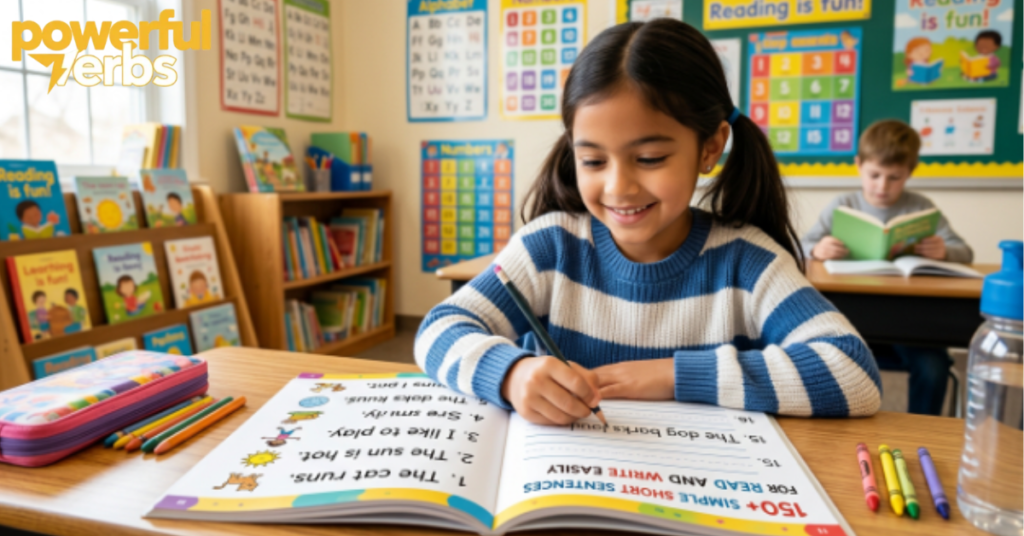
These sentences reflect the world a third grader lives in every day — home, school, nature, and family.
- I wake up early every morning.
- The sun rises in the east.
- My mother makes breakfast for us.
- I wear my uniform to school.
- The school bus arrives on time.
- I sit next to my best friend.
- Our teacher explains the lesson clearly.
- I raise my hand to ask a question.
- We take a break after two classes.
- I drink water from my bottle.
- Lunch tastes delicious today.
- We play on the swings after lunch.
- The afternoon class is about science.
- I pack my bag before going home.
- My father picks me up from school.
- I change my clothes at home.
- We eat dinner as a family.
- I read a chapter of my storybook.
- I brush my teeth before sleeping.
- I say goodnight to everyone.
Section 2: Short English Sentences for Grade 3 Reading Practice
These ultra-short sentences are perfect for reading aloud, flashcard practice, and building speed and confidence.
- The sky is blue.
- Grass is green.
- Birds can fly.
- Fish live in water.
- The dog wags its tail.
- A cat drinks milk.
- Snow is white and cold.
- Fire is very hot.
- Stars shine at night.
- The moon is bright.
- I can run fast.
- She can jump high.
- He is very tall.
- We are good friends.
- They laugh together.
- The baby is sleeping.
- My bag is heavy.
- The book is thin.
- This mango is sweet.
- The lemon is sour.
- Roses are beautiful.
- The river flows gently.
- Clouds float in the sky.
- Butterflies are colorful.
- The rabbit is white.
- Monkeys climb trees.
- The lion is strong.
- An elephant is huge.
- A bee makes honey.
- The parrot can talk.
Section 3: School-Related Sentences for Grade 3 Students
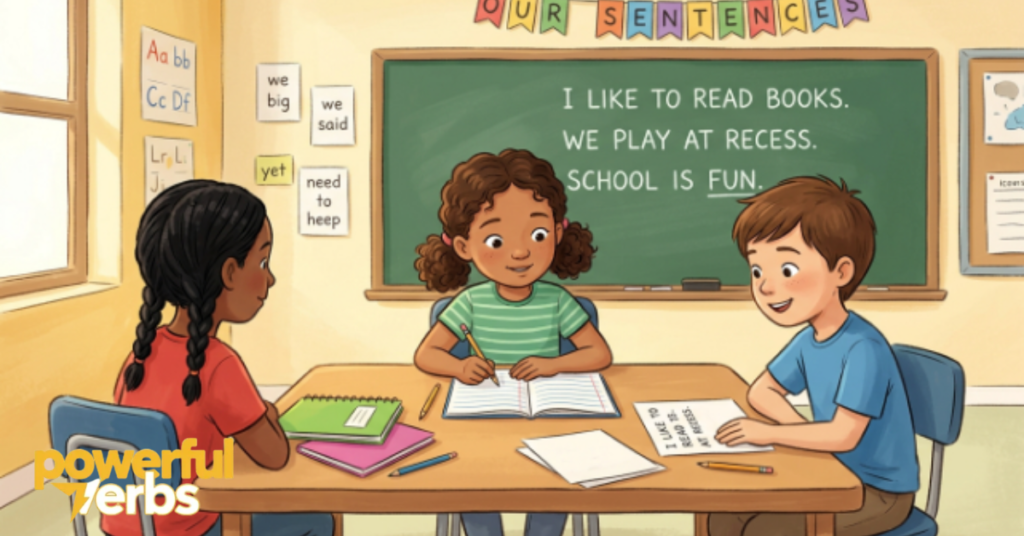
These sentences help students talk and write about their school experiences, an important topic at every grade level.
- My school has a big playground.
- Our classroom is neat and clean.
- The teacher writes on the whiteboard.
- I sharpen my pencil every morning.
- We submit our homework on time.
- The library has hundreds of books.
- I borrowed a story from the library.
- Science class is my favorite.
- We do an experiment today.
- Art class is fun and creative.
- I drew a picture of a rainbow.
- Physical education keeps us fit.
- We sang the national anthem together.
- Our principal visited our classroom.
- I received a gold star for reading.
- Spelling tests happen every Friday.
- I studied hard for the exam.
- My report card made my parents proud.
- We have a school trip next week.
- I love learning something new every day.
Section 4: Nature and Environment Sentences for Grade 3
Understanding nature through language builds both vocabulary and environmental awareness — a key part of the Grade 3 curriculum.
- Trees give us clean air.
- We must not cut down forests.
- The ocean is deep and wide.
- Rainwater fills the rivers.
- Animals depend on plants for food.
- The seasons change four times a year.
- Spring brings flowers and warm air.
- Summer is hot and sunny.
- Leaves fall from trees in autumn.
- Winter brings cold winds and fog.
- Farmers grow food for everyone.
- Bees help flowers to grow.
- Plastic harms sea animals.
- We should save water every day.
- Planting trees helps the earth.
- The desert is dry and sandy.
- Mountains are covered with snow.
- Earthquakes shake the ground.
- Rain fills our lakes and rivers.
- We must protect our environment.
Section 5: Family and Relationships Sentences for Grade 3
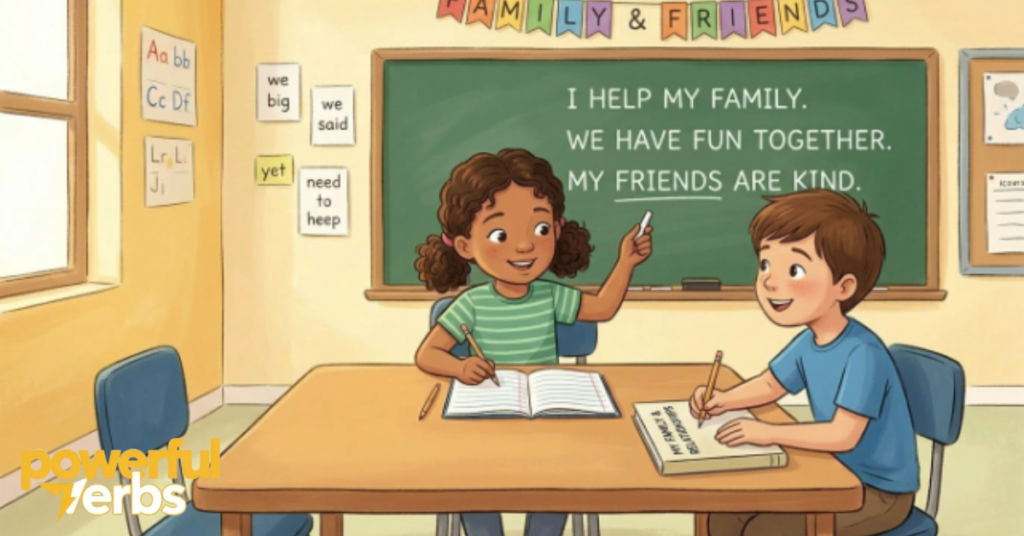
Family-centered sentences help students connect emotionally to language learning, making the material far more meaningful.
- My mother is kind and caring.
- My father works very hard.
- I love my younger sister.
- My brother helps me with homework.
- My grandmother tells amazing stories.
- My grandfather goes for a walk every day.
- We visit our relatives on holidays.
- My family eats dinner together.
- We help each other in our home.
- I feel safe with my family around.
- My parents support all my dreams.
- My aunt bakes the best cakes.
- My uncle teaches me to ride a bicycle.
- Family time is the best time.
- I am grateful for my loving family.
Section 6: Feelings and Emotions Sentences for Grade 3
Emotional vocabulary is an often-overlooked part of language learning. These sentences help students identify and express how they feel.
- I feel happy when I play with friends.
- She feels sad when she loses her toy.
- He is excited about his birthday.
- I am nervous before an exam.
- We feel proud when we do well.
- She was surprised by the gift.
- He feels bored without something to do.
- I get angry when someone is unfair.
- She feels calm by the ocean.
- He feels confused about the question.
- I am grateful for my good health.
- She feels lonely when no one plays with her.
- We feel joyful during festivals.
- He feels brave when he tries something new.
- I feel loved by my family every day.
Section 7: Action Sentences for Grade 3 (Subject + Verb + Object)
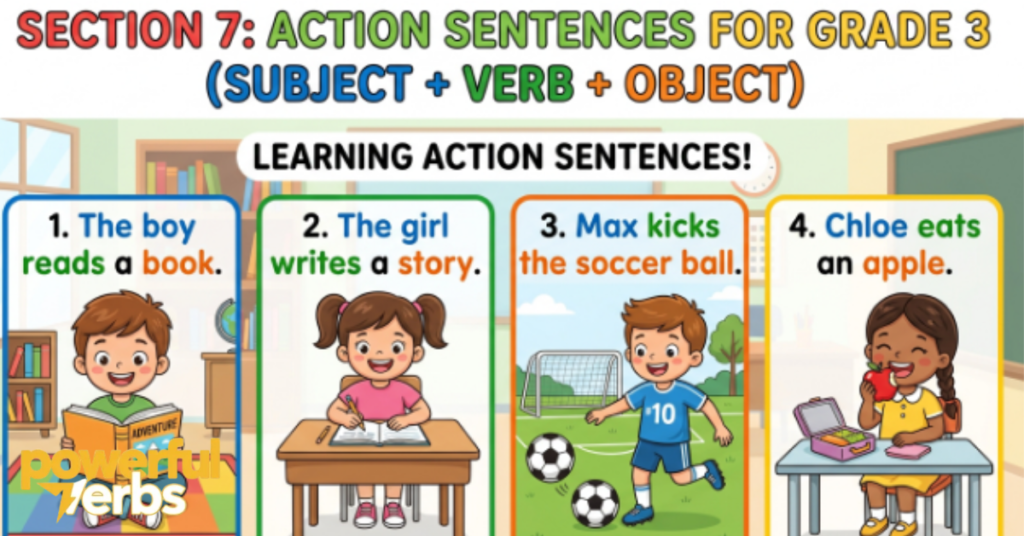
These sentences strengthen understanding of basic sentence structure — the foundation of all writing skills.
- The chef cooks a delicious meal.
- The artist paints a beautiful picture.
- The doctor treats sick patients.
- The farmer harvests golden wheat.
- The student reads a thick textbook.
- The driver steers the big bus.
- The pilot flies the airplane.
- The librarian sorts the new books.
- The gardener waters the plants.
- The engineer builds a strong bridge.
- The baker bakes fresh bread.
- The swimmer crosses the wide pool.
- The dancer performs on the stage.
- The scientist studies the tiny insects.
- The musician plays a beautiful melody.
Section 8: Question Sentences for Grade 3
Teaching students to write and ask questions builds critical thinking alongside language skills.
- Where do you live?
- What is your favorite color?
- How old are you?
- Who is your best friend?
- When does school start?
- Why do leaves change color?
- How does a caterpillar become a butterfly?
- What do you like to eat for breakfast?
- Where does the sun go at night?
- How many planets are in our solar system?
- Who invented the telephone?
- What makes you happy?
- Why is the sky blue?
- When is your birthday?
- How do fish breathe underwater?
Section 9: Positive Affirmation Sentences for Grade 3
These sentences build confidence, self-expression, and a growth mindset — all vital for young learners.
- I am a smart and capable student.
- I can learn anything with practice.
- Every mistake helps me grow.
- I am kind to everyone around me.
- I believe in myself every day.
- Hard work always brings good results.
- I am proud of my efforts.
- I help others when they need me.
- I face challenges with a brave heart.
- I am getting better every single day.
Section 10: Everyday English Phrases for Grade 3 Students
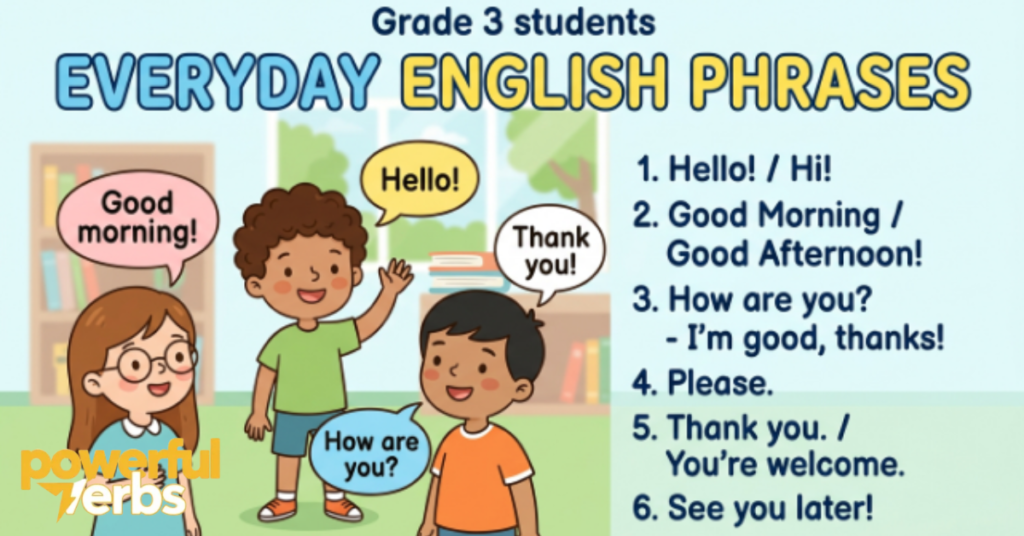
These classroom and home phrases help students communicate politely and confidently in real conversations.
| Situation | Useful Phrase |
| Greeting | Good morning, how are you? |
| Requesting | May I please have some water? |
| Thanking | Thank you very much. |
| Apologizing | I am sorry, it was my mistake. |
| Asking for help | Could you please help me with this? |
| Entering class | May I come in, ma’am? |
| Not understanding | Could you please explain that again? |
| Agreeing | Yes, I completely agree with you. |
| Disagreeing politely | I think it might be different. |
| Saying goodbye | Have a wonderful day! |
Section 11: Grade 3 Sentences Worksheet — Fill in the Blanks
Use these practice exercises to check reading comprehension and sentence-building skills.
Instructions: Fill in the blank with the correct word from the box.
Word Box: library, friendly, morning, clean, slowly, garden, careful, bright
- The flowers in the __________ smell wonderful.
- Please be __________ when crossing the road.
- She walks __________ so the baby does not wake up.
- We must keep our classroom __________.
- I visit the school __________ to borrow books.
- The stars were __________ and clear last night.
- Good __________ is the best time to exercise.
- My new classmate is very __________ and helpful.
Answer Key (For Teachers/Parents):
- garden
- careful
- slowly
- clean
- library
- bright
- morning
- friendly
Section 12: Grade 3 Sentences — True or False Exercise
Read each sentence and write TRUE or FALSE.
- Fish can live outside the water. ___
- The sun rises in the west. ___
- We breathe in oxygen. ___
- Books help us learn new things. ___
- Trees give us wood and oxygen. ___
- The moon produces its own light. ___
- A caterpillar can become a butterfly. ___
- Doctors help sick people feel better. ___
Answers: 1-False, 2-False, 3-True, 4-True, 5-True, 6-False, 7-True, 8-True
Tips for Parents: How to Use These Sentences at Home
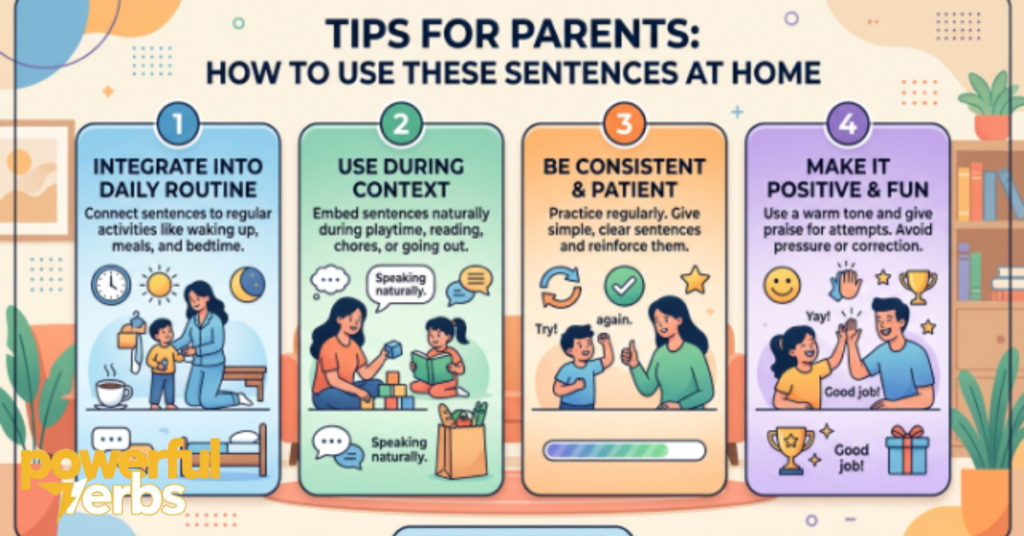
- Daily reading practice — Pick 10 sentences each morning and read them aloud together.
- Dictation exercises — Read a sentence slowly while your child writes it down. Check spelling together.
- Act it out — For action sentences, ask your child to perform the action while saying it.
- Make flashcards — Write one sentence per card. Review them during car rides or meals.
- Build longer texts — Ask your child to connect three sentences into a small paragraph.
- Discuss meanings — After each sentence, ask “What does this mean?” or “Can you tell me more?”
- Swap the words — Change one word in a sentence to make a new sentence (e.g., change “dog” to “cat”).
Tips for Teachers: Classroom Activities Using These Sentences
- Sentence scrambles — Cut each sentence into individual words and ask students to reassemble them correctly.
- Gap fill worksheets — Remove key nouns or verbs and have students supply the missing words.
- Partner reading — Students take turns reading one sentence each, alternating back and forth.
- Sentence sorting — Mix sentences from different categories (family, nature, school) and ask students to sort them.
- Illustration activity — Students draw a picture that matches a sentence and label it.
- Sentence expansion — Start with a short sentence and challenge students to add details: “The dog runs.” → “The big brown dog runs fast in the park.”
- Daily warm-up — Begin each class by writing one sentence on the board for students to copy and illustrate.
Frequently Asked Questions
Q: How many sentences should a Grade 3 student practice each day?
A: Educational experts recommend practicing 10 to 15 sentences daily. This daily habit builds vocabulary, reading speed, and writing fluency without overwhelming young learners.
Q: Are these sentences suitable for ESL learners in Grade 3?
A: Absolutely. These sentences use high-frequency vocabulary, simple grammar structures, and familiar topics that work equally well for native English speakers and ESL/EFL learners at the third-grade level.
Q: What makes a sentence appropriate for Grade 3 level?
A: A Grade 3 sentence should contain 5 to 12 words, use familiar vocabulary from everyday life, follow standard subject-verb-object structure, and introduce one clear idea without complex clauses or technical terms.
Q: How can I use these sentences to improve my child’s writing?
A: Start by having your child read and copy each sentence. Then move to dictation (you say it, they write it). Finally, encourage them to write original sentences using the same vocabulary and sentence patterns they have practiced.
Q: What is the difference between a simple sentence and a compound sentence?
A: A simple sentence expresses one complete idea with a subject and a verb (e.g., “The cat sleeps.”). A compound sentence joins two simple sentences with a conjunction (e.g., “The cat sleeps, and the dog plays.”). Grade 3 focuses primarily on mastering simple sentences before moving to compound ones.
Final Words
Mastering simple short sentences for Grade 3 is a critical step in every child’s literacy journey. The 150+ sentences in this guide cover every topic a third-grade student encounters — from daily life and school to nature, family, emotions, and beyond. Each sentence is crafted to be readable, memorable, and genuinely useful.
Bookmark this page and use it regularly. The more a child reads, writes, and speaks these sentences, the stronger their language foundation becomes — and that foundation supports every subject they will ever study.
Keep learning, keep practicing, and remember: every great writer started with a simple sentence.

Liam Johnson is a dedicated language expert with 4 years of professional experience. He specializes in Grammar, Vocabulary, and Sentence structure.
