

Introduction
What Are Verbs?
Verbs are action or state words that tell us what a subject is doing or being in a sentence. Every complete sentence in English must have a verb to make sense and express a full thought.
Why Verbs Are Important in English Grammar?
Without verbs, a sentence is incomplete and meaningless. Verbs carry the main message of every sentence and connect the subject to the rest of the information being communicated.
Understanding the Basics
What Is a Verb?
A verb is a word that expresses an action, occurrence, or state of being. It can show physical actions like run and write, mental actions like think and believe, or states like is and seems.
How Verbs Work in a Sentence
A verb always connects to the subject of a sentence. In “She reads a book,” the verb “reads” tells us exactly what the subject “she” is doing at that moment.
Role of Verbs in Communication
Verbs give life and meaning to every sentence we speak or write. They express time through tenses, show conditions through modals, and describe states through linking verbs in all types of communication.
Classification of Verbs
Overview of the 8 Types of Verbs
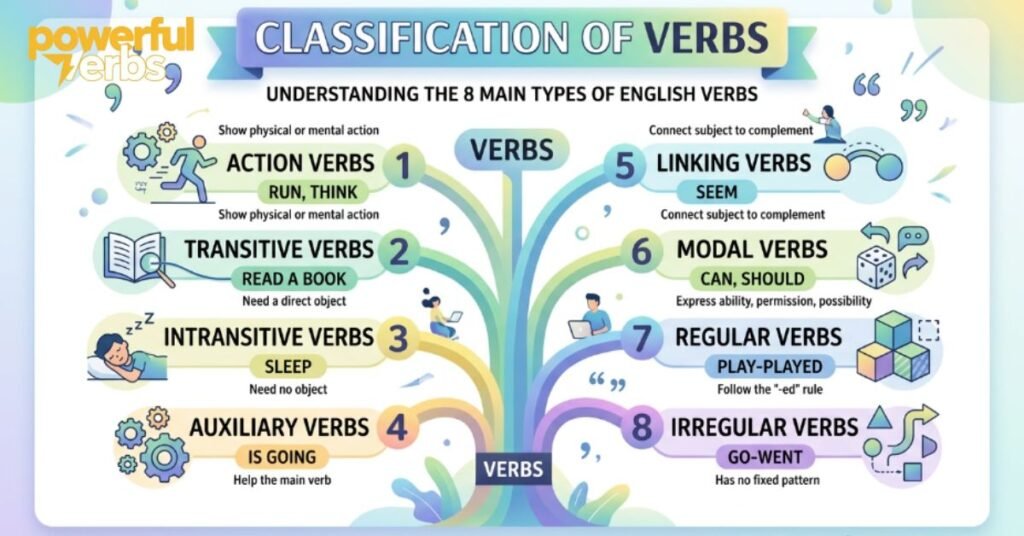
English verbs are classified into eight main types based on how they function in a sentence. Each type has its own definition, rules, and specific role that make sentences more accurate and meaningful.
| # | Verb Type | Key Feature |
| 1 | Action Verbs | Show physical or mental action |
| 2 | Transitive Verbs | Need a direct object |
| 3 | Intransitive Verbs | Need no object |
| 4 | Auxiliary Verbs | Help the main verb |
| 5 | Linking Verbs | Connect subject to complement |
| 6 | Modal Verbs | Express ability, permission, possibility |
| 7 | Regular Verbs | Follow the “-ed” rule |
| 8 | Irregular Verbs | Has no fixed pattern |
Detailed Explanation of the 8 Types of Verbs
✦ Action Verbs
Definition
An action verb expresses something that a person, animal, or thing physically or mentally does. It is the most common type of verb found in everyday English sentences.
Examples
run, jump, eat, write, think, play, read, speak, laugh, swim
Usage in Sentences
- She writes in her diary every night.
- The dog runs across the field.
- He thinks about the answer carefully.
✦ Transitive Verbs
Definition
A transitive verb is an action verb that transfers its action to a direct object. Without the object, the sentence feels incomplete, and the meaning is unclear.
Direct Object Concept
The direct object is the person or thing that receives the action of the verb. In “She kicked the ball,” the verb “kicked” is transitive, and “ball” is the direct object.
Examples
- She bought a new dress. (dress = direct object)
- He sent a message. (message = direct object)
- They painted the wall. (wall = direct object)
✦ Intransitive Verbs
Definition
An intransitive verb expresses an action that does not pass to any object. The sentence is complete and meaningful even without adding any object after the verb.
No Object Requirement
Intransitive verbs stand alone and still make complete sense. In “She laughed,” there is no object needed because the verb “laughed” already gives the full message.
Examples
- The baby cried all night.
- He arrived late to school.
- The birds sing every morning.
✦ Auxiliary (Helping) Verbs
Definition
An auxiliary verb, also called a helping verb, works alongside the main verb to form tenses, questions, negatives, and passive voice sentences. It does not carry the main meaning alone.
Primary & Modal Helpers
Primary auxiliaries include be, have, and do. Modal auxiliaries include can, will, should, must, and may. Both types support the main verb in different ways.
Examples in Sentences
- She is writing a letter. (is = auxiliary)
- They have finished the task. (have = auxiliary)
- He does not understand. (does = auxiliary)
✦ Linking Verbs
Definition
A linking verb connects the subject of a sentence to a word that describes or identifies it. It does not show action but instead shows a state or condition of the subject.
Subject–Complement Relationship
The word that follows a linking verb is called the subject complement. It either describes the subject or renames it. In “She is tired,” the verb links “she” to the description “tired.”
Examples
- He seems happy today.
- The food smells delicious.
- They are good students.
✦ Modal Verbs
Definition
A modal verb is a special type of auxiliary verb that expresses the speaker’s attitude about an action. It shows ability, permission, possibility, or obligation depending on the context.
Functions
| Modal Verb | Function | Example |
| can | ability | She can swim fast. |
| may | permission | You may leave now. |
| might | possibility | It might rain today. |
| must | obligation | You must follow the rules. |
| should | advice | You should study daily. |
| will | future intention | He will come tomorrow. |
| would | polite request | Would you help me? |
| could | past ability | He could run as fast as a child. |
✦ Regular Verbs
Definition
A regular verb follows a fixed and predictable pattern when forming its past tense and past participle. You simply add -ed or -d to the base form of the verb.
“-ed” Rule Formation
| Base Form | Past Tense | Past Participle |
| walk | walked | walked |
| play | played | played |
| jump | jumped | jumped |
| clean | cleaned | cleaned |
| love | loved | loved |
Examples
- She walked to school yesterday.
- They played football all evening.
- He cleaned his room after lunch.
✦ Irregular Verbs
Definition
An irregular verb does not follow the standard “-ed” rule when forming its past tense or past participle. Each irregular verb has its own unique past form that must be memorized separately.
No Fixed Pattern
| Base Form | Past Tense | Past Participle |
| go | went | gone |
| eat | ate | eaten |
| write | wrote | written |
| take | took | taken |
| come | came | come |
| buy | bought | bought |
| run | ran | run |
| speak | spoke | spoken |
Examples
- She wrote a long letter yesterday.
- He went to the market in the morning.
- They ate dinner together last night.
Comparison Section
Transitive vs Intransitive Verbs
| Feature | Transitive | Intransitive |
| Needs an object | Yes | No |
| Action transfers | To an object | Stays with the subject |
| Example | She ate the apple. | She ate quickly. |
| The sentence is complete without an object | No | Yes |
Regular vs Irregular Verbs
| Feature | Regular Verbs | Irregular Verbs |
| Past tense rule | Add “-ed” | No fixed rule |
| Easy to predict | Yes | No |
| Must memorize | No | Yes |
| Example | play → played | go → went |
Linking vs Action Verbs
| Feature | Linking Verbs | Action Verbs |
| Shows action | No | Yes |
| Describes state | Yes | No |
| Followed by | Complement | Object or nothing |
| Example | She is smart. | She runs fast. |
Examples Section
20+ Mixed Examples of All Verb Types
| Sentence | Verb | Type |
| She runs every morning. | runs | Action |
| He kicked the ball hard. | kicked | Transitive |
| The baby cried loudly. | cried | Intransitive |
| She is reading a book. | is | Auxiliary |
| He seems very tired today. | seems | Linking |
| You must follow the rules. | must | Modal |
| They played in the park. | played | Regular |
| She wrote a beautiful poem. | wrote | Irregular |
| The children laughed happily. | laughed | Intransitive |
| He bought a new car. | bought | Transitive/Irregular |
| She can speak three languages. | can | Modal |
| The soup smells delicious. | smells | Linking |
| We have finished our homework. | have | Auxiliary |
| He jumped over the fence. | jumped | Regular |
| They went to school early. | went | Irregular |
| She teaches English grammar. | teaches | Transitive |
| The dog barked all night. | barked | Regular/Intransitive |
| He should study more carefully. | should | Modal |
| She feels happy and relaxed. | feels | Linking |
| They ate lunch together today. | ate | Irregular/Transitive |
| The sun rises in the east. | rises | Intransitive |
| He does not understand this. | does | Auxiliary |
Sentence Breakdown Practice
- “She has written a great essay.” → has = auxiliary, written = irregular past participle
- “He can play the guitar.” → can = modal, play = action verb
- “They cleaned the classroom.” → cleaned = regular transitive verb
Rules & Usage Patterns
How to Identify Verb Types in Sentences
Ask yourself three key questions: Does the verb show action or state? Does it need an object? Does it help another verb? These three questions will help you correctly identify almost any verb type in any sentence.
Common Sentence Structures with Verbs
- Action: Subject + Action Verb + Object → She reads a book.
- Linking: Subject + Linking Verb + Complement → He is smart.
- Auxiliary: Subject + Auxiliary + Main Verb → They are playing.
- Modal: Subject + Modal + Base Verb → You should rest.
Verb Agreement Basics
A verb must always agree with its subject in number. Use singular verbs with singular subjects and plural verbs with plural subjects. For example, say “He runs” not “He run,” and “They run” not “They runs.”
Common Errors
Frequent Mistakes Students Make
- Using irregular verbs with “-ed” → ✗ “She goed” → ✔ “She went”
- Confusing linking and action verbs → ✗ “She looks at beautiful” → ✔ “She looks beautiful.”
- Forgetting the object with transitive verbs → ✗ “He kicked.” → ✔ “He kicked the ball.”
- Wrong modal + verb form → ✗ “She can swims” → ✔ “She can swim”
- Using auxiliary incorrectly → ✗ “She is go” → ✔ “She is going”
How to Correct Them
Always memorize irregular verb forms separately and practice them in sentences daily. Learn which verbs are transitive so you never forget to add the object when writing sentences.
Practice Section
Exercise 1: Fill in the Blanks
Fill each blank with a suitable verb from the given type.
- She __________ (action verb) to school every day.
- He __________ (modal verb) speak three languages fluently.
- They __________ (auxiliary verb) finishing their homework right now.
- The flowers __________ (linking verb) very beautiful in spring.
- She __________ (irregular verb) a letter to her friend last night.
Exercise 2: Identify the Verb Type
Write the type of verb for each underlined word.
- She is a great student. → ___________
- He kicked the ball into the net. → ___________
- They should practice every day. → ___________
- The baby slept for two hours. → ___________
- She has completed all tasks. → ___________
Exercise 3: Choose the Correct Verb
Circle the correct verb to complete each sentence.
- She (go/went) to the market yesterday.
- He (can / cans) solve this problem easily.
- They (is/are) playing in the garden right now.
- The soup (smells / smell) really delicious today.
- She (cleaned / cleans) her room every Saturday morning.
Exercise 4: Sentence Formation Practice
Write one original sentence for each verb type listed below.
- Action Verb → ___________
- Modal Verb → ___________
- Linking Verb → ___________
- Regular Verb → ___________
- Irregular Verb → ___________
Assessment Section
Mini Quiz (10 Questions — MCQ / True & False)
- “She ran fast.” — ran is a:
(a) Regular verb (b) Irregular verb (c) Linking verb
- Modal verbs always need an “-s” in the third person.
True / False
- Which is a linking verb?
(a) run (b) seem (c) kick
- “He kicked the ball.” — This verb is:
(a) Intransitive (b) Transitive (c) Modal
- “She has eaten.” — “has” is an:
(a) Action verb (b) Auxiliary verb (c) Irregular verb
- Regular verbs add “-ed” to form the past tense.
True / False
- Which sentence is correct?
(a) She can swims. (b) She can swim. (c) She cans swim.
- “The milk smells sour.” — “smells” is a:
(a) Action verb (b) Linking verb (c) Modal verb
- Intransitive verbs always need a direct object.
True / False
- Which is an irregular verb?
(a) walked (b) played (c) wrote
Answer Key
- (b) Irregular verb
- False
- (b) seem
- (b) Transitive
- (b) Auxiliary verb
- True
- (b) She can swim.
- (b) Linking verb
- False
- (c) wrote
Creative Application
Story Builder Activity for Students
Read the mini story below and underline every verb you find. Then write which type each verb is next to it.
“Sara woke up early and felt excited. She can speak English very well. She packed her bag and went to school. Her teacher is very kind. The students are learning new grammar rules today. Sara must practice her verbs every night.”
Verbs to identify: woke, felt, can, speak, packed, went, is, are, learning, must, practice—find them all and write their types.
Write Your Own Paragraph Using All Verb Types
Write a short paragraph of 8 to 10 sentences about your school day. Try to use at least one example of each verb type: action, transitive, intransitive, auxiliary, linking, modal, regular, and irregular. Underline each verb and write its type above it.
Summary
Key Takeaways of Verb Types
| Verb Type | One-Line Rule | Quick Example |
| Action Verb | Shows what subject does | She runs daily. |
| Transitive Verb | Needs a direct object | He kicked the ball. |
| Intransitive Verb | Needs no object | She laughed. |
| Auxiliary Verb | Helps the main verb | They are playing. |
| Linking Verb | Connects subject to complement | He seems tired. |
| Modal Verb | Shows ability/permission/possibility | You must study. |
| Regular Verb | Adds “-ed” for past tense | She walked home. |
| Irregular Verb | Has its own past form | He went to school. |
Optional Extension (For Advanced Learning)
Once you master these 8 verb types, you are ready to explore verb tenses, subject-verb agreement, and passive voice. These advanced topics build directly on the verb knowledge you have learned in this article.
Would You Like the Next Lesson?
- Tenses and Verb Forms — Learn how verbs change across 12 English tenses with clear rules and examples.
- Parts of Speech Full Guide—Master all 8 parts of speech, including nouns, adjectives, adverbs, and more.
- Sentence Structure (Simple to Complex) — Learn how to build simple, compound, and complex sentences step by step.
Conclusion
Verbs are the engine of every English sentence—without them, nothing moves, nothing happens, and nothing makes sense. Learning all 8 types of verbs gives you a powerful tool to write correctly, speak confidently, and understand English grammar at a deep level.
Use the practice exercises, review the comparison tables, and apply what you learned in your own writing every day. The more you practice, the more naturally these verb types will appear in your sentences without any effort.
Frequently Asked Questions
1. What are the 8 types of verbs in English grammar?
The 8 types of verbs in English grammar are action verbs, linking verbs, helping (auxiliary) verbs, modal verbs, transitive verbs, intransitive verbs, phrasal verbs, and infinitive verbs—each serving a unique grammatical role in a sentence.
2. What is the difference between a transitive and an intransitive verb with examples?
A transitive verb requires a direct object to complete its meaning (e.g., “She wrote a letter”), while an intransitive verb does not need an object (e.g., “He laughed loudly”).
3. How do linking verbs work in English grammar, and what are some common examples?
Linking verbs connect the subject of a sentence to a describing word or noun, without showing action—common examples include “be,” “seem,” “appear,” “become,” “feel,” “look,” “smell,” “sound,” and “taste.”
4. What is a modal verb, and how is it different from a regular helping verb?
Modal verbs like “can,” “could,” “may,” “might,” “shall,” “should,” “will,” “would,” and “must” express ability, possibility, or necessity, while regular helping verbs like “is,” “are,” “have,” and “do” simply support the main verb in a sentence.
5. Can you give me easy examples of action verbs used in everyday English sentences?
Action verbs describe physical or mental actions—for example, “She runs every morning” (physical) or “He thinks carefully before speaking” (mental) are everyday examples of action verbs in use.
6. What are phrasal verbs in English, and why are they so important to learn?
Phrasal verbs are combinations of a verb and a preposition or adverb that create a new meaning, such as “give up,” “look after,” or “run into“—mastering them is essential because they are widely used in everyday spoken and written English.
7. What is an auxiliary verb, and how is it used in a sentence?
An auxiliary or helping verb works alongside the main verb to form tenses, questions, or negatives—for example, in “She is running” and “Did you eat?” the words “is” and “did” are auxiliary verbs.
8. How do you use infinitive verbs correctly in English grammar?
An infinitive verb is the base form of a verb, usually preceded by “to” (e.g., to run, to speak, to learn), and can function as a noun, adjective, or adverb—for example, “She wants to learn Spanish” uses an infinitive as the object.
9. What is the rule for using modal verbs like “should,” “must,” and “might” in English sentences?
Modal verbs are always followed by the base form of the main verb (without “to”)—for example, say “You must go,” not “You must to go”—and they never change form regardless of the subject.
10. How can I quickly identify which type of verb is being used in an English sentence?
To identify a verb type, ask three questions: Does it show action or a state? Does it need an object? Does it help another verb? Your answers will point you to the correct category among the 8 types of English verbs.

Liam Johnson is a dedicated language expert with 4 years of professional experience. He specializes in Grammar, Vocabulary, and Sentence structure.
