

Introduction
Two small words—but they cause big confusion. “FOR” and “OF” look simple, yet many learners mix them up every day. Once you understand the core idea behind each word, using it correctly becomes much easier.
This lesson will teach you when to use “FOR” and when to use “OF,” with clear rules, real examples, comparison tables, practice exercises, and a quick quiz. By the end, you will feel confident choosing the right word every time.
Why do learners confuse “for” and “of”? Both words are very short and appear in hundreds of sentences. Learners often translate directly from their own language, which gives the wrong result in English. Some phrases also look similar, which makes it easy to mix them up.
What this lesson will help you achieve: By the end of this lesson, you will know the exact difference between FOR and OF. You will be able to pick the right word quickly, fix your old mistakes, and write English sentences with more confidence.
Basic Meaning Overview
What does “FOR” mean? FOR shows purpose, direction, or benefit. It answers the question “why?” or “for whom?” Example: “I bought flowers for my mother.” — Here, FOR tells us who receives the benefit.
What does “OF” mean? OF shows a relationship, connection, or belonging. It links two nouns together. Example: “the color of the sky.” — Here, OF connects “color” to “sky.”
Core Understanding
The idea of “purpose/direction” in FOR. Think of FOR as a pointer—it always points toward a goal, a reason, or a person. “This gift is for you.” — The word FOR directs something toward someone or something.
The idea of “relation/belonging” in OF. Think of OF as a link—it connects two things to show they belong together. “The door of the house.” — The word OF links “door” to “house” to show they are related.
When to Use “FOR”
Main Uses of FOR:
- Purpose or reason — I study for a better future.
- Benefit or recipient — She made tea for her friend.
- Duration of time — He waited for two hours.
- Support or intention — Are you for or against this plan?
When to Use “OF”
Main Uses of OF:
- Belonging or possession—The house of my uncle is big.
- Connection between things — She is the head of the school.
- Part of a whole — A piece of cake is on the table.
- Description or relation — A man of great courage helped us.
Side-by-Side Comparison
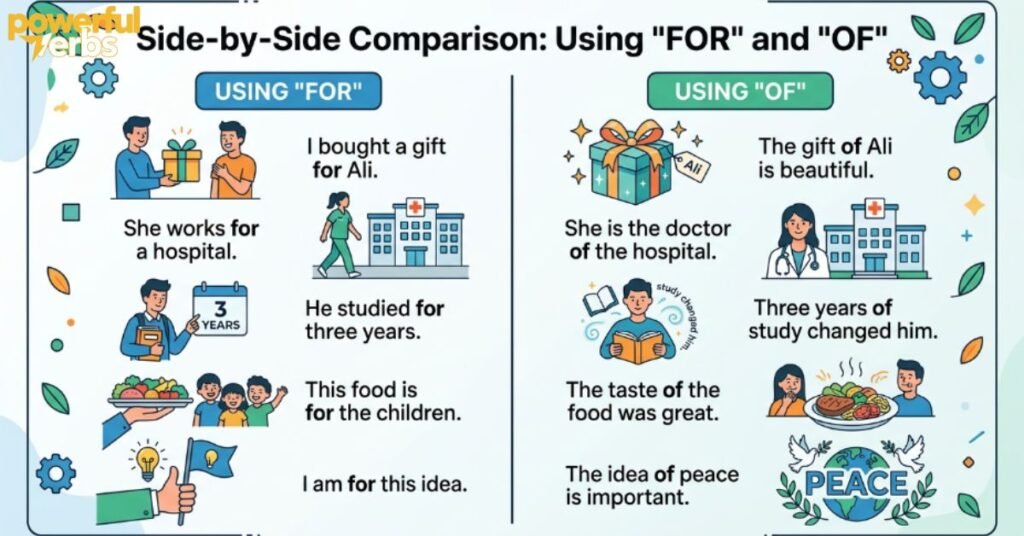
| Using FOR | Using OF |
| I bought a gift for Ali. | The gift of Ali is beautiful. |
| She works for a hospital. | She is the doctor of the hospital. |
| He studied for three years. | Three years of study changed him. |
| This food is for the children. | The taste of the food was great. |
| I am for this idea. | The idea of peace is important. |
Rules and Patterns to Remember
Use FOR when you are showing purpose, benefit, or direction. Ask yourself: “Why?” or “For whom?” — If the answer fits, use FOR. Examples: “for my brother,” “for two days,” “for a good reason.”
Use OF when you are showing ownership, relation, or that something is part of something else. Ask yourself: “Does this belong to something?” — If yes, use OF. Examples: “the end of the road,” “a cup of water,” “the king of the city.”
Common Mistakes Learners Make
Mixing “for” and “of” in sentences:
❌ Wrong: She is the manager for the company. ✅ Right: She is the manager of the company.
❌ Wrong: A glass of water is waiting for you. ✅ Right: A glass of water is waiting for you.
Overthinking fixed phrases: Some phrases are fixed and must be memorized.
- “A lot of,” “a piece of,” “a cup of” → always use OF.
- “Wait for,” “apply for,” “look for” → always use FOR. Do not try to change them.
Incorrect translation habits: Learners sometimes translate word-for-word from Urdu or another language. This causes errors. Instead, think in English and ask: Is this showing purpose? Use FOR. Is this connecting two things? Use OF.
How to Fix These Mistakes:
- Ask yourself: “Am I showing why or for whom?” → use FOR.
- Ask yourself: “Am I connecting two things?” → use OF.
- Thinking trick: Replace FOR with “the purpose “is”—if it makes sense, FOR is correct.
- Thinking trick: Replace OF with “belongs “to”—if it makes sense, OF is correct.
Practice Section
A) Fill in the Blanks (FOR / OF)
- This letter is ______ the teacher.
- The capital ______ Pakistan is Islamabad.
- She waited ______ an hour.
- The color ______ her dress is red.
- He applied ______ a new job.
- A bottle ______ water fell on the floor.
- I am grateful ______ your help.
- The end ______ the story was surprising.
B) Multiple Choice — Choose FOR or OF
- She is the director ___ the school. (for/of)
- He bought flowers ___ his mother. (for/of)
- A piece ___ bread is on the plate. (for/of)
- We have been waiting ___ two hours. (for/of)
- The smell ___ the food is amazing. (for/of)
- This ticket is ___ the concert tonight. (for/of)
C) Sentence Creation Write 2 sentences using FOR and 2 sentences using OF about your daily life. Example: “I wake up early for school.” / “The name of my school is Lahore Grammar.”
D) Error Correction — Fix the Wrong Sentences
- He is the owner for the car.
- She made food of her family.
- A cup for tea is on the table.
- I am looking of my keys.
Answer Key
A) Fill in the Blanks: for, of, for, of, for, of, for, of
B) Multiple Choice: 1-of, 2-for, 3-of, 4-for, 5-of, 6-for
D) Error Correction:
- He is the owner of the car.
- She made food for her family.
- A cup of tea is on the table.
- I am looking for my keys.
Mini Quiz
- The roof ___ the house is broken. (for/of)
- I cooked this meal ___ you. (for/of)
- A lot ___ students passed the exam. (for/of)
- He has worked here ___ five years. (for/of)
- She is the queen ___ the city. (for/of)
- This bag is ___ the trip. (for/of)
- The pages ___ this book are torn. (for/of)
- I am grateful ___ your kindness. (for/of)
Answers: 1-of, 2-for, 3-of, 4-for, 5-of, 6-for, 7-of, 8-for
Creative Activity
Story Building Using “for” and “of”
Read the story below. Notice how FOR and OF are used naturally. Then write your own short paragraph using both words at least twice each.
One morning, Sara went to the market. She was looking for a birthday gift. She found a beautiful box of chocolates. “This is perfect for my best friend,” she said. The price of the box was low. She also bought a bottle of juice. She felt happy for the rest of the day.
Quick Revision Summary
- FOR points toward a purpose, reason, or person. It answers “why?” or “for whom?” Use it for duration, benefit, and support.
- OF connects two things to show they are related. It answers “which?” or “belongs to what?” Use it for possession, parts of a whole, and description.
- When in doubt—purpose or direction? Use FOR. Relation or belonging? Use OF.
Next Lesson Suggestion
You have now mastered FOR and OF. Your next step is to study other common preposition pairs: “to/from,” “in/on,” and “at/in.” These pairs follow similar logic and will build on what you learned today. Once comfortable, you can also explore advanced uses of FOR and OF in formal writing and fixed expressions.
Conclusion
FOR and OF are two of the most common prepositions in English. FOR points toward a purpose or person, while OF connects two things to show relation or belonging. Keeping this simple difference in mind will help you avoid most mistakes.
Practice the exercises, review the rules, and use these words in your own writing every day. The more you use them naturally, the easier they will become. Keep going — you are on the right track.
Frequently Asked Questions
1. What is the difference between “for” and “of” in English grammar?
“For” expresses purpose, duration, or benefit (e.g., This is for you), while “of” shows possession, relationship, or belonging (e.g., The color of the sky).
2. When should I use “for” instead of “of” in a sentence?
Use “for” when you want to show reason, purpose, or intent—as I did it for fun—and use “of” when describing what something belongs to or is made from, like “a cup of tea.”
3. Can you give me simple examples of “for” and “of” used correctly in sentences?
Sure! For example, she baked a cake for her friend. “Of” example: The lid of the jar was tight. Both show relationships, but “for” points to purpose and “of” points to possession or composition.
4. Why do people confuse “for” and “of” in English writing?
People confuse “for” and “of” because both link nouns to other words, but their roles differ—”for” signals intent or exchange, while “of” signals belonging or description, making the distinction subtle for non-native speakers.
5. Is it correct to say “a glass of water” or “a glass for water”?
Both can be correct but mean different things—a glass of water means the glass contains water right now, while a glass for water means the glass is intended or designed to hold water.
6. How do I use “for” correctly when talking about time or duration?
Use “for” with a specific length of time to show how long something lasts—for example, I studied for two hours, or she lived there for a decade. It answers the question “How long?”
7. What are the most common grammar rules for using “of” in English?
Use “of” to show the following: possession (the roof of the house), composition (a bar of chocolate), quantities (a lot of people), and descriptions (a man of courage). It connects a noun to what it belongs to or is made of.
8. How do “for” and “of” work differently in phrases like “because of” versus “because for”?
“Because of” is the correct phrase—it means “as a result of,” like “She left because of the rain.” “Because for” is grammatically incorrect in standard English and should always be avoided.
9. When is it correct to say “in search of” versus “in search for”?
Both are used, but “in search of” is more formal and grammatically traditional, as in “He went in search of answers.” “In search for” is commonly heard in informal speech but is less preferred in written English.
10. How do “for” and “of” differ when used after adjectives like “proud” or “responsible”?
The adjective determines which preposition follows—”proud of” and “responsible for” are fixed collocations in English. “Of” follows adjectives describing feelings toward something, while “for” follows adjectives linked to duty or cause.

Liam Johnson is a dedicated language expert with 4 years of professional experience. He specializes in Grammar, Vocabulary, and Sentence structure.
