

English spelling mistakes are more common than people think—and “losing” vs “loosing” is one of the most searched confusions online. These two words look almost the same, but they have very different meanings. This article will clear everything up in simple, easy English.
Introduction
If you have ever typed “loosing” when you meant “losing,” you are not alone. Millions of people make this mistake every day in texts, emails, and even school exams. The good news is that once you understand the difference, you will never mix them up again.
Quick Answer (Featured Snippet – Difference in One Line)
“Losing” means failing to win or misplacing something. “Loosing” means releasing or setting something free—and it is rarely used in modern English.
Meaning & Core Difference
What Does “Losing” Mean?
“Losing” is the present participle of the verb “lose.” It is used when someone fails to win, cannot find something, or is in the process of no longer having something. It is one of the most commonly used words in everyday English.
- She is losing the game.
- He keeps losing his keys.
- Our team is losing by two points.
What Does “Loosing” Mean?
“Loosing” is the present participle of the verb “loose” when used as a verb. It means to release, untie, or set free. This usage is very rare and mostly found in older English texts, archery, or formal/literary writing.
- The archer was loosing arrows at the target.
- He loosed the dog from its leash.
Key Difference Between Loosing vs Losing
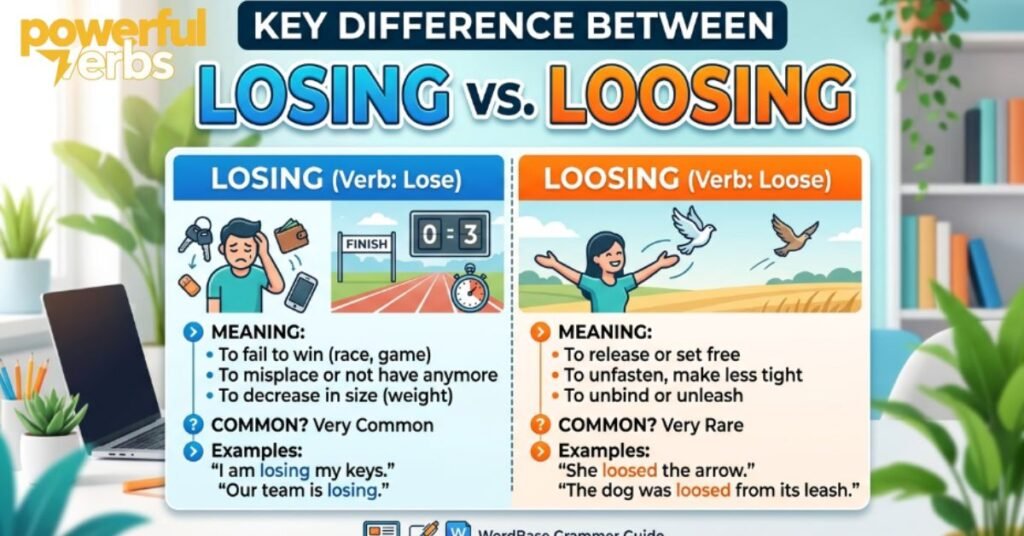
| Word | Base Verb | Meaning | Common? |
| Losing | Lose | To fail, misplace, or not win | Very Common |
| Loosing | Loose (verb) | To release or set free | Very Rare |
The core difference is simple: losing = not winning, while loosing = releasing something. In 99% of everyday writing, the word you need is losing.
Why These Words Are Often Confused
People confuse these words because they look and sound very similar. Both have double-O in the spelling area and end in “-ing.” When people are typing fast, the brain skips the details and picks the wrong one. Also, many people do not know that “loose” can be used as a verb, so they think “loosing” is just a misspelling of “losing.”
Origin & Language Rules
Origin of “Losing”
“Losing” comes from the Old English word “losian,” which meant to be lost or to perish. Over centuries, it evolved into the modern verb “lose,” and its “-ing” form became “losing.” It has been a standard English word for over a thousand years.
Origin of “Loosing”
“Loosing” comes from the Old English word “losian” and later “losen,” meaning to set free or release. It shares its roots with the adjective “loose” but took a different path in meaning. In Middle English literature and the Bible, “loose” as a verb was quite common.
British English vs American English Usage
Both British and American English use “losing” as the standard form for failing or misplacing. “Loosing” is equally rare in both dialects. There is no major difference between British and American English on this point — both prefer “losing” in everyday use.
Is “Loosing” Ever Correct?
Yes — but only in very specific situations. “Loosing” is correct when it means physically releasing something, like an arrow, a rope, or an animal. It also appears in some religious or literary texts. However, in modern casual writing, business writing, or school work, “loosing” rarely appears. If you are writing about a game, a competition, or misplacing something, always use “losing.”
Usage & Grammar
How to Use “Losing” Correctly
Use “losing” any time you talk about the following:
- Not winning a game or competition
- Misplacing an object
- Gradually losing something (weight, money, time, hope)
- Someone being in a bad situation
Examples:
- We are losing the match.
- I am losing my patience.
- She is afraid of losing her job.
How to Use “Loosing” Correctly
Use “loosing” only when the verb “loose” makes sense—meaning to untie, release, or shoot something free.
Examples:
- The hunter was loosing arrows in the field.
- They were loosing the horses from the stable.
Grammar Rules to Remember
- Lose → Losing (one “o,” drop the “e,” add “-ing”)
- Loose → Loosing (two “o’s,” keep both, add “-ing”)
- “Losing” has one “o”—just like the word “lone.”
- If you can replace the word with “releasing,” use “loosing.” If not, use “losing.”
Common Situations Where “Losing” Is Used
- Sports: The team is losing the championship.
- Relationships: He is scared of losing her.
- Health: She has been losing weight.
- Objects: I keep losing my phone.
- Money: The company is losing profit.
Examples Section
Losing in Sentences (Easy Examples)
- They are losing the debate badly.
- I hate losing at chess.
- He is losing his hair at a young age.
- Stop losing focus during class.
- Our business is losing customers every month.
- She is losing hope of finding her cat.
- Are you losing weight on purpose?
- The player kept losing points due to fouls.
Loosing in Sentences (Correct Usage Examples)
- The soldier was loosing arrows from the hilltop.
- She was loosing the knot slowly with her fingers.
- The farmer loosed the cattle into the open field.
- He loosed the sails and let the wind take over.
Real-Life Conversation Examples
Example 1 – Wrong:
“We are loosing this game.”
Example 1 – Correct:
“We are losing this game.”
Example 2 – Correct Use of Loosing:
“The archer stood still before loosing the final arrow.”
Example 3 – Wrong:
“I keep loosing my glasses everywhere.”
Example 3 – Correct:
“I keep losing my glasses everywhere.”
Losing vs Loosing in Everyday Writing
In everyday writing—texts, emails, social media, and school assignments—you will seldom need “loosing.” Stick to “losing” unless you are writing about archery, releasing animals, or literary fiction. When in doubt, ask: Does this mean “not winning” or “releasing”? That question alone will save you every time.
Common Mistakes
Common Mistakes with Loosing and Losing
- Writing “loosing a game” instead of “losing a game.”
- Using “loosing weight” instead of “losing weight.”
- Saying “I am loosing my mind” instead of “losing my mind.”
- Confusing “loose” (adjective) with “lose” (verb) and then incorrectly forming “loosing.”
Why People Incorrectly Use “Loosing”
The main reason is the double-O in “loose” and the visual similarity to “losing.” People also over-correct when they are unsure — they add an extra “o” thinking it looks more complete. Additionally, autocorrect on phones sometimes suggests “loosing” without flagging it as wrong.
Frequent Errors in Exams and Writing
- ❌ “He is loosing the competition.” → ✅ “He is losing the competition.”
- ❌ “We are loosing time.” → ✅ “We are losing time.”
- ❌ “She is loosing her confidence.” → ✅ “She is losing her confidence.”
- ❌ “Stop loosing things.” → ✅ “Stop losing things.”
Correct Approach to Avoid Mistakes
Before using either word, ask yourself: Am I talking about releasing something? If not, use losing. If yes, use loosing. Also, remember that “lose” has one “o”—so “losing” also has one “o.” It is that simple.
Comparison Section
Loosing vs Losing – Side-by-Side Comparison Table
| Feature | Losing | Loosing |
| Base verb | Lose | Loose (as verb) |
| Number of O’s | One (lo-sing) | Two (loo-sing) |
| Common meaning | Not winning / misplacing | Releasing/untying |
| Used in daily writing | Very often | Very rarely |
| Correct in a sports context | ✅ Yes | ❌ No |
| Correct in the archery context | ❌ No | ✅ Yes |
| Formal writing | Common | Rarely |
Losing vs Loose vs Loosing (Important Difference)
- Loose (adjective) = not tight. “This shirt is too loose.”
- Lose (verb) = to fail or misplace. “Don’t lose your ticket.”
- Losing (verb -ing form) = in the process of losing. “He is losing his wallet again.”
- Loosing (verb -ing form of loose) = releasing. “She was loosing the rope.”
These four words are connected but serve completely different roles. Knowing all four will make your English much stronger.
Quick Memory Trick to Remember the Difference
“Losing has one O — just like you lose ONE thing at a time.”
If the word has two O’s (loosing), it means releasing or letting go—think of two O’s as two open doors letting something escape. If it has one O (losing), you’re not winning, or you’ve lost something.
Trend & Usage Data
Loosing vs Losing – Google Trends & Usage Data
According to Google Trends and corpus data from Google Books, “losing” is searched and used hundreds of times more frequently than “loosing.” In fact, “loosing” barely registers on usage charts in the 21st century. Most modern dictionaries list “loosing” as a rare or archaic verb form.
Which Word Is More Common in 2026?
In 2026, “losing” dominates all forms of writing — social media, news articles, academic papers, and everyday conversation. “Loosing” is so uncommon that many native English speakers are not even aware it is a real word. If you are writing for an online audience, using “loosing” in place of “losing” will make your content look like it has a spelling error, even if it is technically being used correctly in an archery context.
Extra Sections
When NOT to Use “Loosing”
Do not use “loosing” when:
- Talking about a sports match or game
- Describing weight loss or hair loss
- Writing about emotions like “losing hope” or “losing patience.”
- Referring to losing money, time, or opportunities
- Using it in any school or professional writing unless it is clearly about releasing something
Can “Loosing” Be Used in Formal Writing?
“Loosing” can appear in formal writing only when it is used in its correct sense—releasing or untying. For example, in a military history paper, you might write: “The archers began loosing their arrows at dawn.” Outside of such rare contexts, “loosing” should be avoided in formal writing because most readers will think it is a spelling error.
Tips to Improve Your English Spelling
- Read more books and articles in English — patterns stick naturally
- Use a spellchecker, but also learn the rules behind corrections
- Keep a personal list of words you commonly misspell
- Practice writing sentences with confusing word pairs
- When unsure, look up the base verb first, then form the -ing version
Commonly Confused Words Like Losing
| Confused Pair | Quick Difference |
| Lose vs Loose | Lose = verb (to fail); Loose = adjective (not tight) |
| Then vs Than | Then = time; Than = comparison |
| Your vs You’re | Your = possession; You’re = you are |
| Their vs There vs They’re | Ownership/place/contraction |
| Affect vs Effect | Verb / Noun |
| Its vs It’s | Possession / it is |
Conclusion
The difference between “losing” and “loosing” is simple once you know it. “Losing” is the word you need almost every time — whether you are talking about a game, an object, or an emotion. “Loosing” only appears in rare, specific situations involving release or archery, and is seldom used in everyday modern English.
Always remember: one “o” in losing means you are one step away from getting it right. Keep this rule in mind, and you will never confuse these two words again.
Frequently Asked Questions
1. What is the difference between “losing” and “loosing” in English?
“Losing” means failing to win or misplacing something, while “loosing” means releasing or setting something free—though “loosing” is rarely used in everyday modern English.
2. How do I know when to use “losing” versus “loosing” in a sentence?
Use “losing” when talking about defeat, misplacement, or loss — for example, “We are losing the game.” Use “loosing” only when you mean releasing or untying something, like “loosing an arrow.”
3. Is loosing even a real word, or is it always a spelling mistake?
Yes, “loosing” is a real English word, but it’s uncommon and means to release or set free. In most everyday contexts, if you’ve typed “loosing,” it’s likely a spelling error for “losing.”
4. Why do so many people confuse the words losing and loosing when they write?
People confuse them because “loose” and “lose” look nearly identical, and adding “-ing” makes them even harder to tell apart — but only “losing” drops the silent ‘e,’ while “loosing” keeps the double ‘o.’
5. What does it mean when someone says they are losing their mind?
“Losing their mind” is an idiom meaning someone feels overwhelmed, extremely stressed, or is acting irrationally — for example, “With all these deadlines, I’m losing my mind.”
6. Can you give me a simple example sentence using losing and loosing correctly?
Sure! “Our team is losing the match” uses “losing” correctly (defeat). “The archer was loosing arrows at the target” uses “loosing” correctly (releasing).
7. What is the correct spelling when talking about losing weight—is it losing or loosing weight?
The correct spelling is always “losing weight”—with one ‘o.’ Writing “loosing weight” is a common spelling mistake that means something completely different.
8. How do I remember the spelling difference between losing and loosing once and for all?
Use this simple trick: “lose” has one ‘o’ because you already lost a letter—so “losing” also has one ‘o.’ If you have two o’s, you’ve got “loose,” not “lose.”
9. Is loosing ever used in modern English writing, or has it become completely outdated?
“Loosing” does appear in formal, literary, or archaic contexts—like “loosing the hounds” or “loosing an arrow” — but it is rarely used in modern everyday writing or speech.
10. What part of speech are losing and loosing, and how are they used grammatically in a sentence?
Both are present participles—verb forms ending in “-ing.” “Losing” comes from the verb “to lose” and “loosing” from “to loose,” and both function as verbs or adjectives in a sentence, such as “the losing team” or “loosing the knot.”

Liam Johnson is a dedicated language expert with 4 years of professional experience. He specializes in Grammar, Vocabulary, and Sentence structure.
