

Internet slang moves fast, and new abbreviations pop up every day in text messages, social media, and online chats. BFFR is one of those terms that has taken over Gen Z conversations in a big way. If you’ve seen it and had no idea what it means, you’re in the right place.
This article breaks down everything you need to know about BFFR — what it means, how people use it, where it came from, and when you should or shouldn’t say it. By the end, you’ll feel totally comfortable with this slang term.
Introduction
What BFFR is and why people see it in chats
BFFR is a slang acronym that people use in text messages, social media comments, and online chats. You’ll see it pop up when someone is reacting to something unbelievable, dramatic, or just plain ridiculous. It’s become one of the go-to expressions for Gen Z when they want to say something strong without typing a whole sentence.
Why does slang like this become popular online?
Short expressions travel fast on the internet because people want to react quickly and with emotion. Slang like BFFR saves time and still carries a lot of meaning and attitude. Once a term gets used in memes or viral posts, it spreads to group chats, comment sections, and texting within days.
What Does BFFR Mean in Text?
Simple explanation in one clear meaning
BFFR stands for “Be F*ing For Real.” It’s a stronger, more intense version of saying “are you serious right now?” or “come on, be honest.” The word in the middle adds extra emotion and emphasis to the reaction.
Most widely accepted usage today
Today, almost everyone who uses BFFR means the same thing—a call for honesty or a reaction of disbelief. It’s used when someone says or does something that seems unbelievable, fake, or over the top. This meaning is consistent across platforms like TikTok, Instagram, Twitter/X, and iMessage.
How People Actually Use BFFR
Tone in conversation (serious, funny, sarcastic)
BFFR doesn’t always mean the same thing in every conversation because tone changes everything. Sometimes it’s funny and playful, sometimes it’s genuinely frustrated, and other times it’s pure sarcasm. The way it’s used tells you more than the words themselves.
Context-based meaning instead of a fixed definition
The actual meaning of BFFR depends heavily on what’s happening in the conversation. If a friend says something dramatic, “BFFR” is a funny clapback. If someone is lying or exaggerating, it becomes a serious challenge to be honest.
Different Interpretations of BFFR
“Be F***ing For Real” (most common meaning)
The most widely used and accepted meaning is “Be F***ing For Real.” This is what the vast majority of people mean when they type it. It carries a mix of shock, disbelief, and a demand for honesty all at once.
Other, less common or incorrect expansions
Some people have tried to expand BFFR as “Best Friend For Real” or “Best Friends Forever Real,” but these are not common or widely accepted. These interpretations are usually made by people who don’t know the actual meaning. In modern slang culture, the strong version is clearly the dominant definition.
Why meanings vary online
The internet is full of people from different backgrounds, ages, and regions, so slang gets misunderstood sometimes. Older users might try to assign friendlier meanings to acronyms that are actually edgy or sarcastic. This is why context always matters when you’re reading slang in a conversation.
Real Chat Examples of BFFR
Casual conversation
Friend 1: I just walked 10 miles to avoid paying for parking. Friend 2: BFFR 😭 You could’ve just taken the bus.
Friend group chat
Alex: I’m thinking of quitting my job because my boss looked at me weirdly. Jordan: BFFR, Alex; that’s not a real reason lol. Sam: Yeah, BFFR, talk to him first.
Gaming or online chat
Player 1: That shot was totally unfair; the game is broken. Player 2: BFFR, you were literally standing in the open.
Social media comments
(Post says: “I can’t believe people still use cash in 2026.”) Comment: BFFR, not everyone has Apple Pay. 💀
Why People Use BFFR in Conversations
Expressing disbelief
BFFR is the perfect response when someone says something that seems impossible or too dramatic to be true. It instantly communicates that you can’t believe what you just read or heard. It’s a one-word reality check that hits harder than just saying “Really?”
Calling out exaggeration
When someone is clearly blowing things out of proportion, BFFR cuts right through it. It tells the other person to stop being dramatic and be honest about what’s actually happening. It’s direct, punchy, and leaves no room for confusion.
Reacting emotionally in short form
Sometimes you feel strongly about something but don’t want to write a paragraph. BFFR lets you pack a big emotional reaction into just four letters. It saves time while still making your feelings completely clear.
Where BFFR Is Commonly Used
Social media platforms
BFFR is all over TikTok comment sections, Twitter/X threads, and Instagram replies. It gets used when someone posts something outrageous, controversial, or unbelievable. It’s also common in video captions when creators are reacting to crazy content.
Messaging apps
iMessage, WhatsApp, Snapchat, and Discord are full of BFFR moments between friends. It’s the kind of slang that fits perfectly in a quick text reply without needing any extra explanation. People in close friend groups use it constantly throughout the day.
Memes and online reactions
BFFR has made its way into meme culture as a caption or reaction image phrase. You’ll see it paired with dramatic faces, shocked expressions, or confused animals for comedic effect. Once slang enters meme culture, it becomes a permanent part of internet language.
Tone and Intent Behind BFFR
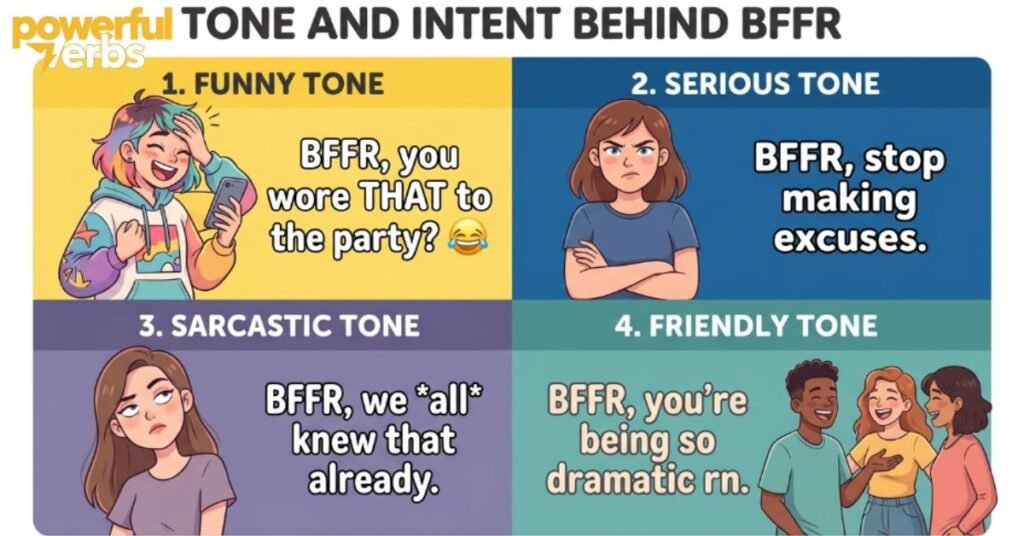
| Tone | When It’s Used | Example |
| Funny | Reacting to something silly | “BFFR, you wore THAT to the party 😂.” |
| Serious | Calling someone out for lying | “BFFR, stop making excuses.” |
| Sarcastic | Mocking an obvious statement | “BFFR, we all knew that already.” |
| Friendly | Playful teasing among friends | “BFFR, you’re being so dramatic rn.” |
Funny usage
When “BFFR” is used funnily, it’s light-hearted and not meant to hurt anyone’s feelings. It’s more like a playful eye-roll than actual frustration. Friends use it on each other all the time when something is just too ridiculous not to laugh at.
Serious usage
In a more serious context, BFFR is used when someone genuinely needs to hear the truth. It’s a way of saying “stop pretending and be real with me right now.” The tone is firm and direct, not playful at all.
Sarcastic usage
Sarcastic BFFR usually comes with a 💀 or 😭 emoji and is meant to mock something obvious or over-the-top. It’s often used online when someone states something ridiculous as if it’s a fact. The sarcasm is usually pretty clear from the surrounding conversation.
Friendly usage
Between close friends, BFFR is mostly just a fun reaction with no real edge to it. It’s like saying, “Oh, come on, stop it,” in a teasing, affectionate way. This is probably the most common way friends use it day to day.
When to Use BFFR
Informal chats
BFFR works perfectly in relaxed, casual conversations where there are no rules about what you can say. If you’re texting a friend about something wild that happened, BFFR fits right in. It adds personality and energy to a message without needing much context.
Friends and peers
This slang is best used with people you already know well and are comfortable with. People your own age who use the same internet slang will understand it immediately. It creates a sense of shared language and connection when used among friends.
Online comments
Social media comment sections are great places to use BFFR when reacting to posts or other comments. It’s short enough to type quickly and strong enough to say exactly what you mean. Just make sure the post’s vibe matches the tone before you drop it.
When Not to Use BFFR
Professional communication
Never use BFFR in a work email, a message to your boss, or any kind of professional conversation. Slang like this looks unprofessional and can be misunderstood in a work setting. Keep your workplace messages clear, polite, and formal.
Formal messages
School assignments, official forms, college applications, and any formal writing are not the place for BFFR. Even in academic group chats, it’s better to stay neutral and professional. Save the slang for after-school texts with your friends.
Sensitive situations
If someone is going through something difficult or emotional, BFFR can come across as dismissive or rude. It’s not the right response when someone is vulnerable or needs support. Read the room — some moments call for kindness, not internet slang.
How to Respond to BFFR
Funny reply
“Okay, okay BFFR, I was just joking 😭.” “I AM being for real tho 💀, this really happened.”
Casual reply
“Lol sorry, but it’s true.” “That’s literally what happened tho.”
Supportive reply
“I know it sounds crazy, but hear me out.” “I get it, but I’m being honest with you.”
Confused reply
“Wait, what does that mean lol?” “Why are you saying that??”
Friendly comeback
“No, YOU BFFR; stop being dramatic.” “BFFR back at you; you know I’m right 😂.”
Similar Slang Words and Alternatives
- FR (For Real) — A softer version of BFFR, used to agree or emphasize that something is true
- No way—A classic expression of disbelief that everyone understands
- Are you serious? The full phrase version of what BFFR is trying to say
- Deadass—New York slang meaning completely serious or for real
- Ong (On God) — Used to swear something is true or react strongly to something unbelievable
BFFR vs Other Internet Slang
Comparison with similar expressions
| Slang | Meaning | Strength Level |
| FR | For Real | Mild |
| Deadass | Completely serious | Medium |
| BFFR | Be F***ing For Real | Strong |
| No cap | No lie, I’m serious | Medium |
| Ong | On God (swearing it’s true) | Strong |
Differences in tone and strength
BFFR is stronger and more expressive than simple alternatives like “FR” or “for real.” It carries more emotion, more attitude, and more urgency than most of its alternatives. That’s exactly why it became so popular — it hits harder.
Where BFFR Came From
Internet slang evolution
BFFR is part of a long tradition of internet users shortening emotional phrases into quick abbreviations. Just like LOL, OMG, and SMH before it, BFFR followed the same pattern of turning feelings into fast-to-type letters. The internet keeps creating new ones because communication keeps speeding up.
Gen Z communication style
Gen Z grew up texting and posting online, so they naturally developed a fast, expressive, and often funny language style. BFFR fits perfectly into that world because it’s short, emotional, and multi-purpose. It reflects how this generation communicates — quick, honest, and with a lot of attitude.
Meme culture influence
Memes played a huge role in spreading BFFR beyond just friend groups and into mainstream internet culture. When a phrase gets used in a viral meme format, millions of people learn it almost overnight. Meme culture is basically the fastest dictionary in the world for slang.
Is BFFR Still Used Today?
Current usage trend
Yes, BFFR is absolutely still being used in 2026 and doesn’t show any signs of disappearing soon. It shows up regularly in TikTok comments, Twitter/X threads, Discord servers, and everyday text conversations. Its versatility keeps it fresh and relevant even as newer slang comes along.
Why is it still relevant in 2026 conversations
BFFR has stuck around because it fills a very specific emotional gap—the need to express disbelief or demand honesty in just one short burst. Not every slang word finds that perfect niche, but BFFR did. As long as people are dramatic online (which is forever), BFFR will have a place in conversations.
Common Misunderstandings
Thinking it’s a positive acronym
Some people see BFFR and assume it has something to do with “best friends” because of the letters BFF. This leads them to misread it as something warm or supportive when it’s actually the opposite in tone. Always look at the context before assuming what any acronym means.
Confusing it with friendship-related meanings
Because BFF already exists as a popular acronym meaning “Best Friends Forever,” it’s easy to attach that same energy to BFFR. But the R changes everything — it makes the phrase a strong reaction, not a term of endearment. These two acronyms have nothing to do with each other in actual usage.
Misreading tone in messages
Even if you know what BFFR means, getting the tone wrong can cause misunderstandings. Someone might send it jokingly, and the receiver takes it seriously, or vice versa. When in doubt, add an emoji or follow-up message to make the tone clear.
Quick Summary
Simple breakdown of meaning and usage
| Feature | Detail |
| Full form | Be F***ing For Real |
| Main use | Expressing disbelief or demanding honesty |
| Common platforms | TikTok, Instagram, iMessage, Discord |
| Used by | Mostly Gen Z and younger millennials |
| Tone | Funny, sarcastic, serious, or friendly |
| Best used with | Close friends and peers |
| Avoid using in | Work, school, formal, or sensitive settings |
| Still popular? | Yes, widely used in 2026 |
Conclusion
BFFR is a powerful piece of internet slang that packs a lot of meaning into four simple letters. It’s expressive, flexible, and perfectly designed for the fast-moving world of online communication. Whether you’re calling someone out or just reacting to something wild, BFFR gets the job done.
Now that you know exactly what it means, where it came from, and when to use it, you’re fully caught up with modern chat language. Just remember to read the room, keep it out of formal settings, and have fun with it in the right conversations.
Frequently Asked Questions
1. What does BFFR mean when someone sends it to you in a text message?
BFFR stands for “Be F***ing Fr Real,” used in text messages to express disbelief or shock or to tell someone to be honest and serious about what they’re saying.
2. How do you use BFFR in a text conversation without sounding rude?
Use BFFR when reacting to something unbelievable or calling out exaggeration—for example, “You paid $500 for that? BFFR 😂”—but keep in mind it contains strong language, so use it only with close friends.
3. Is BFFR a positive or negative thing to say in a text message?
BFFR is generally neutral to playful — it’s not meant as a serious insult but rather as a blunt, humorous way to challenge something that sounds unrealistic or too dramatic.
4. What is the difference between BFFR and FR in texting slang?
“FR” means “For Real” and is a simple agreement or emphasis, while “BFFR” is the intensified, more expressive version that adds shock or disbelief—making it much stronger in tone and emotion.
5. Where did the slang term BFFR originally come from?
BFFR gained popularity through TikTok and social media platforms around 2022–2023, where Gen Z users began using it in reaction videos and comment sections to call out unrealistic or dramatic situations.
6. Can BFFR be used funnily or sarcastically in texts?
Yes, BFFR is very commonly used sarcastically or humorously—for example, if a friend says they’re “too tired” after sleeping 10 hours, you might reply, “BFFR right now 💀” to joke about how unbelievable their claim sounds.
7. Is it appropriate to use BFFR in professional or formal text messages?
No, “BFFR” is not appropriate for professional or formal communication because it contains explicit language—it should only be used in casual conversations with friends or peers who are familiar with Gen Z slang.
8. What are some real-life examples of BFFR used in everyday text messages?
A common example would be: “You’re canceling plans again? BFFR!” or “She said she didn’t know the test was today… BFFR, it’s been on the board all week.” Both show disbelief or frustration in a casual, texting tone.
9. How do you respond when someone sends you BFFR in a text message?
When someone sends you BFFR, they’re challenging your honesty or expressing disbelief—you can respond by clarifying your point, laughing it off with an emoji, or doubling down with “No, seriously, I’m dead serious! 😭”
10. Are there other slang words similar to BFFR that mean the same thing in texting?
Yes, slang terms like “NGL” (Not Gonna Lie), “ISTG” (I Swear to God), “No Cap,” and “FR FR” carry similar energy to BFFR—all used to emphasize truth, disbelief, or a call for seriousness in casual text conversations.

Liam Johnson is a dedicated language expert with 4 years of professional experience. He specializes in Grammar, Vocabulary, and Sentence structure.
