

Introduction
Reading tone in text is really hard. When someone talks to you face-to-face, you can hear their voice and see their face. But online, all you have are words — and words alone can be confusing.
That is why “/s” became popular on the internet. It is a small tag that tells people, “Hey, I was being sarcastic.” In this guide, you will learn exactly what “/s” means, where it came from, how to use it, and why it matters.
What Does “/s” Mean?
Simple Explanation
“/s” is a tone tag used at the end of a sentence to show sarcasm. It tells the reader that the message is not meant to be taken seriously or literally. Think of it as a label that flips the meaning of what was just said.
Quick Example
Someone says, “Oh wow, Monday mornings are my absolute favorite. /s”
That “/s” at the end tells you the person hates Monday mornings. Without it, you might think they actually love them. One small tag changes everything.
Why “/s” Exists
The Problem It Solves
Sarcasm is one of the most misunderstood things in online communication. What sounds funny out loud can come across as rude or confusing in a text message.
- Misunderstood sarcasm causes fights, hurt feelings, and awkward moments online every single day.
- Lack of tone in text means people cannot hear if you are joking or serious, so they guess—and they often guess wrong.
“/s” was created to fix this exact problem. It removes the guessing and makes your meaning crystal clear.
What “/s” Communicates Instantly.
Using “/s” sends two very important signals to the reader without needing any extra explanation.
- Tone clarity — the reader immediately knows the sentence is sarcastic, not sincere.
- Intent behind the message — it shows you are joking, not being mean or passive-aggressive.
One tiny tag does a lot of work. It saves relationships, avoids drama, and keeps conversations friendly.
How “/s” Works in Language
Sentiment Inversion (Simple Explanation)
Sentiment inversion means saying the opposite of what you mean. For example, saying “Great, another homework assignment” when you actually hate homework. Your words say one thing, but your real feelings are the opposite. “/s” marks that flip so the reader does not miss it.
Why the Slash Matters
The slash “/” is used because it looks like a tag in coding language. It signals the “end” of something—in this case, the end of a sincere statement. It tells the reader: close the literal meaning, and open the sarcastic one. The format is borrowed from HTML tags like and that open and close ideas.
Where You’ll See “/s” Online
In Text Messages
“/s” shows up in casual texting between friends and family. It keeps jokes from turning into arguments. If you text someone “You’re so smart /s,” and they know the tag, they will laugh instead of getting offended.
On Social Platforms
On platforms like Instagram, TikTok, and Facebook, people use “/s” in captions and comments. It helps followers understand the mood of a post, especially when the humor is dry or not obvious.
In Forums and Comments
Comment sections are full of sarcasm, and “/s” helps readers catch it fast. Without it, sarcastic comments often start heated debates because people take them literally.
Platform-Specific Use
On Reddit (Why It’s Common)
Reddit is probably where “/s” is most popular. Reddit threads move fast, topics get serious quickly, and users come from all over the world. “/s” became a community standard there because it prevents massive misunderstandings in long comment chains. Many subreddits actually expect you to use it.
On Twitter / X (Why It’s Debated)
On Twitter/X, “/s” is more controversial. Some users feel it kills the joke by explaining it too much. Others argue it is necessary because tweets are short and the tone is very easy to miss. The debate is still going, but both sides agree that sarcasm without a label causes problems.
In Comment Sections
YouTube and news comment sections are full of sarcastic remarks that people mistake for real opinions. “/s” helps readers know when someone is mocking an idea versus genuinely supporting it. It keeps comment sections a little less chaotic.
How to Use “/s” Correctly
Correct Placement
Always put “/s” at the very end of the sarcastic sentence. It should come right after the last word with a space before it.
Example: “I just love sitting in traffic for two hours. /s”
Incorrect Placement
Do not put “/s” in the middle of a sentence or at the beginning. It only works when it closes the sarcastic statement.
Wrong: “/s I love waiting in line for hours.” Wrong: “I /s love waiting in line for hours.”
Quick Checklist
- Put /s at the end of the sentence
- Add a space before /s
- Use it only for the sarcastic part
- Do not use it on every sentence in a paragraph
- Make sure the sentence actually sounds sarcastic
When to Use “/s”—and When Not To
When It Helps
Use “/s” when your message could easily be misread as serious. If the sarcasm is subtle, dry, or directed at someone who might not know you well, adding “/s” is the smart move. It protects you from drama.
When It Feels Unnecessary
If you are talking to a close friend who always gets your humor, “/s” might feel extra. Between people who know each other’s tone well, the tag can feel robotic or over-explained. Context matters a lot.
Tone vs Overuse
Using “/s” on every other sentence makes your writing feel cold and mechanical. Sarcasm should feel natural — save the tag for moments when the message is genuinely confusing. Overusing it trains readers to ignore it.
Examples in Real Conversations
With “/s”
“Oh sure, waking up at 5 am is the best thing ever. /s” — The reader laughs because they understand it is sarcasm.
“Yeah, I totally love it when my Wi-Fi goes out during a movie. /s” — Clear, funny, and no confusion.
Without “/s”
“Oh sure, waking up at 5 am is the best thing ever.” — Someone might actually think you are a morning person.
“Yeah, I totally love it when my Wi-Fi goes out during a movie.” — Could sound sincere or could sound sarcastic. Nobody knows.
Comparison
| Sentence | With /s | Without /s |
| “I love Mondays.” | Clearly sarcastic | Sounds genuine |
| “Great, more meetings.” | Funny complaint | Might seem enthusiastic |
| “This is so easy.” | Could be mocking | Could be sincere |
“/s” in Meme Culture
- Humor trends online move fast, and “/s” has become part of that humor. Memes often use sarcasm layered with irony, and “/s” helps audiences track which layer they are on.
- Irony layers get deep in internet culture. Sometimes a post is sarcastic about being sarcastic. In those cases, “/s” becomes both a punchline and a tool, and knowing when it is being used seriously versus ironically is part of the joke itself.
“/s” vs Other Tone Indicators
Comparison Table
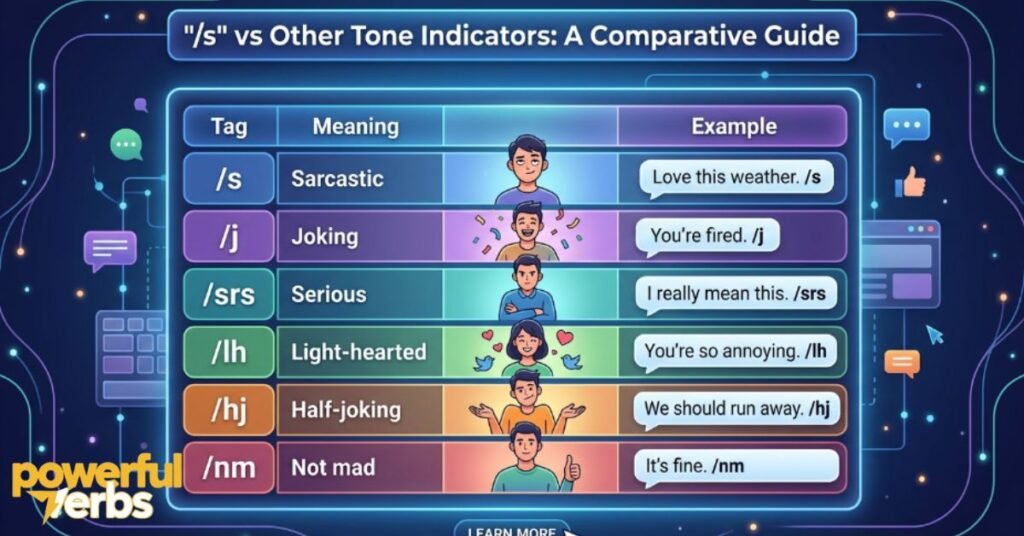
| Tag | Meaning | Example |
| /s | Sarcastic | “Love this weather. /s” |
| /j | Joking | “You’re fired. /j” |
| /srs | Serious | “I really mean this. /srs” |
| /lh | Light-hearted | “You’re so annoying. /lh” |
| /hj | Half-joking | “We should run away. /hj” |
| /nm | Not mad | “It’s fine. /nm” |
Common Alternatives
Some people use emojis instead of tone tags. The 🙄 eye-roll emoji signals sarcasm. The 😂 emoji shows that something is a joke. Italics or quotation marks are also used to hint at irony. But none of these are as direct and clear as “/s.”
Sarcasm vs Irony in Online Language
Sarcasm
Sarcasm is saying the opposite of what you mean, usually to mock or tease. It has a sharp, critical edge. “Oh yeah, you’re a real genius,” said after someone makes a mistake, is sarcasm. The speaker means the person is not a genius at all.
Irony
Irony is broader. It is when the outcome or statement is the opposite of what was expected, but without the mocking tone sarcasm carries. A firefighter’s house burning down is ironic. Saying “wow, what great timing” when everything goes wrong at once is ironic. “/s” covers sarcasm more than pure irony.
What “/s” Does NOT Mean
- Avoiding confusion is important here. Some people think “/s” means “seriously”—it does not. Others think it stands for “said” as in “as said before. “Both are wrong.
- Common misinterpretations include thinking “/s” makes a sentence aggressive or passive-aggressive on purpose. In reality, it does the opposite. It reduces aggression by making the humor clear. “/s” is a friendly signal, not a hostile one.
Cultural and Language Differences
- Not everyone understands tone tags. In many cultures, sarcasm is not a common communication style. Someone from a culture where people speak more directly may read “/s” and still not understand the joke. The tag only works if the reader knows what it means.
- Cross-language limitations are real. If someone is reading in their second or third language, they may miss the sarcasm entirely, even with the tag. In global conversations, it is always better to be extra clear rather than rely on tone tags alone.
How “/s” Affects Communication Today
- Clarity vs over-explaining is a constant tension. “/s” makes online conversations clearer, but some people feel it over-explains humor and kills the vibe. The best writers use it only when necessary — not as a crutch for every joke they make.
- Changing digital habits is part of the story, too. A generation of people grew up using tone tags, and they now expect them in sensitive conversations. It has quietly changed the way people think about tone, empathy, and communication responsibility online.
How “/s” Interacts with AI and Algorithms
Why Sarcasm Confuses Systems
AI systems like chatbots, content filters, and sentiment analysis tools struggle with sarcasm. They read words literally. A sentence like “Oh great, another data breach” might be flagged as positive by an AI because of the word “great.” The sarcasm flies right over the algorithm.
How “/s” Helps Interpretation
When “/s” is present, a well-trained AI can recognize the sarcasm marker and adjust its reading of the sentence. Some modern language models are trained specifically to detect tone tags. This is one reason “/s” is actually useful beyond just human readers—it helps machines understand human humor better, too.
Is “/s” Still Relevant?
- Current usage trends show that “/s” is still widely used, especially by younger generations and in online communities that value clear communication. It is not going away anytime soon, even as new slang and tags appear every year.
- The future of tone indicators might include new formats, AI-assisted tone detection, or even built-in platform features that let you tag the tone of a post. But for now, “/s” remains one of the simplest and most recognized tools for marking sarcasm online.
Related Tone Tags
- /j means joking—used when something sounds harsh but is meant in fun. Example: “You’re the worst. /j”
- /srs means serious—used to show that a message is not a joke, especially after a funny conversation. Example: “No but actually, are you okay? /srs”
- /lh means lighthearted—used when teasing someone gently without any real criticism. Example: “You always do this. /lh”
- “/hj” means half-joking—used when something is part joke and part real. Example: “I kind of want to quit. /hj”
- “/nm” means “not mad”—used to reassure someone that there is no anger behind a message. Example: “You forgot again. /nm”
- /pos means positive connotation—used to make sure a word or phrase is read in a good way. Example: “You’re so weird. /pos”
Common Mistakes to Avoid
- Wrong placement is one of the most common errors. Putting “/s” at the start or middle of a sentence confuses readers. It always goes at the end, right after the sarcastic statement is finished.
- Overuse makes the tag lose its power. If you use “/s” after everything, readers stop trusting it. Save it for sentences where the sarcasm is not obvious on its own.
- Using it in serious contexts is a big mistake. If someone is going through something difficult, dropping a “/s” in the middle of the conversation feels dismissive and rude. Know when humor is welcome and when it is not.
Quick Summary
| Topic | Key Point |
| What /s means | Mark’s sarcasm at the end of the sentence |
| Why it exists | Solves tone confusion in text |
| Where it is used | Reddit, Twitter, texts, comments |
| Correct use | End of sentence, with a space |
| When to skip it | Close friends, obvious jokes |
| Related tags | /j, /srs, /lh, /hj, /nm |
| Common mistake | Overusing it or wrong placement |
| AI relevance | Helps machines detect sarcasm |
Conclusion
“/s” is one of the smallest but most powerful tools in online communication. It takes one second to type, and it can save a friendship, prevent a fight, or just make a joke land the way it was supposed to.
As long as people keep texting, posting, and commenting online, tone will always be hard to read. Tags like “/s” are not just internet slang—they are a new kind of punctuation for the digital world.
Frequently Asked Questions
1. What does /s mean when someone uses it at the end of a message online?
The /s tag is a sarcasm marker used at the end of a sentence to signal that the statement is sarcastic, helping readers understand the tone since text lacks vocal cues.
2. Why do people put /s at the end of their sentences on Reddit and social media?
People use /s on Reddit and social media to clearly label sarcasm so their joke or ironic comment isn’t misunderstood, especially in text where tone of voice isn’t visible.
3. Where did the /s sarcasm tag originally come from on the internet?
The /s tag originated from HTML-style formatting conventions, mimicking closing tags like </sarcasm>, and became widely popularized on Reddit as a simple shorthand for sarcasm.
4. How do I use the /s tag correctly in an online comment or text message?
Simply write your sarcastic statement and add /s at the very end—for example, “Oh great, another Monday. Love those /s” — to let readers know you’re being sarcastic.
5. Does everyone online know what /s means, or is it only used in certain communities?
While /s is widely recognized on platforms like Reddit, Twitter, and Discord, not all internet users are familiar with it, so it’s most reliable in tech-savvy or community-driven spaces.
6. Is there a difference between using /s and just writing “lol” or “jk” to show sarcasm?
Yes—/s specifically flags sarcasm, while “jk” means “just kidding” and “lol” signals humor broadly; /s is the clearest and most direct way to label irony or sarcasm online.
7. Can using the /s tag actually help avoid misunderstandings in online arguments or debates?
Absolutely — the /s tag prevents sarcastic comments from being taken literally, which helps reduce unnecessary conflicts or hurt feelings in heated online discussions.
8. Are there other sarcasm or tone tags similar to /s that people use in online conversations?
Yes, tone tags like /j (joking), /hj (half-joking), /srs (serious), and /irony are also used, especially in neurodivergent-friendly communities where clear communication of tone is especially helpful.
9. Why is the /s sarcasm marker especially important for people with autism or social communication differences?
For neurodivergent individuals who may find it harder to detect implied tone, /s removes ambiguity by explicitly stating that a message is sarcastic, making online communication more inclusive and accessible.
10. Should I always use /s when being sarcastic online, or are there times when it’s better to leave it off?
Use /s when there’s a real risk of being misunderstood—if your sarcasm is obvious from context or you’re with close friends who know your humor, leaving it off is perfectly fine.

Liam Johnson is a dedicated language expert with 4 years of professional experience. He specializes in Grammar, Vocabulary, and Sentence structure.
