

Every single day, your brain runs on autopilot — and not always in your favor. Negative habits are silent saboteurs that quietly drain your energy, damage your health, destroy your focus, and strain your most valuable relationships. The most troubling part? Most people do not even realize they have these destructive routines until the consequences become impossible to ignore.
Whether you are a student struggling with chronic procrastination, an adult trapped in a cycle of unhealthy behaviors, or a parent trying to guide your child toward smarter choices — this deeply researched guide on negative habits and bad habit examples is built specifically for your needs.
This article covers 150+ bad habit examples organized by life category, explains the neuroscience behind habit formation, and provides proven, actionable strategies to help you swap destructive patterns for empowering ones. Unlike shallow competitor lists, every section here delivers real depth, psychology-backed context, and practical solutions you can apply starting today.
The journey toward a better version of yourself begins with one honest look in the mirror. Let us start there.
1. What Are Negative Habits? (The Psychology Behind Bad Behavior)
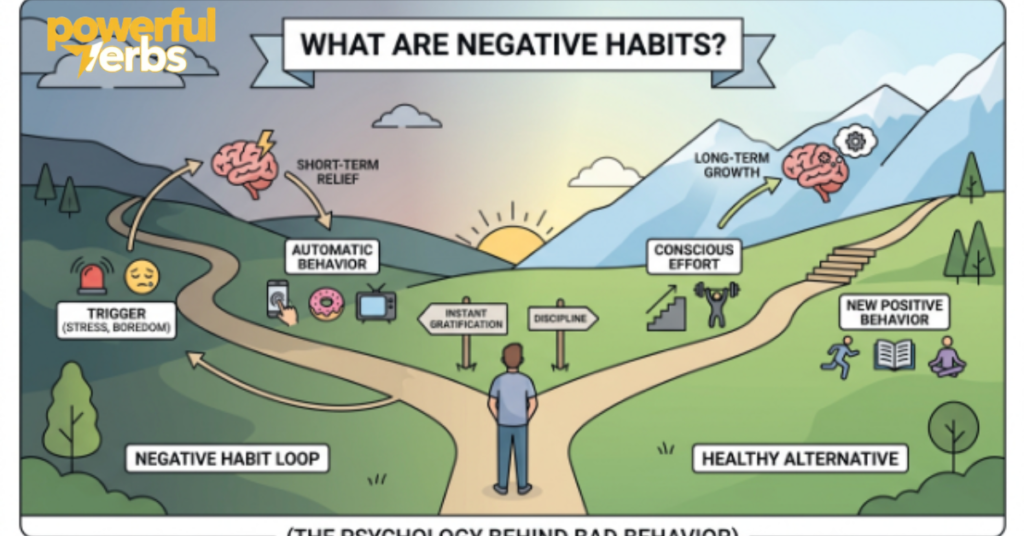
A negative habit is any repeated, automatic behavior that delivers short-term comfort or temporary reward while causing long-term damage to your physical health, emotional well-being, financial stability, productivity, or personal relationships.
Unlike deliberate conscious decisions, habits are largely automatic behavioral loops stored deep within the brain’s basal ganglia — the neural region responsible for pattern recognition, routine execution, and reward-seeking behavior. This neurological reality explains precisely why bad habits feel effortless to fall into yet incredibly difficult to escape.
Behavioral psychologists define every habit using the 3-Part Habit Loop, a model popularized by researcher Charles Duhigg and supported by decades of neuroscience:
| Stage | What Happens | Real-Life Bad Habit Example |
| Cue (Trigger) | A stimulus activates the habit pathway | Feeling stressed at work |
| Routine (Behavior) | The automatic negative action is performed | Reaching for cigarettes or junk food |
| Reward (Result) | Short-term relief reinforces the loop | Temporary feeling of calm or comfort |
The most critical insight from this model: you cannot permanently delete a habit from your brain — you can only replace the routine while keeping the cue and reward. This understanding separates people who successfully overcome negative habits from those who repeatedly fail.
Key Takeaway: Negative habits are not moral failures or character flaws. They are learned neurological patterns that can be consciously unlearned with the right approach, consistent effort, and proper support systems.
2. How Bad Habits Form Inside Your Brain
Bad habits do not develop randomly. They grow through a process called neurological reinforcement — each time you repeat a behavior and experience even a small reward, your brain strengthens the associated neural pathway. Over time, this pathway becomes so deeply grooved that the behavior happens without conscious thought.
Primary Factors That Accelerate Bad Habit Formation
Chronic stress and anxiety activate the brain’s primitive reward-seeking system, pushing people toward familiar behaviors that offer quick emotional relief — regardless of long-term consequences.
Environmental conditioning means that certain locations, specific people, particular times of day, or sensory triggers (a smell, a sound, a visual cue) can automatically activate habitual responses without any conscious decision being made.
Dopamine dependency plays a central role. Habits that release dopamine — the brain’s primary pleasure chemical — become self-reinforcing. Social media scrolling, sugar consumption, gambling, and substance use all hijack this system.
Emotional avoidance drives many of the most harmful habits. People develop routines specifically designed to numb, distract from, or suppress uncomfortable emotions rather than process them in healthy ways.
Social modeling and environment mean that the habits of people around you dramatically influence your own behavioral patterns — especially during childhood and adolescence when neural pathways are most impressionable.
3. The True Cost of Ignoring Negative Habits
Many people underestimate how severely bad habits affect their lives because the damage accumulates gradually rather than appearing all at once. Here is a clear picture of what is truly at stake:
Physical Health Consequences — Poor sleep habits, unhealthy eating patterns, sedentary behavior, and substance use collectively increase the risk of heart disease, type 2 diabetes, obesity, chronic fatigue, and premature aging.
Mental and Emotional Damage — Habits like negative self-talk, chronic overthinking, social comparison, and emotional suppression are strongly linked to clinical anxiety, depression, and low self-esteem.
Financial Destruction — Impulsive spending, gambling, avoiding financial planning, and lifestyle inflation can quietly accumulate into thousands of dollars of unnecessary debt and missed wealth-building opportunities.
Relationship Erosion — Habits like constant interrupting, chronic criticism, emotional unavailability, and dishonesty slowly corrode even the strongest relationships, often beyond repair.
Career Stagnation — Procrastination, poor time management, resistance to feedback, and unprofessional behavior directly limit career advancement and income potential.
Compound Effect — Perhaps most dangerously, bad habits compound over time. A habit that wastes just 30 minutes per day accumulates to over 180 hours per year — time that could have been invested in learning, relationships, or health.
4. How to Break Bad Habits: A Science-Backed 6-Step Framework
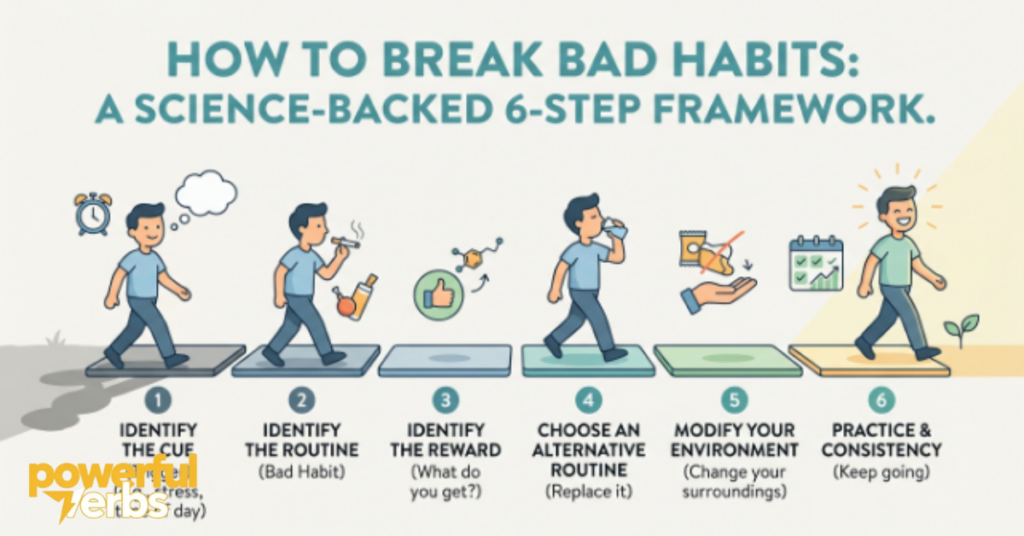
Breaking negative habits is genuinely difficult — but absolutely achievable with the right systematic approach. Here is a proven framework grounded in behavioral psychology and neuroscience research:
Step 1: Identify and Document Your Triggers
Keep a habit journal for 7 to 14 days. Each time you engage in the negative habit, write down exactly what preceded it — your emotional state, physical location, time of day, who was present, and what you were thinking. Patterns will quickly emerge. You cannot change what you cannot clearly see.
Step 2: Define the Specific Reward You Are Seeking
Ask yourself honestly: what itch is this habit scratching? Are you seeking stress relief, social connection, stimulation, distraction, validation, or physical comfort? Identifying the underlying need makes it possible to find healthier ways to meet that same need.
Step 3: Design a Replacement Routine
Rather than simply trying to stop the negative behavior (which creates a vacuum the old habit will rush to fill), deliberately design a competing positive behavior that provides a similar reward. Replace stress-eating with a 5-minute walk. Replace mindless scrolling with a 10-minute reading session. Replace cigarettes with deep breathing exercises.
Step 4: Restructure Your Environment
Environmental design is one of the most powerful and underutilized tools for habit change. Remove triggers from your immediate environment. Make bad habits harder to access and good habits easier to execute. Delete social media apps from your home screen. Keep healthy snacks at eye level. Put your phone in another room at bedtime.
Step 5: Implement a 21/90 Commitment Strategy
Research suggests it takes a minimum of 21 days to begin breaking a habit and approximately 90 days to establish a genuinely new automatic behavior. Commit to your replacement routine for at least 21 consecutive days without exception. Track your streak visually — a simple calendar with X marks creates powerful psychological momentum.
Step 6: Build an Accountability System
Share your habit-change goal with a trusted friend, family member, or mentor. Research consistently shows that social accountability increases the probability of follow-through by more than 65 percent. Consider joining a support group, working with a behavioral coach, or using habit-tracking apps to maintain consistent accountability.
5. Master List: 150+ Negative Habits Everyone Should Know and Avoid
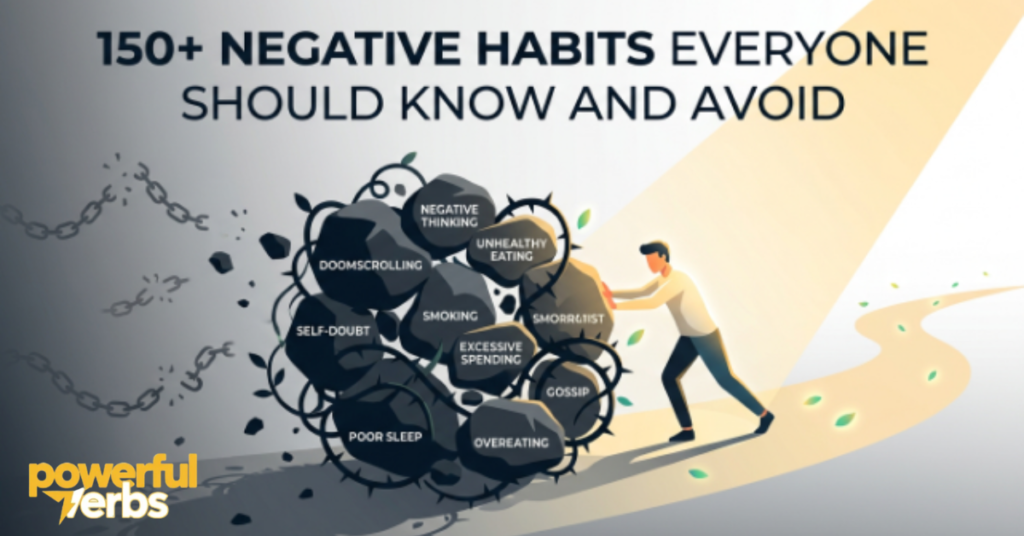
This comprehensive master list covers the full spectrum of negative habits across all major life areas. Use this as your personal self-awareness checklist.
Health and Body Negative Habits
- Chronic procrastination on health appointments
- Skipping breakfast consistently
- Eating junk food as primary nutrition
- Consuming excessive added sugar daily
- Drinking insufficient water throughout the day
- Overeating during emotional distress
- Eating meals too quickly without mindful chewing
- Late-night eating close to bedtime
- Relying heavily on caffeine to function
- Smoking cigarettes or using tobacco products
- Drinking alcohol excessively and regularly
- Avoiding all forms of physical exercise
- Maintaining consistently poor sitting posture
- Oversleeping on weekends disrupting your body clock
- Staying awake past midnight without necessity
- Ignoring routine medical and dental checkups
- Nail biting as a stress response
- Skin picking or hair pulling compulsively
- Consuming excessive processed and ultra-refined foods
- Holding in emotions rather than processing them healthily
Mental and Emotional Negative Habits
- Persistent negative self-talk and inner criticism
- Chronic overthinking that paralyzes decision-making
- Catastrophizing minor setbacks into major disasters
- Comparing yourself constantly to others on social media
- Perfectionism that prevents starting or completing tasks
- Excessive worrying about events beyond your control
- Ruminating repeatedly on past mistakes and failures
- Avoiding all situations that cause discomfort or anxiety
- Suppressing and bottling up difficult emotions
- Engaging in black-and-white all-or-nothing thinking
- Seeking external validation for every decision you make
- Maintaining a chronically pessimistic worldview
- Refusing to accept constructive feedback or criticism
- Staying permanently locked inside your comfort zone
- Practicing self-sabotage when success feels unfamiliar
- Dismissing your own achievements and minimizing wins
- Overanalyzing every social interaction after it ends
- Using humor to deflect from genuine emotional pain
- Refusing professional mental health support when needed
- Ignoring the early warning signs of burnout and exhaustion
Social and Relationship Negative Habits
- Interrupting others mid-sentence during conversations
- Talking excessively without actively listening
- Gossiping about friends, colleagues, or acquaintances
- Spreading unverified rumors or secondhand information
- Being chronically late to appointments and commitments
- Canceling plans repeatedly at the last minute
- Holding grudges and refusing to forgive past wrongs
- Criticizing others frequently without offering solutions
- Being judgmental about choices that do not affect you
- Using passive-aggressive communication instead of direct honesty
- Avoiding difficult but necessary conversations
- Lying habitually even about inconsequential matters
- Cheating in games, academics, or professional settings
- Taking credit for work that others contributed to
- Being chronically rude or dismissive to service workers
- Overreacting emotionally to minor misunderstandings
- Excessive jealousy that poisons close relationships
- Isolating yourself from supportive social connections
- Using sarcasm as a default communication weapon
- Forgetting to express genuine gratitude to important people
Productivity and Time Management Negative Habits
- Procrastinating on important tasks until the last moment
- Multitasking excessively, reducing quality of all outputs
- Poor time blocking and scheduling throughout the day
- Not maintaining organized to-do lists or priority systems
- Ignoring deadlines until they become critical emergencies
- Overcommitting to obligations you cannot realistically fulfill
- Spending hours on low-value busy work while avoiding priorities
- Starting multiple projects simultaneously without finishing any
- Working without defined goals or measurable milestones
- Skipping regular breaks, leading to cognitive fatigue
- Being perpetually disorganized in physical and digital spaces
- Avoiding planning for the future due to uncertainty anxiety
- Constantly checking email and notifications interrupting deep work
- Delaying difficult decisions until circumstances force your hand
- Blaming external circumstances for your own unfinished responsibilities
- Neglecting important tasks in favor of comfortable trivial ones
- Saying yes automatically without evaluating realistic capacity
- Working in chaotic environments that sabotage concentration
- Failing to review and learn from completed projects and mistakes
- Treating rest and recovery as laziness rather than necessity
Digital and Technology Negative Habits
- Scrolling social media mindlessly for hours without purpose
- Using your smartphone during family meals and conversations
- Checking your phone immediately upon waking each morning
- Reading and replying to messages while driving
- Binge-watching television series for consecutive hours
- Excessive online gaming that displaces real-life responsibilities
- Oversharing deeply personal information on public platforms
- Engaging in arguments and conflict with strangers online
- Consuming violent, disturbing, or degrading content regularly
- Using screens for stimulation instead of meaningful leisure
- Never taking digital detox breaks from connected devices
- Allowing push notifications to interrupt every productive session
- Doom-scrolling negative news that amplifies anxiety and helplessness
- Using technology as a primary escape from real-world problems
- Neglecting face-to-face relationships in favor of digital connections
Financial Negative Habits
- Impulsive shopping triggered by emotions rather than genuine need
- Living consistently beyond your income without a sustainable budget
- Accumulating credit card debt through minimum-payment thinking
- Never tracking where your money actually goes each month
- Procrastinating on building an emergency financial safety fund
- Gambling or speculative investing money you cannot afford to lose
- Comparing your lifestyle and possessions to wealthier peers
- Avoiding all conversations about money due to stress or shame
- Making major financial decisions impulsively without research
- Neglecting retirement savings during your peak earning years
Career and Professional Negative Habits
- Arriving unprepared to meetings and professional presentations
- Missing deadlines that affect colleagues and team deliverables
- Avoiding speaking up with valuable ideas in professional settings
- Resisting learning new skills relevant to your industry
- Burning bridges with former employers or professional contacts
- Taking personal calls and browsing unrelated content during work hours
- Failing to communicate proactively when problems arise
- Neglecting professional development, certifications, and continued learning
- Speaking negatively about colleagues or management to peers
- Taking on excessive workload while refusing to delegate appropriately
6. Bad Habit Examples for Students
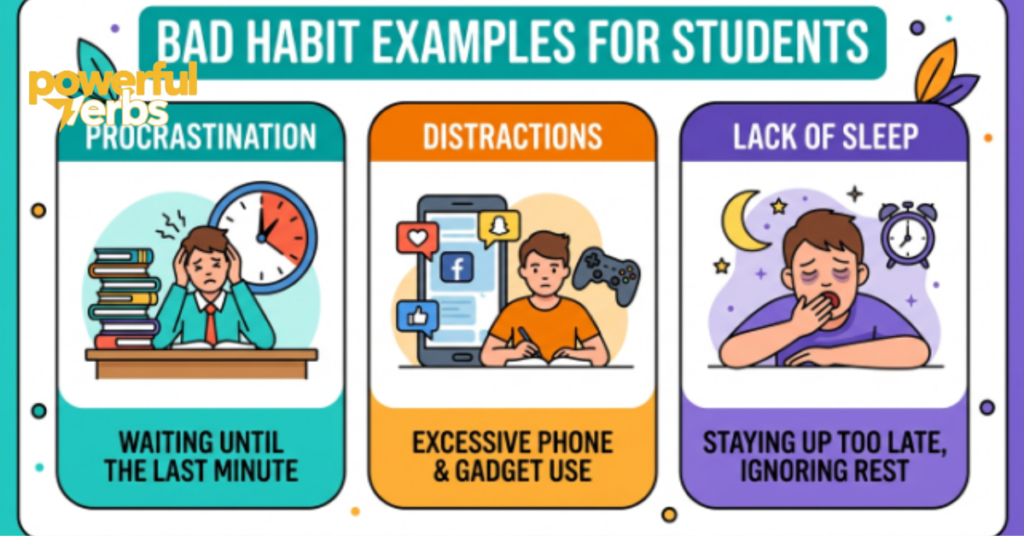
Students face a unique constellation of negative habits that directly undermine academic performance, mental health, and long-term career trajectory. Understanding and addressing these habits early creates a powerful foundation for lifetime success.
Academic Performance Habits That Hurt Students
Procrastinating on Assignments and Projects — Perhaps the most universally recognized student bad habit, academic procrastination goes far beyond mere laziness. It is typically driven by perfectionism, fear of failure, or overwhelming task size. Students who consistently wait until the final hours produce lower-quality work, experience significantly higher stress, and miss opportunities to genuinely learn the material. The solution involves breaking assignments into small, dated micro-tasks and beginning each study session with the hardest item first.
Cramming Instead of Spaced Repetition Learning — Last-minute cramming might rescue a single exam grade, but it produces almost no long-term knowledge retention. Research from cognitive psychology consistently demonstrates that spaced repetition — reviewing material at increasing intervals over time — produces dramatically better memory consolidation and deeper conceptual understanding. Students who cram are essentially borrowing from tomorrow to survive today.
Skipping Classes and Lectures Regularly — Missing even a small percentage of classes compounds quickly. Beyond the lost information, students who skip frequently miss contextual explanations, in-class examples, and the interpersonal signals instructors provide about what material will actually appear on assessments.
Passive Rather Than Active Studying — Re-reading notes and highlighting text are among the least effective study strategies known to educational psychology. Active recall — testing yourself, explaining concepts aloud, creating visual maps — produces far superior comprehension and retention. Students who confuse time spent with learning achieved chronically underperform their actual potential.
Overusing Smartphones During Study Sessions — A smartphone within arm’s reach reduces available cognitive capacity even when the screen is off. The mental effort of resisting potential notifications occupies working memory that should be processing academic content. Placing devices in another room during study blocks is one of the highest-leverage academic interventions available to students.
Additional Student Bad Habits to Eliminate
- Copying homework or submitting others’ work as your own
- Staying awake gaming or watching content on exam nights
- Eating nutritionally poor food that impairs cognitive function
- Neglecting physical exercise that directly boosts brain performance
- Avoiding tutoring or academic support out of embarrassment
- Disorganized note-taking that makes review sessions impossible
- Setting unrealistic study goals that guarantee daily failure
- Comparing academic performance to peers rather than personal growth
- Ignoring mental health symptoms that are affecting concentration
- Refusing to ask questions in class out of fear of appearing uninformed
7. Negative Habits for Adults
Adults carry a particularly heavy burden when it comes to negative habits — because adult responsibilities magnify every consequence, and the habits formed in adulthood often persist for decades without deliberate intervention.
Health-Related Adult Bad Habits
Neglecting Preventive Medical Care — Adults frequently postpone routine health screenings, dental visits, and annual checkups due to time pressure, cost concerns, or low-grade health anxiety. This habit is particularly costly because most serious health conditions are dramatically easier and less expensive to treat when detected early. Skipping prevention is never actually saving time — it is borrowing against future crisis.
Sedentary Work and Leisure Patterns — The combination of desk-based professional work and screen-based entertainment means many adults spend 12 or more hours daily in seated positions. This level of physical inactivity is now classified as an independent risk factor for cardiovascular disease, metabolic disorders, and musculoskeletal problems — regardless of whether individuals exercise intermittently.
Chronic Sleep Deprivation as a Badge of Honor — A troubling cultural norm positions insufficient sleep as evidence of dedication or productivity. In reality, sleeping fewer than 7 hours consistently impairs judgment, emotional regulation, immune function, hormone balance, and long-term cognitive health. No amount of willpower compensates for the neurological costs of sleep debt.
Relationship and Social Adult Bad Habits
Overworking at the Expense of Family Connection — Many adults justify excessive work hours by pointing to financial necessity or career ambition. While economic realities are real, chronically prioritizing professional output over presence in close relationships creates irreversible damage — particularly with children during critical developmental windows.
Using Substances to Manage Stress — Alcohol, recreational substances, prescription medication misuse, and even excessive caffeine consumption are commonly used by adults as stress regulation tools. While these may provide temporary relief, they prevent the development of genuine emotional resilience and frequently create secondary problems that exceed the original stress they were meant to address.
8. Bad Habit Examples in Relationships
Relationships are perhaps the domain where negative habits cause the most far-reaching damage, because the people we harm are those we value most. The habits below represent some of the most common and most destructive patterns observed in romantic partnerships, friendships, and family dynamics.
Communication Habits That Destroy Relationships
Chronic Interrupting and Talking Over Others — This habit communicates, at a deeply subconscious level, that your thoughts are more important than the other person’s. Over time, partners who are consistently interrupted stop sharing vulnerably, creating emotional distance that is difficult to bridge.
Criticism Versus Complaint — Relationship researcher Dr. John Gottman’s decades of research identified criticism as one of the primary predictors of relationship breakdown. The difference between a complaint (“I felt hurt when you didn’t call”) and a criticism (“You never think about anyone but yourself”) seems subtle but is psychologically enormous. Criticism attacks the person; a complaint addresses the specific behavior.
Stonewalling and Emotional Withdrawal — When conflict becomes overwhelming, some partners shut down entirely — going silent, leaving rooms, or becoming emotionally unavailable. While this may reduce immediate tension, it communicates rejection and abandonment to the other party, escalating underlying issues rather than resolving them.
Dishonesty Through Omission — Many people in relationships maintain technically truthful communication while strategically omitting information their partner would genuinely want or need to know. This pattern erodes trust gradually and systematically, often surfacing dramatically when the omissions are eventually discovered.
Additional Relationship Negative Habits
- Keeping score of past wrongs as relationship leverage
- Involving extended family or friends in private couple conflicts
- Using your partner’s vulnerabilities against them during arguments
- Prioritizing phone use over quality time and genuine presence
- Expressing contempt through eye-rolling, mockery, or dismissiveness
- Avoiding genuine emotional intimacy due to fear of vulnerability
- Projecting your own insecurities onto your partner’s behavior
- Making important shared decisions without appropriate consultation
- Comparing your partner unfavorably to other people
- Refusing to acknowledge when you are genuinely wrong
9. Bad Habit Examples for Kids
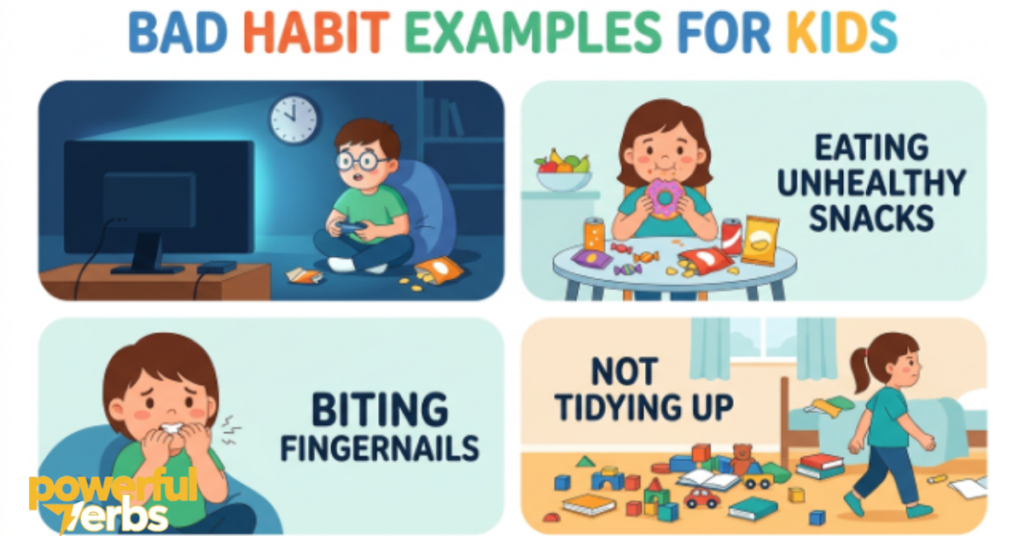
The negative habits children develop during formative years create neural pathways that, without conscious intervention, will shape their adult patterns of thinking, relating, and behaving. Parents and educators play an irreplaceable role in identifying and redirecting these early behavioral patterns.
Physical and Health Habits in Children
Excessive and Unstructured Screen Time — Research consistently links excessive childhood screen consumption to delayed speech development, reduced attention span, impaired sleep quality, diminished physical activity, and difficulty developing the patience required for deep learning. The issue is not screens themselves but the displacement of developmental activities — physical play, creative exploration, social interaction — that screens replace.
Irregular and Poor Sleep Patterns — Children require significantly more sleep than adults to support brain development, emotional regulation, and immune function. Habits like resisting bedtime, using devices in bed, and irregular sleep scheduling during weekends disrupt the circadian rhythm in ways that affect concentration, mood, and behavior throughout the following day.
Unhealthy Eating Habits Formed Early — The dietary preferences formed during childhood have remarkable staying power into adulthood. Children who develop habits of rejecting vegetables, choosing processed snacks over whole foods, and using food as an emotional reward carry these patterns forward with significant long-term health consequences.
Social and Behavioral Habits in Children
Disrespectful Communication Patterns — Talking back, dismissing adult guidance, and using disrespectful language are habits that, if left uncorrected, translate into authority conflicts in educational settings, workplaces, and social environments throughout life.
Lying to Avoid Consequences — Children who develop habitual dishonesty as a conflict-avoidance strategy miss learning the critical life skill of accountability. Natural consequences, delivered with empathy and consistency rather than punishment, are far more effective long-term teachers than shame-based responses.
Additional Children’s Negative Habits
- Not brushing teeth regularly despite parental reminders
- Avoiding reading and rejecting intellectual challenges
- Being chronically impatient and unable to delay gratification
- Interrupting adults’ conversations without recognizing social cues
- Excluding peers from activities based on superficial differences
- Throwing tantrums rather than developing verbal emotional expression
- Being careless with shared belongings and public property
- Refusing to take responsibility for mistakes and errors
- Mimicking aggressive behaviors observed in media or games
- Developing screen dependency as a primary emotional regulation tool
10. Mental Health Destroying Negative Habits
These habits deserve particular attention because their damage is largely invisible until it becomes severe. Mental health habits form gradually through repeated patterns of thought and emotional response — but their cumulative effect can be devastating.
Chronic Negative Self-Talk — The internal narrative you maintain about yourself is arguably the single most influential factor in your psychological well-being. People who habitually interpret events through a lens of self-blame, inadequacy, or hopelessness experience measurably higher rates of depression and anxiety regardless of external circumstances.
Social Comparison as a Default Mental Activity — Social comparison has always existed, but social media has transformed it into a constant, always-available cognitive habit. Regularly measuring your behind-the-scenes reality against others’ curated highlights creates a structural inequality that reliably produces feelings of inadequacy, envy, and dissatisfaction.
Avoidance of Discomfort as a Life Strategy — Anxiety grows in direct proportion to avoidance. Every time you avoid a situation that makes you uncomfortable, your brain records the avoidance as confirmation that the situation was genuinely dangerous, making the anxiety stronger. Gradual, deliberate exposure to manageable discomfort is the foundation of psychological resilience.
Neglecting Sleep as Mental Health Treatment — Sleep is not optional maintenance for mental health — it is the primary mechanism through which the brain processes emotional experiences, consolidates memories, and regulates mood-related neurotransmitters. Chronic sleep deprivation is both a symptom and a cause of deteriorating mental health.
Rumination Without Resolution — There is a meaningful difference between constructive reflection (reviewing an experience to extract lessons) and destructive rumination (replaying painful events without movement toward resolution). Rumination is strongly correlated with depression severity and duration.
11. Professional and Career Bad Habits
Your career success is shaped not only by your skills and knowledge but by the daily professional habits you maintain. These often-overlooked behaviors can quietly determine whether talented individuals advance, stagnate, or actively damage their professional reputation.
- Arriving to meetings consistently unprepared and unfocused
- Failing to follow through on professional commitments and promises
- Avoiding difficult conversations until situations reach crisis level
- Speaking negatively about organizational leadership in informal settings
- Resisting organizational change rather than adapting proactively
- Taking sole credit for collaborative team achievements
- Neglecting to build and maintain a genuine professional network
- Working reactively rather than proactively on strategic priorities
- Using passive-aggressive behavior when direct communication feels risky
- Failing to document important professional agreements and commitments
- Dismissing feedback from supervisors without genuine consideration
- Allowing workplace conflict to fester unaddressed for extended periods
- Undermining colleagues through subtle competitive behaviors
- Avoiding skill development because current abilities feel sufficient
12. Digital and Technology Bad Habits
Our relationship with technology is perhaps the defining behavioral challenge of the current era. The negative habits that develop around digital consumption are particularly insidious because they are deliberately engineered and reinforced by the platforms themselves.
Phantom Phone Checking — The compulsive habit of checking your phone in the absence of any notification — simply out of habit — represents a dramatic disruption to sustained attention and present-moment awareness. Studies suggest the average person checks their phone over 100 times daily, with a significant percentage of those checks occurring without any external trigger.
Continuous Partial Attention — Always maintaining background awareness of digital notifications while engaging in supposedly present activities creates a state of perpetual distraction that prevents genuine depth of engagement in any single activity. Relationships, work quality, creative thinking, and physical safety all suffer from this habit.
Algorithmic Passive Consumption — Allowing social media and streaming algorithms to determine your information diet means surrendering significant intellectual agency. The content these systems prioritize is optimized for engagement, not for your personal growth, balanced perspective, or genuine well-being.
13. Financial Bad Habits That Keep You Poor
Financial habits operate over decades, meaning the compound cost of poor money behaviors is almost always dramatically larger than people intuitively estimate.
Lifestyle Inflation Without Savings Strategy — Automatically increasing spending whenever income rises — rather than strategically directing a portion of income increases toward savings and investment — is one of the primary reasons many high earners build surprisingly little wealth over working lifetimes.
Emotional Spending as Stress Management — Using purchasing as a response to negative emotional states creates a behavioral loop where spending temporarily masks uncomfortable feelings while simultaneously creating financial stress that generates more uncomfortable feelings requiring more spending.
Avoiding Financial Literacy Out of Shame — Many people have profound gaps in basic financial knowledge — budgeting, compound interest, investment principles, tax strategy — yet never address these gaps because financial ignorance carries social stigma. This avoidance perpetuates cycles of poor financial decision-making across generations.
14. Physical Health Negative Habits
Sedentary Behavior Between Exercise Sessions — Many people believe that exercising for 30 to 60 minutes several times weekly adequately compensates for otherwise sedentary days. Current research challenges this assumption significantly — prolonged sitting creates independent metabolic risks that targeted exercise sessions do not fully counteract.
Chronic Dehydration — Mild dehydration — levels common among people who do not prioritize fluid intake — measurably impairs cognitive performance, physical endurance, mood regulation, and kidney function. The habit of waiting until thirst signals appear means operating in a state of mild dehydration much of the time, since thirst is a delayed physiological signal.
Skipping Warm-Up and Recovery Practices — Athletes and regular exercisers who skip proper warm-up protocols and post-exercise recovery practices accumulate microinjuries and chronic tension that eventually manifest as significant musculoskeletal problems, frequently ending regular exercise participation entirely.
15. How to Replace Bad Habits with Good Ones (Habit Stacking Method)
Habit stacking — a technique developed by behavioral researcher BJ Fogg and expanded by James Clear in his seminal work on habit formation — provides a highly practical framework for replacing negative habits with positive alternatives.
The formula is simple but powerful: After/Before [CURRENT HABIT], I will [NEW POSITIVE HABIT].
Practical examples of habit stacking in action:
| Negative Habit to Replace | Trigger/Context | Replacement Habit Stack |
| Checking phone immediately upon waking | Alarm goes off | Before checking phone, do 5 minutes of intentional breathing |
| Stress-eating junk food | Feeling work pressure | After closing laptop at break, drink a full glass of water first |
| Mindless social media scrolling | Waiting in lines | During waiting time, listen to a single educational podcast chapter |
| Skipping exercise | After returning home | Immediately upon entering home, change into workout clothes before sitting |
| Late-night screen use | After 9 PM | After dinner, put phone in designated charging station in another room |
| Negative self-talk upon waking | Morning grogginess | After feet hit floor, state one genuine personal strength aloud |
The key principle: rather than relying on willpower to avoid a negative habit, you are restructuring your environment and behavioral sequences so that the positive alternative becomes the path of least resistance.
FAQs
What is the most common negative habit adults struggle to break?
Procrastination is consistently identified as the most prevalent and impactful negative habit among adults globally. Research suggests that approximately 20 percent of adults qualify as chronic procrastinators, with consequences spanning career performance, financial well-being, physical health maintenance, and relationship quality. The habit persists because it provides immediate relief from discomfort while deferring consequences to a future self that feels psychologically distant.
How long does it realistically take to break a bad habit?
The commonly cited figure of 21 days is significantly optimistic for most habits. Research published in the European Journal of Social Psychology found that habit formation times ranged from 18 to 254 days depending on the complexity of the behavior, individual differences in neuroplasticity, and consistency of practice. A more realistic expectation for most meaningful habit changes is 60 to 90 days of consistent alternative behavior.
Can someone have too many bad habits to change?
No. The human brain retains neuroplasticity — the capacity to form new neural pathways and weaken existing ones — throughout the entire lifespan. What becomes harder with age is not the biological capacity for change but the accumulated strength of existing pathways, the complexity of environmental triggers, and the reduced social pressure to change that younger developmental stages naturally provide. Meaningful change is always possible; the strategy simply needs to be appropriately matched to the individual’s circumstances.
What is the difference between a bad habit and an addiction?
Both habits and addictions involve repeated behavioral loops reinforced by neurological reward. The meaningful differences lie in the degree of compulsion, the severity of withdrawal when the behavior is interrupted, the extent to which the behavior disrupts normal functioning despite clearly recognized consequences, and the presence of physical dependency in some substance-based patterns. If a behavior feels genuinely uncontrollable despite sincere desire to stop and is causing significant life disruption, professional evaluation is always appropriate.
Why do people return to bad habits after successfully stopping?
Relapse in habit change most frequently occurs because the environmental and emotional triggers that originally created the habit remain unchanged, the replacement routine was not sufficiently satisfying, or periods of stress activated old neural pathways that remained dormant but not eliminated. Effective long-term habit change requires ongoing environmental management, stress regulation skills, and genuine self-compassion when setbacks occur — because treating relapse as catastrophic failure typically produces more relapse, not less.
How do negative habits affect mental health specifically?
Negative habits and mental health exist in a bidirectional relationship. Poor mental health — particularly anxiety and depression — drives the development of negative coping habits, while those habits in turn worsen mental health symptoms. Common mechanisms include: sleep disruption habits impairing mood regulation, avoidance habits preventing development of psychological resilience, negative self-talk habits strengthening depressive cognitive frameworks, and social isolation habits reducing access to the interpersonal support that buffers psychological distress.
What are the first negative habits to address for maximum life improvement?
Research and clinical experience consistently point to sleep quality, physical movement, and primary relationship communication patterns as the highest-leverage starting points for habit change. Improving sleep directly enhances willpower, emotional regulation, cognitive function, and physical health — creating a neurological foundation that makes every other habit change substantially easier. Physical movement produces immediate and cumulative benefits across mood, cognition, energy, and physical health. And improving communication habits in close relationships produces immediate quality-of-life improvements while building the social support infrastructure that sustains all other positive changes.
Final Thoughts
Recognizing your negative habits is not a reason for shame — it is an act of profound self-awareness and genuine courage. Every person on earth carries behavioral patterns that do not serve them. The difference between those who grow and those who stagnate is not the absence of bad habits but the willingness to look at them clearly, understand them with compassion, and take deliberate steps toward something better.
The 150+ negative habits documented in this guide represent common human struggles, not personal failures. Whether you are a student building the foundation of your adult life, a professional navigating complex demands, a parent trying to model healthy patterns for your children, or an adult seeking to build a more intentional life — the path forward is the same: start where you are, choose one habit to address, and take the smallest possible step today.
Progress does not require perfection. It only requires consistency, honesty, and the belief that you are genuinely worth the effort.

Liam Johnson is a dedicated language expert with 4 years of professional experience. He specializes in Grammar, Vocabulary, and Sentence structure.
