
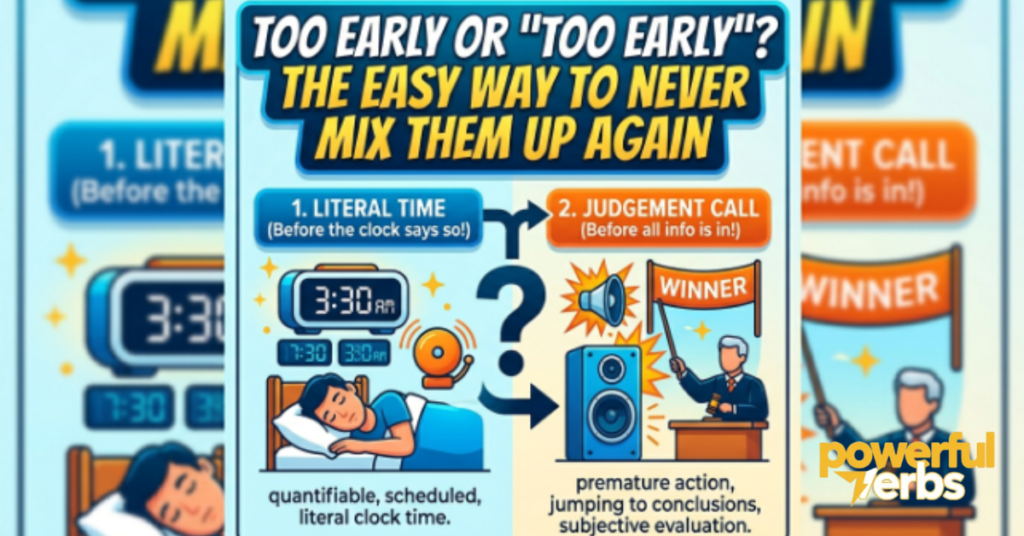
If you’ve ever paused mid-sentence wondering whether to type too early or too early, you’re not alone. This is one of the most common spelling confusions in everyday English, and the good news is that the answer is short, simple, and easy to lock into memory forever.
The correct phrase is “too early.” The form “to early” does not exist in proper English and should never be used.Below, we’ll break down exactly why this happens, how to remember the rule permanently, and how to use “too early” naturally in speech, writing, texting, and formal communication.
see also: Too Many vs To Many: Which Is Correct? (Grammar Guide)
Why Do People Mix Up “To” and “Too” in the First Place?
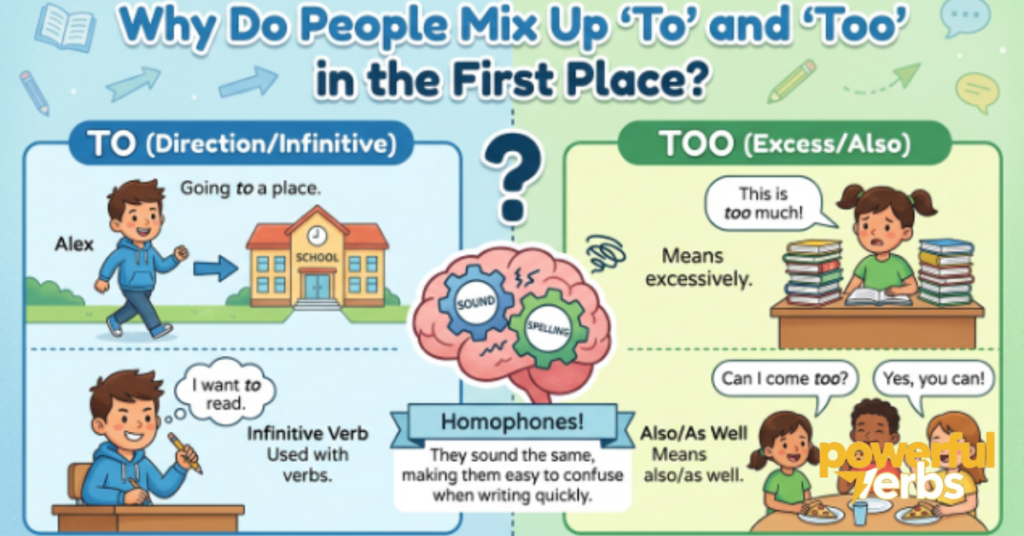
The root of the confusion isn’t grammar — it’s sound. When spoken aloud, “to” and “too” are pronounced identically. Your ear cannot tell them apart, so your brain sometimes types whichever spelling comes first.
But written English doesn’t follow sound — it follows function. Each word has a specific job:
- “To” points toward a destination, a purpose, or connects with a verb (go to the store, to learn, to sleep).
- “Too” means “excessively” or “also” — it adds intensity or quantity to whatever follows it.
Since “early” describes a point in time, and time can be excessive or insufficient, only “too” — the intensifier — fits the job. “To” has no function in front of a time-related adjective like “early.”
What “Too Early” Really Means
“Too early” describes something happening before it should, before it’s expected, or before it’s convenient. It signals excess — just like in these familiar patterns:
- too loud
- too slow
- too expensive
- too early
Each one shows “more than what’s needed or wanted,” and “too early” works the exact same way for time.
Everyday Examples of “Too Early” in Action
- Your alarm rings at 4:30 AM: “It’s too early to be awake.”
- You show up before the doors open: “We got there too early.”
- A teacher is asked about exam results after one day: “It’s too early to know the results.”
- Someone proposes marriage on a first date: “Isn’t this a bit too early?”
In every case, the timing itself isn’t wrong — it’s simply ahead of what feels right or expected.
Why “To Early” Breaks the Rules of Grammar
Think of “to” as a word that always needs a job to do. It either shows direction (to the office), purpose (to study), or links to a verb (to run, to eat). “Early” is neither a place nor a verb, so pairing it with “to” leaves the sentence structurally broken.
That’s the simple reason “to early” is always incorrect, in every context, with no exceptions.
Too Early vs Too Early — Side-by-Side Comparison
| Phrase | Correct? | Why | Example |
| to early | Incorrect | “To” cannot modify a time-based adjective | “I left to early” ❌ |
| too early | Correct | “Too” expresses excess in time | “I left too early” ✅ |
A Memory Trick You’ll Never Forget
Here’s a simple visual hack that sticks instantly:
“Too” has an extra O — and extra O means extra meaning.
So whenever the situation feels “extra” early — more early than it should be — reach for the spelling with the extra letter: too.
Where You’ll Hear “Too Early” Most Often
This phrase shows up constantly in daily conversations across different settings:
Mornings: “It’s too early for coffee to even kick in.”
Workplaces: “A 7 AM meeting feels too early for most employees.”
Education: “It’s too early to start exam revision in January for a December test.”
Shopping seasons: “Markets stocking holiday items in September feels too early.”
Relationships: “Talking about moving in together after two weeks seems too early.”
Once you notice it, you’ll realize this phrase is part of daily speech far more than most learners expect.
The “Too Early to + Verb” Pattern
One of the most useful structures in spoken and written English pairs “too early” directly with an infinitive verb:
- too early to tell
- too early to judge
- too early to celebrate
- too early to predict
Sample sentences:
- It’s too early to tell how this will turn out.
- It’s too early to predict the final score.
- It’s too early to celebrate before the results are confirmed.
Mastering this pattern instantly makes your spoken and written English sound more fluent and natural.
Too Early vs Very Early — They’re Not the Same
This is where many learners stumble. “Very early” and “too early” feel similar but carry opposite emotional tones.
| Phrase | Feeling | Example |
| very early | Neutral, acceptable | “I woke up very early to exercise.” |
| too early | Negative, inconvenient | “I woke up too early and couldn’t fall back asleep.” |
“Very early” simply states a fact about timing. “Too early” adds a layer of complaint or discomfort.
Using “Too Early” in Questions
This phrase flows naturally into question form as well:
- Is it too early to call her?
- Is it too early to start dinner?
- Is it too early to bring up the topic?
- Is it too early to leave the party?
These questions sound completely natural in casual conversation and show how flexible the phrase really is.
Other Word Pairs That Follow the Same Rule
Once you understand the “to early or too early” rule, you’ll automatically fix a whole family of related mistakes:
- to late → too late
- to big → too big
- to small → too small
- to fast → too fast
- to much → too much
Learning one rule here solves several common spelling errors at once.
Formal and Professional Usage
In business or academic writing, “too early” appears just as often, usually in cautious or analytical statements:
- It is too early to draw definitive conclusions from this data.
- It would be too early to comment on the merger before due diligence is complete.
- Analysts say it’s too early to forecast long-term market behavior.
Words You Can Use Instead of “Too Early”
For variety in your writing, these synonyms carry a similar meaning:
- prematurely
- ahead of schedule
- before time
- excessively early
- ahead of the curve
Example: “The announcement was made prematurely, before all the facts were confirmed.”
The Opposite of “Too Early”
The natural opposite is too late — meaning past the right moment instead of before it.
Example: “We arrived too late to catch the opening act.”
A Quick Story to Lock In the Rule
Sara set her alarm for a 5 AM flight. When it rang, she opened one eye, looked outside, and groaned, “It’s too early for this.” The sky was still dark, the birds hadn’t woken up, and even her cat was still asleep on the pillow. That moment — dark, quiet, and far too soon — is exactly what “too early” feels like.
Quick Practice
Fill in the blank with the correct word:
We left the party ___ early and missed the best part. It’s ___ early to know if the plan will work. He showed up ___ early for his own interview.
Answers: too early, too early, too early — every single blank takes “too,” never “to.”
Conclusion
Whenever you’re describing time that happens sooner than expected, sooner than needed, or sooner than comfortable, the correct word is always too early. Never write “to early,” since “to” simply has no grammatical role in front of a time word like this. The mix-up feels confusing only because the two words sound alike when spoken aloud.
Once you separate sound from spelling, the rule becomes permanent in your memory. Remember that “too” carries an extra O, and that extra O stands for extra meaning — excess, more than needed, more than expected. Apply that one visual trick consistently, and you’ll never hesitate over this pair again. With this rule locked in, your writing instantly looks cleaner, more confident, and more polished in every conversation, email, or document you write.
see also: To Fast or Too Fast: Which Is Correct? (Easy Grammar Guide)
FAQs
Is it “too early” or “too early”?
“Too early” is the only correct form. “To early” is grammatically wrong because “to” cannot describe time.
What does “too early” mean?
It means something is happening sooner than expected, needed, or comfortable.
Why do so many people write “to early” by mistake?
Because “to” and “too” sound identical when spoken, even though their grammatical roles are completely different.
Can “too early” be used in formal writing?
Yes, it’s commonly used in professional, academic, and journalistic writing to express caution about timing.
What’s the difference between “very early” and “too early”?
“Very early” is neutral and acceptable, while “too early” implies the timing is inconvenient or unwanted.
What is the opposite of “too early”?
The opposite is “too late,” which describes something happening after the right moment instead of before it.

Liam Johnson is a dedicated language expert with 4 years of professional experience. He specializes in Grammar, Vocabulary, and Sentence structure.
